Enterovirus 71 is one of the most important causes of HFMD and a major concern after poliovirus because both of them cause flaccid paralysis.
Enterovirus 71 outbreaks have been seen in different countries, mostly in Asia (
26). This virus has some tools to overcome the native immune system response. Poor IFN induction in infected cells was reported in some studies and others indicated that cells should be treated with high dose IFN to protect cells from infection (
26,
27). In contrast, in HT-29 cells,
Enterovirus 71 induced IFN production better than RD and Hella cells. These findings indicate that different tissues and cells show different interactions to
Enterovirus 71 infection. In the IFN production cascade TRIF is reduced significantly in the 12 hours after RD cells infection and usually is not seen in the 36 hours after infection, but the TRIF level does not show any change in HT-29 cells after infection with
Enterovirus 71 (
27).
Enterovirus 71 overcomes the host native immune system by affecting the IFN signaling cascade, this cascade is induced by IFN and leads to expression of ISGs like OAS1 and MxA. These ISGs have negative results on virus replication and maturation. After IFN attachment to IFNR (interferon receptor), a cascade of proteins like JNK1, TYK2, STAT1, and 2 and IRF9 are activated by phosphorylation which leads to expression of ISGs. The virus can disrupt this pathway and inhibit IFN response (
28). Lu et al. infected RD cells with
Enterovirus 71 and treated with or without interferon and revealed that 2A protease reduce IFNR1 level and suppress IFN signaling cascade 6 hours after infection (
23) but Liu et al. (
29) used MRC-5 (human embryonic lung fibroblast) or RD cells infected with
Enterovirus 71, and treated with IFN-α2b. This study indicated that
Enterovirus 71 inhibits the cellular type I IFN antiviral pathway by downregulating JAK1. In fact, no change in IFNR level is observable after infection and
Enterovirus 71 block JAK1 and TYK2 phosphorylation by JAK1 downregulation.
Interestingly, no change in JAK1 mRNA level has been reported; but protein level has been reduced which indicates a disruption in translation stage (
29). Liu et al. hypothesized that maybe interaction of more than one viral protein is responsible for this reduction and 2A or 3C do not affect IFN signaling pathway. On the other hand, some studies reported that 3C protease can cleave IRF9, an effective adaptor in the IFN signaling cascade and inhibit ISRE promoter activation (
24). Wang et al. though, suggest a new hypothesis for the IFN signaling cascade disruption which is different from previous reports. This study indicates that
Enterovirus 71 does not affect IFN signaling cascade by phosphorylation suppression of STAT1 or IFNR1 and JAK1 downregulation, but inhibits their translocation to nucleus by disrupting the interaction between P-STAT1 and KPNA1 using the degradation of KPNA1 (
25).
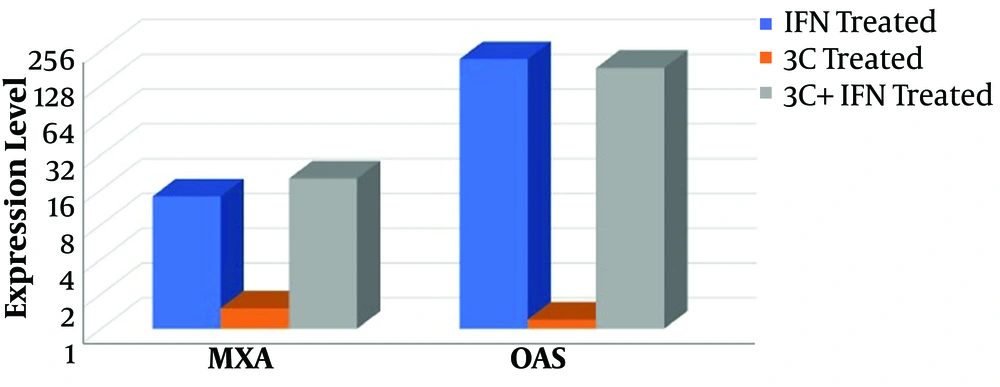
These reports indicate that there is no similar hypothesis about the 3C role in the inhibition of the IFN signaling pathway. Based on these different hypotheses, we evaluate 3C protease effects on IFN signaling pathway as the most important protease of enteroviruses. Our results in this study were in accordance with Wang et al. (
25) and Liu et al. (
29) reports, our study demonstrates that 3C does not inhibit the IFN signaling pathway. As observable in
Figure 3, two ISGs, Mxa and OAS do not affect by 3C protease treatment. There was no difference between ISGs expression in IFN+ and 3C-IFN+ group, in both of them Mxa expression level increased ~20 fold and OAS increased ~181 fold,
Figure 3. A little reduction in OAS expression level was observed (181 fold in 3C+IFN group compared to 216 fold in IFN+ group) but was not significant; similar to Wang et al. (
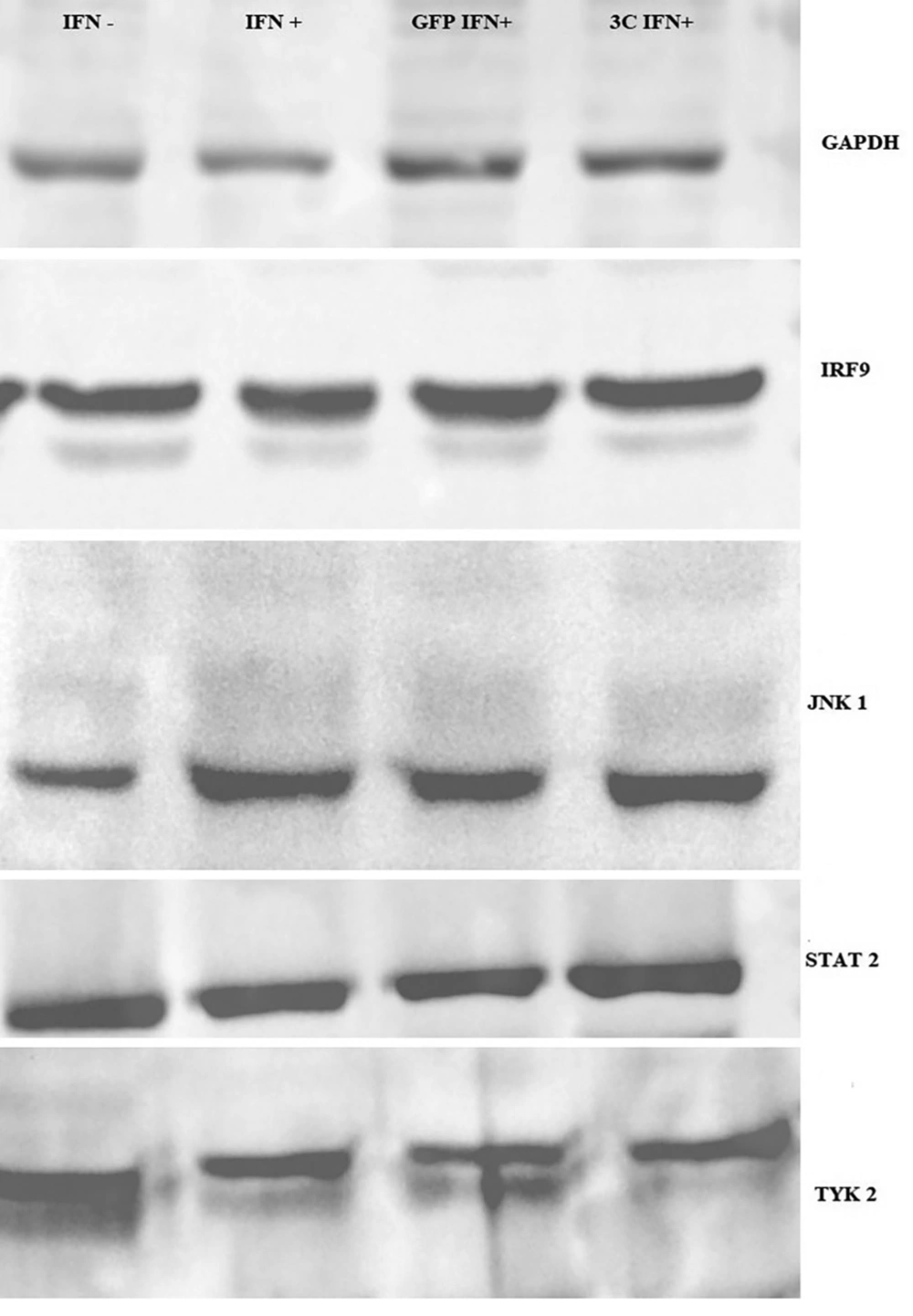
25) which reported small but nonsignificant changes in expression level of some ISGs in cells treated with 2A and 3C proteases. Four proteins of IFN signaling cascade were also evaluated by Western blot analysis for observation of possible reduction in expression level or signs of cleavage.
As indicated, there is no difference in translation level and possible cleavage in these proteins between 3C treated and control group. Wang et al. also demonstrated that even phosphorylation of IFN signaling pathway proteins such as STAT1 and 2 and JNK1 which are reported in previous studies were not affected by 3C or 2A protease and using luciferase assay indicated that IFN pathway works normally in the presence of ectopic 2A and 3C, but KPNA1 degradation has the main role in the suppression of the IFN signaling pathway in
Enterovirus 71 infection. While KPNA1 is responsible for protein translocation to nucleus, this protein degraded in a caspase 3 dependant manner and neither 2A or 3C have no role in KPNA1 degradation (
25). Our result is in accordance with Wang et al., (
25) which demonstrates that IFN signaling pathway suppression has no relation with 3C protease activity of
Enterovirus 71.
This study revealed that host and viral protein interactions are complex which are affected by different factors such as tissue and cell type, immune system situation of host and different kinds of host. Maybe more evaluation of other cells leads to different and new results about this interaction between Enterovirus 71 proteases and IFN signaling cascade. It will also be interesting to focus on the role of other viral proteins on IFN pathway inhibition. These findings indicate that viral and host protein interaction is multifactorial and needs more research to gain a wide and better view about viral pathogenesis and host response.
5.1. Conclusions
3C protease does not reduce ISG expression level and IFN pathway protein such as STAT2, IRF9, TYK2 and JNK1 and could not suppress IFN signaling pathway alone.