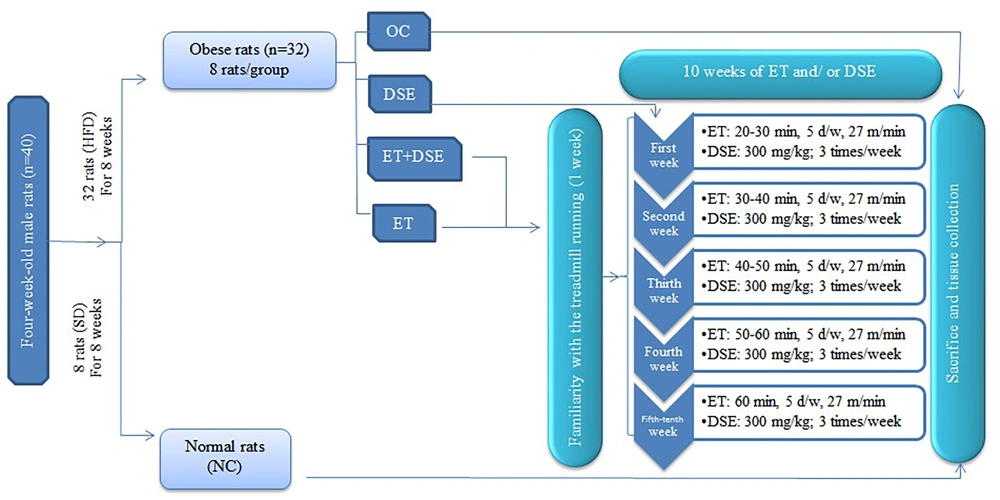
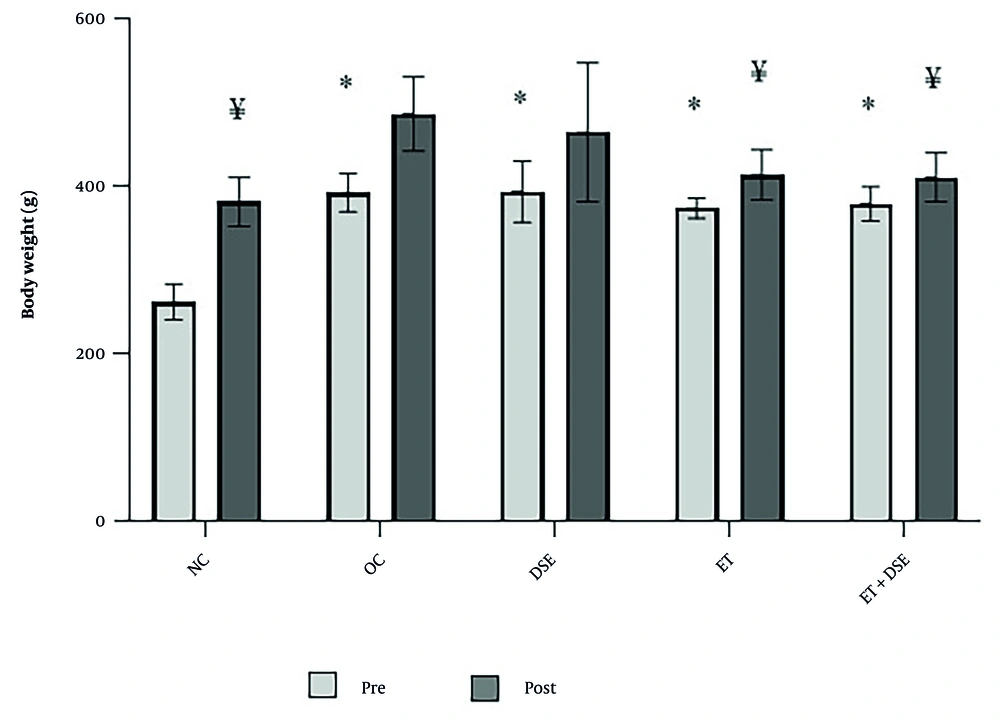
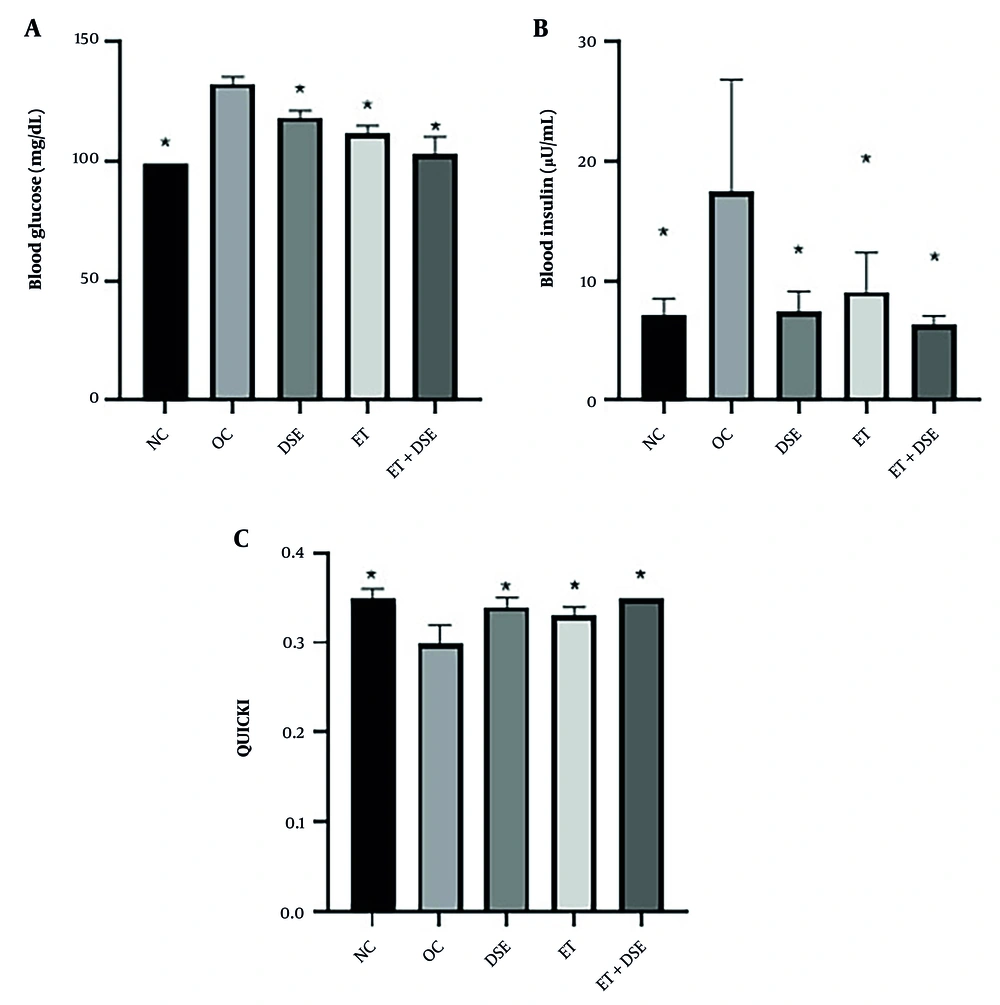
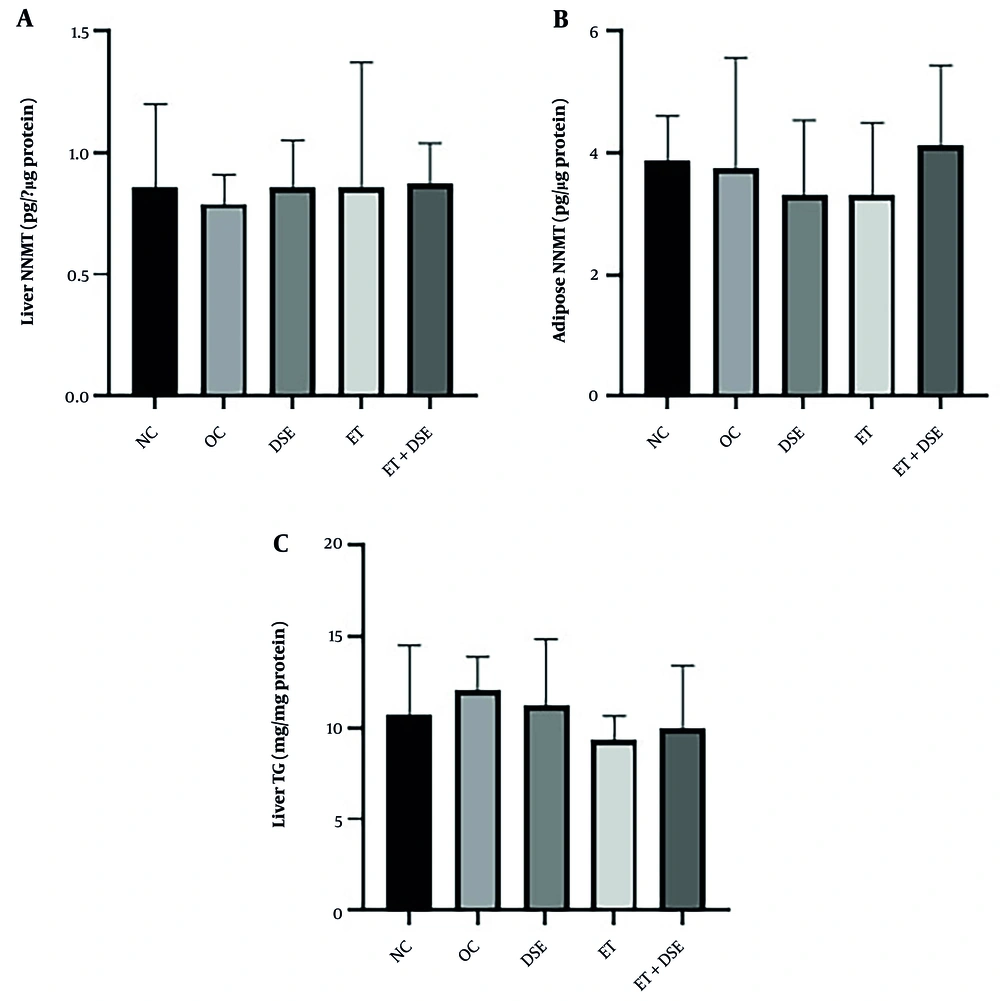
This study examined the effects of 10 weeks of ET and DSE on body weight, blood glucose, insulin levels, the QUICKI Index, NNMT levels in the liver and adipose tissue, and liver TG levels in HFD-induced obese rats. Compared to the OC group, the ET, DSE, ET+DSE, and NC groups exhibited significantly lower blood glucose and insulin levels, as well as a higher QUICKI Index. However, NNMT levels in the liver and adipose tissue, as well as liver TG levels, remained unchanged after the 10-week intervention in all groups.
Previous studies have reported that HFD decreases insulin sensitivity and glucose tolerance (
20,
38). Consistent with these findings, our results showed that HFD affected glycemic indices, as evidenced by the differences between the NC and OC groups. Additionally, exercise training has been recognized as a therapeutic and preventive intervention for insulin resistance (
39). As expected, the DSE, ET, and ET+DSE groups had lower blood glucose and insulin levels, as well as higher QUICKI indices, compared to the OC group. In line with our findings, Horii et al. reported that eight weeks of aerobic training reduced fasting blood glucose and improved insulin sensitivity in rats with type 2 diabetes (
40). Endurance training has been shown to enhance glucose transport through glucose transporter type 4 (GLUT4) and modulate enzymes involved in glucose phosphorylation and oxidation (
21,
40). Furthermore, ET increases energy expenditure, promotes weight loss, enhances glucose delivery to muscles, stimulates fatty acid oxidation, and ultimately improves insulin sensitivity (
39,
40). In this study, rats in the ET and ET + DSE groups had lower body weight compared to the OC group at the end of the 10-week intervention. The improvements in blood glucose, insulin levels, and the QUICKI Index in the training groups are likely attributable to weight loss induced by exercise training.
Interestingly, the DSE group also exhibited lower blood glucose and insulin levels, as well as a higher QUICKI Index. This may be attributed to the antioxidant and anti-inflammatory properties of dill, which can improve insulin sensitivity and reduce blood lipid levels (
23,
24). The findings of Haidari et al. align with our results, demonstrating reductions in fasting blood glucose, insulin levels, and insulin resistance following dill extract consumption (
24). The glucose-lowering effect of dill extract is likely mediated by its flavonoid content, particularly quercetin-3-O-β-D-glucuronide, which exhibits insulin-like effects and enhances glucose uptake in peripheral tissues (
23,
24).
According to recent studies, one mechanism influencing glycemic indices is changes in the NNMT enzyme in the liver and adipose tissue. The NNMT is a cytosolic enzyme primarily expressed in the liver and adipose tissue, catalyzing the N-methylation of nicotinamide (NAM) and regulating lipid, cholesterol, and glucose metabolism (
5,
7). In this context, Kannt et al. demonstrated that NNMT expression in adipose tissue is higher in diabetic patients than in healthy individuals and that there is an inverse relationship between insulin sensitivity and NNMT expression in adipose tissue (
22). Although NNMT expression in adipose tissue correlates with adiposity in both mice and humans (
12), one study suggested that NNMT upregulation can differentially regulate liver fat accumulation (
10).
However, a key finding in the present study is that despite improvements in glycemic indices following ET and DSE, no significant changes were observed in NNMT levels in the liver and adipose tissue of obese rats. It has been reported that NNMT levels and activity in different organs, particularly the liver and adipose tissue, as well as circulating MNA concentrations, vary under different physiological conditions, such as disease, exercise, and HFD (
6,
22). One study showed that NNMT levels in adipose tissue decreased significantly after 12 weeks of ET in diabetic patients with a high BMI, although the underlying mechanisms remain unclear (
22).
The role of NNMT in aerobic and anaerobic energy metabolism also differs (
22,
41,
42). For instance, anaerobic exercise has been shown to enhance NNMT expression in skeletal muscles more than aerobic exercise, especially when glucose is the primary energy source (
41). Additionally, inhibiting NNMT activity with MNA impaired the performance of rats during anaerobic ET (
42). The endurance nature of the exercise training used in the present study may explain the lack of significant changes in NNMT levels in the liver and adipose tissue.
It has been reported that feeding mice with an HFD selectively increases NNMT activity in adipose tissue while leaving liver activity unchanged (
5). Interestingly, we observed no changes in NNMT levels in the liver or adipose tissue under HFD (no difference between the NC and OC groups), which may explain why this enzyme remained unaffected by training and extract consumption. Some studies suggest that the composition of dietary fat and the use of different fatty acids can produce varying metabolic responses, particularly in fat oxidation rates across tissues (
43,
44). Diets with a higher proportion of polyunsaturated and monounsaturated fatty acids (e.g., oleic acid) compared to saturated fatty acids increase fat oxidation in adipose tissue and reduce fat deposition in other tissues, such as the liver, which is critical for preventing HFD-induced metabolic dysfunction (
44).
In the present study, the higher ratio of polyunsaturated and monounsaturated fatty acids to saturated fatty acids in the HFD may have increased beta-oxidation of fats, thereby reducing the impact of HFD on NNMT and TG levels. The presence of compounds like oleic acid in HFD can also enhance beta-cell activity and insulin sensitivity (
44). Thus, not only the quantity of dietary fats but also their composition plays a fundamental role in metabolic changes, including fat accumulation and lipid metabolism.
The duration of HFD exposure may also influence metabolic responses. For example, fat mass increases continuously over 6, 10, and 20 weeks of HFD consumption. However, the expression of adipogenesis regulatory genes (e.g., PPAR, adiponectin, and leptin) peaks early in HFD exposure and gradually declines over time (
45). In the current study, prolonged HFD exposure may explain the lack of significant effects on NNMT levels in the liver and adipose tissue, and improvements in insulin sensitivity and glycemic indices may have occurred through mechanisms other than NNMT. Definitive conclusions in this area should be made cautiously, and further research is needed with varying durations of HFD and different fatty acid compositions.
Another possible reason for the lack of change in NNMT levels in adipose tissue and liver, despite improved insulin sensitivity, is the small sample size and large standard deviation of NNMT data. Larger sample sizes reduce the standard deviation of the distribution of sample means, enhancing confidence in the results and increasing the likelihood of detecting statistical significance (
46).
Furthermore, NNMT knockdown has been shown to significantly reduce body weight, fat mass, and insulin levels in female mice fed a Western diet (47% kcal from fat and 34% kcal from carbohydrates). However, no changes were observed in body weight, fat mass, fasting blood glucose, insulin levels, or glucose tolerance in HFD-fed NNMT knockdown male mice (60% kcal from fat and 20% kcal from carbohydrates). Gender differences have been proposed as a potential explanation for this discrepancy (
47). The exclusive use of male rats in the present study may explain the lack of HFD effects on NNMT. Including both male and female rats in future studies could provide a more comprehensive understanding of this phenomenon.
Although previous studies have reported that ET and dill extract reduce lipid accumulation in liver tissue (
20,
24), our findings showed no significant differences in liver TG levels between groups after HFD intervention (no difference between NC and OC groups) or following DSE and ET (no difference between DSE, ET, ET+DSE, and OC groups). One related study found that using an HFD with MNA decreased serum and liver cholesterol and liver TG levels in mice. By stabilizing the SIRT1 protein through its fatty acid β-oxidation properties, MNA effectively reduces liver lipid levels, highlighting the beneficial role of NNMT in hepatocyte gluconeogenesis (
6). The lack of change in liver TG levels in our study may be due to the absence of changes in NNMT and, consequently, the lack of MNA and SIRT1 activity.
The results regarding NNMT levels in the liver and adipose tissue and their physiological effects are contradictory (
5,
10,
22). While inhibiting or reducing NNMT in adipose tissue can enhance insulin sensitivity (
5,
22), the precise mechanisms by which NNMT influences insulin sensitivity and blood glucose regulation remain unclear. In the present study, the increase in the QUICKI Index may have been independent of changes in NNMT levels in the liver and adipose tissue. Therefore, additional research is necessary to better understand the role of NNMT in glucose regulation.
5.1. Limitations
This study has several limitations. First, we only investigated NNMT levels in the liver and adipose tissue of rats and did not assess transcriptomic data, which complicates inferences about changes in protein activity and the regulation of targeted mechanisms. Second, we did not measure plasma levels of MNA or essential intermediates, such as NAD+ and SAM, which are substrates for the NNMT reaction. Future studies should focus on transcriptional factors and the upstream and downstream pathways of NNMT. Additionally, the lack of measurement of total phenols, flavonoids, and flavonols in the DSE, as well as the small sample size, are limitations of this study. To draw more accurate conclusions regarding the effects of ET and DSE on research indicators, particularly NNMT, it is recommended to use a larger sample size and quantify the total phenols, flavonoids, and flavonols in the DSE.
Another limitation is the method of dill extraction and administration, which may have influenced the results related to insulin sensitivity and NNMT levels in the liver and adipose tissue. Techniques such as ultrasonic-assisted extraction can enhance the efficiency of extracting beneficial compounds, while hydrodistillation provides an alternative method to isolate essential oils with distinct chemical compositions. In this study, hydrodistillation was used, which is a practical and common extraction method. Future studies should compare different extraction methods (e.g., steam distillation versus solvent extraction) and their effects on insulin sensitivity and NNMT activity in both animal models and humans.
5.2. Conclusions
Based on our results, 10 weeks of ET and DSE, either alone or in combination, reduced blood glucose and insulin levels and increased the QUICKI Index in obese rats. However, no changes were observed in NNMT levels in the liver and adipose tissue or in liver TG levels, likely due to the lack of effect of HFD on these indicators. Further research is needed to clarify the effects of ET and DSE on NNMT levels in the liver and adipose tissue.