
1. Background
Substance use disorder (SUD) is a chronic, relapsing condition that affects nearly 16% of the global population. It leads to severe social problems and a substantial financial burden (1). Methamphetamine (METH), a synthetic psychostimulant, is one of the most widely abused illicit drugs worldwide and has become a major public health concern in Iran (2). Recent data indicate high rates of METH use, with approximately 47% of people who inject drugs (PWID) in Iran reporting METH use in the past 3 months (3) and approximately 15% of psychiatric inpatients reporting METH use in the past 3 months (4).
Chronic METH use is associated with a range of devastating neurological and psychiatric consequences (2, 5). Notably, METH use induces profound neurotoxicity, primarily through oxidative stress and neuroinflammation (5). This process damages dopaminergic and serotonergic terminals and triggers neuronal apoptosis (5). Approximately 40% of chronic users experience METH-induced psychosis, which is characterized by severe psychotic symptoms that may persist for months or years after cessation of use (2). This persistent damage underscores the critical need for effective pharmacological interventions.
The underlying neurobiology involves complex pathways. Methamphetamine readily crosses the blood-brain barrier and markedly increases synaptic dopamine levels. This excess dopamine can undergo auto-oxidation, generating reactive oxygen species and leading to significant cellular damage (5, 6). Furthermore, METH abuse activates the innate immune system in the brain. Microglia, the resident immune cells, express Toll-like receptors (TLRs), and METH has been shown to induce TLR signaling, leading to the release of pro-inflammatory cytokines, such as TNF-α, interleukin 1 beta, and IL-6, which perpetuate neuroinflammation and contribute to negative affect and craving (7, 8). Importantly, this neuroinflammatory state and oxidative stress are not only implicated in neurotoxicity but are also recognized as key drivers of drug craving and relapse, creating a self-perpetuating cycle of addiction (7, 8).
Beyond neuroinflammation, the adenosine system plays a critical role in METH-induced neurotoxicity and addiction. Adenosine A2A receptors (A2ARs), which are key modulators of dopamine and glutamate signaling, are highly enriched in brain nuclei involved in reward processing. Preclinical evidence strongly suggests that A2AR is a promising target for mitigating the effects of METH. For instance, the A2AR antagonist FTBI has been shown to prevent METH-induced cellular toxicity in neuronal cell lines (9). Recently, A2ARs have been shown to function as fine regulators of neurotransmission and to modulate reward-related behaviors linked to psychostimulant use (10). Moreover, human genetic studies have confirmed that polymorphisms in the ADORA2A gene, such as rs5751876, are closely associated with susceptibility to METH use disorder and craving intensity. Notably, serum A2AR protein levels were significantly higher in patients with METH use disorder than in healthy controls (1, 11). Together, this compelling evidence from bench and bedside research provides a strong rationale for targeting the A2AR pathway as a novel therapeutic strategy for METH use disorder (12).
Despite advances in understanding METH neurobiology and the existence of treatment guidelines for acute management (13), treatment options for persistent METH-induced psychosis remain limited. Available pharmacological interventions, primarily antipsychotics, often show variable efficacy and may be associated with significant adverse effects, highlighting a clear unmet need for novel, well-tolerated adjunctive therapies (2, 5).
Given that neuroinflammation and oxidative stress are well-established key drivers of both craving and psychosis in METH use (7, 8, 14), interventions that simultaneously target these interconnected pathways are highly desirable. Curcumin (CUR), the primary bioactive polyphenol in turmeric, has emerged as a promising multitarget therapeutic candidate owing to its potent antioxidant, anti-inflammatory, and neuroprotective properties (15-18). Curcumin can suppress activation of the transcription factor nuclear factor kappa B, thereby reducing levels of key pro-inflammatory cytokines, such as TNF-α and IL-6 (14). A specific cis-trans isomer of CUR has been identified as a potential ligand for A2A and A2B adenosine receptors, suggesting a novel mechanism of action that could directly modulate the reward pathways implicated in addiction (19). Further evidence also indicates that CUR may act through direct A2A activation to mediate neuroprotective and anti-inflammatory effects (16).
However, the clinical application of conventional CUR has been severely limited by its exceptionally poor bioavailability, primarily because of low solubility and extensive first-pass metabolism. Nano-CUR formulations have been developed to overcome these barriers by substantially enhancing solubility, cellular permeability, and systemic absorption (20, 21). This technological advancement allows therapeutic efficacy at substantially lower and more feasible doses, such as 80 mg/day, compared with the several grams per day often required for standard CUR, which is frequently associated with low patient adherence. Recent randomized controlled trials have demonstrated the clinical benefits of Nano-CUR in different populations, including positive effects on inflammatory markers in children with cystic fibrosis (22) and significant improvements in negative symptoms when added to antipsychotic treatment in patients with chronic schizophrenia (23), further supporting its translational promise (24).
In summary, although it is well established that neuroinflammation and oxidative stress play key roles in METH-induced psychosis (7, 8, 14), and CUR has demonstrated anti-inflammatory and neuroprotective properties in preclinical and clinical studies (15-18), no clinical trial to date has investigated the potential therapeutic effects of Nano-CUR specifically in patients with METH-induced psychosis. This represents a significant knowledge gap, given the urgent need for well-tolerated adjunctive therapies for this condition.
2. Objectives
Given the severe impact of METH-induced psychosis, the clinical need for better-tolerated adjunctive therapies, and the promising multitarget effects of CUR, this study was designed to test the hypothesis that adjunctive Nano-CUR supplementation would reduce craving and psychotic symptoms in patients with METH-induced psychosis by modulating underlying neuroimmune and inflammatory pathways. Therefore, this double-blind, randomized, placebo-controlled trial aimed to investigate the effects of Nano-CUR on: (1) Craving levels and psychotic symptoms; (2) serum levels of pro-inflammatory cytokines, including TNF-α and IL-6; and (3) serum levels of key neuroimmune receptors, including adenosine A2A receptor and TLR4.
3. Methods
3.1. Study Design and Ethical Considerations
This randomized, double-blind, placebo-controlled trial was conducted on 50 eligible inpatients with Methamphetamine-induced psychosis (MIP) admitted to Kargarnejad Psychiatric Hospital, Kashan University of Medical Sciences, Iran. Diagnosis and eligibility assessment were confirmed by a senior research psychiatrist, addiction specialist, psychologist, and cardiologist. The study protocol was approved by the Ethics Committee of Kashan University of Medical Sciences (IR.KAUMS.REC.1402.258; approval date: 2024-01-28) and registered in the Iranian Registry of Clinical Trials (IRCT20240208060938N1; registration date: 2024-02-28). All procedures were conducted in accordance with the ethical principles of the Declaration of Helsinki. Written informed consent was obtained from all participants.
3.2. Participant Recruitment and Eligibility
Participants were recruited by convenience sampling from eligible patients admitted from April 2024 to October 2024. All patients admitted to the hospital during this period were screened by the multidisciplinary team. Eligible patients who met all inclusion criteria and none of the exclusion criteria were invited to participate. Written informed consent was obtained from all participants before enrollment. Inclusion and exclusion criteria were assessed by a multidisciplinary team. At baseline, comprehensive demographic information was collected from all participants, including age, gender, education level, marital status, age at first METH use, emotional support status, occupation, daily METH consumption, and duration of METH use in years.
The diagnosis of MIP was confirmed based on the Diagnostic and Statistical Manual of Mental Disorders, Fifth Edition criteria for substance-induced psychotic disorder, which require: (A) the presence of prominent hallucinations or delusions; (B) evidence from history, physical examination, or laboratory findings that the symptoms developed during or within 1 month of METH intoxication or withdrawal; and (C) the disturbance is not better explained by a primary psychotic disorder. Patients with a history of any primary psychotic disorder, including schizophrenia, schizoaffective disorder, or bipolar disorder with psychotic features, were excluded, as stated in exclusion criterion 5.
The inclusion criteria were as follows: (1) Age ≥ 18 years; (2) hospitalization due to MIP, as diagnosed by a senior research psychiatrist; (3) chronic METH use disorder diagnosis based on Diagnostic and Statistical Manual of Mental Disorders, Fifth Edition criteria; (4) regular METH use (> 2 days/week for > 1 year); (5) a score between 10 and 70 on the DDQ at baseline; (6) no history of other SUDs, including opioids, heroin, crack, or cannabis; and (7) willingness to complete the informed consent form.
The exclusion criteria were as follows: (1) Unwillingness to continue participation at any stage; (2) dependence on any substance other than METH; (3) history of traumatic brain injury, intellectual disability, or organic brain syndromes; (4) cardiovascular disorders, metabolic or neurological diseases, or other severe organic conditions; (5) any past or current psychotic disorder, including manic episodes, schizophrenia, or schizoaffective disorder; (6) pregnancy; (7) reported hypersensitivity or adverse effects to the study intervention; (8) use of CUR or other antioxidant/anti-inflammatory supplements within the past 3 months; and (9) positive urine test for illicit drugs other than METH during the trial.
3.3. Randomization, Blinding, and Intervention
Participants were randomly assigned to receive either nano-micellar curcumin (SinaCurcumin® 40 mg capsules, Exir Nano Sina Co, Iran) or identical placebo (microcrystalline cellulose) twice daily for 4 weeks (total daily dose, 80 mg in the intervention group).
The pharmaceutical company prepared the intervention and placebo capsules in identical packaging with numerical codes. The placebo capsules were identical to the active capsules in size, shape, and color. Patients with MIP were randomly assigned to 2 study arms using balanced block randomization, with block sizes of 4 and a 1:1 allocation ratio generated using Stat Trek software. This approach ensured equal distribution of patients between the Nano-CUR and placebo groups while minimizing the risk of selection bias.
To ensure allocation concealment, the randomization sequence was generated by an independent statistician who was not involved in patient enrollment or assessment. Group assignments were placed in sequentially numbered, opaque, sealed envelopes. The envelopes were opened only after the participant had completed all baseline assessments and provided informed consent, ensuring that enrolling personnel remained blinded to the upcoming assignment.
Both participants and investigators were blinded to group assignments until completion of data analysis. All patients continued standard antipsychotic and mood-stabilizing medications. Adherence was monitored through direct observation during hospitalization.
The randomization code was broken only after all data had been collected and statistical analysis was complete. The psychiatrists prescribing concomitant medications were also blinded to group assignment, ensuring that treatment decisions were made independently of the study intervention.
3.4. Concomitant Medications
All participants were inpatients under the care of the same psychiatrist and received standard pharmacotherapy for MIP as clinically indicated. The treatment protocol for the unit primarily involved the use of second-generation antipsychotics, such as risperidone or olanzapine, and mood stabilizers, such as sodium valproate. The psychiatrists treating the patients, who were blinded to study group assignment, prescribed these medications based on clinical need. This standardized clinical management ensured that all patients received comparable care, making systematic differences in concomitant treatment between the 2 groups unlikely.
3.5. Outcome Measures
3.5.1. Primary Outcomes
Craving: Craving was measured using the DDQ. This 14-item self-report instrument assesses immediate craving for substances on a 5-point Likert scale (0 - 5), with total scores ranging from 0 to 70. Higher scores indicate stronger craving intensity. The Persian version has demonstrated reliability and validity in SUD (25, 26).
Psychotic Symptoms: The severity of psychotic symptoms was assessed using the PANSS. This 30-item clinician-rated instrument evaluates symptom severity through 3 subscales: positive symptoms (7 items), negative symptoms (7 items), and general psychopathology (16 items). Each item is scored from 1 (absent) to 7 (extreme), with higher scores indicating more severe symptoms. The Persian version has been validated and shows good psychometric properties (2, 27).
All PANSS assessments were conducted by a single trained psychiatrist who had received formal training in PANSS administration and was supervised by a senior research psychiatrist to ensure consistency and accuracy. Therefore, inter-rater reliability was not applicable.
3.5.2. Secondary Outcomes: Biochemical Parameters
Serum levels of TNF-α and IL-6 were measured using Iranian ELISA kits (Karmaneya Pars Gene Co, Iran). Adenosine A2A receptor (ADORA2A) and TLR4 were measured using human ELISA kits (ZEELBIO GmbH, Germany). Assessments were conducted at baseline (T0), after 4 weeks of intervention (T1), and at 1-month follow-up after the intervention period (T2, for DDQ and PANSS only).
3.6. Blood Sampling and Biochemical Analysis
A 10-mL venous blood sample was collected without a fasting requirement at T0 and T1. Blood was allowed to clot at room temperature for 30 minutes and centrifuged at 1500 × g for 10 minutes. Separated serum was aliquoted and stored at -70°C until analysis.
Serum levels of the following parameters were quantified using ELISA according to the manufacturers’ protocols (28): TNF-α and IL-6 were measured using commercial ELISA kits (Karmaneya Pars Gene Co, Iran), and ADORA2A and TLR4 were measured using human ELISA kits (ZEELBIO GmbH, Germany). Serum concentrations were measured as follows: TNF-α and IL-6 in pg/mL, ADORA2A in ng/mL, and TLR4 in mmol/L. All assays were performed using an ELISA microplate reader, with measurements conducted in duplicate for accuracy.
3.7. Safety Reporting
The safety of Nano-CUR supplementation was actively monitored throughout the study. No serious adverse events were reported in either the Nano-CUR or placebo group. This finding is consistent with the established safety profile of CUR and its nano-formulations, which are generally well tolerated (21). Additionally, all patients were screened by the multidisciplinary team for potential drug interactions on admission and throughout the trial period, and no patient received medications with known major interactions with METH, such as monoamine oxidase inhibitors or linezolid.
3.8. Statistical Analysis
Data were analyzed using SPSS version 21. Normality was assessed using the Kolmogorov-Smirnov test. Within-group comparisons were performed using paired t-tests or Wilcoxon signed-rank tests. Between-group comparisons were performed using independent t-tests or Mann-Whitney U tests. Categorical variables were analyzed using chi-square tests. Linear mixed models examined longitudinal changes in primary outcomes across all 3 time points (baseline, week 4, and 1-month follow-up), with adjustment for baseline scores. For biochemical parameters (TNF-α, IL-6, A2A, and TLR4), between-group comparisons were performed using linear mixed models to analyze the group × time interaction effect across baseline and week 4, with adjustment for baseline values.
Missing data were handled using per-protocol analysis, which included only participants who completed the entire study protocol. The 5 participants who discontinued the study (3 from the placebo group and 2 from the Nano-CUR group) were excluded from the final analysis. The reasons for discontinuation, including early hospital discharge followed by unwillingness to continue supplementation, were documented and reported in the CONSORT flow diagram (Figure 1). A P-value < 0.05 was considered statistically significant.
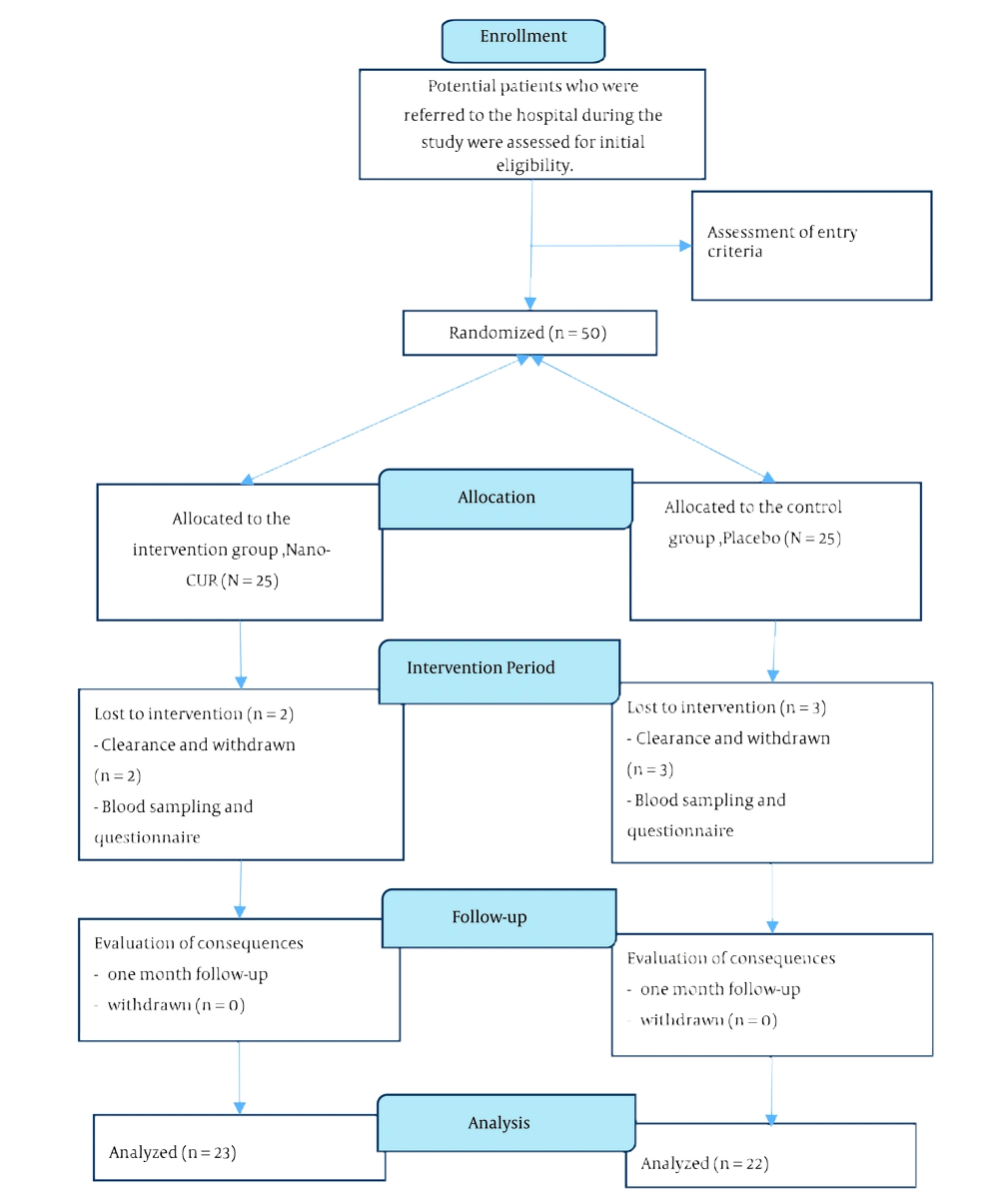
Figure 1.
Flow diagram of patient progression through the study.
3.9. Sample Size Calculation
Because of the novelty of this intervention, no previous studies were found that investigated the effects of Nano-CUR on craving (DDQ), psychotic symptoms (PANSS), or the specific serum parameters TNF-α, IL-6, ADORA2A, and TLR4 in patients with MIP. Therefore, the sample size calculation was based on Hamilton Anxiety Rating Scale scores from a previous study examining CUR supplementation in patients with major depressive disorder (29). With a mean difference of 3.6, standard deviation of 2.8, power of 90% (β = 0.1), and α = 0.05, a sample size of 22 participants per group was required. Accounting for a potential 10% dropout rate, the final sample size was set at 25 participants per group (total, N = 50).
4. Result
4.1. Participant Flow and Baseline Characteristics
The CONSORT flow diagram of participant enrollment, randomization, allocation, follow-up, and analysis is shown in Figure 1. During the 4-week intervention period, 5 participants discontinued the study. Three participants from the placebo group and 2 from the Nano-CUR group were lost to follow-up because of early hospital discharge followed by unwillingness to continue supplementation. Consequently, the final per-protocol analysis included 45 participants who completed the entire study protocol (Nano-CUR, n = 23; placebo, n = 22). No further dropouts occurred during the 1-month follow-up period.
Baseline demographic and clinical characteristics of the participants are presented in Table 1. There were no significant differences between the Nano-CUR and placebo groups in any assessed baseline variables, including demographic characteristics (age, gender, education level, marital status, emotional support, and occupation), substance use-related variables (age at first METH use, duration of METH use, and daily METH consumption), and anthropometric measures (weight and body mass index [BMI]) (P > 0.05 for all comparisons), indicating successful randomization.
Table 1.
Patient Characteristics a
| Variables | Placebo (n = 22) | Nano-CUR Group (n = 23) | P-Value |
|---|---|---|---|
| Age, y | 38.30 ± 11.68 | 37.26 ± 9.36 | 0.739 b |
| Weight, kg | 72.45 ± 10.93 | 73.47 ± 12.36 | 0.772 b |
| BMI, kg/m² | 24.23 ± 2.91 | 23.49 ± 3.50 | 0.447 b |
| Age at first METH use, y | 31.77 ± 13.18 | 29.86 ± 9.44 | 0.864 c |
| Gender | 0.139 c | ||
| Male | 20 (90.9) | 23 (100) | |
| Female | 2 (9.1) | 0 (0) | |
| Education | 0.612 c | ||
| Illiterate | 1 (4.5) | 1 (4.3) | |
| Elementary | 7 (31.8) | 8 (34.8) | |
| Diploma | 10 (45.5) | 12 (52.2) | |
| University | 4 (18.2) | 2 (8.7) | |
| Marital status | 0.325 d | ||
| Single | 13 (59.1) | 10 (43.5) | |
| Married | 6 (27.3) | 7 (30.5) | |
| Divorced | 2 (9.2) | 3 (13) | |
| Cohabiting | 0 (0) | 3 (13) | |
| Widowed | 1 (4.5) | 0 (0) | |
| Level of emotional support | 0.252 c | ||
| None | 3 (13.6) | 1 (4.3) | |
| Low | 8 (36.4) | 7 (30.4) | |
| Average | 7 (31.8) | 9 (39.2) | |
| High | 4 (18.2) | 6 (26.1) | |
| Occupation | 0.418 d | ||
| Full-time job | 1 (4.5) | 2 (8.7) | |
| Unemployed | 10 (45.5) | 14 (60.9) | |
| Freelance job | 7 (31.8) | 7 (30.4) | |
| Retired | 1 (4.5) | 0 (0) | |
| Student | 1 (4.5) | 0 (0) | |
| Homemaker | 2 (9.2) | 0 (0) | |
| Amount of METH consumed per day, g | 0.86 ± 0.46 | 1.0 ± 0.78 | 0.773 c |
| Duration of METH use, y | 6.14 ± 5.19 | 7.0 ± 4.46 | 0.471 b |
Abbreviations: BMI, Body Mass Index; METH, methamphetamine; Nano-CUR, nano-curcumin.
a Values are expressed as mean ± SD or No. (%).
b P-values were obtained from the independent t-test.
c P-values were obtained from the independent Mann-Whitney test.
d P-values were obtained from the independent chi-square test.
4.2. Primary Outcomes
Craving (DDQ Score): Linear mixed model analysis adjusted for baseline scores revealed a significant main effect of time [F (2, 84.01) = 71.94, P < 0.001], a significant main effect of group [F (1, 45.08) = 46.77, P < 0.001], and a significant group × time interaction [F (2, 84.01) = 38.57, P < 0.001] on craving levels (Table 2). Post hoc analysis showed a substantially greater reduction in craving scores in the Nano-CUR group (baseline, 33.78 ± 9.74; week 4, 20.73 ± 6.3; follow-up, 21.52 ± 7.4) compared with the placebo group (baseline, 29.64 ± 9.8; week 4, 27.5 ± 6.64; follow-up, 28.09 ± 5.94) at both week 4 and 1-month follow-up. At week 4, the between-group mean difference was -6.77 points (95% CI, -10.67 to -2.87; Cohen d = 1.72), consistent with a large clinical effect. At 1-month follow-up, the reduction remained significant, with a mean difference of -6.57 points (95% CI, -10.59 to -2.55; Cohen d = 1.04).
Psychotic Symptoms (PANSS Total Score): Linear mixed model analysis adjusted for baseline scores revealed a significant main effect of time (F [2, 89.74] = 63.91, P < 0.001), a significant main effect of group (F [1, 51.03] = 41.91, P < 0.001), and a significant group × time interaction (F [2, 89.75] = 22.86, P < 0.001) (Table 2). The Nano-CUR group showed a markedly greater reduction in psychotic symptoms (baseline, 69.08 ± 16.59; week 4, 54.08 ± 13.82; follow-up, 53.73 ± 13.1) at both week 4 and 1-month follow-up compared with the placebo group (baseline, 72.22 ± 19.04; week 4, 68.86 ± 16.17; follow-up, 67.36 ± 14.73). At week 4, the between-group mean difference was -14.78 points (95% CI, -23.85 to -5.71; Cohen d = 1.78), consistent with a large clinical effect. At 1-month follow-up, the reduction remained significant, with a mean difference of -13.63 points (95% CI, -22.03 to -5.23; Cohen d = 1.68).
Table 2.
| Variables and Groups | N | Baseline | Week 4 | Follow-up | Effect | F-Value [df1, df2] | P-Value |
|---|---|---|---|---|---|---|---|
| DDQ total score | |||||||
| Placebo | 22 | 29.64 ± 9.8 | 27.5 ± 6.64 | 28.09 ± 5.94 | Group | F [1, 45.08] = 46.77 | < 0.001 |
| Nano-CUR | 23 | 33.78 ± 9.74 | 20.73 ± 6.3 | 21.52 ± 7.4 | Time | F [2, 84.01] = 71.94 | < 0.001 |
| Group × time | F [2, 84.01] = 38.57 | < 0.001 | |||||
| PANSS total score | |||||||
| Placebo | 22 | 72.22 ± 19.04 | 68.86 ± 16.17 | 67.36 ± 14.73 | Group | F [1, 51.03] = 41.91 | < 0.001 |
| Nano-CUR | 23 | 69.08 ± 16.59 | 54.08 ± 13.82 | 53.73 ± 13.1 | Time | F [2, 89.47] = 63.91 | < 0.001 |
| Group × time | F [2, 89.74] = 22.86 | < 0.001 |
Abbreviations: DDQ, Desire for Drug Questionnaire; Nano-CUR, nano-curcumin; PANSS, Positive and Negative Syndrome Scale.
a Values are expressed as mean ± SD.
b Significant interaction and main effects from linear mixed model analysis, adjusted for baseline scores, are reported in the table (P < 0.05).
These findings are further illustrated in Figure 2, panels A and B, which show the trajectories of DDQ and PANSS scores across the 3 study time points.
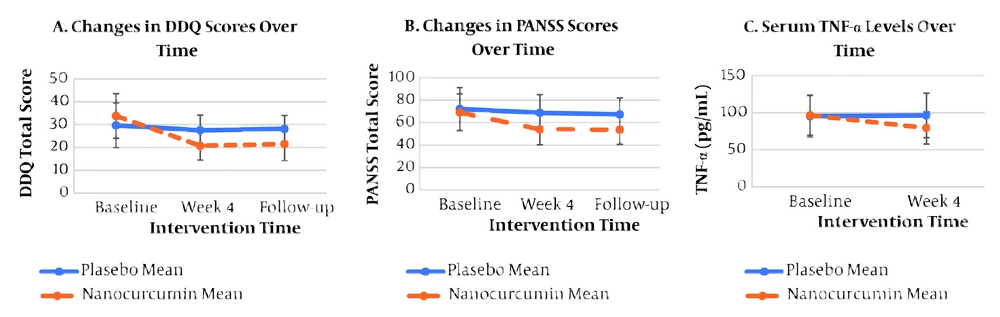
Figure 2.
Effect of Nano-CUR versus placebo on A, craving (DDQ scores); B, psychotic symptoms (PANSS scores); and C, serum TNF-α levels across study time points in patients with MIP. Data are presented as mean ± SEM. DDQ, Desire for Drug Questionnaire; MIP, methamphetamine-induced psychosis; Nano-CUR, nano-curcumin; PANSS, Positive and Negative Syndrome Scale; SEM, standard error of the mean; TNF-α, tumor necrosis factor-alpha.
4.3. Secondary Outcomes: Biochemical Parameters
Analysis of serum biomarkers using a linear mixed model adjusted for baseline values at week 4 revealed significant between-group differences for specific pathways (Table 3). The Nano-CUR group demonstrated a significant reduction in TNF-α levels (baseline, 96.48 ± 26.89; week 4, 79.49 ± 21.73) compared with the placebo group (baseline, 95.35 ± 28.39; week 4, 96.44 ± 30.06), with an MD of -18.07 pg/mL (95% CI, -30.7 to -5.45; P = 0.006). However, no significant between-group difference was observed in adenosine A2A receptor levels (MD = -0.051 ng/mL; 95% CI, -0.154 to 0.053; P = 0.32). Similarly, no significant between-group differences were found for IL-6 (P = 0.723) or TLR4 (P = 0.522) levels. This effect is visualized in Figure 2, panel C, confirming the significant reduction in TNF-α following Nano-CUR supplementation.
Table 3.
Serum Levels of Inflammatory Cytokines and Cellular Receptors at Baseline and After 4 Weeks of Intervention
| Variables | Placebo Group (n = 22) a | Nano-CUR Group (n = 23) a | Adjusted Between-group Difference at Week 4 (LMM) b | ||||
|---|---|---|---|---|---|---|---|
| Baseline | Week 4 | Baseline | Week 4 | F-Value [df1, df2] c | MD [95% CI] | P-Value d | |
| TNF-α, pg/mL | 95.35 ± 28.39 | 96.44 ± 30.06 | 96.48 ± 26.89 | 79.49 ± 21.73 | F [1, 43] = 8.24 | -18.07 [-30.7, -5.45] | 0.006 |
| IL-6, pg/mL | 23.93 ± 6.75 | 23.65 ± 8.50 | 25.32 ± 10.08 | 24.30 ± 6.75 | F [1, 43] = 0.13 | -0.739 [-5.02, 3.22] | 0.723 |
| A2A, ng/mL | 0.62 ± 0.2 | 0.654 ± 0.25 | 0.716 ± 0.15 | 0.70 ± 0.15 | F [1, 43] = 1.02 | -0.051 [-0.154, 0.053] | 0.32 |
| TLR4, mmol/L | 7.48 ± 2.96 | 8.23 ± 3.16 | 8.63 ± 2.85 | 9.78 ± 3.14 | F [1, 43] = 0.42 | 0.404 [-0.84, 1.58] | 0.522 |
Abbreviations: TNF-α, tumor necrosis factor-alpha; IL-6, interleukin-6; A2A, adenosine A2A receptor; TLR4, Toll-like receptor 4.
a Values are expressed as mean ± SD.
b Data are presented as mean difference (MD) and 95% confidence interval (CI). The MD represents the difference in the change from baseline to week 4 between the Nano-CUR and placebo groups.
c F-values and degrees of freedom are from the LMM testing the group × time interaction.
d Between-group comparisons were performed using a Linear Mixed Model (LMM), testing the group × time interaction effect across baseline and week 4 and adjusting for baseline values.
5. Discussion
5.1. Summary of Key Findings
This trial demonstrated that adjunctive Nano-CUR supplementation significantly reduced craving and psychotic symptoms in patients with MIP. Additionally, Nano-CUR significantly reduced serum levels of the pro-inflammatory cytokine TNF-α compared with placebo. No significant changes were found in adenosine A2A receptor, IL-6, or TLR4 levels.
5.2. Interpretation and Comparison with Previous Literature
5.2.1. Effects on Craving and Psychotic Symptoms
The significant improvement in craving and psychotic symptoms observed in our study aligns with the growing body of evidence on the neuroprotective properties of CUR. Our findings are consistent with those of Kanchanatawan et al. (29), who reported significant improvements in depression and anxiety scores following CUR supplementation in patients with major depressive disorder. The reduction in craving is particularly noteworthy. This effect is plausibly mediated by the observed reduction in TNF-α, as neuroinflammation is a well-established driver of reward dysfunction and craving behavior (7, 8). Furthermore, the ability of CUR to modulate dopamine signaling and reduce oxidative stress in reward-related brain regions represents another potential mechanism that could contribute to this effect (5, 30).
5.2.2. Effects on Inflammatory Pathways
The significant reduction in TNF-α levels observed in the Nano-CUR group provides compelling evidence for the anti-inflammatory effects of CUR in the context of METH use disorder. This finding is consistent with multiple studies. Hadizadeh-Bazaz et al. demonstrated the ability of CUR to reduce TNF-α and malondialdehyde levels in rat models of METH neurotoxicity (14), while Wilar et al., in a recent systematic review, reported significant reductions in TNF-α following Nano-CUR supplementation across multiple populations (24). Furthermore, this anti-inflammatory property appears to extend to other SUDs. Clinical trials have shown that Nano-CUR supplementation significantly reduces inflammatory biomarkers, such as C-reactive protein, in patients with nicotine dependence or methadone use disorder (31, 32).
Although conventional anti-inflammatory drugs, such as nonsteroidal anti-inflammatory drugs and corticosteroids, are available, they often target single inflammatory pathways and are associated with significant adverse effects, particularly with the long-term use required for chronic conditions such as SUD. In contrast, Nano-CUR offers a unique multitarget advantage with an exceptionally favorable safety profile (15, 33, 34). It not only modulates inflammation through multiple pathways, such as nuclear factor kappa B inhibition and TNF-α reduction, but also concurrently addresses oxidative stress and promotes neuroprotection (14, 34). This holistic approach of simultaneously targeting the interconnected pathophysiology of neuroinflammation, oxidative damage, and neuronal dysfunction makes Nano-CUR a particularly suitable and sustainable adjunctive therapy for the long-term management of neuropsychiatric conditions.
5.2.3. Interpretation of Non-significant Findings for Interleukin 6, Toll-Like Receptor 4, and Adenosine A2A Receptor
In the present study, serum levels of IL-6, TLR4, and adenosine A2A receptor did not show statistically significant changes. However, this finding does not diminish the potential involvement of these pathways in the observed therapeutic effects. Previous studies have reported that natural anti-inflammatory compounds such as CUR often exert their primary effects by modulating downstream signaling cascades, such as inhibition of nuclear factor kappa B and subsequent reduction of TNF-α, rather than directly altering upstream receptor expression, such as TLR4 (35, 36). This is corroborated by studies showing that CUR can reduce inflammatory cytokines without significantly changing TLR4 expression in certain experimental models (37). Therefore, the lack of significant effects on IL-6 and TLR4 suggests a degree of specificity in the anti-inflammatory actions of Nano-CUR, with preferential targeting of certain pathways, a finding consistent with other research (38).
Regarding the adenosine A2A receptor, the lack of a significant change indicates that the intervention did not substantially alter the levels of this receptor in peripheral serum. It is important to note the receptor’s predominant expression within the central nervous system (10, 39); therefore, peripheral serum measurements may not accurately reflect functional or expression changes occurring in the brain. Although the A2A receptor remains a biologically plausible target based on established literature (11, 12, 40), our findings do not support its involvement through peripheral measurement in the observed clinical effects.
Collectively, these findings suggest that the significant clinical improvements in psychotic symptoms and craving are likely mediated through Nano-CUR modulation of key downstream inflammatory pathways, such as TNF-α, rather than through direct, measurable changes in the upstream serum biomarkers assessed in this study, including IL-6, TLR4, and A2A. This interpretation underscores the need for future studies using larger cohorts, longer interventions, and central nervous system-targeted measures to clarify these mechanisms.
5.3. Potential Mechanisms of Action
The therapeutic benefits observed in our study may be mediated through multiple complementary mechanisms, although these should be considered hypothetical and require direct investigation in future studies:
Anti-inflammatory effects: The potent inhibition of nuclear factor kappa B signaling by CUR may have contributed to the reduced TNF-α levels observed, potentially mitigating neuroinflammation (14, 15).
Antioxidant properties: Through scavenging free radicals and enhancing antioxidant enzyme activity, CUR may have reduced oxidative stress damage in neural circuits relevant to psychosis and addiction (14, 34).
Neurotransmitter modulation: Curcumin may normalize dysregulated dopamine and glutamate signaling associated with METH use, possibly through indirect effects on inflammatory pathways (5, 30). Although direct measurement of dopamine was not feasible in this study, related pathways, including TNF-α and adenosine A2A receptor, were investigated. The significant reduction in TNF-α suggests a plausible inflammatory mechanism that could indirectly modulate dopaminergic circuits involved in reward and psychosis.
5.4. Clinical Implications and Potential Applications
Our findings suggest that Nano-CUR could serve as a valuable adjunctive therapy in the management of MIP. The combination of reduced craving and improved psychotic symptoms, coupled with a favorable safety profile, makes Nano-CUR particularly attractive for the long-term management of SUD. Recent reports by Hamlbar et al. and Shafabakhsh et al. further support the therapeutic potential of Nano-CUR formulations across various populations (41, 42).
Regarding generalizability, this study was conducted in a single psychiatric hospital in Iran with a predominantly male sample (96%), which reflects the epidemiology of METH use disorder in this population. Although the findings may be applicable to similar inpatient psychiatric settings with comparable demographic characteristics, caution should be exercised when generalizing them to populations with different gender distributions, outpatient settings, or other cultural contexts. Future multicenter studies with more diverse samples, including female participants, are needed to confirm the generalizability of these findings.
5.5. Limitations and Future Directions
Several limitations should be considered when interpreting the results of this randomized controlled trial. First, the present study was conducted within certain practical constraints, necessitating a focused approach to study design. Consequently, the relatively small sample size may have limited the ability to detect significant effects on certain parameters, raising the possibility of type II errors for some biomarkers, such as IL-6, TLR4, and A2A receptor. Therefore, the significant finding for TNF-α should be considered preliminary and requires confirmation in larger, adequately powered studies.
Second, although the 4-week intervention period was sufficient to demonstrate clinical effects, it may have been insufficient to observe full normalization of certain neurobiological parameters. Third, outcome assessment was limited in some ways. Although concurrent use of antipsychotic medications was ethically necessary, it made it difficult to completely isolate the specific effects of Nano-CUR. Additionally, the analysis focused on the PANSS total score for clinical relevance. A more granular analysis of subscales could provide further insight in future research. Future studies should consider larger sample sizes, longer intervention periods, and, ideally, neuroimaging measures to directly assess brain changes associated with Nano-CUR supplementation.
Fourth, during the 1-month follow-up period, participants were no longer hospitalized and did not receive Nano-CUR supplementation. They returned for clinical interviews and METH urine testing at the end of follow-up. Although no positive tests were reported at that visit, complete control over METH use outside the hospital was not feasible. Therefore, the potential for intermittent use during the follow-up period should be considered a limitation when interpreting the sustainability of the intervention effects.
Fifth, another limitation is the lack of direct measurement of central dopamine function, which was not feasible within the scope and budget of this study. Although related pathways were investigated, future research using more advanced neurochemical techniques would be valuable to directly examine the involvement of dopamine.
Sixth, although all patients received standardized treatment in the same clinical setting by the same psychiatric team following a consistent protocol, as detailed in Section 2.4, and randomization should have balanced potential confounders, the exact distribution of specific antipsychotic and mood stabilizer medications between the 2 groups was not systematically recorded. Therefore, the lack of detailed comparative data on concomitant medications is a limitation of this study, and future research should include systematic recording and reporting of all concomitant treatments.
5.6. Conclusions
In conclusion, this study provides evidence that Nano-CUR supplementation as an adjunctive therapy significantly reduces craving, ameliorates psychotic symptoms, and reduces inflammation, as reflected by TNF-α levels, in patients with MIP. Although some mechanisms require further investigation, the overall pattern of results suggests that Nano-CUR has the potential to be a safe and effective complementary treatment to conventional methods. Future research should focus on optimizing dosage regimens and identifying patient subgroups most likely to benefit from this intervention.