
1. Background
Cystic echinococcosis (CE) is a globally significant zoonotic helminthiasis characterized by diverse clinical manifestations and remains endemic in both developed and developing countries (1-3). The infection is caused by the metacestode stage of Echinococcus granulosus and manifests in accidental human hosts through the development of characteristic fluid-filled cysts, predominantly affecting the hepatic (68% - 89%) and pulmonary (10% - 30%) parenchyma (1, 4).
Surgical intervention is the primary treatment option for human CE. Combination therapy involving surgery and albendazole (ABZ) has been shown to reduce the likelihood of disease recurrence (5). When surgical intervention is contraindicated, chemotherapy with benzimidazole derivatives becomes necessary (4).
Despite its therapeutic effects, ABZ administration presents substantial pharmacokinetic challenges, particularly poor aqueous solubility and limited intestinal absorption (6, 7). To address the challenges posed by poorly water-soluble drugs, various strategies have been implemented, including the use of nanoparticles and emulsions. The advantages of nanomedicines include improved bioavailability and stability, versatile routes of administration, controlled drug release, and reduced toxicity (7). In many instances, nanomedicines passively accumulate in infected tissues (8).
Additional advantages of nanocrystals include reduced effective doses and minimized adverse effects (9). Solid lipid nanoparticles (SLNs) and self-emulsifying drug delivery systems (SEEDS) have attracted considerable interest as viable alternatives to traditional colloidal carriers for a range of therapeutic applications (10). Microemulsions facilitate rapid transit through the stomach, thereby enhancing drug dissolution and permeation within the gastrointestinal tract. In vitro studies have demonstrated that the permeability and protoscolicidal activity of ABZ encapsulated in lipid particles are superior to those of free ABZ (10, 11). Emerging preclinical investigations have demonstrated enhanced protoscolicidal activity of biogenic nanoparticle-encapsulated ABZ formulations against E. granulosus in murine models (4, 7, 12).
2. Objectives
The aim of this study was to evaluate the in vivo efficacy of various ABZ formulations, namely ABZ suspension, ABZ-SLN, and ABZ-ME, against experimental hydatidosis in BALB/c mice. Because hydatid cyst metabolites may interfere with the pharmacokinetic properties of drug absorption, an experimental hydatid infection model was established to approximate the natural pathological conditions of the disease. After 1 month of therapy, ABZ concentrations in hepatic and pulmonary tissues were measured, and the organ distribution of each formulation was compared by HPLC.
3. Methods
3.1. Preparation of Hydatid Cyst Protoscolices
Protoscolices were isolated from hepatic hydatid cysts of sheep at the Ahvaz Central Abattoir and transported to the Department of Parasitology, Faculty of Medicine. The protoscolices were washed 3 times with phosphate-buffered saline (PBS), and viability (> 95%) was confirmed using 0.1% eosin (Merck KGaA, Germany). Viable protoscolices were stored in RPMI medium supplemented with penicillin-streptomycin (BIO-IDEA, Iran) at 4°C and adjusted to a concentration of 4000 protoscolices/mL for subsequent use.
3.2. Experimental Animals and Challenge
The study protocol was approved by the Specialized Ethics Committee for Laboratory Animals under approval code IR.AJUMS.ABHC.REC.1400.061. A total of 25 male BALB/c mice, weighing 18 - 20 g and aged 4 - 8 weeks, were obtained from the Razi Institute Research Center in Hesarak, Karaj, Iran. The mice were divided into 5 groups, and each animal received an intraperitoneal injection of 0.5 mL of a solution containing 2000 protoscolices. The animals were housed in the animal facility of the Faculty of Veterinary Medicine, Shahid Chamran University, under controlled environmental conditions, including a 12-hour light/dark cycle, a temperature range of 22 - 25°C, and 60% relative humidity. Food and water were provided ad libitum for 6 months. All infected mice exhibited viable cysts upon dissection, confirming the adequacy of the infection model.
3.3. Preparation of Albendazole Microemulsion
For the oil base, oleic acid (Samchun, Korea) was combined with Transcutol P (Gattefossé, France) at a ratio of 10:1 (v/v) and thoroughly mixed. The oil phase was then combined with the drug, after which a mixture of surfactants (Tween 80 and Labrasol, 1:1) and a co-surfactant (3:1) was added. Samples exhibiting no turbidity were selected as the appropriate titers.
3.4. Preparation of Albendazole Nanoparticles
Solid lipid nanoparticles were prepared using the cold homogenization method. Briefly, 0.3 g of cholesterol (Solarbio, China), 0.3 g of stearic acid (Applichem, Germany), and 0.1 g of oleic acid (Samchun, Korea) were melted under indirect heating at 65°C. Subsequently, half of the surfactant components, comprising 0.1 g of Tween 80, 0.1 g of Labrasol (Gattefossé, France), and 0.05 g of Capryol (Gattefossé, France), were incorporated into the oily mixture. Then, 0.075 g of albendazole (Sigma, Germany) was added.
Next, 3 mL of the aqueous phase (distilled water) and the remaining half of the surfactant were added to the lipid mixture. The resulting mixture was stirred for 3 minutes using a magnetic stirrer and then sonicated for 32 minutes with a sonicator (Elmasonic, Germany). Finally, 7 mL of cold water (4°C) mixed with polyethylene glycol at a 1:4 ratio was added, and the entire mixture was homogenized for 20 minutes at 12000 rpm using a homogenizer (Heidolph Silent Crusher M, Germany).
3.5. Morphology and Size Characterization
The particle size of both blank SLNs and drug-loaded nanoparticles was assessed using a particle size analyzer (Scatteroscope-qudix, Korea). For scanning electron microscopy (SEM), thin-film samples were prepared, dried at room temperature, and then sent to the Razi Metallurgy Research Center. The acquired images were considered suitable for evaluating morphology and particle size.
3.6. Drug Loading Efficiency
The prepared drug-loaded nanoparticles were centrifuged in a refrigerated microcentrifuge at 25000 rpm for 15 minutes. The 3 aqueous fractions obtained after triple washing with water were pooled, and the drug concentration in the resulting supernatant was measured by HPLC using a C8 column. Drug loading was calculated by subtracting the drug content in the supernatant from the initial drug amount used in the formulation. Loading efficiency was expressed as the percentage of loaded drug relative to the total initial drug amount.
3.7. Drug Release Profile from Drug-Loaded Microemulsion and Solid Lipid Nanoparticles
To evaluate drug release, a static Franz diffusion cell system was used. The concentrations of the released drug were quantified using an HPLC system (Agilent Technologies 1260 Infinity II, USA) equipped with a C8 column. The mobile phase consisted of acetonitrile (Samchun, Korea) and trifluoroacetic acid (Merck, Germany). The concentration of the released drug was determined using a standard curve, and the area under the curve (AUC) was subsequently calculated.
3.8. Treatment of Mice with Drug Formulations
Six months after the initial challenge, all study groups received various formulations of ABZ orally at a dosage of 20 mg/kg/day for 30 days. The groups were as follows:
1) Albendazole suspension (20 mg/kg)
2) Nano-albendazole (20 mg/kg)
3) Albendazole microemulsion (20 mg/kg)
4) Solid lipid nanoparticles containing all nanomedicine components except albendazole
5) Distilled water (control)
Following the treatment period, the animals were euthanized using a ketamine-xylazine combination at a dose of 50 mg/kg. Hepatic and pulmonary tissues were then harvested and stored at -70°C until analysis.
3.9. Drug Extraction from Tissues
Tissue samples were weighed and thoroughly homogenized, after which 1.5 mL of 0.01 M monobasic phosphate buffer (pH 10) was added. Homogenization was performed for 5 - 10 minutes using a homogenizer (Heidolph Silent Crusher M, Germany). Subsequently, 3 mL of an extraction solvent consisting of ethyl acetate and acetonitrile at a 1:5 ratio was added, and the mixture was homogenized for an additional 10 minutes.
The samples were then centrifuged at 5000 rpm for 10 minutes, and the supernatant was collected. An additional 3 mL of the extraction solvent was added to the remaining pellet, followed by homogenization and a second centrifugation. The supernatant from this step was combined with the previously collected supernatant. Next, 8 mL of n-hexane (Merck, Germany) was added to the pooled supernatant, and the mixture was vigorously agitated for 10 minutes before centrifugation at 3500 - 4000 rpm for 10 minutes. The upper n-hexane layer was discarded, and this extraction procedure was repeated once more. The remaining liquid was evaporated under vacuum using a rotary evaporator set at 40°C. The resulting residue was reconstituted in 1 mL of HPLC mobile phase (80% acetonitrile and 20% 0.01% trifluoroacetic acid) and thoroughly vortexed. Drug concentration was measured using the HPLC system under the conditions described previously. Drug concentration in the tissue was determined by plotting a standard curve and performing the necessary calculations.
Extraction recovery was assessed in triplicate by spiking blank tissue homogenates with albendazole (10 µg/g) and processing them identically to the study samples. The mean recovery (± SD, n = 3) was 87.04% ± 3.76% for liver and 90.88% ± 4.21% for lung. All reported tissue concentrations were corrected using these recovery values.
3.10. Statistical Analysis
All statistical analyses were performed using SPSS software version 21. A significance level of P < 0.05 was adopted for all tests. Before parametric analyses, data normality was assessed using the Kolmogorov-Smirnov test. Data conforming to a normal distribution were analyzed using analysis of variance (ANOVA) and Student t-test. For multiple-group comparisons, the Tukey post hoc test was applied. When data deviated from a normal distribution, nonparametric tests, such as the Mann-Whitney U test, were used. A P value < 0.05 was considered statistically significant for all analyses.
4. Results
4.1. HPLC Method Validation
HPLC analysis successfully detected ABZ in tissue samples from SLN-treated mice, with a characteristic peak at a retention time of 7.7 minutes. To confirm method accuracy, samples were spiked with 40 ppm ABZ standard, resulting in a clear increase in peak intensity, while the retention time remained unchanged (Figure 1).

Figure 1.
HPLC chromatograms showing: A, tissue extract from the blank SLN control group (Group 4) exhibiting no peak at 7.7 minutes; B, albendazole detected at 7.7 minutes in tissue from SLN-treated mice; and C, the same sample as in (B) spiked with 40 ppm albendazole standard, confirming peak identity. Conditions: C8 column (250 × 4.6 mm, 5 µm); mobile phase: acetonitrile:0.01% trifluoroacetic acid (80:20); flow rate: 1.0 mL/min; detection: 285 nm; injection volume: 20 µL.
4.2. Repeatability and Accuracy of the HPLC Test
The repeatability and accuracy of the HPLC method for ABZ quantification were evaluated using standard concentrations analyzed under intraday and interday conditions. A standard deviation < 5% indicated acceptable precision, whereas accuracy > 94% was considered indicative of good method validity. As shown in Table 1, the repeatability and accuracy of the HPLC method were confirmed.
Table 1.
Repeatability and Accuracy of HPLC for ABZ Quantification
| Albendazole Concentration (ppm) | Repeatability, Intraday | Repeatability, Interday | Accuracy, Intraday | Accuracy, Interday |
|---|---|---|---|---|
| 0.5 | 4.2 | 3.6 | 94.8 ± 2.6 | 96.5 ± 5.2 |
| 1.0 | 3.9 | 4.7 | 101.8 ± 5.7 | 99.3 ± 5.3 |
| 10.0 | 3.8 | 4.1 | 109.2 ± 3.2 | 100.8 ± 4.9 |
| 20.0 | 2.2 | 3.3 | 102.7 ± 4.4 | 99.1 ± 4.4 |
| 40.0 | 3.5 | 4.6 | 96.3 ± 6.5 | 99.9 ± 3.4 |
4.3. Limit of Quantitation
The limit of quantitation (LOQ) represents the minimum quantifiable concentration detectable by the HPLC method; values exceeding this threshold are considered valid and reportable. The LOQ was determined using a calculation incorporating 2 critical parameters: the slope of the calibration curve and the standard deviation of residuals derived from regression analysis. Using this approach, the LOQ was established at 0.17 ppm. All concentration measurements recorded in this investigation exceeded the 0.17-ppm threshold, thereby meeting the validity criterion for the quantitation limit.
4.4. Albendazole Solubility Assay
The solubility of ABZ in the oil, surfactant, co-surfactant, and, finally, in a combination of all solvents was determined using UV spectrophotometry at a wavelength of 285 nm. These results were subsequently used to formulate an ABZ microemulsion. The findings are presented in Table 2.
Table 2.
Albendazole Solubility in Formulation Components (Mean ± SD, N = 3)
| Components | Solubility (g/mL) |
|---|---|
| Transcutol P and oleic acid | 8.00 ± 0.38 |
| Labrasol and Tween 80 | 4.20 ± 0.29 |
| Capryol | 1.85 ± 0.19 |
| Transcutol P and oleic acid, Labrasol, Tween 80, and Capryol | 13.60 ± 1.95 |
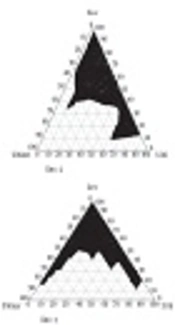
This investigation systematically evaluated the phase behavior and microemulsion formation characteristics of albendazole-containing systems through pseudoternary phase diagram analysis. Phase diagrams were constructed at 2 distinct surfactant-to-co-surfactant (S:CoS) mass ratios, 1:1 and 3:1, as depicted in Figure 2. The shaded regions within the diagrams demarcate the microemulsion existence zones, and the darkened areas correspond to optically isotropic, thermodynamically stable microemulsion phases.
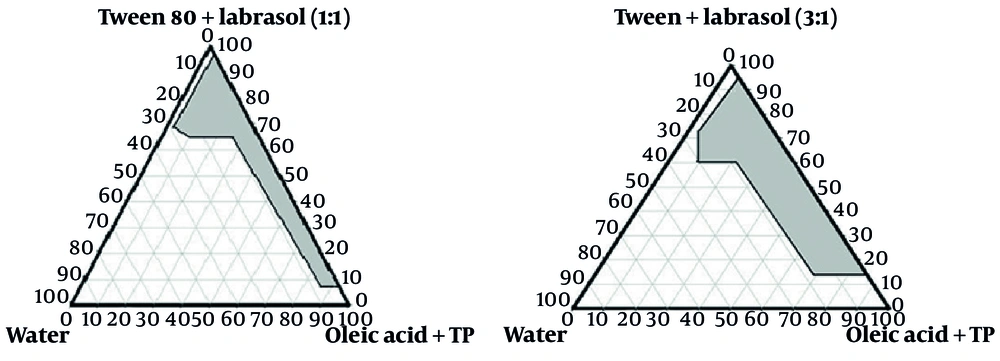
Figure 2.
Microemulsion formation characteristics of albendazole-containing systems through pseudoternary phase diagram analysis at 2 distinct surfactant:co-surfactant (S:CoS) mass ratios: 1:1 and 3:1.
4.5. Characteristics of Albendazole-Loaded Solid Lipid Nanoparticles
4.5.1. Particle Size
Particle size analysis showed a mean hydrodynamic diameter of 139 ± 10 nm with a narrow size distribution (polydispersity index [PDI] = 0.140). Drug-loaded solid lipid nanoparticles exhibited slightly larger dimensions (147 ± 12 nm; PDI = 0.160). These findings indicate a suitable particle size range, suggesting that incorporation of ABZ did not substantially alter particle size or PDI. Both formulations exhibited a satisfactory PDI, a pivotal attribute for nanoparticles intended for systemic action (Figure 3).
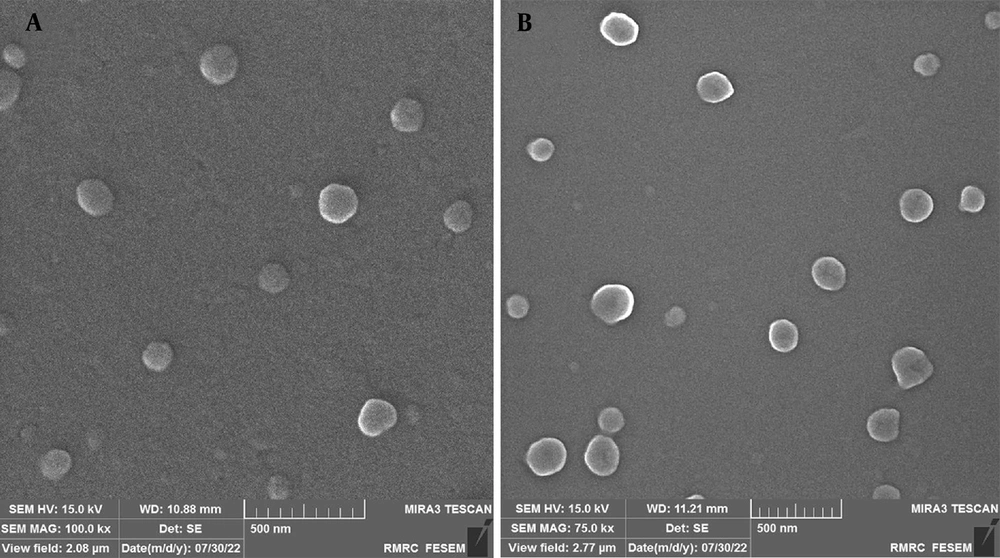
Figure 3.
Representative SEM images of A, blank SLNs (145.5 ± 12.8 nm) and B, ABZ-SLNs (162.8 ± 13.5 nm).
4.5.2. Albendazole Loading and Release Results
Pharmaceutical characterization showed entrapment efficiencies of 62.7% ± 5.3% for ABZ-ME and 59% for ABZ-SLNs, as illustrated in Figures 4 and 5. The dissolution profile demonstrated sustained release kinetics, characterized by the absence of an initial burst phase. Quantitative analysis showed limited drug release during the early phase, with < 10% cumulative release within the initial 8-hour period. Progressive release kinetics were maintained through 72 hours, achieving approximately 50% total drug release.
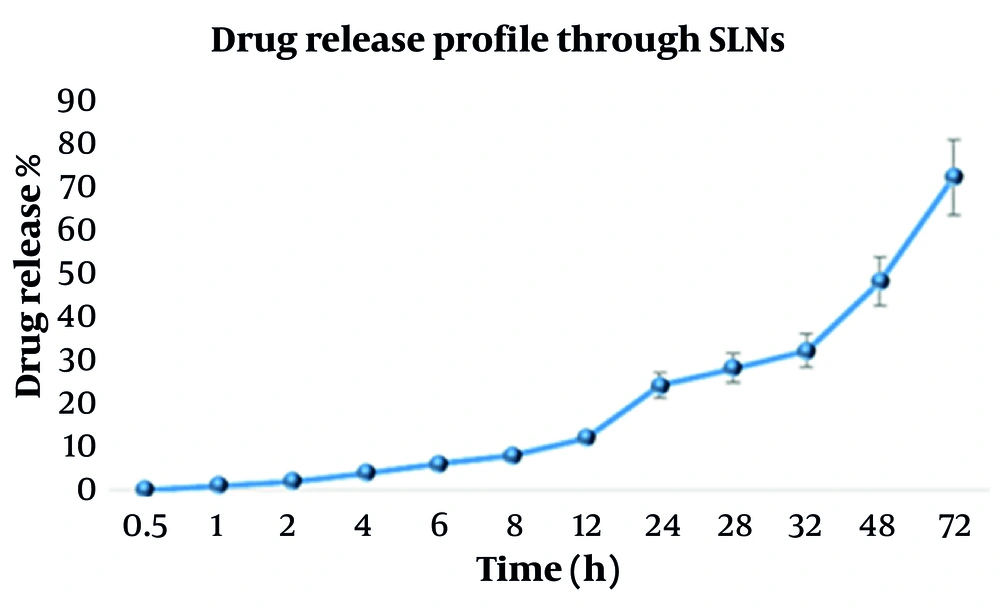
Figure 4.
In vitro release profile of ABZ from solid lipid nanoparticles (SLNs), demonstrating sustained release kinetics over 72 hours (n = 3).
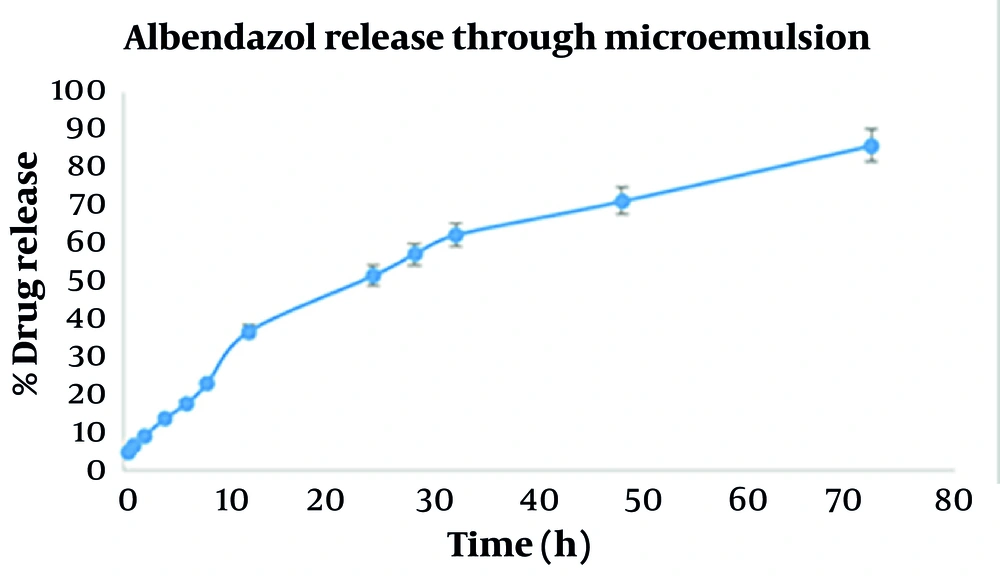
Figure 5.
Comparative release kinetics of the albendazole microemulsion formulation (ABZ-ME), showing a rapid initial release phase followed by sustained drug release (n = 3).
4.6. Drug Concentration in Tissues
Table 3 presents drug concentrations in pulmonary and hepatic tissues relative to the total administered dose of conventional ABZ, ABZ-ME, and ABZ-SLN over 1 month. All formulations were administered orally to the study groups for 1 month, 6 months after intraperitoneal challenge with 2000 protoscolices.
Table 3.
Albendazole Concentration in Tissues After 1 Month of Treatment a
| Formulation Type | Drug Recovered | Percentage of Drug Recovered | ||
|---|---|---|---|---|
| Hepatic Tissue (mg/g Tissue) | Pulmonary Tissue (mg/g Tissue) | Hepatic Tissue | Pulmonary Tissue | |
| ABZ | 0.0042 ± 0.0010 | 0.0051 ± 0.0014 | 0.72 ± 0.11 | 0.78 ± 0.17 |
| ABZ-ME | 0.7100 ± 0.1200 | 1.2200 ± 0.1600 | 2.25 ± 0.47 | 3.14 ± 0.51 |
| ABZ-SLN | 0.4360 ± 0.0700 | 0.6600 ± 0.1100 | 4.45 ± 0.82 | 4.21 ± 0.12 |
a Abbreviation: ABZ, albendazole.
Statistical analysis indicated that ABZ-ME and ABZ-SLN showed significantly higher drug concentrations in both pulmonary and hepatic tissues than conventional ABZ (P < 0.05). In the conventional ABZ group, no significant difference was observed between pulmonary and hepatic tissue drug levels (P > 0.05). Similarly, in the ABZ-ME group, there was no significant difference between pulmonary and hepatic tissue drug levels (P > 0.05). Likewise, no significant difference was found between pulmonary and hepatic ABZ levels in the ABZ-SLN group (P > 0.05).
5. Discussion
ABZ, a broad-spectrum benzimidazole anthelmintic, is widely used in human and veterinary medicine for the treatment of nematode infestations and larval-stage cestode infections.
Current clinical use shows distinct pharmacological profiles depending on the indication. For gastrointestinal nematode infections, a regimen of 400 mg/day for 2 days has an excellent safety profile. However, treatment of larval-stage cestode infections requires prolonged high-dose therapy (800 mg/day for 3 - 6 months) to achieve therapeutic concentrations.
Following oral administration, ABZ reaches peak plasma concentration (Cmax) within 2 - 3 hours. Hepatic microsomal enzymes rapidly metabolize ABZ into its pharmacologically active sulfoxide derivative (ABZ-SO) and inactive sulfone metabolite (ABZ-SN), facilitating renal excretion through enhanced aqueous solubility (15). The maximum plasma concentration (Cmax) of ABZ sulfoxide reaches 0.16 µg/mL, and the elimination half-life (t1/2) ranges from 8 to 12 hours (16). ABZ bioavailability can be enhanced by several factors, including a fatty diet, body weight, sex, age, and concurrent infectious diseases (17). Administration of ABZ with fatty foods or grapefruit juice can increase bioavailability by up to 6.5- and 3.2-fold, respectively, which is particularly important for the treatment of tissue parasites (15). This phenomenon may be attributed to increased drug solubility (18). Whittaker et al. reported that ABZ sulfoxide bioavailability and ABZ half-life vary by age, with significant differences between adults and children (17). Capece et al. demonstrated significant sex-related differences in Tmax and Cmax plasma drug levels between male and female goats. Following administration of 10 mg/kg ABZ, male goats exhibited a Tmax of 18.33 hours and a Cmax of 4.4 µg/mL for ABZ sulfoxide, whereas female goats showed a Tmax of 16.67 hours and a Cmax of 3 µg/mL (19).
In the present study, 3 ABZ formulations, ABZ suspension, ABZ-ME, and ABZ-SLN, were evaluated in hepatic and pulmonary tissues of BALB/c mice. The findings showed that ABZ levels in the ABZ-ME and ABZ-SLN groups were significantly higher than those in the hepatic and pulmonary tissues of the ABZ suspension group (P < 0.05). In the ABZ suspension group, drug concentrations were 0.0042 mg/g in hepatic tissue and 0.0051 mg/g in pulmonary tissue. In contrast, the ABZ-ME group showed concentrations of 0.7100 mg/g in hepatic tissue and 1.2200 mg/g in pulmonary tissue. Similarly, the ABZ-SLN group exhibited concentrations of 0.4360 mg/g in hepatic tissue and 0.6600 mg/g in pulmonary tissue. These results indicate that advanced ABZ formulations are more effective for the treatment of tissue hydatidosis.
Although ABZ measurement in plasma has been reported in several studies, most articles quantify ABZ metabolites rather than the parent compound because of rapid hepatic metabolism in patients (20). Arroyo et al. reported that ABZ-SO levels in 118 patients with neurocysticercosis receiving 22 mg/kg ABZ for 10 days ranged from 194 to 1364.6 ng/mL in plasma, with variations correlating with age and sex (21).
Permana et al. observed that the concentration gradient across tissues followed the order hepatic > kidney > spleen (22).
In the present study, higher drug concentrations were observed in lung tissue than in liver tissue. This finding may be attributable to hepatic clearance and enterohepatic recirculation, which could reduce measured levels of the parent drug in the liver at a single terminal time point, whereas the lung may act as a slower-release compartment. However, in the absence of plasma pharmacokinetic (PK) data, this interpretation remains hypothetical.
These findings confirm hepatic accumulation of ABZ metabolites and align with our results; however, discrepancies in absolute concentrations may reflect differences in detection methods, treatment duration, and formulation strategies.
In the current study, the concentration of ABZ in the ABZ-ME and ABZ-SLN groups was significantly higher than that in the ABZ suspension group (P < 0.05). Fabbri et al. additionally reported a 183% increase in ABZ bioavailability in the brain tissue of rats with experimental cysticercosis treated with ABZ-loaded lipid nanocapsules compared with the ABZ suspension group, with a 2-fold enhancement in therapeutic efficacy (23). Consistent with these findings, the concentration of ABZ in pulmonary tissue exceeded that in hepatic tissue across the ABZ-ME and ABZ-SLN groups (P < 0.05). Notably, ABZ-SLN demonstrated greater drug accumulation in both hepatic and pulmonary tissues compared with ABZ-ME (P < 0.05), suggesting superiority for systemic tissue distribution. These results align with studies on ABZ-lipid nanocapsules in murine models of cystic echinococcosis, in which enhanced plasma and tissue ABZ levels correlated with improved clinical outcomes (24, 25). In addition, Mukherjee and Plakogiannis demonstrated that a supersaturated SEEDS for ABZ achieved a 52% higher Cmax (P = 0.019) and 56% greater AUC over 24 hours than the standard ABZ suspension (26).
Due to certain experimental limitations, a blank microemulsion group was not included in the current study. However, including a blank microemulsion control in future investigations would provide deeper insight into the inherent effects of the carrier system.
5.1. Conclusions
The present study demonstrates that both ABZ-SLN and ABZ-ME significantly enhance tissue drug distribution compared with conventional ABZ suspension, with pulmonary concentrations consistently exceeding hepatic levels across all formulations. The observed pharmacokinetic improvements, including sustained release profiles and greater tissue accumulation, support these nanocarriers as promising delivery systems that warrant further investigation in therapeutic models. However, 2 key limitations warrant consideration: 1) the absence of metabolite profiling, particularly active ABZ-SO and inactive ABZ-SN levels; and 2) unmeasured drug concentrations in cyst fluid. These findings indicate that ABZ-SLN and ABZ-ME markedly enhance tissue delivery of the parent drug; however, translation to clinical efficacy requires demonstration of elevated active metabolite levels. These gaps highlight critical directions for future research to fully characterize the therapeutic potential of these advanced formulations.