1. Background
Hydatidosis is a serious health problem in many parts of the world, most commonly in sheep-rearing areas. Approximately 65% to 70% of infections occur in the liver, but most organs can be affected (1, 2). Three options are recommended for treatment: surgery, puncture-aspiration injection-respiration (PAIR), and chemotherapy. Although surgery is the method of choice, chemotherapy is an important treatment for inoperable cases or in combination with surgery to prevent recurrent infections (3, 4). Benzimidazole (BZD) compounds are currently administered to patients exhibiting high surgical risk, and pre-and post-operative to prevent secondary hydatidosis (5, 6). Among BZD compounds, albendazole (ABZ) is the drug of choice for echinococcosis in humans and has been demonstrated to be effective against cystic echinococcosis (CE). After oral administration, ABZ is metabolized into albendazole sulfoxide (ABZSO) by hepatic enzymes. These anthelmintic compounds inhibit the polymerization of β-tubulin, which blocks glucose uptake, depletes glycogen, disrupts cell division and, ultimately, results in parasite death (7-9). Hydatid cyst membranes behave like barriers; they consist of one host-derived fibrous layer and two parasite-derived layers that include an external, laminated, a cellular layer (about 1 mm thick) and a thin, inner, cellular, germinal layer (10 - 25 µm thick). The germinal layer in fertile cysts has brood capsules and protoscoleces, but infertile cysts have only a germinal layer without protoscoleces (10). The poor solubility and low gastro intestinal (GI) absorption (< 5%) of drugs means that patients of conventional therapy must consume high doses of drugs for a long period. This can cause adverse side-effects such as abnormal liver function, leucopenia, and GI problems (11, 12). Nano carrier-based drug delivery systems are currently employed to overcome the limitations associated with conventional chemotherapy. These carriers supply the drug for a determined period of time with a controlled dose (13, 14). Several nano-carriers, including micelles, liposomes, nano-capsules, and solid lipid nanoparticles (SLNs), have been developed (14-16). SLNs were used as a drug delivery carrier at the beginning of the 1990s (17). They have been also described as a suitable drug delivery system for lipophilic drugs. The main advantage of SLNs is the use of physiological lipid matrices that decrease immune response and toxicity (18, 19). These carriers have applications for controlled drug release, increasing drug stability, target ability, enhanced therapeutic efficacy, and reduced erratic absorption (20-25). A high correlation between molecular lipid solubility and the bioavailability of lipophilic drugs has been demonstrated; however, the improved dissolution of drug-loaded nanoparticle dosage forms could increase the bioavailability of poorly soluble drugs (26-29). The present study compared the ability of conventional and SLN forms to diffuse ABZ and ABZSO through the cyst layers of fertile and infertile hydatid cysts. It has been reported that the success rate of chemotherapy in hydatid disease can primarily be attributed to the drug’s ability to penetrate the cyst layers and produce an adequate concentration of the drug on the interior agents for a specific period of time (30-32).
2. Objectives
The aim of the current study was to design ABZ and ABZSO-loaded SLNs to increase drug permeation across the hydatid cyst membrane and reduce the systemic side effects of conventional drugs. This study evaluated the physicochemical parameters of the drug required to allow good drug diffusion and enhance the drug concentration in a cyst environment to increase the efficacy by loading into SLNs.
3. Materials and Methods
3.1. Materials
Compritol 888 ATO was gifted from Gattefosse company (France). Polyoxyethylene sorbitan fatty acid ester (Tween 80), polyvinyl alcohol (PVA), and ABZSO were purchased from Sigma-Aldrich. ABZ was kindly supplied by Daroupakhsh pharmaceutical (Tehran, Iran). All other chemicals used were of HPLC grade and were purchased from Sigma chemical (USA). Double distilled and deionized water was used throughout the study.
3.2. Methods
3.2.1. Preparation of SLNs
The blank and drug-loaded SLNs were prepared using micro emulsification and high shear homogenization methods. Briefly, 7 g of comprisal 888 ATO was melted by heating it at 75°C and 500 mg of the drug (ABZ or ABZSO) was dissolved in the melted lipid. Next, 1 g of Tween-80 and 1g of PVA were dissolved in 100 mL of deionized water at 80°C and mixed at a rate of 500 rpm using a magnetic stirrer (IKA, RHB2, Germany). The lipid phase was then added to the aqueous phase and sonicated in an ultrasonic bath (S 3 OH Elma sonic, Germany) for 5 minutes. The mixture was homogenized at 12,000 rpm for 10 - 15 minutes using a mechanical homogenizer (IKA, T25 digital, ULTRA TURRAX, Germany). The nano emulsion was then added to 100 mL of cold deionized water (3°C), mixed for a further 30 minutes, and centrifuged at 5,000 rpm (by Clements 2,000; Australia) for 4 minutes to remove aggregates and larger particles. The supernatant was separated and centrifuged twice at 30,000 rpm for 30 minutes at 4°C using an ultra-cooling centrifuge (Vision Scientific Co., Ltd. South Korea). The resulting SLNs were freeze-dried after freezing them at -20°C and stored in vials at 4°C until use.
3.2.2. Characterization of Nanoparticles
3.2.2.1. Particle Size and Zeta Potential Determination
The mean particle size and polydispersity index (PDI) of the sample dispersions were determined by photon correlation spectroscopy using a particle size analyzer (ScatterScope 1 qudix, Korea). The zeta potential of the SLN dispersions was determined using a zeta sizer (Zen 3600; Malvern instruments; UK). The lipid particulate of the dispersion was diluted (1:100 (v/v)) with double distilled water before the assessments.
3.2.2.2. Particle Shape and Surface Morphology
The shape and the surface morphology of the nano particles were determined using images obtained from an atomic force microscope (AFM) (Nanowizard II; JPK instruments; Germany). The SLN formulations were diluted to 1:10 with distilled water and sonicated for about 30 minutes in an ultrasonic agitator (UP400S; Hielscher Ultrasonics; Germany). The preparations were then deposited onto a mica sheet and observed under the AFM.
3.2.2.3. Measurement of Entrapment Efficiency and Drug-Loading
SLN suspensions were centrifuged twice at 30,000 rpm for 30 minutes, and 1 mL of supernatant was analyzed for the free drug using high performance liquid chromatography (HPLC). The entrapment efficiency (EE; %) and drug-loading (DL; %) were determined as follows:
Where the total drug is the amount of the drug used in the SLN formulation, the free drug is the unloaded drug that presents in the supernatant, and the total lipid is the amount of lipid used in the SLN formulation (33).
3.2.3. In Vitro Drug Release Study
The in vitro drug release from SLNs was evaluated using the dialysis membrane method. Dialysis bags (D6191-25EA; MWCO 12,000 Da cut-off; Sigma-Aldrich) were hydrated in phosphate-buffered saline (PBS) at a pH of 7.4 for 24 hour before use. Four bags were prepared containing free ABZ, free ABZSO, ABZ-SLN, and ABZSO-SLN. About 3 mL of each formulation was placed into a dialysis bag that was tied at both ends and suspended in 25 mL of PBS (a pH of 7.4) under moderate magnetic stirring at 200 rpm at 37°C for 24 hour. Then, 1 mL samples of the release medium were removed and replaced with fresh buffer in predetermined intervals. The samples were evaluated for their drug content using HPLC.
3.2.4. Stability Study
The stability of 5 mL samples of ABZ-SLN and ABZSO-SLN kept in glass vials at -20 and 4°C for 6 months was investigated. The mean particle size, zeta potential, and entrapment efficiency were evaluated after this incubation time (34).
3.2.5. Hydatid Cyst Membrane Permeation
3.2.5.1. Sample Collection
Sheep liver hydatid cysts were collected from abattoirs located in the city of Ahvaz in Khuzestan province in southwestern Iran. They were transported to the parasitology laboratory at the department of parasitology, Ahvaz Jundishapur University of Medical Sciences. To study in vitro hydatid cyst membrane permeation, the hydatid cysts were removed from the livers of infected sheep under aseptic conditions and were washed twice with sterile PBS (with a pH of 7.4). The surfaces of the cyst were sterilized using 70% ethyl alcohol. Their fertility was tested by microscopic examination for the presence of free protoscoleces in cystic fluid (34, 35). The cysts were divided into 10 groups of 4 cysts each, as shown in Table 1. The cysts were maintained in a culture medium (RPMI 1640) containing 25% fetal calf serum, 0.42% D-glucose, 0.45% yeast extract, 200 u/mL of penicillin, 200 µg/mL of streptomycin, and 0.5 µg/mL of amphotericin B at 37°C. Then, 2,000 µg/L doses of the free drugs or SLN-loaded drugs were added to the medium (30), and 2 mL samples of cyst fluid were aspirated from the cysts at 48 hour post-treatment and stored at -20°C prior to the analysis of the permeated drug content using HPLC. Furthermore, to determine the effect of the drug concentration and/or incubation time on drug permeability, some experimental groups were exposed to 2,500 µg/L of the drug, and the concentration of the drug in the cyst fluid was determined after 72 hours of incubation.
Table 1.
Description of Different Study Groups of the Hydatid Cysts
| Group No. | Fertile | Infertile | Control | Treated With Free ABZ | Treated With ABZ-SLN | Treated With Free ABZSO | Treated With ABZSO-SLN |
|---|---|---|---|---|---|---|---|
| 1 | * | * | |||||
| 2 | * | * | |||||
| 3 | * | * | |||||
| 4 | * | * | |||||
| 5 | * | * | |||||
| 6 | * | * | |||||
| 7 | * | * | |||||
| 8 | * | * | |||||
| 9 | * | * | |||||
| 10 | * | * |
3.2.6. ABZ and ABZSO Assay
3.2.6.1. Drug Extraction
Drug extraction co-extracts components that make drug quantification difficult. Briefly, after centrifugation (5,000 rpm, 15 minutes, 4°C), the samples were subject to extraction using acidic denaturation over 30 minutes by adding 500 μL of 3% HCl to 500 μL of the sample with 50 µg/mL of mebendazole as an internal standard. It was centrifuged at 14,000 rpm for 10 minutes to allow phase separation. The pure supernatant was then transferred to a 5 mL tube and the solvent was eliminated by evaporation under a stream of nitrogen. The samples were next dissolved in a 1000 µL mobile phase, well mixed, and then 50 µL of each sample was injected into the HPLC (36). To validate the procedure and quantify the percentage of drugs that can be extracted using this method, determined amounts of the standard drug were added to the cyst fluid and recovered in the same manner as test samples.
3.2.6.2. HPLC Method
The drug concentration was quantified by HPCL (Cecil 1100 series; UK). The mobile phase consisted of acetonitrile double-distilled water adjusted to a pH of 3.5 using orthophosphoric acid (60:40 (v/v)). A C18 reversed-phase column (H1; Nucleosil 100-5 C18 PAH; UK) with dimensions of 250 × 4.6 mm and a packing particle size of 5 μm was used. The mobile phase flow rate was set at 1.2 mL/min. The effluents from the column were detected at 254 nm. About 50 µL of the sample was injected, and the total run time was 30 minutes. The retention time for the ABZ and ABZSO was 3.52 and 4.59 minutes, respectively.
3.3. Statistical Analysis
All tests were repeated three times, and the results were presented as mean ± SD. The statistical evaluations were carried out using one-way ANOVA using SPSS, version 22, software. To indicate the significant differences between treatment groups, Tukey’s test was employed as a post-test and the results were considered significant at P < 0.05.
4. Results
4.1. Physicochemical Characterization
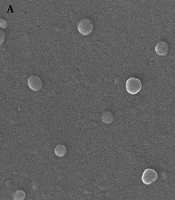
Physicochemical characterizations of ABZ-SLN and ABZSO-SLN are presented in Table 2. The mean particle sizes were < 180 nm and are shown in Figure 1. The PDI were ~ 0.08 for both formulations. It has been stated that PDI values of < 0.3 are considered ideal and indicate a narrow size distribution and that < 0.1 is considered mono-dispersed. These results indicate that both drugs had narrow size dispersions and were mono-dispersed. The EE was 91% and 94% and DL was 6.1% and 6.34% for ABZ-SLN and ABZSO-SLN, respectively.
Table 2.
The Results of the Characterization of ABZ and ABZSO Solid Lipid Nanoparticles
| Drug | Particle Size (nm) | PDI | Zeta Potential (mV) | % EE | % DL |
|---|---|---|---|---|---|
| ABZ-SLN | 179 | 0.080 | -38.4 | 91 | 6.1 |
| ABZSO-SLN | 163 | 0.064 | - 46.8 | 94 | 6.34 |
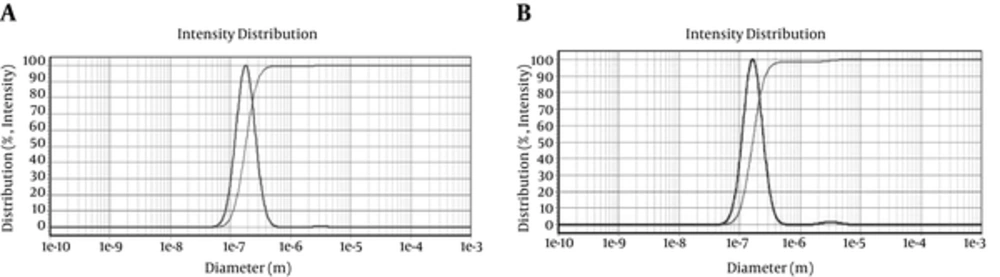
Figure 1.
A: ABZ-SLN; B: ABZSO-SLN.
The zeta potential indicates the surface charge and is an important parameter for the stability of the formulation and the prevention of aggregation. Largely negative zeta potentials were obtained for both formulations and indicated their stability. An increase in the zeta potential was observed with ABZSO-SLN (-46.8 mV) over ABZ-SLN (-38.4 mV).
4.1.1. Particle Morphology
The AFM images of the SLN formulations deposited on mica are shown in Figure 2. All SLN images had a spherical ovoid shape with an average particle size of 163 nm for ABZ-SLN and 179 nm for ABZSO-SLN.
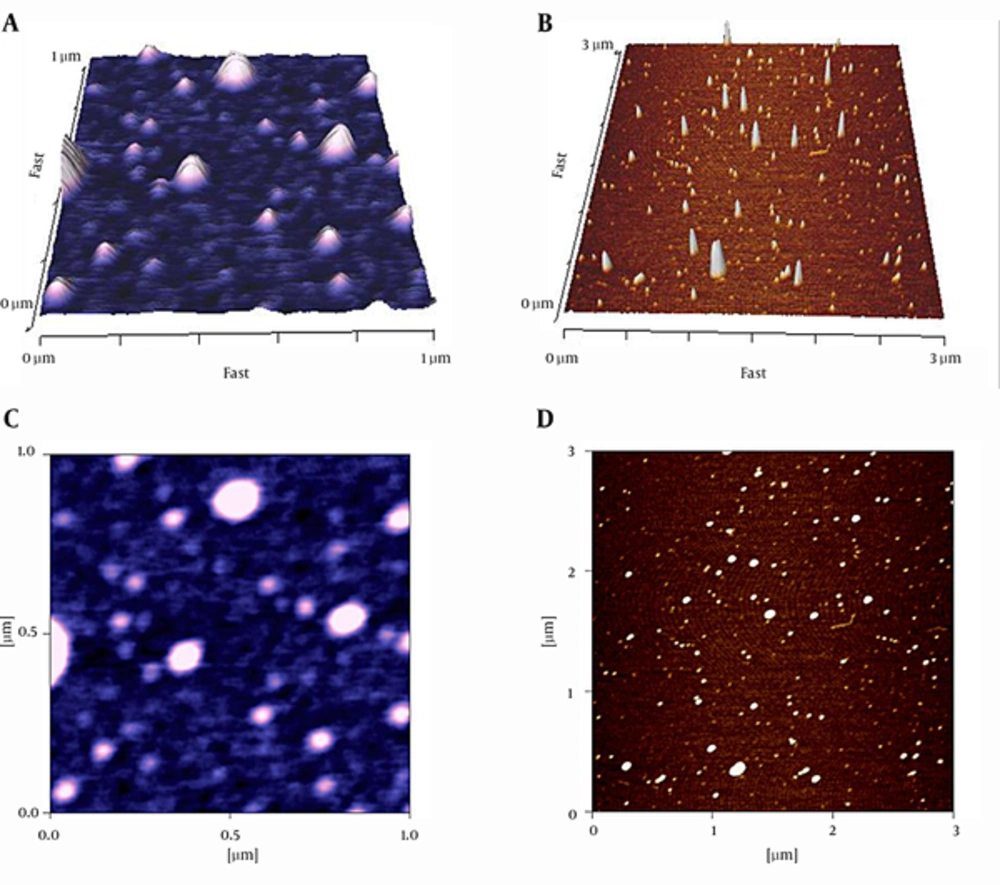
Figure 2.
AFM Images of ABZ-SLN (A and C) and ABZSO-SLN (B and D) Formulations
4.2. In Vitro Drug Release
The in vitro release behaviors of the free drugs and drug-loaded SLNs were studied by dialysis and the results are presented in Figure 3. Free ABZ and ABZSO released approximately 90% of the drug within the first half hour; both SLN formulations exhibited a slower release than the free drugs. The percentage of cumulative release over the first half hour was 88.3%, 80.5%, 38.6%, and 32.1% for the free ABZ, free ABZSO, ABZ-SLN, and ABZSO-SLN, respectively.
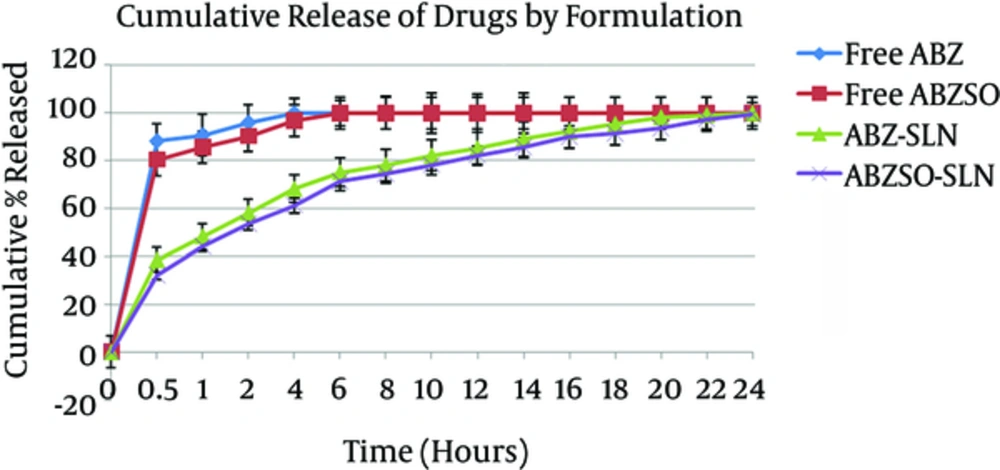
Figure 3.
Cumulative Release of Drugs From Free Drug Suspensions or Drug-Loaded SLNs (Mean ± SD)
4.3. Stability
The stability of the ABZ-SLN and ABZSO-SLN was determined after storage at -20°C and 4°C for 6 months, and the results are shown in Table 3. Both SLN formulations showed stability with no significant change in particle size, zeta potential, and EE (P < 0.05). The stability of the formulations can be attributed to the highly negative charges of the nanoparticles.
Table 3.
The Results of the Stability Tests for ABZ and ABZSO Solid Lipid Nanoparticles After 6 Months
| Drug | Particle Size (nm) | PDI | Zeta Potential (mV) | % EE | % DL | |||||
|---|---|---|---|---|---|---|---|---|---|---|
| -20°C | +4°C | -20°C | +4°C | -20°C | +4°C | -20°C | +4°C | -20°C | +4°C | |
| ABZ-SLN | 193 | 202 | 0.092 | 0.11 | -32.6 | -30.6 | 88 | 86 | 5.8 | 5.6 |
| ABZSO-SLN | 180 | 191 | 0.083 | 0.094 | - 41.5 | - 37.8 | 91 | 89 | 6.1 | |
4.4. Permeation Study
The intra-cystic drug concentrations were evaluated by reverse-phase HPLC to determine the permeation characteristics of all formulations under optimal conditions for separation. Chromatographic peaks were clearly separated from neighboring peaks, and no interference peaks were seen. The linearity of the calibration curves were proven for concentration ranges of 5 to 90 μg/L for ABZ and ABZSO. The correlation coefficient (R2) of the calibration curves were 0.9958 for ABZ and 0.9974 for ABZSO, respectively. Drug concentrations were quantified for all experimental groups and the mean ± SD of results are listed in Table 4, respectively. No drugs were detected in the control groups. The concentrations of ABZ-SLN and ABZSO-SLN in the cyst fluid were significantly greater for all experimental groups over the free suspensions. The results show an increase in drug concentrations in the smaller cysts (0 - 20 mm) for both formulations (Figure 4). These results also showed that ABZSO had greater diffusion into the hydatid cyst than did ABZ in both the free and nano forms. Higher concentrations of ABZ and ABZSO were observed in fertile cysts in both the free and nano forms (Figure 4). The highest concentration was obtained for ABZSO-SLN in fertile cysts at 72 hour post-treatment. Increasing the dosages and treatment duration increased the diffusion in all groups.
Table 4.
Specifications and Results of the Hydatid Cyst Permeation Study
| Study Groups | Cyst Size (mm) | Free/SLN Loaded Drug Conc. in Culture Mediuma | Free ABZa,b | ABZ-SLNa,b | Free ABZSOa,b | ABZSO-SLNa,b | ||||
|---|---|---|---|---|---|---|---|---|---|---|
| After 48 h | After 72 h | After 48 h | After 72 h | After 48 h | After 72 h | After 48 h | After 72 h | |||
| Control fertile cyst | 20 - 40 | 0 | 0 | 0 | 0 | 0 | 0 | 0 | 0 | 0 |
| Fertile cysts | 0 - 20 | 2000 | 970 ± 18 | 1220 ± 36 | 1560 ± 42 | 1760 ± 59 | 1010 ± 23 | 1350 ± 24 | 1690 ± 54 | 1800 ± 40 |
| Fertile cysts | 20 - 40 | 2000 | 860 ± 14 | ND | ND | 890 ± 18 | ND | 1600 ± 57 | ND | |
| Control infertile cyst | 20 - 40 | 0 | 0 | 0 | 0 | 0 | 0 | 0 | 0 | |
| Infertile cysts | 0 - 20 | 2000 | 790 ± 19 | 900 ± 33 | 1600 ± 48 | 870 ± 28 | 1080±36 | 1570 ± 46 | 1730 ± 49 | |
| Infertile cysts | 20 - 40 | 2000 | 720 ± 21 | ND | ND | 760 ± 21 | ND | 1490±33 | ND | |
| Fertile cysts | 0 - 20 | 2500 | 1280 ± 30 | 1500 ± 40 | 2080 ± 55 | 1360 ± 43 | 1650 ± 45 | 1950 ± 47 | 2340 ± 35 | |
| Infertile cysts | 0 - 20 | 2500 | 1130 ± 28 | 1380 ± 42 | 1970 ± 42 | 1160 ± 34 | 1580 ± 38 | 1800 ± 45 | 2150 ± 57 | |
Abberivation: ND: not determined.
aValue's unit is µg/L.
bConc. in Cyst Fluid.
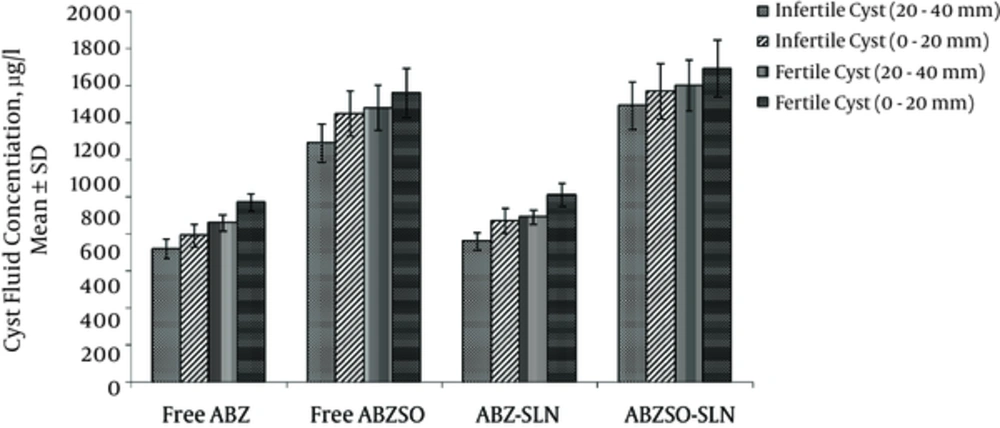
Figure 4.
Concentrations of ABZ and ABZSO in Different Groups of Fertile and Infertile Cysts over 48 hour (Mean ± SD)
5. Discussion
The management of hydatid disease is challenging, and problems in the treatment of this disease remain unresolved (37). The limitations in surgery indicate that medicinal treatment has frequently been employed alone or in combination with surgery for this disease (9, 38, 39). The challenge is to increase the effect of chemotherapy by increasing the drug concentrations in the cyst environment using suitable formulations (30, 31, 39). ABZ is a lipophilic anthelmintic drug for the treatment of echinococcosis in humans. Its active metabolite (ABZSO) has been shown to be an active anthelmintic agent (38). Poor solubility is the main problem in formulations of these compounds; only 10% to 20% of the drug in serum diffuses into the cyst layers. GI mucous behaves like a lipid barrier, and the absorption rate of compounds is based upon their degree of solubility (27, 28, 40). Nanoparticle drug delivery systems are currently employed to obtain a stable nano-suspension with increases in the drug solubility and dissolution rate (27, 28, 41, 42). Thus this in vitro comparative study was designed to improve the hydatid cyst membrane permeation by loading into SLNs. The micro-emulsification and high shear homogenization methods utilized for the preparation of SLNs in the current study have advantages, such as their simplicity, production of nanoparticles with small particle sizes, low PDI, and high EE. The results show that the average diameters of the nanoparticles were within the nano range of 163 to 179 nm. Previous studies on the mean size of particles have found larger sizes than those in the current study (31, 43). The mean particle size is considered to be the most important parameter for improved drug absorption and permeability. Particles with sizes of < 200 nm usually show increased stability and prolonged circulation; by contrast, particles with sizes of > 200 nm are rapidly eliminated by the reticule endothelial system and a low percentage could achieve the target site (44). The PDI was < 0.1 for both drug-loaded SLNs, indicating a very narrow size and mono-dispersed distribution. The zeta potential is the most important factor to affect the stability of the SLN formulations. The zeta potential values in the present study were -38.4 mV and - 46.8 mV for ABZ-SLN and ABZSO-SLN, respectively. These highly negative charges indicate the stability of SLN formulations. It was demonstrated that negative surface charges with high zeta potential induced by anionic surfactants increased SLN stability and decreased particle aggregation (31, 42). The results revealed high EE (~ 95%) for the formulations. Truong Cong et al. (31) prepared ABZ-loaded SLN with 36.4% ± 6.4% EE. The high EE observed in the present study has not been produced in previous studies using these drugs (31, 43). The method, lipid type, surfactant, and ratio of the drug to lipid used could have increased the results for these parameters (33, 45). The in vitro release behaviors of the free and nano formulations were compared in the present study. Both free drugs released about 90% within the first half hour. The drug release profiles for the SLNs were slower than for the free forms and showed a slow release pattern, so that only 38.6% and 32.1% of the drug was release in the first half hour from the ABZ-SLN and ABZSO-SLN, respectively. In spite of sustained drug release in SLN formulations, these formulations released their whole drug content within 24 hour. This is in agreement with the results of previous studies (27, 33, 46). Drug diffusion through the cyst layers was detected in all experimental groups by HPLC. An increase in the drug concentration in the cyst fluid was demonstrated in the groups treated with ABZ-SLN and ABZSO-SLN (P < 0.05) and was probably the result of the better permeability of the nano drugs. Truong Cong et al. (31) used a different methodology and showed that the diffusion of ABZ-SLN from the nanoparticles through the hydatid cyst layer was greater than for free ABZ. Ravichandran (27) reported an improvement using nanoparticles for the increased bioavailability of lipophilic drugs such as ABZ. It was suggested that nanoparticles increased the surface-to-mass ratios more than other particles, increasing the capacity to bind and transfer higher amounts of compounds (47-49). Greater permeability was observed in fertile cysts, even in conventional and nano forms. No data have been found comparing the permeability of drugs into fertile and infertile hydatid cysts. There are structural differences in the germinal layer between fertile and infertile hydatid cysts. This layer greatly affects the permeability of the cysts, and it has been suggested that this structural difference may affect the penetration rate of the drugs (10, 31). The present results show a significant correlation between the drug concentration and the size of cysts; smaller cysts showed better permeability for both formulations. Perez-Serrano et al. (50) also reported that BZD performed better protoscolicidal action on young protoscoleces than after they had developed cyst layers. It appears that the major factor affecting the permeability of the drugs is the thickness of the cyst layers; larger forms have thicker layers, which become a thick barrier. The current study compared the permeability of ABZ and ABZSO into hydatid cysts. The results indicate that ABZSO better diffuses into hydatid cysts than ABZ in both the free and nano forms. No study was found that compared the permeability of ABZ and ABZSO into hydatid cysts. Lanusse et al. (51) reported that ABZSO has greater solubility than other BZDs. It appears that the improved dissolution of drugs increases their diffusion. The results of this study show that ABZ and ABZSO achieved good physicochemical characterizations and controlled release by loading into SLNs. The in vitro permeability study revealed that ABZ-SLN and ABZSO-SLN could significantly enhance the penetration of ABZ and ABZSO into the hydatid cysts; there was also increased permeability into fertile cysts in both conventional and SLNs formulations and higher permeability into small cysts. The findings also demonstrate the increased permeability of ABZSO over ABZ. In conclusion, taken together, these results suggested that preparations containing ABZ and ABZSO-loaded nanoparticles are promising for the treatment of hydatidosis.