
1. Background
Methamphetamine (METH) use disorder is a chronic, relapsing condition associated with substantial neuropsychiatric, cognitive, and physical comorbidities, imposing a considerable burden on individuals, families, and healthcare systems worldwide (1, 2). According to the World Drug Report 2024, an estimated 30 million people used amphetamines, and the number of individuals with drug use disorders reached 64 million globally. Although agonist replacement therapies such as methadone are a cornerstone of treatment for opioid dependence, no pharmacologically equivalent intervention exists for METH use disorder (MUD) (3). Psychosocial interventions remain the mainstay of treatment; however, their efficacy is often limited by high rates of attrition and relapse, underscoring the urgent need for effective pharmacological adjuncts (4).
The clinical presentation of METH withdrawal is characterized by a cluster of symptoms, including depression, anxiety, anhedonia, fatigue, psychomotor retardation, and sleep disturbances, which can be severe and protracted (5, 6). These symptoms, particularly when coupled with intense drug craving, are major drivers of early relapse and treatment failure (7, 8). Furthermore, chronic METH use is known to induce neurotoxicity and oxidative stress, contributing to deficits in cognitive functions (e.g., attention, memory, and executive function) and exacerbating mood disorders such as anxiety and depression (9, 10). Therefore, interventions that can simultaneously alleviate withdrawal symptoms, reduce craving, and improve mood and cognitive function could substantially enhance treatment outcomes in this patient population.
Crocin (CRO), the primary bioactive constituent of saffron (Crocus sativus L.), has garnered increasing attention for its diverse pharmacological properties (11). This water-soluble carotenoid is responsible for the characteristic color of saffron and has potent antioxidant and anti-inflammatory effects, which are thought to underlie its neuroprotective capabilities (12, 13). A comprehensive meta-research review of saffron clinical studies published through 2021 confirmed that saffron significantly improves symptoms of depression, cognitive function, and sexual dysfunction compared with controls, with common side effects (e.g., dry mouth, nausea, poor appetite, and headache) but no serious adverse reactions reported (11). Emerging evidence also suggests that CRO may modulate several neurotransmitter systems implicated in addiction and mood regulation, including the glutamatergic, dopaminergic, and serotonergic systems (14, 15). Preclinical studies have demonstrated that saffron administration attenuates morphine-induced conditioned place preference (CPP) and reduces withdrawal symptoms in morphine-dependent animals, suggesting a potential role in modulating reward pathways and withdrawal processes (16). Additionally, CRO has been shown to exert antidepressant and anxiolytic effects in both animal models and human trials for major depressive disorder (17, 18). Recent research has further shown that CRO administration may protect against substance-induced neurotoxicity through its antioxidant properties and modulation of inflammatory pathways (19, 20). A recent overview of systematic reviews confirmed that saffron is beneficial, safe, and tolerable in treating neurological and psychiatric disorders (e.g., depression, anxiety, and cognitive disorders). In addition, studies have explored the therapeutic implications of CRO in specific neurodegenerative conditions such as Parkinson's disease (21) and its general properties as a bioactive biomolecule (14). Furthermore, investigations into the neuropsychotropic effects of CRO have provided comprehensive evidence for its clinical efficacy in neurological and psychiatric disorders. These properties position CRO as a promising candidate for managing the multifaceted sequelae of METH dependence.
Clinical evidence specifically examining the effects of CRO in substance-dependent populations has emerged in recent years. A trial by Abbaszadeh-Mashkani et al. (22) demonstrated that CRO supplementation (30 mg/day for 12 weeks) significantly improved craving and withdrawal symptoms in opioid-dependent patients (ODP) undergoing MMT, although no effects on cognitive function were observed. Another randomized clinical trial by Ghaderi et al. (23) examined clinical and metabolic responses to CRO in patients under MMT and reported significant improvements in various clinical parameters. Furthermore, a clinical trial by Mahdavi et al. (24) investigated oral supplementation with CRO in cigarette smokers and demonstrated beneficial effects on inflammatory markers and oxidative stress. However, conflicting findings have been reported, as another clinical trial found no significant benefits of CRO on withdrawal symptoms, craving, or psychological parameters in opioid users during detoxification (25). A study by Khalatbari-Mohseni et al. (26) examined the effects of CRO on psychological parameters in patients under MMT, suggesting potential benefits for depression and anxiety. These mixed findings highlight the need for further rigorous research, particularly in populations with stimulant use disorders.
2. Objectives
To date, clinical research on the efficacy of CRO specifically in individuals with MUD remains limited. Given its neuroprotective, mood-enhancing, and potential anti-craving properties, we hypothesized that CRO supplementation would ameliorate withdrawal syndrome, reduce cravings, and improve associated psychological and cognitive symptoms in this population. Accordingly, this trial was designed to evaluate the effect of CRO supplementation on clinical symptoms (withdrawal and craving), psychological indicators (anxiety, depression, and stress), sleep quality, sexual function, and cognitive performance in METH-dependent patients undergoing MMT.
3. Methods
3.1. Study Design
This clinical trial was conducted at the Substance Abuse Center of Kashan University of Medical Sciences (KAUMS), Iran, and included 80 eligible patients undergoing methadone maintenance therapy (MMT) with comorbid methamphetamine use disorder (MUD). Diagnosis and eligibility were confirmed by a multidisciplinary team comprising a senior research psychiatrist, an addiction specialist, a psychologist, a pharmacologist, and a cardiologist. The study protocol received ethical approval from the Ethics Committee of KAUMS (Approval number: IR.KAUMS.MEDNT.REC.1403.237; Date: February 16, 2025) and was prospectively registered with the Iranian Registry of Clinical Trials (Registration number: IRCT20250221064794N1; Date: February 25, 2025). Sampling began on April 5, 2025, and ended on August 7, 2025 (https://en.irct.ir/trial/82048). All study procedures complied with the ethical standards set forth in the Declaration of Helsinki, and written informed consent was obtained from each participant before enrollment.
Participants (Inclusion/Exclusion criteria): Eligible participants were adult males aged 25 - 55 years with a confirmed diagnosis of MUD according to DSM-5 criteria and a documented history of METH use (Patients using METH and amphetamine; test positive for METH) who were seeking treatment. Inclusion required medical stability and written informed consent. Exclusion criteria were unwillingness to cooperate; psychiatric disorders, including psychotic and bipolar disorders; suicide attempts; consumption of CRO, anti-inflammatory, and antioxidant supplements during the last 3 months; warfarin use; high blood pressure and thyroid disease; a positive urine test for cannabis; and allergy to the study supplement or reports of side effects from taking the medication during the trial.
3.2. Sample Size
Sample size was calculated based on the change scores of the DDQ from a previous randomized controlled trial (22). The mean change in craving was −0.3 ± 3.6 in the placebo group and −2.9 ± 5.3 in the intervention group. The between-group difference (Δ) was 2.6, and the pooled standard deviation was 4.53. Using the formula for comparing two independent means, with α = 0.05 and power = 80%, the required sample size was estimated at 48 participants per group. However, given the number of participants who did not meet the inclusion criteria and the recruitment barriers encountered, the final analysis was conducted with 40 participants in each group.
3.3. Randomization, Blinding, and Intervention
In this clinical trial, participants were recruited using convenience sampling. Eligible individuals were randomly assigned to one of two study groups using balanced block randomization with a block length of four and a 1:1 allocation ratio, generated using Epi Info software. This method ensured an even distribution of participants between the CRO and placebo groups while reducing the potential for selection bias. To maintain blinding, placebo tablets were formulated to match the CRO tablets exactly in dimensions, shape, visual characteristics, flavor, and consistency. The study employed a double-blind design; neither participants nor researchers were informed of group assignments until the conclusion of the trial. Study medications were supplied in opaque, uniformly labeled containers (designated A for the CRO group and B for the placebo group), and the allocation key was known only to the pharmacist responsible for preparation. Throughout the study, a quality assurance protocol was implemented to preserve the integrity of the randomization process and blinding procedures. Participants in the intervention arm received CRO tablets at a dosage of 15 mg twice daily (Total 30 mg/day) for eight consecutive weeks, whereas those in the control arm received matching placebo tablets over the same period. All participants continued their standard methadone maintenance therapy without any changes during the study. To promote adherence, each participant received a weekly text message via mobile phone. The CRO and placebo tablets were supplied by Pooyesh Darou Sina Company (Mashhad, Iran). CRO was extracted from saffron stigmas and crystallized according to a previously published protocol. Both CRO and placebo were formulated as film-coated tablets, each containing either 15 mg of CRO or placebo. In this study, the purity of CRO exceeded 95%, and the primary excipient used in the CRO tablets was Avicel.
3.4. Safety Reporting
CRO has a favorable safety profile and is not associated with significant adverse effects. To date, no published study has investigated the effects of CRO supplementation in individuals who use METH. The dosage selected for the present study was determined based on findings from prior research (conducted on patients with diabetic maculopathy) and the compound’s acceptable safety profile (27). In this trial, safety assessments were conducted monthly, during which the following potential side effects of CRO were systematically queried: Nausea, vomiting, sleep disturbances, dizziness, tremor, edema of the feet, increased appetite, abdominal pain, restlessness, and ocular redness and burning. Notably, only mild adverse events were reported.
3.5. Outcome Measures
3.5.1. Primary Outcomes
Withdrawal Symptoms: The Amphetamine Withdrawal Questionnaire (AWQ) is a brief, validated, and reliable instrument designed to evaluate the severity of withdrawal symptoms associated with amphetamine use. The total possible score on the AWQ ranges from 0 to 40, with higher scores reflecting more severe withdrawal. Each item on the questionnaire is rated on a five-point scale as follows: 1) not at all; 2) very little; 3) a little; 4) quite a lot; 5) very much (28).
Craving Intensity: The Drug Desire Questionnaire (DDQ) is a 13-item instrument that assesses three primary components of craving: desire and intention to use drugs (Items 1, 2, 4, 6, 10, 13, and 14), negative reinforcement (Items 5, 9, 11, and 12), and perceived control over drug use (Items 3 and 8). Respondents rate each item on a seven-point Likert scale based on their immediate thoughts or feelings at the time of administration. Response options are as follows: 1) not at all; 2) mild; 3) mild to moderate; 4) moderate; 5) moderate to severe; 6) severe; and 7) approximately complete.
3.6. Secondary Outcomes
Sleep Quality: The Pittsburgh Sleep Quality Index (PSQI) is a practical assessment tool designed to evaluate both the quality and pattern of sleep in adult populations (29). Sleep quality was evaluated using the 19-item PSQI, which assesses seven distinct dimensions of sleep. The validity and reliability of the Persian adaptation of the PSQI were confirmed by Farrahi and colleagues (30). This instrument encompasses seven components: subjective sleep quality, sleep latency, sleep duration, habitual sleep efficiency, sleep disturbances, use of sleep medication, and daytime dysfunction. Total scores on the index range from 0 to 21, with higher scores reflecting poorer sleep quality. The assessment was administered at baseline and at the conclusion of the study.
Sexual Function: The International Index of Erectile Function (IIEF) is a 15-item instrument designed to assess various domains of male sexual function. The questionnaire evaluates five distinct dimensions: sexual desire, orgasmic function, erectile function, sexual satisfaction, and overall satisfaction. The total possible score ranges from 0 to 75, with higher scores indicating better sexual functioning. According to the scoring classification, scores between 0 and 10 reflect severe sexual dysfunction; scores of 11 to 16 indicate moderate dysfunction; scores of 17 to 21 denote mild to moderate dysfunction; scores of 22 to 25 correspond to mild dysfunction; and scores of 26 to 30 represent normal sexual function (31).
Cognitive Performance: The Cognitive Abilities Questionnaire (CAQ) was developed to evaluate seven distinct cognitive domains: Memory, selective attention and inhibitory control, decision-making, planning, sustained attention, social cognition, and cognitive flexibility. The instrument comprises 30 items, with each subscale containing between five and seven questions. Responses are recorded on a five-point Likert scale ranging from "almost never" (score of 1) to "almost always" (score of 5), yielding a total possible score between 30 and 150. Higher scores on the CAQ reflect greater impairments in cognitive abilities. The questionnaire demonstrated a Cronbach's alpha coefficient of 0.83, indicating acceptable internal consistency. Overall, the CAQ exhibits desirable validity and reliability for assessing cognitive functioning.
Psychological Status: Levels of depression, anxiety, and stress were measured using the 21-item Depression Anxiety Stress Scale (DASS-21). The psychometric properties (e.g., validity and reliability) of this instrument were established by Sahebi and colleagues. Each of the three subscales consists of seven items, with individual items rated on a scale from 0 to 3. Higher scores on any given subscale reflect more severe levels of depression, anxiety, or stress, respectively.
All evaluations were conducted at two time points: baseline (Week 0) and following the eight-week intervention period (Week 8). Assessments were administered by trained interviewers using structured interviews, and the evaluators remained blinded to participant group assignments throughout the study.
Statistical analyses
The Shapiro–Wilk test was used to assess the normality of continuous variables. Baseline characteristics were compared between the CRO and placebo groups using independent-samples t tests for continuous variables and chi-square tests for categorical variables. To evaluate the effects of the interventions, separate analyses of covariance (ANCOVA) were conducted for each outcome. All analyses were conducted according to the intention-to-treat (ITT) principle. Missing outcome data were handled using the last-observation-carried-forward (LOCF) method, and all randomized participants were included in the analyses. To control the family-wise error rate associated with multiple comparisons, p values were adjusted using the Holm–Bonferroni procedure across all primary and secondary outcomes. Both unadjusted and adjusted p values are reported. Effect sizes were expressed as partial eta squared (η2p), with values of approximately 0.01, 0.06, and 0.14 representing small, medium, and large effects, respectively (32). Statistical significance was defined as a two-sided p value < 0.05. All statistical analyses were performed using SPSS software (version 21.0; IBM Corp., Armonk, NY, USA).
4. Results
Participant Flow and Baseline Characteristics: Initially, 80 METH-dependent patients undergoing MMT who met the eligibility criteria were enrolled and randomly assigned to either the CRO group (n = 40) or the placebo group (n = 40). In the CRO arm, six participants were excluded from the final analysis because of relocation to another city (n = 1) or voluntary withdrawal from the intervention for personal reasons (n = 5). In the placebo arm, three participants discontinued the study because of personal circumstances. Missing values were handled using the last-observation-carried-forward technique. The ITT protocol was applied to all randomized individuals and all parameters. A flow diagram illustrating participant disposition throughout the study is provided in Figure 1. The baseline demographic and clinical characteristics of the study participants are summarized in Table 1.
Table 1.
Baseline Demographic and Clinical Characteristics of Participants a
| Variables | Placebo (n = 40) | CRO (n = 40) | P-Value |
|---|---|---|---|
| Age (y) | 42.50 ± 4.57 | 42.17 ± 4.24 | 0.743 b |
| Duration of addiction (y) | 22.50 ± 4.72 | 22.30 ± 5.02 | 0.855 b |
| Duration of smoking (y) | 24.15 ± 4.58 | 24.47 ± 4.56 | 0.752 b |
| Duration of methadone use (y) | 6.22 ± 1.70 | 5.85 ± 2.04 | 0.375 b |
| Methadone dose (mL/d) | 25.50 ± 9.79 | 28.15 ± 10.17 | 0.239 b |
| Duration of METH use (y) | 2.00 ± 0.87 | 2.07 ± 0.79 | 0.690 b |
| METH dose (g/wk) | 0.83 ± 0.61 | 0.96 ± 0.68 | 0.395 b |
| Education | 0.747 c | ||
| Primary | 11 (27.5) | 11 (27.5) | |
| Secondary | 11 (27.5) | 14 (35) | |
| Diploma | 17 (42.5) | 13 (32.5) | |
| University | 1 (2.5) | 2 (5) | |
| Marital status | 0.649 c | ||
| Single | 13 (32.5) | 10 (25) | |
| Married | 19 (47.5) | 19 (47.5) | |
| Widowed/Divorced | 8 (20) | 11 (27.5) | |
| Job status | 0.494 c | ||
| Unemployed | 18 (45) | 14 (35) | |
| Employed | 0 (0.0) | 1 (2.5) | |
| Self-employed | 22 (55) | 25 (62.5) | |
| Other medications | 0.908 c | ||
| Antidepressants | 1 (2.5) | 1 (2.5) | |
| Hypnotics and sedatives | 7 (17.5) | 5 (12.5) | |
| Other drugs | 2 (5) | 3 (7.5) | |
| None | 30 (75) | 31 (77.5) | |
| History of withdrawal attempts (times) | 0.014 c | ||
| None / One | 0 (0.0) | 0 (0.0) | |
| Two | 13 (32.5) | 4 (10) | |
| Three | 8 (20) | 5 (12.5) | |
| Four | 9 (22.5) | 8 (20) | |
| Five or more | 10 (25) | 23 (57.5) | |
| Hallucinations and delusions | 0.260 c | ||
| Yes | 25 (62.5) | 20 (50.0) | |
| No | 15 (37.5) | 20 (50.0) | |
| Weight loss | 0.775 c | ||
| Yes | 32 (80) | 33 (82.5) | |
| No | 8 (20) | 7 (17.5) | |
| Side effects | 0.708 c | ||
| Dizziness | 0 (0.0) | 1 (2.5) | |
| Nausea and vomiting | 2 (5) | 2 (5) | |
| Restlessness | 0 (0.0) | 1 (2.5) | |
| None | 38 (95) | 36 (90) |
a Values are expressed as mean ± SD or No. (%)
b Based on independent t-test
c Based on Pearson Chi-square test
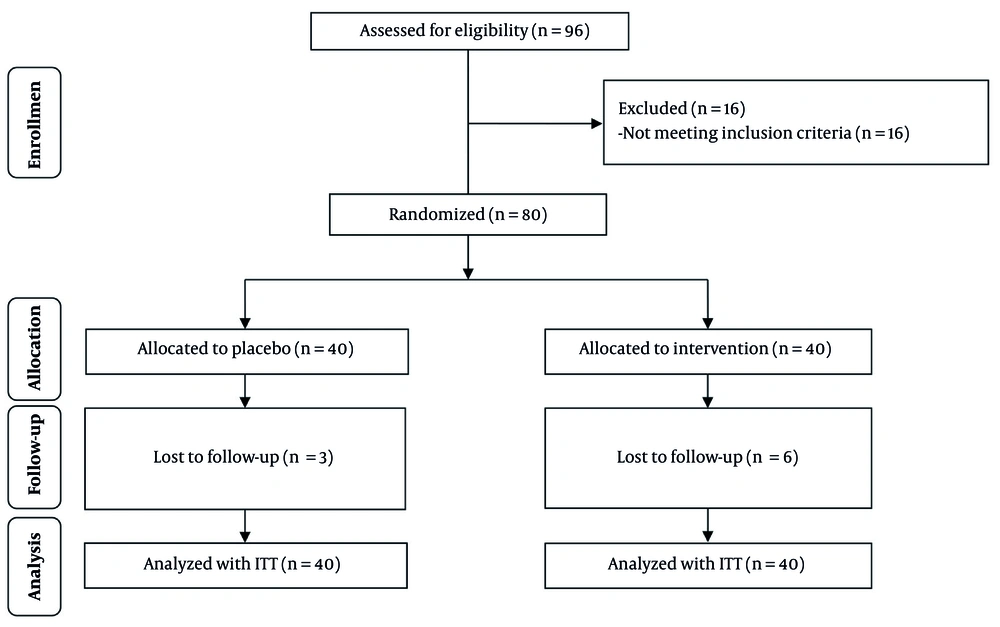
Figure 1.
Diagram of how patients are examined in a trial
4.1. Primary Outcomes
Changes in withdrawal symptoms and craving from baseline to post-intervention are presented in Table 2 and Figure 2. After 8 weeks of intervention, participants receiving CRO showed a greater reduction in withdrawal symptoms than the placebo group (−0.67 ± 1.04 vs. −0.07 ± 0.82; Holm-adjusted P = 0.036), with a medium effect size (η2p = 0.091). Similarly, the reduction in craving was significantly greater in the CRO group than in the placebo group (−0.60 ± 1.03 vs. 0.10 ± 0.95; Holm-adjusted P = 0.024), corresponding to a medium effect size (η2p = 0.110).
Table 2.
Changes in Withdrawal Symptoms and Craving in METH Users a
| Variables | Placebo (n = 40) | CRO (n = 40) | P (Unadjusted) | P (Holm-Adjusted) | ES (η²p) | ||||
|---|---|---|---|---|---|---|---|---|---|
| Baseline | End of Trial | Change b | Baseline | End of Trial | Change b | ||||
| Withdrawal symptoms (AWQ) | 28.67 ± 4.29 | 28.60 ± 4.61 | -0.07 ± 0.82 | 28.12 ± 3.53 | 27.45 ± 3.66 | -0.67 ± 1.04 | 0.009 | 0.036 | 0.091 |
| Craving (DDQ) | 30.65 ± 6.86 | 30.75 ± 7.00 | 0.10 ± 0.95 | 29.02 ± 6.71 | 28.42 ± 6.61 | -0.60 ± 1.03 | 0.004 | 0.024 | 0.110 |
a Values are expressed as mean ± SD. Obtained from ANCOVA; (Adjusted for baseline values, age, duration of methadone use, methadone dose, duration of METH use, and METH dose).
b Calculated change from baseline to end of trial.
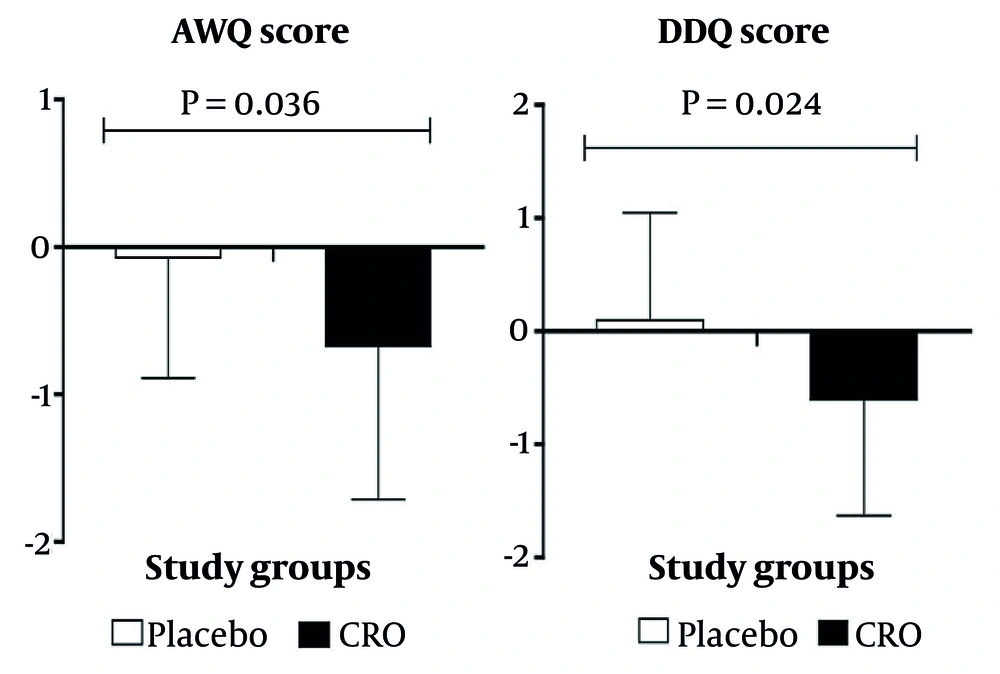
Figure 2.
Changes in withdrawal symptoms and craving
4.2. Secondary Outcomes
Changes in sleep quality, sexual function, and cognitive function are presented in Table 3 and Figure 3. After 8 weeks of intervention, participants receiving CRO showed a greater improvement in sleep quality than those receiving placebo (−0.62 ± 0.80 vs. −0.17 ± 0.54; Holm-adjusted P = 0.025), with a medium effect size (η2p = 0.103). No significant between-group differences were observed for sexual function (−0.22 ± 0.99 vs. 0.10 ± 1.08; Holm-adjusted P = 0.294; η2p = 0.029) or cognitive function (−0.42 ± 1.81 vs. 0.00 ± 1.08; Holm-adjusted P = 0.150; η2p = 0.029), both corresponding to small effect sizes.
Table 3.
Changes in Sleep Quality, Sexual Function, and Cognitive Function in METH Users a
| Variables | Placebo (n = 40) | CRO (n = 40) | P (Unadjusted) | P (Holm-Adjusted) | ES (η²p) | ||||
|---|---|---|---|---|---|---|---|---|---|
| Baseline | End of Trial | Change b | Baseline | End of Trial | Change b | ||||
| Sleep Quality (PSQI) | 4.67 ± 1.30 | 4.50 ± 1.41 | -0.17 ± 0.54 | 4.60 ± 1.05 | 3.97 ± 1.07 | -0.62 ± 0.80 | 0.005 | 0.025 | 0.103 |
| Sexual Function (IIEF) | 35.62 ± 7.57 | 35.72 ± 7.33 | 0.10 ± 1.08 | 35.50 ± 6.44 | 35.27 ± 6.32 | -0.22 ± 0.99 | 0.147 | 0.294 | 0.029 |
| Cognitive Function (CAQ) | 86.42 ± 11.26 | 86.42 ± 11.20 | 0.00 ± 1.08 | 84.37 ± 11.02 | 83.95 ± 11.27 | -0.42 ± 1.81 | 0.150 | 0.150 | 0.029 |
a Values are expressed as mean ± SD. Obtained from ANCOVA; (Adjusted for baseline values, age, duration of methadone use, methadone dose, duration of METH use, and METH dose).
b Calculated change from baseline to end of trial.
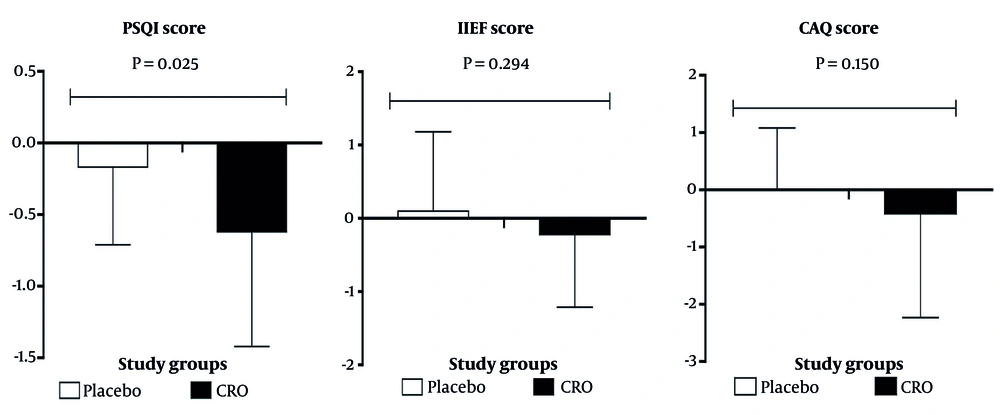
Figure 3.
Changes in sleep quality, sexual function, and cognitive function
Changes in anxiety, depression, and stress scores are presented in Table 4 and Figure 4. Compared with placebo, the CRO group showed significantly greater reductions in anxiety (−1.20 ± 1.62 vs. 0.02 ± 1.40; Holm-adjusted P < 0.008) and depression (−1.17 ± 1.59 vs. −0.20 ± 1.34; Holm-adjusted P = 0.014), with large (η2p = 0.157) and medium (η2p = 0.126) effect sizes, respectively. There was no significant effect of CRO administration on stress scores (−0.95 ± 1.67 vs. −0.10 ± 1.27; Holm-adjusted P = 0.054; η2p = 0.075) compared with the placebo group.
Table 4.
Changes in Anxiety, Depression, and Stress in METH Users a
| Variables | Placebo (n = 40) | CRO (n = 40) | P (Unadjusted) | P (Holm-Adjusted) | ES (η²p) | ||||
|---|---|---|---|---|---|---|---|---|---|
| Baseline | End of Trial | Change b | Baseline | End of Trial | Change b | ||||
| Anxiety | 18.22 ± 5.90 | 18.25 ± 5.99 | 0.02 ± 1.40 | 17.65 ± 4.74 | 16.45 ± 4.42 | -1.20 ± 1.62 | < 0.001 | < 0.008 | 0.157 |
| Depression | 17.90 ± 4.96 | 17.70 ± 4.84 | -0.20 ± 1.34 | 17.35 ± 4.62 | 16.17 ± 4.38 | -1.17 ± 1.59 | 0.002 | 0.014 | 0.126 |
| Stress | 22.75 ± 6.08 | 22.65 ± 6.06 | -0.10 ± 1.27 | 22.25 ± 5.32 | 21.30 ± 5.15 | -0.95 ± 1.67 | 0.018 | 0.054 | 0.075 |
a Values are expressed as mean ± SD. Obtained from ANCOVA; (Adjusted for baseline values, age, duration of methadone use, methadone dose, duration of METH use, and METH dose).
b Calculated change from baseline to end of trial.
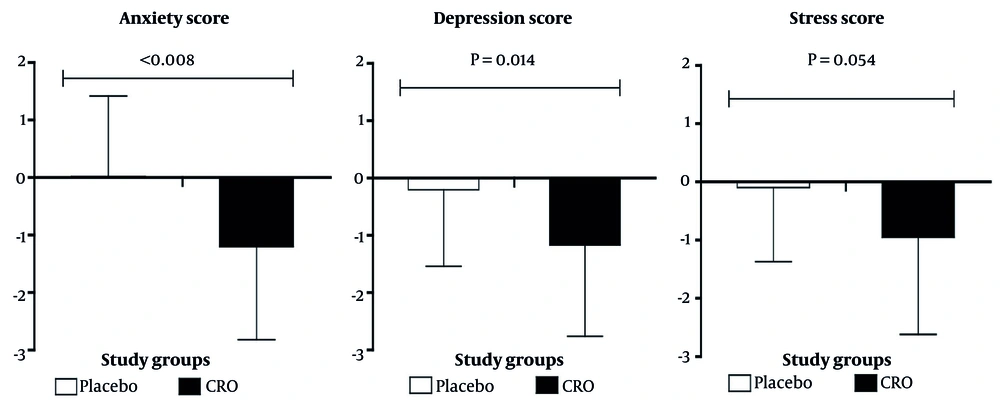
Figure 4.
Changes in anxiety, depression, and stress
5. Discussion
The present trial provides evidence that CRO supplementation, administered as an adjunct to MMT, significantly reduces withdrawal symptoms, craving, sleep disturbance, and psychological distress (anxiety and depression) in METH-dependent patients. These findings are consistent with, and extend, the growing body of literature supporting the therapeutic role of CRO in substance use disorders, while representing one of the first trials to examine this intervention specifically in an METH-using population.
The observed reduction in withdrawal symptoms is mechanistically coherent with the known neuroprotective and anti-inflammatory properties of CRO. Chronic METH use is linked to oxidative stress, neuroinflammation, and sustained dysregulation of dopaminergic pathways, all of which contribute to withdrawal-related neurobiological disruption and subjective discomfort (33-35). As a potent antioxidant carotenoid, CRO may attenuate these perturbations by scavenging reactive oxygen species (ROS) and modulating pro-inflammatory mediators [e.g., tumor necrosis factor-alpha (TNF-α) and interleukin-6 (IL-6)] (36, 37). Analogous improvements have been reported in studies of ODP, in which CRO supplementation reduced withdrawal severity and enhanced general well-being (22, 38). Although the neurobiological substrates of METH and opioid withdrawal differ in important respects, both involve shared mechanisms of oxidative stress and neuroinflammation, which may account for the parallel therapeutic effects observed across these populations.
Craving reduction represents another salient finding of this trial. METH craving is fundamentally linked to dopaminergic dysregulation in the mesolimbic system, glutamatergic imbalance in corticostriatal circuits, and heightened HPA-axis stress reactivity (39). CRO has been demonstrated to modulate dopaminergic neurotransmission and exert anxiolytic effects via serotonergic and glutamatergic pathways, which may indirectly attenuate cue-induced and stress-induced craving (14, 40). These neurochemical effects, combined with the capacity of CRO to reduce psychological distress, may create a reinforcing cycle that supports sustained engagement with treatment and reduces relapse vulnerability.
Improvements in anxiety and depression were among the most robust findings of the present trial. However, although the effect on stress approached significance, it did not reach the conventional threshold. MUD is strongly associated with mood dysregulation, heightened stress sensitivity, and impaired emotional processing as consequences of prolonged disruption of monoaminergic neurotransmission (10, 41). The antidepressant and anxiolytic effects of CRO are well documented in preclinical and clinical studies, with proposed mechanisms (e.g., inhibition of serotonin reuptake, modulation of NMDA receptor activity, and attenuation of oxidative stress) in limbic structures (17, 42, 43). These findings are consistent with clinical trials in ODP in which CRO produced comparable psychological benefits (22, 26, 38), suggesting that its mood-enhancing properties may generalize across different substance-using groups and support its potential as a complementary pharmacological agent for addressing the psychological burden of stimulant dependence.
The significant improvement in sleep quality aligns with the established effects of CRO on sleep architecture, including modulation of GABA-A receptors and regulation of circadian rhythm-related pathways (2, 44). Sleep disturbance is a cardinal feature of METH withdrawal that profoundly impairs quality of life and substantially increases relapse risk (45); therefore, the beneficial effects of CRO on sleep represent a clinically meaningful therapeutic target in this population.
In contrast to its effects on psychological and withdrawal-related outcomes, CRO did not significantly improve cognitive performance over the 8-week study period. METH-related cognitive deficits, particularly in the domains of attention, working memory, and executive function, are typically severe, reflect structural and functional neuronal injury, and may require longer treatment durations to demonstrate measurable improvement (46, 47). Additionally, the cognitive effects of CRO may be more modest in magnitude than its psychological effects (48), necessitating larger sample sizes or more sensitive and ecologically valid neurocognitive assessment instruments for detection. Cognitive impairments associated with chronic METH exposure may also be less amenable to antioxidant monotherapy alone, potentially requiring multimodal interventions incorporating cognitive rehabilitation, aerobic exercise, or neurostimulation approaches. Studies in ODP have similarly shown inconsistent effects of CRO on cognition (22, 25, 26, 38), further supporting the notion that its cognitive impact may be limited, context-dependent, or require extended administration.
The absence of a significant effect on sexual function is likewise consistent with the complexity of sexual dysfunction in this population. Sexual dysfunction in METH users is a multifactorial condition influenced by neurochemical alterations, comorbid psychological distress, and the well-documented adverse effects of methadone on sexual function and hormone levels (49). Although CRO has demonstrated benefits for sexual function in other clinical populations, most notably in individuals with antidepressant-induced sexual dysfunction, the multifactorial etiology of dysfunction in METH-MMT patients may limit the efficacy of antioxidant supplementation alone. Notably, psychological interventions such as matrix intervention and emotion regulation training have been shown to improve social cognition and emotional recognition in this population, highlighting the potential value of integrating psychosocial approaches. In addition, adjuvant interventions such as nano-curcumin, which significantly reduced psychotic symptoms and craving in subjects with methamphetamine-induced psychosis, could be explored as adjunctive treatments (50). Longer treatment durations, higher doses, or targeted combination approaches may be required to achieve clinically meaningful improvements in this domain.
However, certain limitations warrant acknowledgment. The first limitation is the absence of a Statistical Analysis Plan (SAP), meaning that all secondary outcome analyses are exploratory and the risk of type I error due to multiple comparisons cannot be excluded. The sample size, though adequate for detecting primary outcomes, was modest and may have been insufficient to detect smaller effects on secondary outcomes such as cognition and sexual function. The 8-week study duration may have been too short to capture the full cognitive benefits of CRO, given the chronicity and severity of METH-related neurological damage. The study was restricted to male participants, which inherently limits the generalizability of the findings to female populations. Additionally, no repeated urine drug screens were conducted to objectively verify METH use status during the trial, and the exclusive reliance on self-report outcome measures introduces the possibility of response bias, a limitation that should be addressed in future studies. In addition, medication adherence was not objectively verified. No pill counts, medication diaries, or plasma CRO measurements were performed. Reliance on self-reported adherence (via text message reminders and clinic inquiries) may have introduced bias, as patients overestimated or misreported their true CRO intake. The high prevalence of polysubstance use in this population, despite verification efforts, makes it difficult to entirely isolate the neurological effects of METH from those of other substances. Long-term follow-up data are unavailable, precluding assessment of the durability of observed treatment effects. Detailed assessment of polysubstance use severity and systematic recording of all concurrent psychiatric medications were not among the primary objectives of this trial, and unmeasured confounding cannot be entirely excluded. Finally, the sample size (n = 40 per group) was below the a priori calculated requirement (n = 48 per group) due to recruitment challenges inherent to this hard-to-reach population. While post-hoc power analysis confirmed adequate power (≥ 80%) for detecting the observed effects on primary outcomes, the study was likely underpowered for secondary outcomes with small effect sizes, particularly cognitive and sexual function. This underpowering may have contributed to the non-significant findings in these domains and should be considered when interpreting the results. Future studies with larger samples are warranted to confirm these findings and explore smaller effect sizes.
Future studies should incorporate several methodological enhancements, including longer follow-up periods, dose-optimization paradigms, and the inclusion of female participants. Given the multifaceted nature of METH-induced neuropsychiatric sequelae, future investigations should not only explore the potential of other pharmacological agents, such as mirtazapine, in mitigating craving and dependence (51), but also examine the role of natural antioxidants such as ginseng in modulating oxidative stress biomarkers (52). Moreover, comprehensive assessments should address polysubstance use severity, precise patterns of METH use, and concurrent psychiatric medications. To ensure multimodal outcome evaluation, it is recommended that future research employ objective neuroimaging biomarkers, urinary markers, sexual hormone levels, inflammatory markers, oxidative stress indices, blood concentrations of CRO metabolites, and performance-based neuropsychological tests such as the Trail Making Test, Stroop test, and digit span task. The integration of CRO with cognitive rehabilitation or other neuroprotective strategies may represent a promising avenue for addressing the cognitive sequelae of MUD. Furthermore, subsequent investigations should prioritize determining minimal clinically important difference (MCID) thresholds that are specifically tailored to distinct populations. It is also essential to evaluate whether extended treatment durations or escalated doses of CRO yield larger effect sizes that approach or meet clinically relevant benchmarks. Additionally, we concur that future trials with adequately powered sample sizes should systematically examine the history of withdrawal attempts, either as a moderator or a covariate, given its potential influence on craving, relapse risk, and overall treatment responsiveness. Finally, to strengthen confirmatory inferences, future studies are strongly advised to pre-register their statistical analysis plans (SAPs) prior to data collection.
5.1. Conclusions
This trial demonstrated that 8 weeks of CRO supplementation led to statistically significant improvements in withdrawal symptoms, craving, sleep disturbance, and psychological distress (anxiety and depression) in METH-dependent patients undergoing MMT. While these findings support the potential safety and limited efficacy of CRO as an adjunctive agent, the absence of clinically meaningful changes, particularly in cognitive function, sexual function, and stress, highlights the need for cautious interpretation. We acknowledge that our previous conclusion may have overstated the clinical significance of the findings. Future studies should prioritize the establishment of population-specific MCIDs and employ extended treatment durations, objective biomarkers, and more comprehensive neurocognitive assessments.