1. Background
Plants play an essential role in the everyday needs of human life. They are used as food, cosmetics, flavors, medicines, and ornaments (1). Medicinal plants because of their potential health effects have become part of complementary medicine worldwide (2). Various plant extracts have been widely used for therapeutic purposes, including battling infectious diseases (3). Verbascum L. is a member of the family Scrophulariaceae represented by 5,100 species, all of which are grown in temperate and tropical areas (4). The genus Verbascum comprises 360 species (5). Scrophulariaceae are a source of saponins, monoterpene glycosides, iridoids, phenylethanoid glycosides, neolignan glycosides, flavonoids, steroids, spermine alkaloids, phenolic acids, and fatty acids (6). Plants within the genus of Verbascum have beneficial therapeutic effects and are employed in traditional medicine. It is reported that the leaves and flowers of Verbascum show mucolytic and expectorant effects and are utilized to treat respiratory diseases such as dry cough, bronchitis, tuberculosis, and asthma in traditional medicine. Also, these plants are drawn upon to treat superficial fungal infections, rheumatic pain, hemorrhoids, diarrhea, and wounds. It is also reported that these plants have inhibitory effects against influenza viruses A2 and B and murine lymphocytic leukemia (7). In Asia, Europe, and Northern America, several Verbascum species have been indicated as having antioxidant, narcotic, antiseptic, emollient, astringent, expectorant, sedative, and diuretic properties; moreover, they are used as a treatment for inflammations, tumors, and migraine (8). The ever-increasing resistance of human pathogens to the available antimicrobial agents is a serious threat, resulting in an urgent need for novel antibiotic resources such as plants (9). Some species of the genus Verbascum have been used by mankind since ancient times to treat internal and external infections. The genus Verbascum has been tested for antimicrobial and antifungal activity; however, the results have revealed that the extracts of the different species of the genus Verbascum do not exhibit similar antimicrobial effects against different kinds of bacteria and fungi (10).
2. Objectives
The aim of the present study was to compare the efficacy of the methanol, ethanol, and aqueous extracts of Verbascum thapsus against Streptococcus pyogenes (S. pyogenes), Escherichia coli (E. coli), Staphylococcus aureus (S. aureus), Candida albicans (C. albicans), and Aspergillus fumigatus (A. fumigatus) via the disk diffusion method and determination of minimal inhibitory concentration (MIC) values.
3. Materials and Methods
3.1. Collection, Identification, and Preparation of the Plant Material
Aerial parts of V. thapsus were collected from the suburbs of Arak, Markazi Province, center of Iran, and identified by the Research Center of Agriculture and Natural Resources of Sari, Mazandaran, Iran. A voucher specimen (Herbarium No. 448) was deposited at the herbarium of the Research Center of Agriculture and Natural Resources of Sari, Mazandaran. The collected plant material was dried in the shade, and the leaves were separated from the stem and ground in a grinder with a 2-mm diameter mesh. The aqueous extract of V. thapsus was obtained by blending 10 g of V. thapsus powder in 100 mL of boiling sterile distilled water, centrifuged at 5,000 rpm, and sterilized by filtration (0.45 μm). The aqueous extract was concentrated in vacuum at 40°C using a rotary evaporator. The residues obtained were stored at 4°C. The methanol extract of V. thapsus was prepared by taking 10 g of V. thapsus powder in Soxhlet extraction with methanol (3X) for 6 hours. Then, the methanol was evaporated under vacuum, and the residue was dissolved in dimethyl sulfoxide (DMSO) to give a concentration of 100 mg mL-1. The ethanol extract of V. thapsus was obtained by blending 10 g of V. thapsus powder with 50% ethanol (3X) at 50°C. The ethanol was evaporated under vacuum, and the residue was dissolved in DMSO to give a concentration of 100 mg mL-1. For the isolation of essential oil, 100 g of V. thapsus powder was hydrodistillated in a Clevenger-type apparatus for 3 hours. The oil was dried over anhydrous sodium sulfate and kept at 4°C in a sealed brown vial (10).
3.2. Antimicrobial Assay
E. coli ACCT 25922, S. aureus ACCT 1112, S. pyogenes PTTC 1447, C. albicans ATCC 10231, and A. fumigatus ATCC 26606 were obtained from the Industrial Research and Training Center of Iran to examine the antimicrobial activity of V. thapsus.
The disk diffusion method with a 6-mm filter paper disk (Roshd Research Laboratory, Iran) was used for the screening of antibacterial and antifungal activities (11). The bacterial and fungal strains were respectively tested on Müller-Hinton and Sabouraud dextrose agars. Sterilized paper disks were loaded with different amounts of V. thapsus extracts (ethanol, methanol, and water) and oil (100, 200, 300, and 400 μg, respectively) and then placed on the inoculated agars. Antimicrobial tests by the disc diffusion method were carried out using 100μL of suspension containing 108 CFU/mL of the microorganisms. All the plates were incubated at 37°C for 24 hours for bacteria; at 25°C for 24 hours for C. albicans; and at 29°C for 2 days for A. fumigatus. Inhibition zone diameters were measured after a conventional incubation period. Gentamicin (10 μL) and nystatin (10 μL) (obtained from Sigma) were used as positive reference standards respectively for bacterial and fungal strains. Antimicrobial tests were thereafter carried out via the disc diffusion method using 100 μL of suspension containing 108 CFU/mL of bacteria. Antimicrobial activity was evaluated by measuring the zone of inhibition against the test organisms. Each assay in this experiment was repeated 3 times.
The MIC values of the V. thapsus extracts and oil against the bacterial strains and the A. fumigatus and C. albicans isolates were also determined based on a micro-well dilution method (12, 13). The inocula of the microorganisms were prepared from broth cultures, and suspensions were adjusted to 0.5 McFarland standard turbidity. The 96-well plates were prepared by dispensing into each well 1 mL of nutrient broth. Also, 1 mL of V. thapsus extracts initially prepared at a concentration of 1000 μg/mL was added into the first and second wells. Subsequently, 1 mL from 1 mL of the content of test tube number 2 was added to test tube number 3 and mixed completely. This process was performed serially to the last test tube. At the end, 1 mL content of the last test tube (number 12) was discarded. Finally, 100 μL of the inoculums was added to test tubes number 2 to 12; and in order to have equal amounts of material in all the test tubes, 0.9 mL of test tube number 1 was discarded. The plate was covered with a sterile plate sealer. The contents of each well were incubated in a shaking incubator at 200 rpm at 37°C for an appropriate time period (24 hours for bacteria and 72 hours for fungi). Microbial growth was determined by absorbance at 600 nm using the microplate reader. The extracts and essential oil tested in this study were screened 3 times against each organism. The MIC was defined as the lowest concentration of the compounds to inhibit the growth of the microorganisms (12).
DMSO 10%, which was used for diluting the alcoholic extracts and oil of V. thapsus to a concentration of 100 mg mL-1, was tested against the microbial strains of the present study and showed no antimicrobial activity.
4. Results
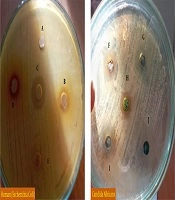
The inhibition zone against S. aureus, S. pyogenes, and E. coli for all the 3 extracts is shown in Table 1. The disk diffusion test showed that the methanol extract of V. thapsus had more growth inhibitory effects on E. coli and S. pyogenes than the aqueous and ethanol extracts. On the other hand, the methanol and aqueous extracts had no effects on S. aureus, while the ethanol extract had growth inhibitory effects on this bacterium. A. fumigatus and C. albicans were not susceptible to the antimicrobial compounds of the extracts. Surprisingly, no antibacterial or antifungal activity was observed for the essential oil of V. thapsus.
Table 1.
Antimicrobial Activity of Verbascum thapsus Extracts and Oil Against the Tested Microbial Strains Based on the Disk Diffusion Method a
| Strains | Aqueous Extract, μL | Ethanol Extract, μL | Methanol Extract, μL | Essential Oil, μL | Gentamicin | Nystatin | ||||||||||||
|---|---|---|---|---|---|---|---|---|---|---|---|---|---|---|---|---|---|---|
| 10 | 20 | 30 | 40 | 10 | 20 | 30 | 40 | 10 | 20 | 30 | 40 | 10 | 20 | 30 | 40 | |||
| E. coli | 5.83 ± 0.2 | 6.83 ± 0.2 | 8.93 ± 0.08 | - | 6.03 ± 0.04 | 8 ± 0.35 | 11 ± 0.0 | 7 ± 0.0 | 10 ± 0.0 | 13.87 ± 0.11 | 16.83 ± 0.2 | - | - | - | - | 33.67 ± 0.22 | - | |
| S. aureus | - | - | - | - | - | - | 5.3 ± 0.19 | 7 ± 0.14 | - | - | - | - | - | - | - | - | 25.17 ± 0.2 | - |
| S. pyogenes | - | 5.93 ± 0.08 | 9.07 ± 0.15 | 10 ± 0.0 | - | 5.83 ± 0.2 | 8 ± 0.35 | 10.93 ± 0.36 | - | 8 ± 0.14 | 10.23 ± 0.18 | 13 ± 0.0 | - | - | - | - | 25 ± 0.0 | - |
| A. fumigatus | - | - | - | - | - | - | - | - | - | - | - | - | - | - | - | - | - | 37 ± 2.12 |
| C. albicans | - | - | - | - | - | - | - | - | - | - | - | - | - | - | - | - | - | 23.33 ± 1.08 |
a Inhibition zone is expressed in diameter around the test disk (mm ± SEM).
The MIC value for the aqueous extract was 62.5 μg/mL for E. coli and 250 μg/mL for S. aureus and S. pyogenes. The MIC value of the ethanol extract was 62.5 μg/mL for E. coli and S. pyogenes and 125 μg/mL for S. aureus. The MIC value for the methanol extract for E. coli and S. pyogenes was 31.25 μg/mL (Table 2).
Table 2.
Minimum Inhibitory Concentration Values of Verbascum thapsus Against the Microorganisms Tested in the Microdilution Assay
| Strains | Aqueous Extract, μg/mL | Ethanolic Extract, μg/mL | Methanolic Extract, μg/mL | Essential Oil, μg/mL |
|---|---|---|---|---|
| E. coli | 62.5 | 62.5 | 31.25 | - |
| S. aureus | - | 125 | - | - |
| S. pyogenes | 250 | 62.5 | 31.25 | - |
| A.fumigatus | - | - | - | - |
| C. albicans | - | - | - | - |
5. Discussion
Today more than ever, the increasing occurrence of antibiotic-resistant strains has led to an urgent demand for new antibiotics (14). The majority of the available drugs in developing countries are driven from medicinal plants; and in industrialized countries, plants make up the raw material for the synthesis of pure chemical derivatives (15).
In the current study, 2 Gram-positive strains (S. pyogenes and S.aureus), 1 Gram-negative strain (E. coli), and 2 fungal strains (A. fumigatus and C. albicans) were used to compare the antimicrobial activity of the aqueous-alcoholic extracts and the essential oil of V. thapsus. Some previous investigations have indicated that there is no antimicrobial activity for the oil obtained from the dried flowering aerial parts of V. thapsus (16). In line with these studies, the results of the present study showed that the essential oil of V. thapsus had no antimicrobial activity against any of the bacterial or fungal isolates tested in the study.
The maximal inhibition zone for the microorganisms sensitive to the methanol extract was in the range of 7 - 16.8 mm, and the MIC value was 31.25 mg/mL. For the ethanol extract, the maximal inhibition zone was 5.3 - 11 mm and the MIC value was 62.5 - 125 mg/mL. These results clearly indicated that the alcoholic extracts of V. thapsus were able to inhibit the growth of some pathogenic bacteria; however, the effectiveness varied against the different microorganisms tested. The findings of the present study confirmed the reported results of some other investigations insofar as some Verbascum species contain substances with antimicrobial properties (17, 18). Some studies have been conducted on the antimicrobial properties of several Verbascum species extracts (16, 19-22). The results of the present study are in agreement with a study performed by Guarino (23), who examined the antimicrobial activity of V. macrurum leaves extracts and demonstrated that the ethanol-aqueous extract exhibited the most activity against Gram-positive bacteria such as S. aureus.
In addition, the methanol extracts of the seeds, roots, leaves, and flowers of V. blattaria, V. bombyciferum, V. nigrum, V. chaixii, V. dumulosum, V. phlomoides, V. olympicum, V. roripifolium, and V. phoeniceum have been previously studied for their antimicrobial activities. One study reported that the extracts had a strong antimicrobial activity against E. coli ATCC 11230 (24). Turker and Camper (10) studied the antibacterial activity of V. thapsus extracts (aqueous, ethanolic, and methanolic) and commercial products of Common Mullein (an alcoholic extract, a flower oil, tea bags, and swallow capsules) against some bacterial strains (E. coli, P. aeruginosa, K. pneumoniae, S. aureus, and S. epidermidis) and reported antibacterial activity with S. epidermidis, S. aureus, K. pneumonia, and E coli. The commercially Mullein flower oil sample (flowers extracted in pure olive oil) had growth inhibitory effects on all the test organisms except S. epidermidis and S. pyogenes (10). Another study showed that the V. thapsus oil exhibited concentration-dependent antimicrobial activity against B. subtilis, S. typhi, S. aureus, A. niger, and P. aeruginosa. The results also demonstrated that the essential oil had no antimicrobial activity against E. coli and C. albicans, which chimes in with the results of the present study (18).
These kinds of differences in susceptibility against antimicrobial agents in plant extracts may be related to the inheritance of antimicrobial-resistance genes in bacterial strains and/or the differences in cell-wall composition of bacterial strains (19). Chemical composition may differ between essential oils and extracts from the same or taxonomically similar species (25) due to external factors. These differences will in turn affect the biocidal activity of oils (26).
Finally, the results of the present study indicated that V. thapsus possesses compounds with antibacterial properties that can be used as novel antimicrobial agents in the development of new drugs for the treatment of infectious diseases. The presence of these medicinal effects suggests that this plant, V. thapsus, may be a source of bioactive substances with multifaceted activities. Further phytochemical analyses such as fractionation should be performed on these extracts to isolate active constituents and conduct subsequent pharmacological evaluations.