1. Background
Physiological processes that lead to start the labor are unknown (1). Onset of labor at term is influenced by the complex relationship between mother and fetus. The human gestation period is normally 38 - 40 weeks, which 80% of pregnancies end before 40 weeks and 20% of them at 40 weeks or more (2).
after 40 weeks of gestational age (GA) prenatal care occurs with greater frequency to reduce fetal complications and unpleasant consequences (3). At least perinatal mortality rate is in the weeks 39 - 40 and increases after 40 weeks (4). A pregnancy reaching 42 complete weeks (294 days) is defined as post term. It occurs in about 4% - 19% of pregnancies. The most obstetrics centers terminate pregnancies in 41 - 42 weeks (2). Fetal risks such as macrosomia, shoulder dystocia, fetal damage, oligohydramnios, meconium aspiration, fetal distress and still birth are mostly observed in post term pregnancies (5). Maternal risks such as hemorrhage, abnormal labor, perineal trauma and cesarean section (c/s) following fetal macrosomia, and instrumental delivery are increased in post term compared with term pregnancies (6).
It is intellectual to terminating pregnancies before 42 weeks to have better perinatal outcomes. Appropriate time of intervention, the choice between induction of labor or following expectant strategy and various methods of labor induction, is controversial (7). In administered prolonged pregnancy, many researchers believe that intervention is necessary. Induction of labor means to stimulate uterine contractions before the labor starts spontaneously (with or without rupture of the membranes (ROM). According to the national center for health statistics (NCHS), the annual incidence of induction or augmentation of labor in the United States almost doubled, that is from 9.5% in 1991 to 22.5% in 2006 (2).
Currently, pharmacologic (oxytocin, prostaglandins, mifepristone, relaxin, estrogens and interleukin) and non-pharmacologic methods (stripping, insert catheters in cervix, hygroscopic dilators, nipple stimulation, acupuncture, enema, intercourse and prescribing herbal medicines) are employed to induce labor. All of these methods have maternal and fetal side effects (8). In the past decades, oxytocin was introduced as an effective drug for inductions, by the U.S Food and Drug Administration (FDA) (2). Oxytocin is the most common factor for labor induction, but its success to affect the needed time to start labor depends on condition of cervix, uterine sensitivity, contractions which already exist and biological differences (9). But side effects such as hypotension, bradycardia, headache, nausea and vomiting, seizures and coma, reduce renal clearance of free water, water intoxication, uterine rupture and even death due to cardiac arrest, intracranial hemorrhage, cause of c/s (10) and neonatal hyperbilirubinemia (11) threaten mother and fetus/neonate (12).
Failure of induction is one of the reasons that lead to the increase of c/s rate. C/S rate is 30.3% in the United States of America, 38.2% in Italy and 41.9% in Iran; whereas according to the world health organization (WHO), statement the optimum rate is below 15% (13).
WHO reported that maternal mortality rate (MMR) was 210 in the world in 2010, 500 in Africa and 25 per 100,000 live birth in Iran (14). Today because of synthetic drug complications, using medical plants is considered. According to WHO, 80% of the world population use herbal medicine. It is 33% in the U.S. (15), 70% in New Zealand (16) and According to Amery it is 71.5% in Iran (17). Anethum graveolens, a member of the Apiaceae family, is commonly known as dill. It grows wild and is also cultivated in most parts of the world such as Mediterranean regions, Europe and Central and Southern Asia including Iran. dill includes tannin, resin and essential oils which compose from anethole, limonene, ketone and carvon (18). It is said that tannins are usually from polyphenols, which have contraction properties (19). Anethole which is a component of essential oils is used to relief pain, stress and gastrointestinal problems (20, 21). Low dose of anethole causes blood vessels to constrict by opening the voltage-dependent calcium channels and its high dose is relaxant (22).
Since different doses of anethole alter the pattern of action potentials, this property is used to treat epilepsy (23). The fruit of this plant has antispasmodic effects on smooth muscle and is cited as reducing bleeding, treat premenstrual signs and increasing milk (24, 25). Recently studies have shown that aqueous and alcoholic extracts of dill have anti-oxidant and anti-microbial effects (26, 27).
Naseri et al. (27) showed that uterine muscles of rat contracted in the presence of dill (28). In another study, dill could reduce the amount of corticosteroids in patients with diabetes(29).The animals instinctive knowledge of medicinal plants cannot be denied; for example, female deer eats snakeroot plant and bears use the Horney wildflowers to facilitate the delivery (13). Despite using this herb in folk medicine and reports of initial studies on its different aspects in medicine, no studies are conducted on the effects of dill on induction of labor in Iran or other countries.
2. Objectives
The current study aimed to identify the dietary dill tail effects on induction of labor in comparison with oxytocin in term pregnancy.
3. Patients and Methods
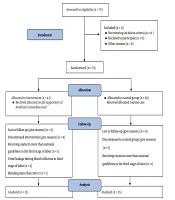
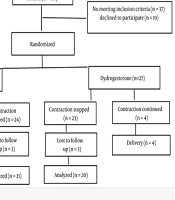
The study was a clinical trial conducted from December 2013 to June 2014 in Ahvaz city, Khuzestan province, South-West of Iran. Among the pregnant women referring to Sina Hospital for weekly visits, 100 eligible pregnant women were selected after examination by an obstetrician, and then were randomly allocated to control and case groups using a random number table. The sample size was at least 50 subjects for each group. Inclusion criteria were primigravida, 41 - 42 weeks of gestation, starting prenatal care in the first trimester, body mass index (BMI) 19.8 - 26, cephalic presentation, singleton pregnancy, reactive non stress test (NST) and Bishop score 4 or less. Bishop score (also known as cervix score) is a pre-labor system to predict the need for labor induction. The five components to be assessed on vaginal examination includes: dilation, effacement and consistency of cervix, position and station of fetus. To assess the fetus, NST was taken for the eligible women; if it was reactive, a midwife explained the purpose of study for the participants and then they read and signed the written consent forms. Due to complications of post term pregnancies, according to some standard protocols, these pregnancies are terminated at this gestational age. Then, 0.018 g/kg of dill seeds and a teaspoon full of sugar was dissolved into 250 mL of boiling water and brewed for about 10 minutes. Subjects in the case group drank it once at the outset of entering. To determine the dose of the drug , the findings of an article assessing the effectiveness of oral dill seeds extracts on postpartum hemorrhage (25) were used. The dill seeds were purchsed from Parsi Teb Company in Tehran. This solution was prepared at hospital by a midwife, and the control group was also given 250 mL of boiled water with a teaspoon full of sugar. The case group was infused with simple Ringer solution, but the control group received standard induction of labor with oxytocin (2). The standard protocol was utilized for labor induction based on 10 units of oxytocin into 1000 mL of Ringer solution which started with four drops and added up four drops every 15 minutes to reach 64 drops. Regulation of solution droplets for the intervention group was similar to that of the controls. In both groups, fetal heart rate and contractions were checked every 15 minutes during the first stage of labor. Maternal vital signs were measured every four hours and if Rupture of membrane (ROM) occurred, temperature was measured once an hour. Vaginal examinations interval were done based on partograph, a chart established by WHO to manage the labor (30). The inductions were performed by the first author a midwife under supervision of an obstetrician. ROM was performed at 3 - 4 cm of cervical dilation in both groups. In control group induction was infused for 8 hours. Both groups were given 24 hours to enter the labor phases. Both groups were controlled for the changes in Bishop score, latent and active phase duration, severity of labor pain in the first stage of labor, the second and third stage duration, also any maternal and fetal complications and when it happened, type of delivery, fetus gender, and Apgar score were recorded. Subjective pain was measured using a horizontal visual analog scale (VAS) in dilatation of 3 cm in latent and dilatation of 7 cm in active phase. Validity and reliability of this scale was confirmed in previous studies (31). According to Friedman curve, cervical dilatation of 3 - 5 cm is the threshold of active phase of labor (2) therefore, middle dilatation was selected in both groups to evaluate the severity of pain in latent and active phase. Duration of uterine contractions was evaluated by touching the uterus fundus. The vaginal examination was determined upon delivery characteristics of each subject. According to Friedman statement, latent phase begins by mother’s understanding of regular contractions associated with progressive dilatation of the cervix. Therefore, it was used to evaluate the latent phase. Moreover, Apgar score of neonates was recorded after delivery and in case of problems it was recorded carefully. Data were collected based on prenatal care form and then analyzed by SPSS software employing Chi-square test, T-test, Mann-Whitney and Fisher tests. P value was set as 0.05 for all analyses.
The study was approved by the Institutional Review Board and the local Research Ethics Committee in Ahvaz Jundishapur university of medical sciences as: Ajums.REC.1392, 159. The study also was recorded at IRCT system as: IRCT2014070518371N1.
4. Results
Results of the study showed no significant differences between the two groups in terms of demographic variables, neonate birth weight and Apgar score (Table 1). The lengths of all stages of labor were significantly lower in the case group compared to those of the control group except for latent phase. The latent phase of the first stage of labor in the control group was shorter than that of the case group and the difference was significant (Table 2). Case group had better Bishop Score following the intervention compared to the control group (Table 3). There were no significant differences between groups regarding subjective labor pain at baseline but in dilatation of 3 cm in latent phase and dilatation of 7 cm in the active phase following the intervention, the control group had severe pain (Table 4). No significant differences (P > 0.05) were observed between the groups regarding vital signs of the participants, fetal heart rate during the labor, Apgar score of neonates, maternal and neonatal complications in the two groups.
Table 1.
Characteristics of the Subjects (n = 50) a
| Variables | Intervention Group | Control Group | P Value |
|---|---|---|---|
| Education | 0.68 | ||
| School | 31 (62.0) | 32 (64.0) | |
| High school | 11 (22.0) | 12 (24.0) | |
| Diploma | 5 (10.0) | 2 (4.0) | |
| Graduate | 3 (6.0) | 4 (8.0) | |
| Body Mass Index , kg/m 2 | 22.03 ± 1.94 | 22.58 ± 1.93 | 0.15 |
| Age, y | 24.16 ± 4.40 | 23.12 ± 4.14 | 0.22 |
| Occupation | 0.60 | ||
| Housewife | 42 (84) | 40 (80) | |
| Employee | 8 (16) | 10 (20) | |
| Gestational age, weeks | 41.12 ± 0.18 | 41.15 ± 0.17 | 0.51 |
| Habitat | 0.61 | ||
| Urban | 43 (86) | 43 (86) | |
| Rural | 7 (14) | 7 (14) | |
| Ethnic | 0.41 | ||
| Arab | 40 (80) | 44 (88) | |
| Fars | 8 (16) | 4 (8) | |
| Bakhtiari | 2 (4) | 2 (4) | |
| Neonatal birth weight, kg | 3085 ± 40 | 3159 ± 35 | 0.33 |
| Neonatal gender | 0.68 | ||
| Female | 29 (58) | 31 (62) | |
| Male | 21 (42) | 19 (38) | |
| Rupture of membranes | 0.001 | ||
| Spontaneous leakage | 32 (65.3) | 6 (12.0) | |
| Amniotomy | 16 (32.7) | 36 (72.0) |
a The values are presented as No. (%) or mean ± SD.
Table 2.
The Duration of Three Stages of Labor in the Two Groupsa
| Variables | Intervention Group | Control Group | P Value |
|---|---|---|---|
| Duration of latent phase, h | 4.15 ± 0.36 | 3.72 ± 0.44 | 0.003 |
| Duration of active phase, h | 2.30 ± 0.34 | 2.76 ± 0.48 | 0.001 |
| Duration of second stage, min | 42.95 ± 8.79 | 58.52 ± 22.58 | 0.004 |
| Duration of third stage, min | 12.00 ± 4.64 | 12.50 ± 2.25 | 0.001 |
aThe values are presented as mean ± SD.
Table 3.
Apgar Score in the Two Groupsa
| Bishop Score | Dill Group | Oxytocin Group | P Value |
|---|---|---|---|
| Before intervention | 2.20 ± 0.88 | 2.28 ± 0.94 | 0.42 |
| 2h after start of labor pain | 4.36 ± 0.72 | 4.24 ± 0.89 | 0.27 |
| 4h after start of labor pain | 8.78 ± 0.73 | 8.28 ± 0.90 | 0.002 |
| 6h after start of labor pain | 11.04 ± 1.15 | 10.82 ± 1.49 | 0.045 |
aThe values are presented as mean ± SD.
Table 4.
The Pain Severity in Two Groupsa
| Variables | Intervention Group | Control Group | P Value |
|---|---|---|---|
| Pain intensity in latent phase | 0.006 | ||
| Vigorous | 10 (20) | 17 (34) | |
| Moderate | 20 (40) | 27 (54) | |
| Fair | 20 (40) | 6 (12) | |
| Pain intensity in active phase | 0.009 | ||
| Vigorous | 17 (34) | 30 (60) | |
| Moderate | 33 (66) | 20 (40) |
aThe values are presented as No. (%).
5. Discussion
Nowadays, pregnant women are concerned about the pharmaceuticals , which can make them attempt to perceive safer motions such as herbal remedies (32). There are relatively few researches on A. graveolens seeds in pregnancy, worldwide. In the current study no maternal or fetal side effects were observed based on consumption of A. graveolens. In another study, there were no abnormal patterns of fetal heart rate (FHR) following taking A. graveolens seeds, but in the study on the effects of intravenous injection of atropine and hyoscine on the progress of labor, cases of tachycardia and bradycardia in the fetus were reported (33). Results of the current study showed that the duration of active phase, second and third stages of labor were significantly shorter in the case group vs. control group except for the latent phase which was shorter in the control group (34); but there are no studies on the dill effects on latent phases in Iran or other countries up to now. Uterine response to oxytocin receptors increased weeks before the labor getting started (2); however, ingredients of dill seeds need time to reach the optimum level in the blood to start uterine contraction. Perhaps due to this reason the latent phase duration was shorter in the control group. Each contraction pattern includes fall time (duration of contractions peak to baseline) and rise time (duration of baseline to peak of each contraction). Driggers et al. (35) stated that F:R time was longer in dystocia group, but some studies said F:R time in dill group due to its contents such as limonene and tannin was shorter than that of the control group. This pattern of contractions leads to shorter labor (36).
Anethum graveolens seeds, due to the materials such as phenol, increase the contractions of uterus. Some researchers reported that phenol increases intracellular Ca2+ during twitch contractions in intact Xenopus skeletal myofibers (17), and new studies showed that dill extract increases uterine contractions immediately after delivery and therefore reduces postpartum bleeding compared with intramuscular oxytocin (25). Researches showed that dill similar to mefenamic acid could reduce primary dysmenorrhea (37). Dill has tannin and anethole which are the essential oils extracted from herbal medicine used to relieve pain, anxiety and digestive problems. Perhaps due to anethole and tannin in dill, the case group felt less pain. In the current study, dill did not cause any maternal and fetal complications; although castor oil significantly reduces the use of oxytocin due to increased prostaglandins to create contractions effectively, it caused nausea and vomiting, severe diarrhea in the pregnant women and the first minute Apgar score was lower in castor oil group vs. the control group. Maybe it was due to the effect of castor oil on the neonatal suffocation and respiratory distress immediately after birth (38). In the current study, Bishop score was better in the intervention group than the control group. It was similar to the consumption of date fruit on cervical ripening (39). Probably dill, similar to date fruit, influenced oxytocin receptors and caused more effective contractions and prepared the cervix for delivery. Another result of the study was bishop score which was better in the case group vs. control group after intervention. It seems that dill similar to hyoscine affected cervical ripening and labor progress (40). The spontaneous rupture of membranes was observed and differences between the two groups were the same as that of the study by Hekmatzade (34), which shows that dill can create uterine contractions significantly effectively in the case group due to the materials such as tannins and anethol.
Strengths of this study include: there were no significant differences between the subjects regarding age, education, habitat, BMI, income and demographic characteristics in the two groups; evaluation of mother and fetal was done in all of the labor phases and for the first time, dill was used as an induction of labor whereas other studies used dill as an augmentation of labor. The current research was not double-blinded because of different aspects of intervention, which is a limitation to this study.
The current study supported the boiled A. graveolens seeds as an effective herb to induction of labor. It is recommended to integrate this method into clinical practice to promote the reproductive health. It is recommended to conduct more studies on the effect of dill seeds on delivery and neonatal outcomes.