1. Background
Memory is a primary function of the brain. It can be defined as the capability of a person to record pieces of information, and retain and recall them whenever needed, and moreover use this information to adapt responses to the environment, therefore it is essential for survival (1). Learning is the process of acquisition of information and skills, while subsequent retention of that information is called memory. Learning and memory together are called cognition. In addition, memory is a process involving the encoding, storing, and recalling of information. Thus, memory records various facts and events, makes it available for further use, and hence can be considered a most valuable health asset (2). Weakened memory, poor learning abilities, degraded retention, and slow recall are frequent problems in stressful conditions. Furthermore, stress, age, and emotions contribute to memory loss, poor learning, dementia, and amnesia or to worse diseases like schizophrenia and Alzheimer’s (3). It is well-known and accepted that medicinal plants play an important role in healthcare systems and can be called a main source of new chemical substances with potential therapeutic effects (4). The most important advantage of phytomedicines and bioactive secondary metabolites are their availability, lower cytotoxicity, and lower price (5). Leguminous seeds are plant foods and contain a high level of phenolic compounds, including condensed tannins. Also, lentils are a leguminous seed rich with natural antioxidants (6-8). Many researchers have confirmed the antioxidant property of tannin constituents present in plant extracts (9, 10). The red lentil belongs to the leguminous family and can be used as an important daily source of phenolic compounds in human diets. Amarowicz’s study in 2009 revealed various classes of phenolic compounds present in red lentil crude extract. Some of the dominant phenolic compounds include quercetin diglycoside, catechin, digallate procyanidin, and p-hydroxybenzoic (6).
2. Objectives
The purpose of this investigation is to evaluate the effect of hydroalcoholic extract of red lentil seed (lens culinaris) on retention and retrieval of memory in young and aged mice.
3. Materials and Methods
3.1. Animals
The young (3 months) and aged (15 months) male Swiss albino mice used in this study (a total of 128 mice in 16 groups ) were purchased from the animal house of Jundishapur University of Medical Sciences, Ahvaz, Iran. They were kept in a clean holding room on a 12 hours light and dark cycle with relative humidity of 45% - 55% and a temperature of 23 ± 2°C. During the experimentation, all mice were fed with concentrated food pellets (Pars Khurakdam Shushtar, Iran) and tap water ad libitum. On the basis of Ahvaz Medical University ethical protocols, ethical issues regarding animals were taken into consideration.
3.2. Preparation of Seeds Extract
Red lentil was purchased from Khuzestan province, Iran during the spring of 2012. Samples of the seeds were identified by a botanist from the division of pharmacognosy at Ahvaz Jundishapur University of Medical Sciences. The seeds was powdered and soaked in a 70% hydro-ethanol solution for 3 days and shaken occasionally; the extract was separated and filtered using Whatman filter papers. The prepared extract was concentrated using rotary vacuum evaporation and then dried in an oven apparatus at a temperature of 35°C. The percentage yield was about 10% for dried hydroalcoholic extract (w/w).
3.3. The Experiments
In this study, two groups of young and aged mice were used. Each group was divided into two subgroups (one of them for retention of memory and the other for retrieval of memory). Each subgroup consisted of test groups (n = 8) which received red lentil extract 400 and 800 mg/kg ip. respectively. The blank group received normal saline (1 mL/100 g), while the control group was untreated. The step-down apparatus used to test passive avoidance consisted of a box measuring 25 × 25 × 20 cm made from an electrical network floor with a hollow 20-cm-high cylinder that was embedded into a rounded and thick plastic plate with diameter of 9 cm and height of 1 cm. On the first day, in order to meet the new requirements and familiarization, the animals were left in the machine freely for as long as 3 min, whereas on the second day, each mouse was placed separately on a round plate of apparatus. The transparent cylinder was removed after 10 sec and the time delay in coming down from the podium was immediately recorded. Animals with latencies longer than 30 sec were excluded from the study. An identical procedure as on the 2nd day was followed on the 3rd day; meanwhile a one-second electric shock (1 mA) was administered when mice had just left the round platform on all paws. The animals were injected with drugs immediately after foot shock in order to study the effects on retention of memory, but the same extract was injected 23.5 hours after the foot shock to study the effect on retrieval of memory (11). On the 4th day, the step-down latency of the mice was recorded. All drugs (RLE) were administered intraperitoneally.
3.4. Statistical Analysis
Statistical analysis was carried out using version 16 of SPSS. All results were expressed as the mean ± SEM. The data was obtained by both one-way and two-way ANOVA and Student’s t-test, then followed by a Tukey post hoc test. It is noticeable that significant levels were set at P < 0.05.
4. Results
4.1. Effects of Extract on Memory Retention
Figure 1A and 1B show comparisons of step-down latency in young and aged mice between the 2nd and 4th day, received RLE (400 and 800 mg/kg ip.), normal saline and untreated group, respectively, in the memory retention tests. The results revealed that RLE significantly (P < 0.05 and P < 0.01) increased step-down latency on day 4 in comparison with day 2, indicating a memory retention enhancer. Results showed that ip. administration of extract (400 and 800 mg/kg) significantly increased step-down latency on the 4th day (P < 0.05 and P < 0.01 respectively) in comparison with the 2nd day. As in the young groups, in the aged animal groups that received extract (400 and 800 mg/kg), step-down latency also increased significantly on the 4th day versus the 2nd day (P < 0.01).
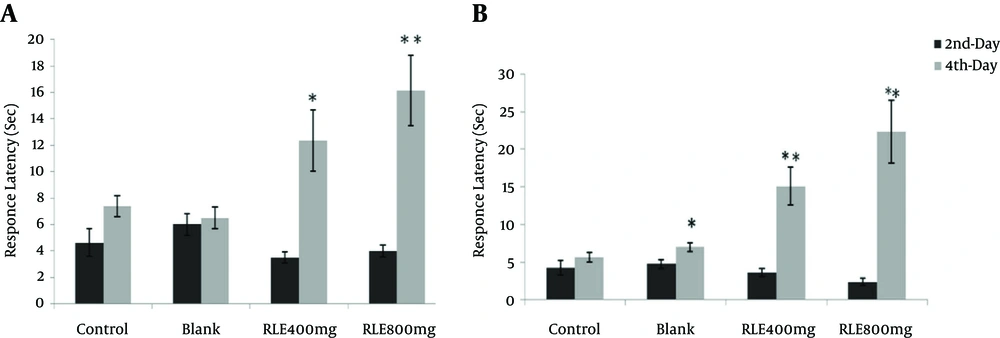
Figure 1.
Significant difference between day 2 and 4 is shown as *P < 0.05, **P < 0.01. Control, no injection; Blank, normal saline (1 mL/100 g). Data is mean ± SEM (n = 8). A and B representing young and aged animal groups respectively.
4.2. Effects of Extract on Memory Retrieval
As mentioned above, RLE enhanced both types of memory, as shown in Figure 2A and 2B. The results of this study indicate that the mean latency time in retrieval of memory in all young and aged groups of mice that received RLE (400 and 800 mg/kg) became significantly longer than that of the control group (as P < 0.01 both dose of 400 and 800 in young and although as P < 0.001 in 800 mg from the aged group).
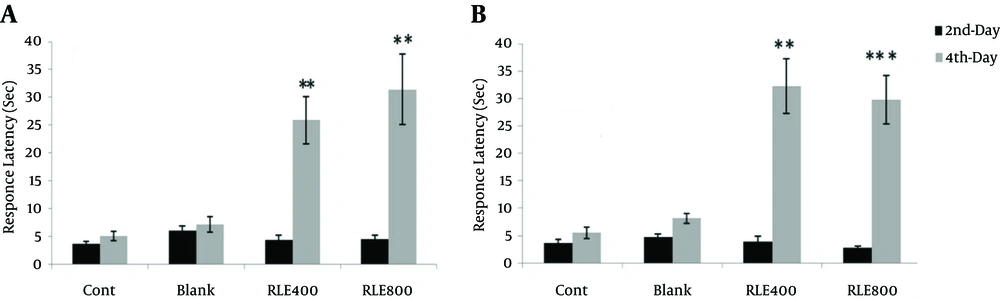
Figure 2.
Significant difference between day 2 and 4 is shown as **P < 0.01. Control, no injection; Blank, normal saline (1 mL/100 g). Data is mean ± SEM. A and B representing young and aged animal groups respectively (n = 8).
Figure 3A and 3B show the distinct ameliorative effects of red lentil hydroalcoholic extract (400 and 800 mg/Kg ip.) on memory retention and retrieval in the passive avoidance step-down test on the 4th day of the study in both young and aged animals. Our results indicated that red lentil extract significantly (P < 0.05 and P < 0.01) increased step-down latency in this test. Tukey post hoc analysis showed that 800 mg/kg of extract is the best dose as a memory retention enhancer, but in memory retrieval, the effects of both extract doses are nearly the same in aged animals.
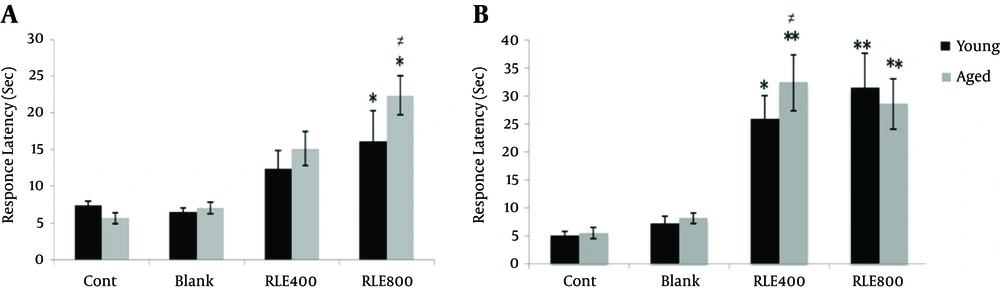
Figure 3.
Significant difference between day 4 of extract groups with control is shown as *P < 0.05, **P < 0.01. Control: no injection, Blank: normal saline (1 mL/100 g). Data is mean ± SEM. Symbol of ≠ shows significant difference between corresponding group (P ˂ 0.05). A and B represents retention and retrieval memory test groups respectively (n = 8).
5. Discussion
Enforce animal are very valuable for our understanding of the psychological and physiological underpinnings of many disease states. For instance, in the arena of memory and learning, applying a model of animals’ discernment us how data processing in damaged and normal brains.
There are several systems involved in memory and cognition that interact cooperatively or competitively for natural function and behaviors, so that experiments by animal’s model instruct us this information (12).
The production of inflammatory mediators causes activation of microglia as well as astrocytes, so in this manner it can contribute in apoptotic serials of neuron cells death in most neurodegenerative conditions and illnesses. Although induction of release the cytokines, e.g. tumor necrosis factor-alpha, TNF-α, interleukin-1b, IL-1b, by elevating oxidase activation of NADPH and induction enzyme activity of NO synthase, prepare some portions of glial cell death processes (13).
Oxidative stress is a key event in the pathogenesis of cerebral ischemia and other neuronal disorders. In ischemic/reperfusion disorders, reactive species produce in extreme levels, which could subsequently result in discrepancies and imbalances between the rate of antioxidants and oxidative agents, especially in elderly lifetime.
Additionally, reactive but bioactive species of oxygen and superoxide radicals can harm and destroy proteins, lipids as like as other cellular macromolecules. There is evidence supporting the hypothesis that herbal polyphenols can provide protection against neurodegenerative changes associated with neuronal damage by their potency in the scavenging of free radicals (14). So these findings motivate us to study the neuroprotective effects of red lentil extract compositions on retention and retrieval of memory in animal models. Nowadays there is great interest in the use of flavonoids and plant derivatives that reach from them in order to improve the functioning of neurons and prevent destructive events, e.g. neurodegenerative events, especially whose related to aging processes.
The use of flavonoid-rich plants or foods in human and animal diets leads to heartening and uplifting of the cognition task of neuronal systems, probably in manner of improvement the regeneration of neuron cells and complex networks by promoting the vulnerability and vitality enhancing of neurons (15). In a similar study by Sarahroodi et al. (16), the recuperative effects of sweet basil hydroalcoholic extract was investigated in animal’s model.
The delay in leaving the platform was measured for both retention and retrieval extract on retention and retrieval of memory test of memory. It has been shown that use of sweet basil extract significantly increases memory retrieval (16). In another study, Flood et al. evaluated the enhancement effect of dehyroepiandrosteron and its sulfate derived on memory retention in mice. They assess improve retention for step-down in a passive avoidance apparatus study (17). Interestingly, lentils were mentioned in ancient treatment remedies and were documented by Dioscorides as one of the therapeutic plants. Lentil seeds are used nowadays in the folk medicine of many ethnicities to treat a variety of illnesses. They are used as a source of lectins for the treatment and prophylaxis of retroviral infections, including human immunodeficiency virus (HIV) infections, as well as for ameliorating coronary heart diseases (CHD) and diabetes, especially type II, controlling body weight, and treating cancers of the colon, breast, and prostate (18). Lentils are a significant dietary source of a plethora of vitamins, including phylloquinone (vitamin K), folate, thiamin (B1), and riboflavin (B2); other water-soluble vitamins, namely niacin, pantothenic acid, and pyridoxine, have also been reported in lentils. In addition, vitamin E (a, b and c tocopherols) was measured in lentils by Ryan et al. (19). Flavonoids have a variety of protective effects on neuron cells and the brain, including protection against neurotoxins, potential reduction and suppression of neuroinflammations, memory and learning also cognitive task promotion. It seems that the effect of these bioactive secondary metabolites is due to two mechanisms.
First, because of their antioxidative and free radical scavenging properties, they interact with harmful molecules and thereby rescue crucial lipids, proteins, and others which in the brain are involved in signaling cascades so ceasing of neuron cells apoptosis started by reactive ion spices and neurotoxins happen and promote synaptic reflectivity and plasticity also survival and repayment neuron body cell and dendrites. Second, they change and develop blood flow in the cerebrovascular network, causing beneficial and advantageous effects on neurogenesis and angiogenesis and finally producing strategic neuronal structure changes.
The present study clearly indicates that consumption of red lentil has potential effects on retention and retrieval of memory. It is thought that the use of flavonoid-rich foods such as red lentil throughout a person’s life can limit neurodegeneration and prevent or reverse age-dependent losses in cognitive performance.