
1. Background
Evidence attests to the key role of subjective sleep quality in maintaining the health, quality of life, and efficient performance of individuals in their daily activities. The systems that apply to sleep-wake adjustment overlap and interact with emotion regulation centers, sensations, and other behaviors. A poor sleep-wake cycle and low subjective sleep quality have debilitative effects on the physical, mental, emotional, and cognitive health of individuals (1-4).
Disordered subjective sleep quality is mainly characterized by biological-cognitive variables such as sleep latency, decreased duration of useful sleep, and sleep efficiency, as well as the disruptions in the daily performance that are caused by poor night sleep quality, sleep medication use, and various sleep disorders. Poor subjective sleep quality causes severe damage to physical health (5), thereby leading to cardiovascular diseases (6), cognitive-behavioral disorders, mood disorders (e.g., depression and anxiety) (7, 8), irritability, fatigue, memory and concentration loss (1), loss of appetite, aggression, and anger (9). In addition, these issues adversely affect the performance and progress of individuals in the community (10), giving rise to social and occupational disruptions (11, 12).
Given the importance of the effects of unfavorable subjective sleep quality on mental function and psychological/physical health, as well as the high number of the individuals seeking treatment for this issue in psychological clinics, several national and foreign studies have been focused on the epidemiological assessment of subjective sleep quality and the associated complications. These studies have mainly emphasized on the necessity of assessing subjective sleep quality and the spread of the subsequent disorders in order to raise the awareness of citizens, implement preventive educational programs, and use effective strategies (3, 13, 14).
According to the literature, 39.3% of adults suffer from insomnia and poor sleep quality and feel exhausted throughout the day (15). In a study in this regard, the prevalence of poor sleep quality has been reported to be 62% (16). In another performed by Wang et al. (17), the prevalence of sleep quality and its influential factors were investigated, and the findings indicated that the score of subjective sleep quality was 3.72; therefore, the prevalence of poor sleep quality and sleep cycle disorders was observed to be relatively high. Furthermore, it was demonstrated that increased age, female gender, marital status (single), low education and income levels, depression, alcohol consumption, and smoking habits could increase the risk of poor sleep quality.
According to the findings of Nicolau et al. (18), women had a more unfavorable sleep quality compared to men, and the women in the premenstrual period reported extremely poor sleep quality. Therefore, hormonal changes in women seem to be involved in the reduction of sleep quality. In the study by Simonelli et al., the prevalence of poor sleep quality was reported to be high in low- and middle-income countries due to cultural, population-related, geographical, and health-related factors (19).
The findings of Yatsu et al. (20) indicated the mean score of subjective sleep quality to be 3.3. In addition, the mentioned research demonstrated a correlation between subjective sleep quality and quality of life. On the same note, Eller et al. (8) reported sleep quality to be relatively favorable in 24% of students, while 6% and 1% of the subjects had poor and extremely poor sleep quality. Furthermore, the students were reported have high frequency of sleep latency, interrupted sleep, morning fatigue, drowsiness throughout the day, nightmares, and waking up earlier than usual in the morning.
The findings of Veldi et al. (21) in this regard demonstrated the high frequency of sleep latency, interrupted sleep, and drowsiness throughout the day and in the classroom in students. Similarly, Pagel and Kwiatkowski (22) assessed the sleep patterns of students, reporting that 69.7% of the students with low GPAs had difficulty sleeping. Moreover, 65.6% of the subjects in the mentioned study walked constantly at night due to the inability to sleep, and 72.7% of those with low sleep quality had difficulty concentrating during the day.
In Iran, some studies have been focused on the prevalence of sleep-wake cycle disorders and subjective sleep quality. For instance, Shaygannejad et al. (23) conducted a research on 495 patients with neurological diseases (mean age: 34.92 years), reporting low sleep quality in the participants. In another study regarding the prevalence of sleep disorders in Ahvaz (Iran), Papi et al. (24) reported low and moderate sleep quality in 13.8% and 81.5% of the participants, respectively, as well as severe sleep disorders in 4.6%. In addition, 86.1% of the subjects had slight-to-severe sleep disorders.
In another study, Chehri and Parsa (25) epidemiologically evaluated sleep health and the influential factors in adults. According to their findings, 64.5% of the adults had unfavorable sleep quality. Nonetheless, no significant correlations were observed between sleep quality and the variables of gender, marital status, education level, and occupation status. In the research by Khazaie et al. (3), 10% of the participants had respiratory failure more than once a week and poor sleep quality. On the same note, Mosavi et al. (2) evaluated medical students and reported that 9.1% had very favorable sleep quality, while 36.1%, 39.3%, and 13.5% had favorable, satisfactory, and unfavorable sleep quality, respectively.
Considering the epidemiological research conducted in this regard and the high prevalence of subjective sleep quality in most of these studies, it is crucial to provide data on sleep health services in order to enhance the knowledge of the public and healthcare staff regarding the issue, promote the required interventional measures to reduce the risk of mental and physical damages in citizens, and improve their social and job performance.
2. Objectives
The present study aimed to evaluate the epidemiology of subjective sleep quality among the citizens of Kermanshah, Iran.
3. Methods
This descriptive-analytical study was conducted on 416 citizens in Kermanshah, Iran with the mean age of 34.35 years. The participants were selected via multistage random sampling. The inclusion criteria were the age of more than 16 years, willingness to participate, and awareness of citizens. The exclusion criteria were the presence of special diseases (e.g., mental disorders, seizures), use of specific drugs/drug abuse, and citizens obligated to work night shifts.
Data were collected using a self-report questionnaire with two sections of demographic characteristics and the Pittsburgh sleep quality index (PSQI). The first section included the demographic characteristics of the participants, including age, gender, marital status, education level, occupation status, monthly income, daily caffeine intake from all beverages, and smoking habits. The second section was the 18-item PSQI by Buysse et al. (26). In this study, we used the Persian version of the PSQI as prepared by Farrahi Moghaddam et al. (27).
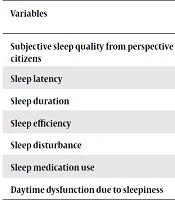
The questionnaire comprised of seven subscales, including subjective sleep quality, sleep latency, sleep duration, sleep efficiency, sleep disturbance, sleep medication use, and daytime dysfunction due to sleepiness, all of which were used to assess the subjective quality of sleep in the participants during one month. The items were scored based on a three-point Likert scale, and the total score of the index was obtained by summing up the scores of the seven subscales (score range: 0 - 21). Scores 0 - 5 indicated very favorable sleep quality, and scores 5 - 11, 11 - 15, and 17 showed relatively favorable, relatively unfavorable, and very unfavorable sleep quality, respectively.
According to Buysse et al. (26), the cutoff point of the PSQI is higher than five, while Backhaus et al. (28) reported the cutoff point to be higher than six; the latter was considered in the present study. In addition, the validity and reliability of the index have been reported to be 0.8 and 0.93 - 0.98, respectively (26). Notably, the reliability and validity of the questionnaire have been confirmed for the Iranian population. In a study by Hassanzadeh et al., the reliability of the index was confirmed at the Cronbach’s alpha of 0.78 - 0.82 (29). In addition, the Cronbach’s alpha of 0.77 has been reported for the PSQI (27), and the Cronbach’s alpha of 0.81 was estimated for the mentioned tool in the current research. The validity of the index was assessed using confirmatory factor analysis, where the fit indices confirmed the validity of the tool.
Data analysis was performed in SPSS version 23 using descriptive and inferential statistics. The subjects were selected via multistage random sampling, and participation in the research was voluntary. The questionnaires were completed anonymously to adhere to confidentiality terms regarding the personal information of the participants. Furthermore, the necessary guidance was provided for the proper collection of the data.
4. Results
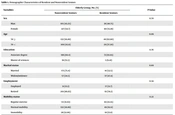
Among the participants, 42.3% were male, and 57.2% were female. In terms of marital status, 44.7% of the participants were single or divorced, and 55.3% were married. As for age, 16.59% of the subjects were aged less than 50 years, and 83.4% were aged more than 50 years; the mean age of the subjects was 64.4 ± 4.65. Table 1 shows the frequency distribution of the scores of the PSQI subscales in the citizens of Kermanshah.
Table 1.
Frequency Distribution (Percentage) of PSQI Subscales in Participants (N = 416)
| Variables | Very Favorable | Relatively Favorable | Relatively Unfavorable | Very Unfavorable |
|---|---|---|---|---|
| Subjective sleep quality from perspective of citizens | 8.7 | 15.2 | 58.5 | 17.5 |
| Sleep latency | 26.9 | 32.7 | 25.5 | 14.9 |
| Sleep duration | 37 | 45.2 | 12.2 | 5.7 |
| Sleep efficiency | 82.1 | 7.2 | 7.2 | 3.5 |
| Sleep disturbance | 11.5 | 53.8 | 30.3 | 4.3 |
| Sleep medication use | 66.1 | 13 | 10.3 | 10.6 |
| Daytime dysfunction due to sleepiness | 44.8 | 28.1 | 16.2 | 10.9 |
According to the information in Table 1, most of the sleep-related problems in the participants were observed in the components of subjective sleep quality from the perspective of the citizens (58.5% relatively unfavorable, 17.5% very unfavorable), sleep latency (25.5% relatively unfavorable, 14.9% very unfavorable), sleep disturbance (30.3% relatively unfavorable, 4.3% very unfavorable), and daytime dysfunction due to sleepiness (16.2% relatively unfavorable, 10.9% very unfavorable). In addition, 10.6% and 10.3% of the subjects used sleep medications at very high and relatively high doses, respectively. On the other hand, the least significant problems were observed in the component of sleep efficiency (7.3% relatively unfavorable, 3.5% very unfavorable). Table 2 shows the descriptive indices of the PSQI and its components.
Table 2.
Descriptive Indices of PSQI and Its Components in Participants (N = 416)
| Variables | Mean Score | Standard Deviation | Skewness | Kurtosis |
|---|---|---|---|---|
| Subjective sleep quality from perspective of citizens | 1.95 | 0.68 | -0.68 | 1.15 |
| Sleep latency | 1.21 | 0.93 | 0.27 | -0.81 |
| Sleep duration | 0.77 | 0.71 | 0.87 | 1.21 |
| Sleep efficiency | 0.09 | 0.36 | 0.50 | 0.29 |
| Sleep disturbance | 1.31 | 0.60 | 0.21 | 0.05 |
| Sleep medication use | 0.51 | 0.94 | 1.77 | 1.78 |
| Daytime dysfunction due to sleepiness | 0.89 | 0.98 | -0.62 | -0.62 |
| Total PSQI score | 6.64 | 2.21 | 0.49 | 0.49 |
According to the information in Table 2, the total mean score of the PSQI was 6.64 ± 2.21. Among the components of the PSQI, the prevalence of sleep quality in the components of subjective sleep quality from the perspective of the participants, sleep disturbance, sleep latency, daytime dysfunction due to sleepiness, sleep duration, sleep medication use, and sleep efficiency was estimated at 1.95 ± 0.68, 1.31 ± 0.60, 1.21 ± 0.93, 0.89 ± 0.98, 0.77 ± 0.71, 0.51 ± 0.94, and 0.09 ± 0.36, respectively. In other words, the highest and lowest prevalence was reported in subjective sleep quality form the perspective of the subjects and sleep efficiency, respectively. Table 3 shows the comparison of the participants in terms of sleep quality based on gender, marital status, and age.
Table 3.
Comparison of Subjects in Terms of Sleep Quality Based on Gender, Education Level, and Age (N = 416)
| Sleep Disturbance | Frequency | Percentage | Mean Sleep Quality | t | df | P value |
|---|---|---|---|---|---|---|
| Gender | 4.023 | 412 | 0.001 | |||
| Female | 238 | 57.2 | 7.91 | |||
| Male | 176 | 42.3 | 6.61 | |||
| Marital status | 4.18 | 414 | 0.001 | |||
| Single/divorced | 186 | 44.7 | 6.60 | |||
| Married | 230 | 55.3 | 7.93 | |||
| Age (y) | ||||||
| < 50 | 69 | 16.59 | 6.59 | 3.13 | 414 | 0.01 |
| ≥ 50 | 347 | 83.41 | 7.98 |
According to the information in Table 3, unfavorable sleep quality was more prevalent in women (3.33 ± 7.91) compared to men (3.10 ± 6.64). Furthermore, significant correlations were observed between age and some sleep quality components of the PSQI, including sleep latency (r = -0.16; P < 0.01), sleep duration (r = 0.19; P < 0.01), sleep medication use (r = 0.18; P < 0.01), and daytime dysfunction due to sleepiness (r = -0.12; P < 0.05). In terms of marital status, 176 subjects (42.3%) were single, while 230 (55.3%) and 10 cases (2.4%) were married and divorced, respectively. According to the findings, the mean sleep quality score was lower in the single participants (2.92 ± 6.60) compared to the married subjects (3.45 ± 7.93), which demonstrated the higher sleep quality in the single individuals compared to those who were married.
5. Discussion
The present study aimed to epidemiologically evaluate the subjective quality of sleep in the citizens of Kermanshah (Iran) in 2017. According to the obtained results, 8.7% of the subjects had very favorable subjective sleep quality, while 15.2%, 58.5%, and 17.5% had relatively favorable, relatively unfavorable, and very unfavorable sleep quality, respectively, which indicated the high prevalence of unfavorable sleep quality in the participants. The total mean score of the PSQI in 79% of the subjects was higher than the cutoff point (M = 6.64), which is consistent with several studies in this regard (15 - 17, 23 - 25). However, our findings are inconsistent with the results obtained by Mosavi et al. (26), who reported the prevalence of unfavorable sleep quality to be 2%. Among the PSQI components in the current research, subjective sleep quality from the perspective of the subjects, sleep latency, and sleep disturbance were highly prevalent; this is in line with the results obtained by Frangopoulos et al. (15) and Wang et al. (17).
In the current research, significant correlations were observed between the sleep quality of the participants and variables of age, gender, and marital status. Accordingly, the sleep quality was more unfavorable in women compared to men, which is in congruence with the results obtained by Wang et al. (17). This finding could be attributed to the differences in the physiological characteristics of women, secretion of female hormones, and hormonal changes associated with menstruation. According to the literature, poor sleep quality is one of the most common symptoms of premenstrual syndrome in women, and decreased estrogen levels due to aging and physiological/hormonal changes during menopause could lead to lighter sleep in women (18). In addition, women experience unfavorable sleep quality due to their social roles (spouse, mother). Another cause of the high prevalence of sleep disorders among women is the higher rate of depression and anxiety compared to men (17). Inconsistent with our findings, Chehri and Parsa (25) reported no significant correlations between sleep quality and the variables of gender, marital status, education level, and occupation status.
The results of the present study demonstrated a significant association between aging and unfavorable sleep quality. Consistent with our findings, several studies have shown that aging leads to changes in the quality and structure of sleep, which in turn cause sleep cycle disturbances and unfavorable sleep quality (17, 22, 23, 25). Nonetheless, it is difficult to determine which sleep changes are directly caused by aging. Sleep-induced waves decrease with age, and segmented sleep with long latency periods leads to unfavorable sleep quality in elder adults through the disruption of sleep patterns (3). Moreover, physical and mental problems in elder adults may increase sleep disorders (4).
Our findings were indicative of a significant association between favorable sleep quality and marital status, so that the single participants had more favorable sleep quality compared to the married subjects. In this regard, our findings are congruent with the results obtained by Wang et al. (17) and Chehri and Parsa (25). The difference between the single and married participants in this regard might be due to the stress caused by more responsibilities later in life, which may adversely affect sleep quality.
One of the major limitations of the present study was the use of a self-report questionnaire for data collection, which had low validity in the estimation of sleep quality. In addition, a cross-sectional design was applied for the assessment of sleep quality within a very short period, which is yet another limitation. Therefore, it is suggested that structured questionnaires be used along with self-report tools. In addition, clinical interviews could be conducted with subjects in order to increase the reliability of the study outcomes. Performing futuristic and longitudinal studies for a period of one year or longer could also yield more valid results.
5.1. Conclusions
According to the results, unfavorable sleep quality had a relatively high prevalence in the citizens of Kermanshah. Some of the key measures to improve sleep quality include further investigations regarding sleep, increasing the awareness of citizens on health and optimal sleep quality, sleep health education, provision of counseling services to the individuals with poor sleep quality, and attention to the diagnosis and treatment of sleep disorders and the influential factors. It is recommended that special attention be paid to the subject of sleep by researchers and more targeted clinical studies be performed to achieve favorable sleep quality and provide solutions to improve the sleep quality of the citizens of Kermanshah.