
1. Background
Pregnancy is a natural process associated with various changes in the body, including the mouth and teeth (1). These changes could lead to problems in the mouth and teeth if not treated in a timely manner (2). Pregnancy is considered to be a risky condition for dental treatments due to the unique nature of the physiological changes and potential risks to the developing fetus (3). Studies in this regard indicate that severe gingivitis in pregnant women is correlated with demographic factors and is a significant risk factor for complications such as preterm birth and low birth weight (4).
In a study, Miyazaki et al. reported a significant correlation between the mean increase in the probing depth and age, especially in the age group of 36 - 42 years (5). Furthermore, Agbelusi et al. observed a significant association between gestational age and the gingival index (6). Tilkaratne also reported that despite similar plaque levels in pregnant and non-pregnant women, the gingival index in pregnant women increased significantly during the first and second trimesters of pregnancy compared to the control group (7). The studies conducted by Gesase, Amar, and Yalcin have also demonstrated that the periodontal status in pregnant women may be affected by social and cultural factors such as education level and previous periodontal treatment (8).
Although pregnancy is not considered a medical disease, the associated physiological changes in women during this period and the health of the fetus propel special considerations regarding dental procedures during pregnancy. Dentists must obtain the vital information on the medical status, medications, and history of gestational diabetes, miscarriage, and hypertension before the treatment of pregnant women (9). Preventive treatment is an inherent element of dental treatments for pregnant women, which encompasses health education programs and plaque control. In addition, the timing of elective dental procedures in pregnant patients is important (10).
Half of all women experience gingivitis during pregnancy, which causes swelling, redness, bleeding, and gingival resorption (11). However, some pregnant women avoid brushing their teeth and using mouthwash due to nausea, which increases the risk of caries. In addition, many pregnant women do not seek preventive or restorative care since they assume that dental treatments could harm the fetus (12).
Periodontal infections are highly common during pregnancy and lactation (13). The prevalence of periodontal diseases increases at the beginning of the second month of pregnancy, reaches a peak in the eighth month, and decreases in the last month of pregnancy (7). Following childbirth and up to two months postpartum, the rate of these infections often returns to normal. However, the rate has been reported to remain higher during breastfeeding in some cases (14, 15).
Periodontal infections in pregnancy may have debilitating effects on the mother and neonate (16). The most common complications of periodontal infections in pregnant women are the increased risk of low birth weight (< 2,500 g), premature birth (gestational age of < 37 weeks), and preeclampsia (8). Several studies have investigated the correlation between the periodontal status and pregnancy outcomes, indicating that scaling and root planning during the second trimester of pregnancy reduce the risk of complications (17-19).
The community periodontal index of treatment needs (CPITN) is used for the epidemiological examination of periodontal diseases (20). Metabolic changes (e.g., hormonal changes) may also affect the oral metabolism of pregnant women as a predisposing factor to periodontal diseases (21). Gingivitis during pregnancy occurs due to increased progesterone and the subsequent impact on the gingival arteries. During pregnancy, estrogen secretion is 30 times higher, and progesterone secretion is 10 times higher than during menstruation (22).
2. Objectives
The present study aimed to investigate the periodontal status of pregnant and lactating women in Ilam province, Iran during 2018 - 2019.
3. Methods
This descriptive-analytical study was conducted on the pregnant and lactating women referred to 12 health centers in Ilam, Iran. Based on the study by Torabi et al. (23), the subjects were selected via cluster and stratified sampling from each center. In total, eight subjects were selected, including four pregnant and four lactating women. Those with systemic disorders (e.g., diabetes), cardiovascular diseases, corticosteroid consumption, and smoking habits were excluded.
3.1. Procedure
Data were collected using a questionnaire consisting of two sections. The first section included demographic data on age, gestational age of the fetus, education level, number of tooth brushing times, and economic status. The second section contained data on the periodontal status assessment based on the CPITN. Several indices cover the progression and etiology of periodontal disease and are used by clinicians to describe the changes in oral tissues (24). Ainamo et al. developed this index (25), and the World Health Organization (WHO) modified the index twice in 1987 and 1997. One of the two versions of this index is the partial CPITN, which examines 10 teeth, and the other version is the full-mouth CPITN, which evaluates 28 teeth (26). The CPITN is primarily a screening procedure, which requires clinical assessments for the presence or absence of periodontal pockets, calculus, and gingival bleeding. The depth of the probe is measured using a Williams calibrated probe and a mirror in the six areas surrounding the teeth, including the mesiobuccal, midbuccal, distobuccal, mesiolingual, midlingual, and distolingual areas. Inflammation, mass, and plaque indices were examined in the present study, and the patients were coded based on the following periodontal index scale:
Code 0: Healthy periodontal status; Code 1: Bleeding with direct/indirect vision after probing; Code 2: Presence of mass and bleeding during probing with the black band completely visible on the probe; Code 3: Presence of a thin periodontal pocket (3 - 5 mm) with the black band on the probe along the gingival margin; Code 4: Presence of a periodontal pocket (≥ 6 mm) with no black band detected on the gums
Data analysis was performed in SPSS version 24 using descriptive statistics (mean, standard deviation, and percentage) and analytical statistics (independent t-test, chi-square, and one-way ANOVA). In all the statistical analyses, the significance level was considered to be 0.05.
3.2. Ethical Considerations
Prior to conducting the research, the required permit was obtained from the Vice Chancellor for Research of Ilam University of Medical Sciences. Due to the necessity of confidentiality, the patients remained anonymous throughout the study, and the information was registered based on their file number.
4. Results
The mean age of the pregnant women was 25.5 ± 62.52 years (minimum: 17 years, maximum: 38 years), and the mean age of the lactating women was 29.08 ± 6.83 years (minimum: 17 years, maximum: 46 years). Overall, 42% of the pregnant women were in their first trimester, 24% were in their second trimester, and 34% were in their third trimester. Among the pregnant women, 49 cases were housewives, and only one patient was employed. As for the lactating women, all the 50 cases were housewives.
Regarding education level, the majority of the pregnant women (40%) had academic education, as well as 38% of the lactating women. In terms of economic status, the highest percentage (54%) had an average economic status among the pregnant women, and 72% of the lactating women had a similar status. Regarding health status, a mean of 38% of the pregnant women and 52% of the lactating women were normal.
Among the pregnant women, 30% had healthy gums (code 0), 18% had bleeding gums (code 1), 36% had a mass (code 2), and 16% had a pocket (code 3) based on the CPTIN. As for the lactating women, 44% had healthy gums (code 0), 32% had bleeding gums (code 1), 20% had a mass (code 2), and 4% had a pocket (code 3). Overall, the incidence of codes two and three was significantly higher in the pregnant women compared to the lactating women.
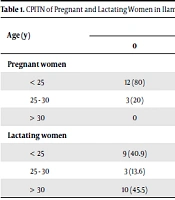
Scaling and referral to a physician (previous referrals) was reported in 56% of the pregnant women and 76% of the lactating women. Among the pregnant women, 52% used toothbrushes and dental floss, and 60% of the lactating women toothbrushes and dental floss as well. In our sample population, 37% of the women had a healthy periodontium, while 63% had periodontal disease (30% pregnant and 44% lactating). However, the rate of a healthy periodontium decreased with age, and the probability of periodontal diseases increased with aging in the pregnant women. In the lactating women, the rate of periodontal health was higher than the pregnant women, and a significant correlation was observed between age and CPITN in the pregnant women (Table 1).
Table 1.
CPITN of Pregnant and Lactating Women in Ilam City Based on Age
| Age (y) | CPITN | P-Value | |||
|---|---|---|---|---|---|
| 0 | 1 | 2 | 3 | ||
| Pregnant women | 0.047 | ||||
| < 25 | 12 (80) | 4 (44.4) | 6 (33.3) | 1 (1.25) | |
| 25 - 30 | 3 (20) | 3 (33.3) | 7 (38.9) | 4 (50) | |
| > 30 | 0 | 2 (22.2) | 5 (27.8) | 3 (37.5) | |
| Lactating women | 0.11 | ||||
| < 25 | 9 (40.9) | 4 (25) | 3 (18.8) | 0 | |
| 25 - 30 | 3 (13.6) | 8 (50) | 3 (30) | 2 (100) | |
| > 30 | 10 (45.5) | 4 (25) | 4 (40) | 0 | |
More than half of the pregnant women with different education levels had plaques and masses. Overall, 67% of the women with healthy gums had academic education, 33% had a high school diploma, and none of them had elementary or middle school education. A significant correlation was denoted between education level and CPITN. In the lactating women, the highest frequency was related to healthy gums in those with academic education, and plaques decreased in those with higher education. A significant correlation was observed between education level and CPITN in the lactating women (Table 2).
Table 2.
CPITN in Pregnant and Lactating Women in Ilam City Based on Education Level
| Education Level | CPITN | P-Value | |||
|---|---|---|---|---|---|
| 0 | 1 | 2 | 3 | ||
| Pregnant women | 0.01 | ||||
| Elementary school | 0 | 2 (22.2) | 5 (27.1) | 3 (37.5) | |
| Junior high school | 0 | 0 | 2 (11.1) | 3 (37.5) | |
| High school | 5 (33.3) | 2 (22.2) | 6 (33.3) | 2 (25) | |
| Academic | 10 (66.7) | 5 (55.6) | 5 (27.8) | 0 | |
| Lactating women | 0.03 | ||||
| Elementary school | 1 (4.5) | 2 (12.5) | 2 (20) | 2 (100) | |
| Junior high school | 3 (13.6) | 4 (25) | 0 | 0 | |
| High school | 7 (31.8) | 6 (37.5) | 4 (23.5) | 0 | |
| Academic | 11 (50) | 4 (25) | 4 (40) | 0 | |
In both the pregnant and lactating women, the status of the CPITN was better with the observance of oral hygiene, and a significant correlation was also denoted between the health status and CIPTN in both groups (Table 3).
Table 3.
Determination of CPITN in Pregnant and Lactating Women in Ilam City Based on Health Status
| Health Status | CPITN | P-Value | |||
|---|---|---|---|---|---|
| 0 | 1 | 2 | 3 | ||
| Pregnant women | 0.04 | ||||
| Poor | 1 (6.7) | 2 (22.2) | 9 (50) | 2 (25) | |
| Moderate | 5 (33.3) | 3 (33.3) | 6 (33.3) | 5 (6.5) | |
| Good | 9 (60) | 4 (44.4) | 3 (16.7) | 1 (12.5) | |
| Lactating women | 0.02 | ||||
| Poor | 1 (4.5) | 4 (25) | 3 (30) | 1 (50) | |
5. Discussion
Given the increasing prevalence of periodontal diseases in pregnant women and the need for special attention to this issue, the present study aimed to investigate the incidence of periodontal diseases in vulnerable populations, especially in Ilam province, which is considered deprived in terms of oral health and specialization. According to the findings, 70.0% of the pregnant women had periodontal diseases, which is consistent with the previous studies in this regard (27-29). Discrepancies may be due to the use of different indices, differences in sociocultural and economic levels, and growing health awareness in some communities.
The current research indicated that increased gestational age was associated with deteriorated CPITN, which is in line with the findings of Wandera et al. (30). Furthermore, periodontal disorders increased with aging, and a correlation was observed between the rate of moderate and severe gingivitis with aging. In the present study, the CPITN score was directly correlated with education level, and higher education levels were associated with better CPITN scores; this is consistent with another study in this regard (30, 31). Therefore, it was concluded that the CPITN was correlated with education level in both the pregnant and lactating women, and education plays a key role in reducing periodontal diseases.
In the present study, no significant difference was observed between the CPITN score and dental referral status; this difference was considered significant in the study by Torabi et al. (23). This could be because our participants did not receive extensive training on oral hygiene from their dentists. Our findings also demonstrated that the pregnant and lactating women with considerable oral hygiene had better CPITN scores, and significant correlation was also observed between the health status and CIPTN in both groups.
5.1. Limitations of the Study
The main limitations of our study were the small sample size and the refusal of some patients to participate in the study; we attempted to solve this issue by free visitation. In addition, the women in the two groups were not matched in terms of age, and further investigations in this regard should evaluate a narrower age group of women. It is also suggested that similar studies be carried out in other provinces if necessary and planning to control the oral health of pregnant and lactating women be incorporated into continuous training programs coherently. Other oral diseases that are prevalent during pregnancy should be examined as well.
5.2. Conclusions
According to the results, the prevalence of periodontal diseases was higher in the pregnant women compared to the lactating women, while the frequency of dental visits was lower in the pregnant women compared to the lactating women. Therefore, the population of pregnant women is at a relatively high risk of periodontal diseases. Given the severe complications of periodontal infections in the fetus and neonate, pregnant women need more oral health education and care.