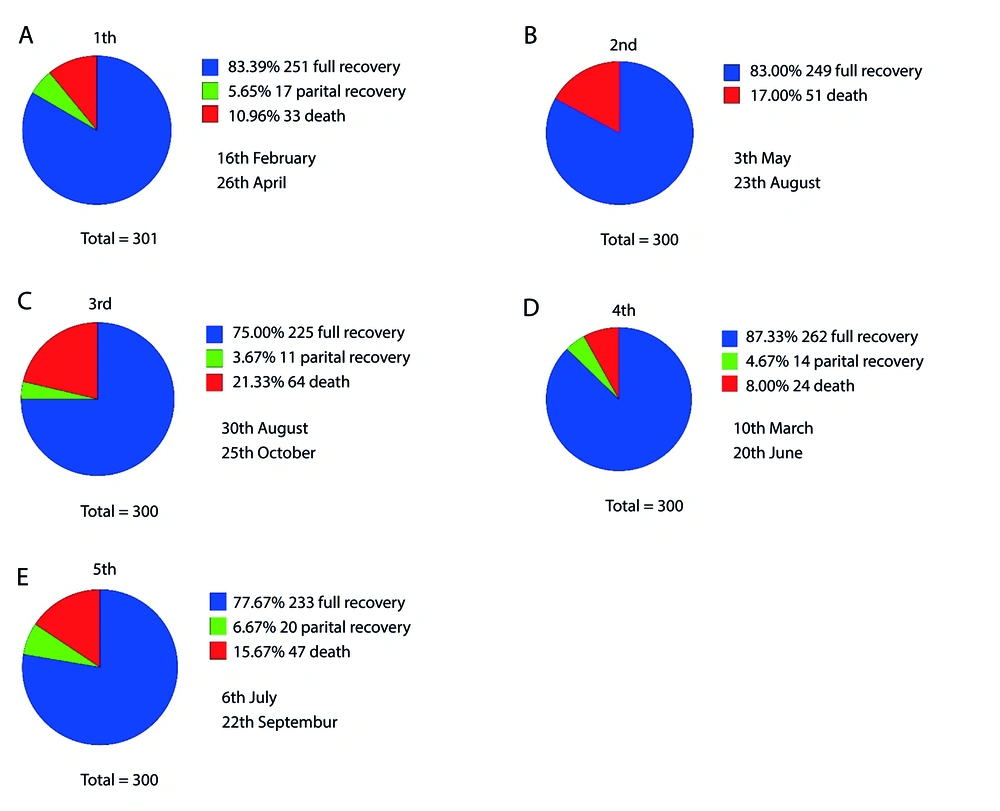
In this study, we investigated LFT findings in COVID-19 patients, considering the timeline of the disease. From November 2019 to September 2021, our country experienced five waves of the disease, each caused by different strains resulting from multiple mutations in the virus genome (
10). Mutations in the viral genome can occur due to various factors, including viral replication enzymes, host enzymes, recombination events, spontaneous nucleic acid damage, and specific genetic elements responsible for the production of new variants (
9). Although SARS-CoV-2 has fewer mutations compared to most RNA viruses due to its error-correcting enzyme, it still undergoes mutations to evade the immune response, develop drug resistance, and adapt to its host (
9,
11). Several mutations, such as B.1.1.7 (alpha), B.1.351 (beta), P.1 (gamma), and B.1.617.2 (delta), have been reported as strains that spread from their original countries (e.g., the UK, South Africa, Brazil, and India) to other nations (
12).
The results of our study revealed that the third wave of the disease, caused by the B.1.1.413 variant, which was initially observed in Western countries, Australia, and Canada (
12), was the most severe among the five waves. It had the greatest impact on disease severity, liver function parameters, and mortality. In contrast, the fourth wave, associated with the B.1.36 variant (originating in China and spreading from west to east) (
12), was the mildest wave, with minimal impact on patient outcomes. However, since the exact variant infecting each patient was not documented in this study, any conclusions regarding the impact of different variants on liver outcomes or the mechanisms underlying these differences will require more in-depth evaluations in future studies.
Although men were more affected than women in all waves, this gender disparity was more pronounced in the stronger waves (waves three and five). Most deaths occurred during waves three, two, and five, in that order. Several studies have reported that men are more susceptible to severe COVID-19 infection and adverse outcomes, including mortality (
13,
14). This gender difference can be attributed to factors such as higher expression of the ACE2 enzyme in men, the influence of male hormones and the X chromosome, lifestyle choices like smoking and alcohol consumption, and women's tendency to adhere more strictly to hygiene practices to prevent SARS-CoV-2 infection (
14).
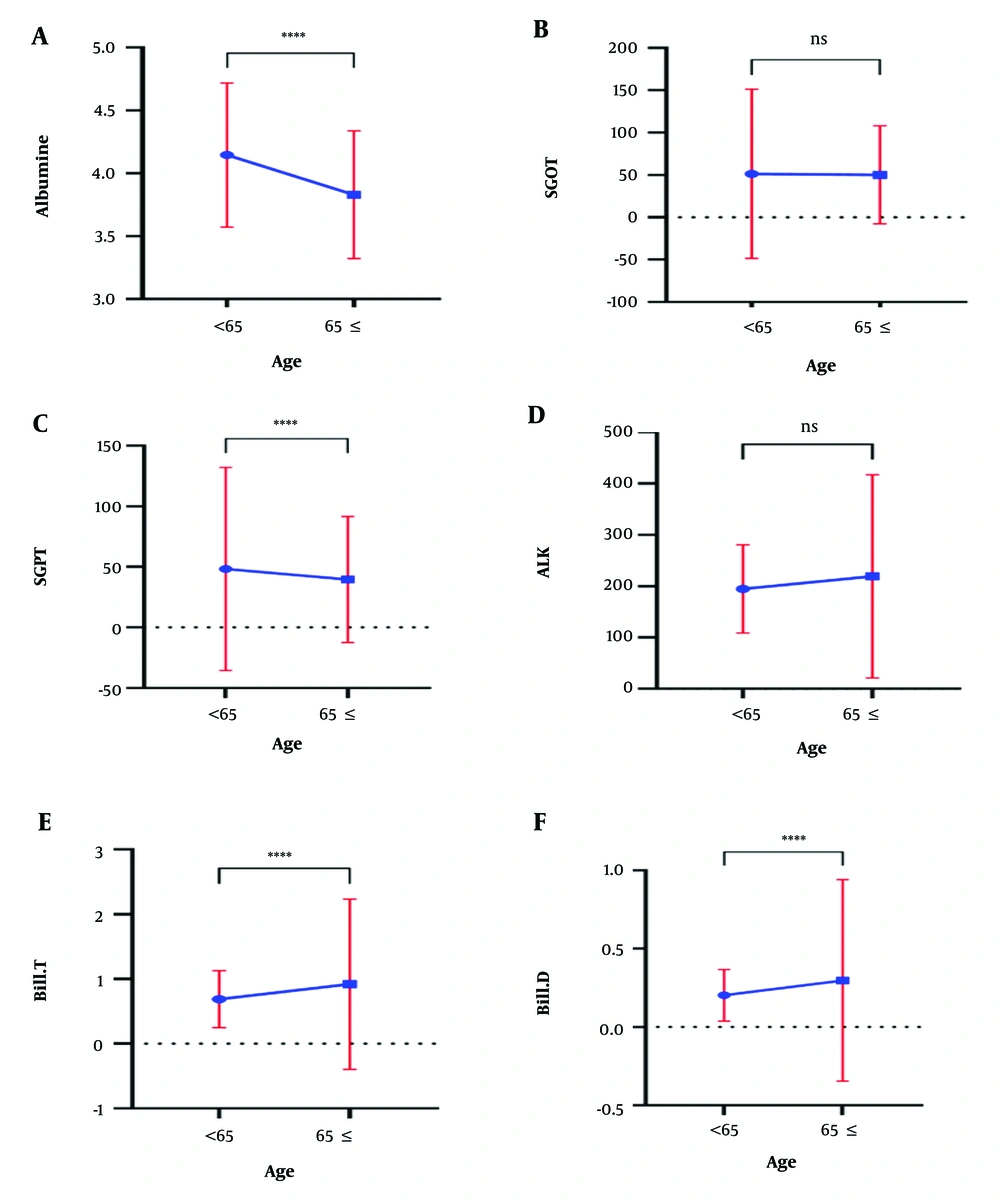
Age, a well-established risk factor in COVID-19, showed a statistically significant relationship with various parameters in our study. The direct association between increasing age and higher mortality rates in COVID-19 patients has been consistently observed in previous studies (
15,
16). In our study, we found that the third wave, which had the highest average age among patients, also had the highest mortality rate. Conversely, the fourth wave had the lowest average age and the lowest mortality rate. Despite most patients being elderly in our study, the average age of patients in the last two waves showed a greater decrease compared to the first two waves. This decrease may reflect factors such as increased virus strength due to mutations, lower vaccination coverage among younger populations, reduced adherence to quarantine and health measures among younger individuals, and a higher susceptibility of younger people to the virus due to their healthier immune systems.
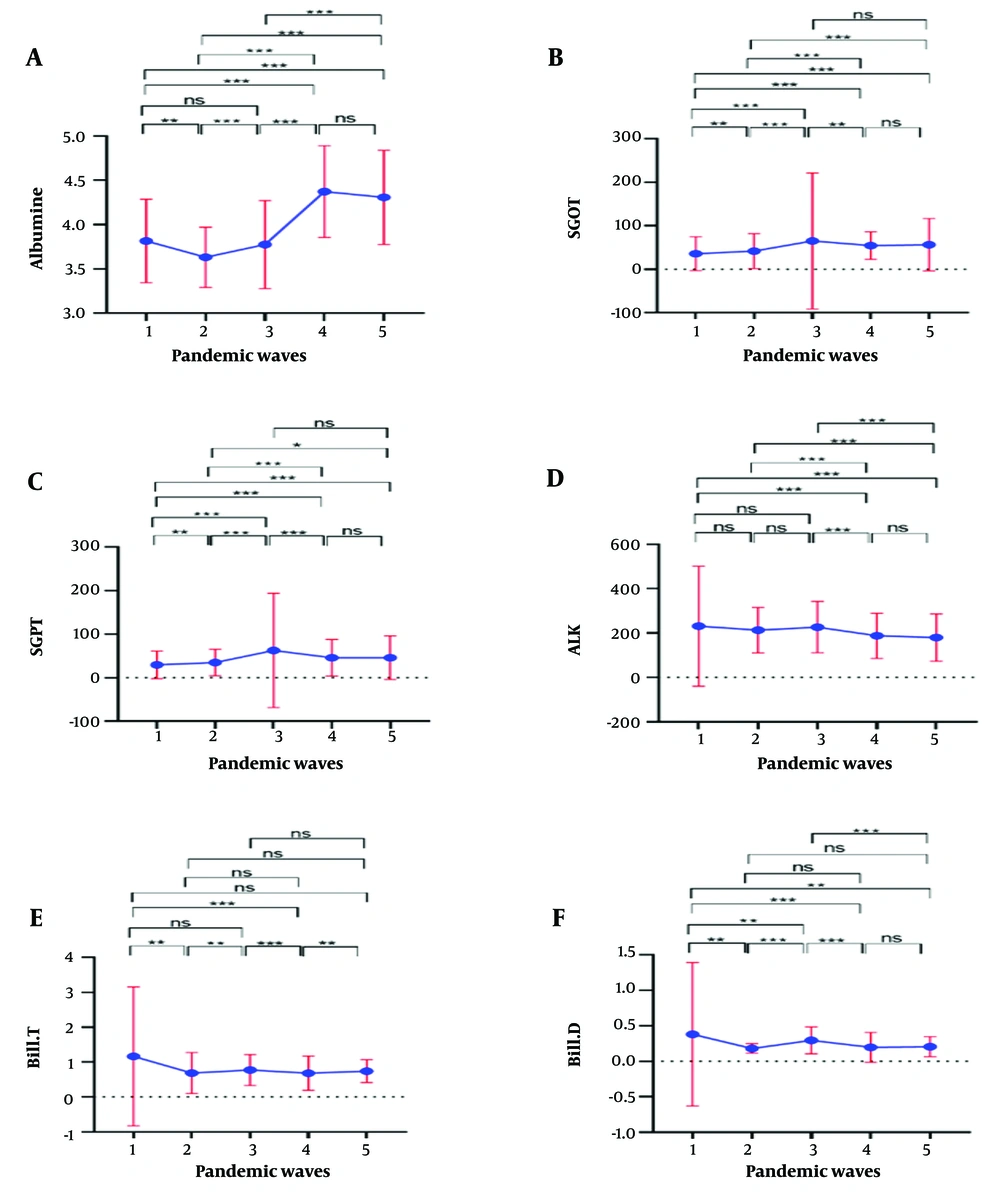
Albumin is a liver-produced protein, and a low level of albumin in serum (below 3.4 g/dL) can indicate liver or kidney dysfunction or other diseases (
15,
16). Although albumin levels were within the normal range in our study across different waves, we observed a greater decrease in albumin levels during the first three waves compared to the last two waves (P < 0.0001). Furthermore, the second and third waves showed the greatest decrease in albumin levels, which also coincided with the highest mortality rates (P < 0.0001). Hypoalbuminemia (albumin below 35 grams per liter) has been reported in 74% of COVID-19 patients in previous studies, with even higher percentages observed in critically ill patients (
15,
16). Similar to our findings, Xu et al. reported hypoalbuminemia in patients with severe COVID-19 infection and suggested it as a predictive factor for infection severity (
15,
16). Reduced albumin synthesis by the liver due to viral proliferation and inhibition of albumin transport-binding sites by SARS-CoV-2 virions are possible explanations for the decreased albumin levels observed during COVID-19 infection.
Bilirubin is a yellow pigment produced from the breakdown of hemoglobin and is an indicator of liver blockage and inflammation when improperly processed by the liver. It is divided into direct and indirect types based on its binding to glucuronic acid (
17). In our study, we investigated bilirubin as a marker for determining liver status in COVID-19 patients. We observed a relationship between increasing age and male gender with bilirubin levels, as well as an association between higher bilirubin levels and increased mortality rates. The first wave had the highest increase in total and direct bilirubin levels. The high expression of ACE2 receptors in bile duct epithelial cells, similar to type 2 alveolar cells, may explain the liver damage caused by the virus and the subsequent elevation of liver parameters such as bilirubin (
18).
Although relatively few studies have been conducted on bilirubin levels in COVID-19 patients, a study by Paliogiannis, which conducted a pooled analysis of six studies, found that five of the studies indicated an increase in bilirubin levels in severe COVID-19 patients compared to those with an intermediate form of the disease (
19). Another study by Liu investigated bilirubin levels as potential indicators of disease severity in COVID-19 patients and found that the death rate among patients with high bilirubin levels was 5.8%, compared to 0.6% among those with normal levels. These patients also tended to have more severe pneumonia and longer recovery durations. Additionally, the increase in conjugated bilirubin (CB) and the ratio of conjugated to unconjugated bilirubin (CB/UCB) were directly associated with disease severity, hospitalization duration, and mortality risk (
20). Therefore, it is important to pay special attention to bilirubin levels in the clinical management of COVID-19 patients.
Aspartate aminotransferase and ALT are essential enzymes found in the heart, liver, kidneys, and muscles. Measuring the levels of these enzymes is crucial for assessing liver health (
21). An increase in these parameters indicates liver damage, and in our study, we observed higher levels of these enzymes in men compared to women. Age did not have a significant effect on AST, but it had a significant inverse relationship with ALT. The third wave had the greatest impact on increasing the levels of these enzymes, and it was also associated with the highest mortality rate. Wang et al.'s meta-analysis study reported an increase in AST and ALT levels associated with patient mortality. Furthermore, the increase in these parameters can serve as a predictive tool for disease recurrence (
22).
The increase in ALT and AST levels is observed in liver damage, which can be attributed to factors such as increased expression of ACE2 receptors in cholangiocytes, cytokine storms caused by an excessive immune response, drug toxicity, and liver failure in patients with multiple organ dysfunction. ACE2 expression is higher in cholangiocytes compared to liver cells, and these cells play a crucial role in liver regeneration and immune response (
23,
24). Liver biopsies from deceased COVID-19 patients have previously shown moderate macrovesicular steatosis and mild globular and portal activity, indicating liver damage (
25). Previous studies on SARS-CoV-2 patients also observed an increase in mitotic cells, along with eosinophilic bodies and ballooned liver cells. The exact cause of these liver injuries is not fully understood but could be attributed to COVID-19 infection, severe inflammatory responses, or drug-induced damage. Similar associations between SARS-CoV and MERS viruses and liver damage have been reported (
23,
24).
Alkaline phosphatase is another enzyme that reflects liver or gallbladder function. Although it is also found in bones, intestines, pancreas, and kidneys, the liver is one of its main sources (
26). In our study, we observed increased levels of ALP among COVID-19 patients, especially in the initial waves (the first and third waves). Although there was no significant relationship between ALP levels and demographic factors (age and sex) in this study, its levels were higher among deceased patients compared to those who had fully or partially recovered. Overall, ALP had weaker associations with other variables compared to the other factors investigated in this study. Hwaiz's study on liver enzymes in COVID-19 patients found that ALP had the lowest percentage increase among other enzymes, at 20.3% (
27). Kumar's study also reported an increase in ALP levels with disease progression (
28), which aligns with the findings of our study, where higher levels were observed among deceased individuals.
Our study faced limitations, such as not evaluating other markers of liver injury or inflammation, such as gamma-glutamyl transferase (GGT), lactate dehydrogenase (LDH), and pro-inflammatory cytokines, as well as the lack of data regarding the ethnicity, socioeconomic status, dietary habits, and alcohol use in the studied cases. These limitations were due to the retrospective nature of the study. Future research with a prospective study design could help provide a more comprehensive understanding of how multiple variables and confounding factors impact the effects of the SARS-CoV-2 virus on liver health. Moreover, future longitudinal investigations of variant-specific changes and how mutations in the viral agent influence liver outcomes and immune responses in COVID-19 patients could significantly contribute to a deeper understanding of the relationship between COVID-19 and liver injury.
5.1. Conclusions
The results of this study showed that the liver is one of the main targets of the coronavirus, and certain mutations of SARS-CoV-2 have increased its cytopathic effect, which has played a significant role in increasing patient mortality by elevating liver enzymes and parameters. Our descriptive study found that older patients and males were more likely to be hospitalized than females. Our findings showed that liver parameters differed between pandemic waves, suggesting varying behaviors of different coronavirus strains. Among these strains, the dominant strain in wave three had the greatest effect on increasing liver parameters, followed by waves one, two, five, and finally, four.