
1. Introduction
Uterine fibroids are the most common tumors of the reproductive system, though their exact prevalence remains unknown as many patients remain asymptomatic and are diagnosed incidentally (1 - 7). When symptomatic, these tumors frequently cause abnormal uterine bleeding (AUB), which affects nearly 70% of patients and represents one of the most common indications for surgical intervention (7 - 8). Other indications for treatment include reduced fertility, dysmenorrhea, and pelvic pain (8).
For submucosal fibroids—those distorting the uterine cavity—hysteroscopic myomectomy is considered the first-line conservative surgical therapy (9). The American Society for Reproductive Medicine (ASRM) recommends resection of fibroids that distort the uterine cavity to improve fertility outcomes and reduce miscarriage risk (7). Preoperative ultrasound is essential to determine the precise location of the fibroid within the uterine cavity before proceeding with surgery (10 - 12).
The procedure requires the use of a liquid medium to distend the uterine cavity, which carries a risk of intravascular absorption—a complication more likely when resection extends into the myometrium. Other reported complications include carbon dioxide embolism, bleeding, and uterine perforation (13).
Despite being a first-line treatment, some studies have reported a risk of surgical re-intervention following hysteroscopic myomectomy, including repeat myomectomy, open myomectomy, or hysterectomy (9, 14). However, there is currently insufficient evidence regarding long-term outcomes for women with symptomatic intracavitary fibroids who undergo this procedure. Such information is particularly important for preoperative counseling and appropriate patient selection (9).
Therefore, in this study, we aim to evaluate the clinical symptoms, complications, and outcomes in patients who underwent hysteroscopic myomectomy at Isfahan Shahid Beheshti and Alzahra Hospitals between 2018 and 2022.
2. Methods
2.1. Sample Selection
In this retrospective study, the medical records of all patients who underwent hysteroscopic myomectomy and have inclusion criteria (between March 2018 and March 2022) at Shahid Beheshti and Alzahra hospitals in Isfahan were assessed. Initially, 382 patients were selected. Then, 55 patients were excluded from the study, and 327 patients remained.
2.2. Procedure
The pathology results for these patients were followed up, and a list of patients with reported myoma pathology was created for further follow-up. The demographic data, including age, number of children, and type of fibroid based on ultrasound or MRI, were extracted from their medical records, along with information about menopausal status, preoperative symptoms, and postoperative complications.
Information, including abnormal bleeding, fertility status before and after surgery, and postoperative complications, including hyponatremia, abnormal bleeding during surgery, and injury to adjacent organs were extracted from medical records.
Data were collected using a researcher-made questionnaire. This information was collected through phone calls. The follow-up period ranged from 3 months to 4 years after surgery.
2.3. Outcome Definition
Outcomes assessed beyond 3 months after surgery were considered long-term. These included symptom resolution, patient satisfaction, fertility outcomes (spontaneous or ART pregnancy), need for repeat hysteroscopic myomectomy, and subsequent hysterectomy. Early postoperative complications and during surgery (e.g., uterine perforation, hyponatremia, hemorrhage, and fever) were categorized as short-term outcomes.
The primary (important) outcome was long-term outcomes, including postoperative clinical pregnancy rate among infertile patients, repeated myomectomy, subsequent TLH, and other outcomes Secondary outcomes included symptoms and perioperative complications and postoperative complications.
2.4. Inclusion and Exclusion Criteria for the Study
Inclusion criteria were as follows: women of reproductive age or postmenopausal women with ultrasound findings indicating submucosal fibroids or fibroids classified as FIGO 0, 1, 2, 3, and 8 (FIGO 8 as a submucosal component); all women with a pathology report confirming the presence of fibroids; and women with infertility or AUB.
Exclusion criteria were as follows: patients who did not respond to follow-up phone calls; patients with incomplete medical records; and patients with unclear fibroid type or unclear reason for referral.
2.5. Hysteroscopic Myomectomy Technique
Hysteroscopic resection of the myoma was performed using a Storz monopolar resectoscope. Cervical priming was achieved with 400 micrograms of misoprostol administered prior to the procedure. Under general anesthesia, with the patient in the lithotomy position and following bladder evacuation, the cervix was grasped and gradually dilated. The resectoscope was then introduced into the uterine cavity, and the submucosal myoma was resected in a layer-by-layer manner under direct visualization.
3. Results
The current study was conducted on 327 patients with a mean age of 43.21 ± 7.035 years. Regarding marital status, 16 participants (4.9%) were single and 311 (95.1%) were married. Additionally, 24 patients (7.3%) were postmenopausal.
The mean duration of surgery was 50.92 ± 24.31 minutes. Partial myomectomy was conducted in 32 patients (9.8%). The mean volume of glycine medium used was 818.20 ± 653.66 mL. The mean myoma size was 30.34 ± 12.91 mm.
Before undergoing myomectomy, the mean number of live births per patient was 1.86 ±1.41, and the mean number of abortions per patient was 0.45 ±0.88.
The frequency of FIGO classification is shown in Table 1.
Table 1.
The Frequency of FIGO
| Variables | Number (%) |
|---|---|
| 0 | 134 (37.01) |
| 1 | 133 (36.7) |
| 2 | 80 (22.09) |
| 3 | 2 (0.55) |
| 8 (cervical fibroid with a submucosal component) | 13 (3.59) |
As shown in Table 1, the most frequent FIGO classification was FIGO 0 (37.01%).
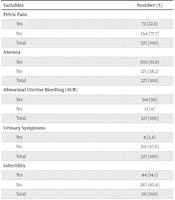
The frequency of clinical symptoms among patients is shown in Table 2.
Table 2.
The Frequency of Clinical Symptoms of Patients
| Variables | Number (%) |
|---|---|
| Pelvic Pain | |
| Yes | 73 (22.3) |
| No | 254 (77.7) |
| Total | 327 (100) |
| Anemia | |
| Yes | 202 (61.8) |
| No | 125 (38.2) |
| Total | 327 (100) |
| Abnormal Uterine Bleeding (AUB) | |
| Yes | 314 (96) |
| No | 13 (4) |
| Total | 327 (100) |
| Urinary Symptoms | |
| Yes | 8 (2.4) |
| No | 319 (97.6) |
| Total | 327 (100) |
| Infertility | |
| Yes | 44 (14.1) |
| No | 267 (85.9) |
| Total | 311 (100) |
As shown in Table 2, pelvic pain, anemia, abnormal uterine bleeding (AUB), urinary symptoms, and infertility were seen in 22.3%, 61.8%, 96%, 2.4%, and 14.1%, respectively. In addition, the most frequently reported clinical symptom was AUB.
The frequency of early (short-term) outcomes among patients is shown in Table 3.
Table 3.
The Frequency of Early (short-Term) Outcomes of Patients
| Variables | Number (%) |
|---|---|
| Uterine Perforation | |
| Yes | 1 (0.3) |
| No | 326 (99.7) |
| Total | 327 (100) |
| Hyponatremia (Serum sodium concentration less than 130 mEq/L) | |
| Yes | 45 (13.8) |
| No | 282 (86.2) |
| Total | 327 (100) |
| Prolonged Hospitalization (hospitalization for more than 1 week) | |
| Yes | 2 (0.6) |
| No | 325 (99.4) |
| Total | 327 (100) |
| Hemorrhage During Surgery (active bleeding exceeding 1 liter) | |
| Yes | 6 (1.8) |
| No | 321 (98.2) |
| Total | 327 (100) |
| Postoperative Fever (≥ 38°C) | |
| Yes | 1 (0.3) |
| No | 326 (99.7) |
| Total | 327 (100) |
As shown in Table 3, uterine perforation, prolonged hospitalization, hemorrhage, and postoperative fever (≥ 38°) were observed in 0.3%, 0.6%, 1.8%, and 0.3%, respectively. Of the 45 patients with hyponatremia, 3 required treatment with furosemide (Lasix) and hypertonic saline.
The frequency of long-term outcomes in patients is shown in Table 4.
Table 4.
The Frequency of Long-Term Outcomes of Patients
| Variables | Number (%) |
|---|---|
| Patient Satisfaction | |
| Yes | 312 (95.4) |
| No | 15 (14.6) |
| Pregnancy by Assisted Reproductive Technology | |
| Yes | 6 (13.64) |
| No | 38 (86.36) |
| Total (Infertile women) | 44 (100) |
| Spontaneous Pregnancy | |
| Yes | 22 (50) |
| No | 22 (50) |
| Total (Infertile women) | 44 (100) |
| Total Pregnancy (Spontaneous + ART) | |
| Yes | 28 (63.63) |
| No | 12 (36.37) |
| Total (Infertile women) | 44 (100) |
| Symptom Resolution | |
| Yes | 231 (70.6) |
| No | 96 (29.4) |
| Total | 327 (100) |
| Repeated Myomectomy (Some fibroids require hysteroscopic intervention due to recurrence) | |
| Yes | 25 (7.6) |
| No | 302 (92.4) |
| Total | 327 (100) |
| Subsequent Total Laparoscopic Hysterectomy | |
| Yes | 35 (10.7) |
| No | 292 (89.3) |
| Total | 327 (100) |
The frequency of outcomes of patients showed that patient satisfaction, and symptom resolution was observed in 95.4% and 70.6% patients, respectively. In addition, among 44 infertile patients, 28 (63.63%) achieved pregnancy, 6 through assisted reproductive technology (ART) and 22 spontaneously. Repeated myomectomy and subsequent TLH were observed in 7.6%, and 10.7%, respectively.
4. Discussion
This study evaluated reproductive and clinical outcomes following hysteroscopic myomectomy in women with submucosal fibroids. Among 44 infertile patients, 28 (63.6%) achieved pregnancy after the procedure; 13.64% conceived using assisted reproductive technology (ART) and 50% conceived spontaneously. These findings indicate that hysteroscopic myomectomy can significantly improve fertility in appropriately selected patients.
Our pregnancy rate is comparable to previous reports. Fonge et al. observed that 22.6% of women conceived using ART after hysteroscopic myomectomy (15), and Litta et al. reported an overall pregnancy rate of 85.8% (16). In contrast, Yu et al. reported a lower pregnancy rate of 25% (17). The lower rate in that study was attributed to possible endometrial injury and postoperative intrauterine adhesions, as well as the presence of concomitant infertility factors (17). Variability in pregnancy outcomes across studies may therefore be explained by differences in patient selection, surgical technique, fibroid size and number, and coexisting infertility causes. Removal of submucosal fibroids likely improves fertility by restoring normal endometrial architecture, enhancing implantation, and reducing inflammatory and mechanical interference with embryo implantation. Clinically, these findings support hysteroscopic myomectomy as a fertility-enhancing procedure before or alongside infertility treatment.
Regarding long-term surgical outcomes, 7.6% of patients underwent repeat myomectomy, suggesting recurrence or incomplete resection, and 10.7% ultimately required total laparoscopic hysterectomy (TLH). Fibroid recurrence is well recognized, as new fibroids may develop or residual tissue may remain after the initial surgery. Similar findings have been reported in the literature: Polena et al. reported repeat surgery in 5.1% of patients with incomplete resection (18), and Derman et al. found that 15.9% of patients required further surgery during 9-year follow-up, while 83.9% did not (19). These data suggest that hysteroscopic resection provides durable symptom control for most patients but not all. Clinically, this emphasizes the importance of long-term follow-up and counseling patients that, although effective, hysteroscopic myomectomy may not prevent future surgery in every case.
Patient-reported outcomes were also favorable. In our study, 95.4% of patients were satisfied with the procedure. This is consistent with the findings of Polena et al., who reported 93.9% satisfaction (18), and Hart et al., who reported 71.4% satisfaction at a mean follow-up of 2.3 years (20). Differences in satisfaction rates likely reflect variations in follow-up duration, symptom severity, and patient expectations. High satisfaction probably results from the minimally invasive nature of hysteroscopic surgery, rapid recovery, and symptom relief. Clinically, these findings reinforce hysteroscopic myomectomy as a patient-acceptable and quality-of-life-improving intervention.
Symptom control further supports the effectiveness of the procedure. In our cohort, 70.6% of patients experienced symptom resolution, whereas 29.4% did not. Similar improvements have been reported previously, including a 94.4% symptom improvement rate in another study (19). Persistent symptoms may be explained by incomplete fibroid removal, recurrence, adenomyosis, or non-structural causes such as anovulatory bleeding. Abnormal uterine bleeding (AUB) was the most common presenting symptom in our patients, consistent with the findings of Ghahiri et al. (21). Therefore, hysteroscopic myomectomy is particularly beneficial for patients with AUB due to submucosal fibroids, although evaluation for other etiologies remains necessary when symptoms persist.
The procedure demonstrated a favorable safety profile. Uterine perforation occurred in 0.3% of cases and postoperative fever in 0.3%. Hemorrhage occurred in 1.8% of patients, and only 0.6% required prolonged hospitalization. These rates are within the range reported in the literature, where major complications occur in approximately 1 - 5% of cases and include fluid overload, hemorrhage, and genital tract trauma (18). Thus, hysteroscopic myomectomy can be considered a safe minimally invasive treatment when performed with appropriate precautions.
Hyponatremia was observed in 13.8% of our patients, using a sodium threshold < 135 mEq/L. The higher rate compared with other reports may be related to differences in diagnostic criteria. However, three patients required treatment with furosemide and hypertonic saline, highlighting the clinical relevance of this complication. Previous reports describe severe cases of hyponatremia following hysteroscopic myomectomy, including a patient who developed acute respiratory distress syndrome and acute kidney injury after serum sodium decreased to 78 mmol/L (22), and another case of water intoxication and cardiac arrest requiring extracorporeal membrane oxygenation (23). These complications are caused by absorption of irrigation fluid during hysteroscopy. Therefore, strict intraoperative fluid monitoring, limiting operative duration, and early correction of electrolyte disturbances are essential preventive strategies. Preferential use of isotonic irrigation solutions, when feasible, may further reduce risk.
Overall, our findings indicate that hysteroscopic myomectomy provides meaningful fertility improvement, effective symptom control, high patient satisfaction, and a low complication rate. The procedure should be considered a first-line uterine-preserving treatment for symptomatic submucosal fibroids, particularly in women desiring fertility, while careful perioperative monitoring and long-term follow-up remain necessary.
4.1. Limitations of This Study
Several limitations of this study should be acknowledged. First, the retrospective design introduces the possibility of selection bias, as only patients with available medical records and successful telephone follow-up were included, and patients lost to follow-up may have had different outcomes. Second, the absence of a control or comparison group prevents causal inference and does not allow direct comparison of hysteroscopic myomectomy with alternative treatments such as medical therapy or other surgical approaches.
In addition, outcome assessment relied partly on patient self-report obtained through telephone interviews, which may be subject to recall bias and misclassification, particularly for symptom resolution and patient satisfaction. Although follow-up extended up to several years, late complications—such as intrauterine adhesions, fibroid recurrence, and delayed need for additional surgery—may have been under-detected because routine imaging or hysteroscopic reevaluation was not performed.
Furthermore, the study population was derived from a single tertiary referral center, which may limit external validity. Heterogeneity in fibroid characteristics (size, number, and FIGO classification) and unmeasured confounders affecting fertility outcomes (e.g., male factor infertility, ovarian reserve, and use of assisted reproductive techniques) also limit interpretation of reproductive results.
Prospective, multicenter studies with standardized postoperative evaluation, objective imaging follow-up, and appropriate comparison groups are required to better determine the long-term safety and effectiveness of hysteroscopic myomectomy.
It is possible that the inclusion criteria for patients with FIGO 1 and 2, but in the hysteroscopy appearance, the myoma had a different FIGO and was included in the study with the hysteroscopy criteria. It was mentioned in the text of manuscript.
4.2. Conclusions
Hysteroscopic myomectomy appears to be an effective and minimally invasive therapeutic option for women with symptomatic uterine fibroids. The procedure was associated with substantial symptom relief and improvement in quality of life, particularly in patients with abnormal uterine bleeding and pelvic discomfort. In addition, the observed reproductive outcomes suggest a beneficial role in selected infertile patients. Overall, hysteroscopic myomectomy can be considered a valuable fertility-preserving intervention when appropriately indicated.