
1. Background
Conduct disorder (CD) is a psychiatric disorder of childhood or adolescence characterized by antisocial behaviors and impaired adherence to social laws and norms (1). According to the fifth edition of the Diagnostic and Statistical Manual of Mental Disorders, CD is characterized by aggression, deception, robbery, destruction of property, and serious violations of rules and laws, often leading to antisocial personality disorder in adulthood (2). Epidemiological studies have reported that CD affects approximately 2% - 9% of girls and 6% - 16% of boys worldwide. Moreover, the onset of this disorder is later in girls than in boys (3-5). Evidence from epidemiological studies conducted in Iran also indicates a substantial burden of psychiatric and disruptive behavioral disorders among Iranian youth (6). These studies have documented notable regional variations influenced by socioeconomic, cultural, and family-related factors, suggesting that the prevalence of CD may be higher in urban and densely populated areas. These findings underscore the need to examine the psychosocial determinants of CD within the Iranian context, where rapid social changes, educational pressures, and shifting family dynamics may contribute to the emergence and persistence of conduct-related problems.
To diagnose CD, at least 3 criteria must have been present during the previous 12 months, including bullying, using any type of weapon, assault, robbery, fire-setting, destruction of property, rape, staying out past curfew, running away, lying, lack of remorse or empathy, and school truancy (7, 8).
According to studies on the etiology of CD, the family environment and parenting style (PST) play important roles (9). Parenting style is defined as a set of behaviors, approaches, and attitudes that parents use when interacting with and raising their children (10). In addition to actual parenting behaviors, the concept of ideal parenting style (IPST) refers to the parenting approach that parents perceive as the most desirable or appropriate for raising their children. Ideal parenting style reflects parents' expectations and beliefs about optimal parenting practices, including emotional support, consistent discipline, effective communication, and appropriate behavioral guidance aimed at promoting healthy child development (11, 12). Accordingly, inappropriate parenting styles, such as unstable parenting, irrational and extreme violence, aggression and punishment, strict rules, lack of empathy, poor parent-child relationships, and insufficient parenting skills, play significant roles in the occurrence of CD among children and adolescents (13, 14). Moreover, unfavorable family-related conditions, such as overcrowded families, inappropriate housing, divorce and separation, personality and mental disorders, alcohol and drug abuse, and poverty, are correlated with the occurrence of CD (15-17).
Because of the broad and important consequences associated with CD, this disorder has been discussed in numerous studies. These consequences are not limited to children and adolescents with CD but may also affect parents and the community (18-20). Many studies have concluded that raising children and adolescents with CD is significantly stressful and challenging for their parents (21, 22). Therefore, parents of children and adolescents with CD may be at risk of impaired quality of life (23). In fact, these parents may experience mental disorders, such as anxiety and depression, which may subsequently affect their parental satisfaction (PSA) (24). Parental satisfaction is defined as the level of satisfaction that parents experience in their parent-child relationship, including activities, communication, praise, punishment, and the child's behavior in relation to responsibilities, compliance, and actions. It is also used to describe parents' satisfaction with their parental role (25).
Previous research has demonstrated a positive and significant correlation between parental satisfaction and parenting style, indicating that parents with favorable parenting styles report acceptable levels of parental satisfaction (26). In addition, parenting barriers and challenges associated with children and adolescents with CD are strongly related to unfavorable parenting styles among their parents (27, 28). Consequently, parental satisfaction among parents of children and adolescents with CD may also be influenced by CD-related limitations, often remaining far from desirable levels.
2. Objectives
Although previous studies have examined the relationships between parenting style, parental satisfaction, and behavioral disorders separately, comprehensive investigations into the interrelationships among PSA, PST, IPST, and CD severity remain limited. Therefore, this study aimed to investigate the relationships among PSA, PST, IPST, and CD severity in children and adolescents, while also considering selected sociodemographic factors. Understanding these relationships may help identify modifiable family-related factors and facilitate the development of preventive and supportive interventions for affected children and their families.
3. Methods
3.1. Study Design and Setting
This cross-sectional study was conducted from June 2023 to January 2024 and aimed to determine PSA and PST among Iranian parents of children and adolescents with CD. The study was conducted at the psychiatric clinics of Imam Hossein Hospital in Tehran, Iran.
3.2. Participants
Participants included one parent of each child or adolescent aged 6 to 17 years with CD who was referred to the psychiatric clinics of Imam Hossein Hospital in Tehran for CD screening. Diagnostic screening for CD was based on the psychiatrist's opinion, medical records and history, and the Rating Scale for Diagnosis of Conduct Disorder (RSDCD). The sample size was calculated using the following formula:
Where z represents the standard normal deviate corresponding to a 95% confidence level (z = 1.96), σ represents the estimated standard deviation of the primary outcome variable (σ ≈ 10), and δ represents the acceptable margin of error (δ ≈ 3). Based on this calculation, the minimum required sample size was estimated to be approximately 43 participants. This estimate guided the initial recruitment process.
Accordingly, among 108 parents of children and adolescents with a definitive diagnosis of CD, 79 met the inclusion criteria and agreed to participate. Ultimately, 60 participants completed all study questionnaires and were included in the final analysis.
3.3. Procedure
To initiate data collection, approval was obtained from the Ethics Committee of Shahid Beheshti University of Medical Sciences (SBMU) and the vice chancellor of SBMU. Verification was then obtained from the education department of Imam Hossein Hospital. Participants were selected by both authors using convenience sampling based on the inclusion criteria. Eligible parents were fathers or mothers of children or adolescents aged 6 to 17 years with CD, based on the psychiatrist's opinion, medical records, and the RSDCD, and whose child had been diagnosed with CD for at least 1 year. In addition, neither the parents nor their children or adolescents had severe physical or psychocognitive disorders that could interfere with participation, as determined by the clinics' psychiatrists, participants' self-reports, and medical history. All participants were required to have sufficient Persian communication skills. Participation was voluntary. Participants who left more than 10% of the questionnaires unanswered were excluded. To ensure the independence of responses, data were collected individually.
After the final participants were identified, the Socio-Demographic Information Questionnaire, Dibble and Cohen Parent Report, and Kansas Parental Satisfaction Scale were provided to participants with comprehensive explanations. In addition, as mentioned earlier, the RSDCD was administered to parents to assess CD severity in their children and adolescents.
3.4. Instruments
The Socio-Demographic Information Questionnaire was designed by the authors and included sociodemographic information about the parents and their children and adolescents with CD. Qualitative content validity was used to evaluate its validity.
The Dibble and Cohen Parent Report, the second instrument used in this study, was developed by Dibble and Cohen in 1974. It consists of 23 items and is used to measure parenting style in 2 conditions: current PST and IPST. Responses are scored on a 7-point Likert scale ranging from never (score 0) to always (score 6). The total score ranges from 0 to 138. A score of 0 to 46 indicates inappropriate PST, a score of 47 to 69 indicates average PST, and a score higher than 69 indicates appropriate PST. The Dibble and Cohen Parent Report demonstrates robust reliability, with prior validation research reporting internal consistency coefficients of 0.76 to 0.84 for the current PST subscale and 0.72 to 0.81 for the IPST subscale (29). Its validity has also been confirmed in several studies (30-33).
The next instrument was the Kansas Parental Satisfaction Scale. This scale was designed by Schumm and Hall in 1985 to evaluate PSA. It consists of 3 items that assess PSA on a 7-point Likert scale from extremely dissatisfied (score 1) to extremely satisfied (score 7). The total score ranges from 3 to 21. A score between 3 and 6 indicates low PSA, a score between 7 and 12 indicates average PSA, and a score higher than 12 indicates high PSA. The reliability of this instrument has been confirmed through internal consistency analysis, with Cronbach α values of 0.78 to 0.85 (34, 35). The Kansas Parental Satisfaction Scale has also shown acceptable validity and has been used in several studies (36-38).
The RSDCD consists of 35 items and 5 factors: aggression, irresponsibility, deception, vandalism, and insufficient interpersonal relationships. Responses are scored on a 5-point Likert scale ranging from never (score 1) to always (score 5). The total score ranges from 35 to 175, with higher scores indicating more severe CD and lower scores indicating milder CD. The construct validity of this questionnaire was calculated using the correlation between the RSDCD and the Child Symptom Inventory-4.
The questionnaires used in this study were validated Persian versions of the original instruments. The Persian version of the Socio-Demographic Information Questionnaire was developed by the authors and examined for content validity. The Persian versions of the Dibble and Cohen Parent Report, the Kansas Parental Satisfaction Scale, and the RSDCD had been previously translated and psychometrically evaluated in Iranian studies.
3.5. Statistical Analysis
Descriptive statistics were used to calculate means, standard deviations, absolute frequencies, and percentage frequencies for sociodemographic and clinical variables. Inferential statistics were used to evaluate the correlations among PSA, PST, and CD severity using the t-test and the Pearson correlation coefficient test. The Spearman correlation coefficient test was used to examine correlations between sociodemographic characteristics and PSA, PST, IPST, and CD severity. In addition, Bayesian regression analysis was used to investigate the mutual correlations and predictive power among PSA, PST, IPST, CD severity, and other demographic characteristics within a comprehensive network of causal and correlational relationships. Bayesian regression analysis was used because it allows examination of a network of mutual relationships among components and variables and helps clarify reciprocal associations, temporal precedence, and the sequence of related factors in a simultaneous, network-based manner. This approach is particularly useful when modeling complex interrelations among multiple variables and estimating probabilistic associations while incorporating prior information (39). Data were analyzed using SPSS version 26, with the test error rate and significance level set at less than 0.05.
3.6. Ethical Considerations
This study was approved by the SBMU Research Ethics Committee, and the ethical code IR.SBMU.RETECH.REC.1401.818 was obtained. The ethical principles of voluntary participation, permission to withdraw, provision of information, and confidentiality were observed throughout all stages of the study. Written informed consent was obtained from all participants.
4. Results
4.1. Sociodemographic Characteristics of Children and Adolescents With CD and Their Parents
Among the 60 parents, most were middle-aged (mother's age, 41.15 ± 7.42 years; father's age, 44.31 ± 7.85 years), female (70.0%), and had at least one employed parent (56.7%). More than half had secondary educational status and medium economic status. Most children and adolescents with CD were in middle childhood (12.51 ± 3.02 years), male (68.3%), and had poor educational status (65.0%) (Table 1).
Table 1.
Sociodemographic Characteristics and Descriptive Indicators of Children/Adolescents with Conduct Disorder and Their Parents a
| Variables | Value |
|---|---|
| Parents | |
| Gender | |
| Male | 18 (30.0) |
| Female | 42 (70.0) |
| Total | 60 (100.0) |
| Occupation status | |
| Both unemployed | 16 (26.7) |
| One employed | 34 (56.7) |
| Both employed | 10 (16.7) |
| Total | 60 (100.0) |
| Educational status | |
| Both primary | 9 (15.0) |
| Both secondary | 32 (53.3) |
| Both higher | 4 (6.7) |
| Primary and secondary | 9 (15.0) |
| Secondary and higher | 6 (10.0) |
| Total | 60 (100.0) |
| Economic status | |
| Poor | 29 (48.3) |
| Medium | 31 (51.7) |
| Total | 60 (100.0) |
| Mental disorders | |
| None | 18 (30.0) |
| One | 20 (33.3) |
| Both | 22 (36.7) |
| Total | 60 (100.0) |
| Habitation | |
| Village | 9 (15.0) |
| City | 51 (85.0) |
| Total | 60 (100.0) |
| Mother's age | 41.15 ± 7.42 (27 - 54) |
| Father's age | 44.31 ± 7.85 (32 - 62) |
| Children and adolescents | |
| Gender | |
| Male | 41 (68.3) |
| Female | 19 (31.7) |
| Total | 60 (100.0) |
| Educational status | |
| Dropout | 14 (23.3) |
| Failed | 3 (5.0) |
| Poor | 39 (65.0) |
| Normal | 4 (6.7) |
| Total | 60 (100.0) |
| Mental disorders | |
| No | 19 (31.7) |
| Yes | 41 (68.3) |
| Total | 60 (100.0) |
| Age | 12.51 ± 3.02 (6 - 17) |
a Values are expressed as No. (%) or mean ± SD (min - max).
4.2. Levels and Values of PSA, PST, and IPST Among Parents of Children and Adolescents With CD
The mean values of PSA, PST, and IPST among parents of children and adolescents with CD were 7.88 ± 3.11, 51.45 ± 11.77, and 60.43 ± 12.78, respectively. Most parents had medium PSA (66.7%). Although most parents had normal levels of PST and IPST (51.7% and 65.0%, respectively), the values of these variables differed depending on the comparison performed (IPST/PST ratio: mean, 1.18; SD, 0.11) (Tables 2-4).
Table 2.
Variables and Values of PSA, PST, and IPST Among Parents of Children and Adolescents with Conduct Disorder a
| Variables | Values |
|---|---|
| PSA | |
| Low (below 6) | 12 (20.0) |
| Medium (6 - 12) | 40 (66.7) |
| High (above 12) | 8 (13.3) |
| Total | 60 (100.0) |
| PST | |
| Inappropriate (below 46) | 21 (35.0) |
| Normal (46 - 69) | 31 (51.7) |
| Appropriate (above 69) | 8 (13.3) |
| Total | 60 (100.0) |
| IPST | |
| Inappropriate (below 46) | 8 (13.3) |
| Normal (46 - 69) | 39 (65.0) |
| Appropriate (above 69) | 13 (21.7) |
| Total | 60 (100.0) |
| PSA | 7.88 ± 3.11 (3 - 17) |
| PST | 51.45 ± 11.77 (33 - 83) |
| IPST | 60.43 ± 12.78 (41 - 97) |
a Values are expressed as No. (%) or mean ± SD (min - max).
Table 3.
Levels of PSA, PST, and IPST Among Parents of Children and Adolescents with CD
| Variables | Absolute t Value | df | Statistical Significance | Mean Difference | 95% CI, Lower | 95% CI, Upper |
|---|---|---|---|---|---|---|
| PSA | 19.64 | 59 | 0.001 | 7.88 | 7.08 | 8.69 |
| PST | 33.84 | 59 | 0.001 | 51.45 | 48.41 | 54.49 |
| IPST | 36.61 | 59 | 0.001 | 60.43 | 57.13 | 63.74 |
Table 4.
Ratio Statistics for IPST/PST
| Variables | Values |
|---|---|
| Mean | 1.18 |
| Minimum | 0.97 |
| Maximum | 1.53 |
| SD | 0.11 |
| Range | 0.56 |
4.3. Severity of CD Among Children and Adolescents
The mean CD severity score among children and adolescents with CD was considerable (146.42 ± 17.14). The lower and upper confidence limits of CD severity were 141.99 and 150.85, respectively, further emphasizing this severity (Table 5).
Table 5.
Severity of CD in Children and Adolescents with the Disorder
| Variables | Severity of CD |
|---|---|
| Absolute t value | 66.16 |
| df | 59 |
| Statistical significance | 0.001 |
| Mean difference | 146.42 |
| 95% CI (lower - upper) | 141.99 - 150.85 |
| No. (min - max) | 60 (111 - 171) |
| Mean ± SD | 146.42 ± 17.14 |
| SE mean | 2.21 |
4.4. Cross-Correlations Among CD Severity, PSA, PST, and IPST
According to the Pearson correlation coefficient test, significant inverse correlations were observed between CD severity and PST (r = -0.44, P = 0.001), IPST (r = -0.42, P = 0.001), and PSA (r = -0.27, P = 0.03). In addition, PSA showed positive, significant correlations with PST (r = 0.62, P = 0.001) and IPST (r = 0.65, P = 0.001) (Table 6).
Table 6.
Pearson Correlation Coefficients Between CD Severity, PSA, PST, and IPST
| Variables and Measures | Severity of CD | PSA | PST | IPST |
|---|---|---|---|---|
| Severity of CD | ||||
| Pearson correlation | 1 | -0.27 a | -0.44 a | -0.42 a |
| P-value (2-tailed) | - | 0.03 | 0.001 | 0.001 |
| N | 60 | 60 | 60 | 60 |
| PSA | ||||
| Pearson correlation | -0.27 a | 1 | 0.62 a | 0.65 a |
| P-value (2-tailed) | 0.03 | - | 0.001 | 0.001 |
| N | 60 | 60 | 60 | 60 |
| PST | ||||
| Pearson correlation | -0.44 a | 0.62 a | 1 | 0.91 a |
| P-value (2-tailed) | 0.001 | 0.001 | - | 0.001 |
| N | 60 | 60 | 60 | 60 |
| IPST | ||||
| Pearson correlation | -0.42 a | 0.65 a | 0.91 a | 1 |
| P-value (2-tailed) | 0.001 | 0.001 | 0.001 | - |
| N | 60 | 60 | 60 | 60 |
a Significant at the 0.05 level.
4.5. Correlations Between Sociodemographic Characteristics and PSA, PST, IPST, and CD Severity
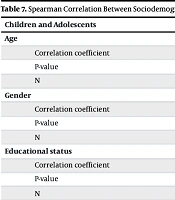
According to the Spearman correlation coefficient test results, several correlations were observed among these variables. Specifically, significant inverse correlations were found between PST and IPST and parental mental disorders (r = -0.331, P = 0.005; r = -0.258, P = 0.023, respectively) and between IPST and fathers' age (r = -0.234, P = 0.036). Conversely, positive and significant correlations were observed between PSA, PST, and IPST and parental economic status (r = 0.291, P = 0.012; r = 0.374, P = 0.002; and r = 0.422, P = 0.001, respectively) and between PSA, PST, and IPST and parental educational status (r = 0.264, P = 0.021; r = 0.305, P = 0.009; and r = 0.345, P = 0.004, respectively). In addition, various correlations were observed between CD severity and the sociodemographic characteristics and descriptive indicators of children and adolescents with CD; however, they were not significant (Tables 7 and 8).
Table 7.
Spearman Correlation Between Sociodemographic/Descriptive Indicators and CD Severity
| Children and Adolescents | Severity of CD |
|---|---|
| Age | |
| Correlation coefficient | 0.175 |
| P-value | 0.181 |
| N | 60 |
| Gender | |
| Correlation coefficient | 0.019 |
| P-value | 0.887 |
| N | 60 |
| Educational status | |
| Correlation coefficient | -0.227 |
| P-value | 0.082 |
| N | 60 |
| Mental disorders | |
| Correlation coefficient | 0.078 |
| P-value | 0.555 |
| N | 60 |
Table 8.
Spearman’s Rho Correlation Between Sociodemographic/Descriptive Indicators and PSA, PST, IPST Severity
| Mother's Age | PST | IPST | PSA |
|---|---|---|---|
| Correlation coefficient | -0.127 | -0.109 | -0.185 |
| P-value | 0.167 | 0.205 | 0.078 |
| N | 60 | 60 | 60 |
| Father's age | |||
| Correlation coefficient | -0.181 | -0.234 a | -0.173 |
| P-value | 0.083 | 0.036 | 0.093 |
| N | 60 | 60 | 60 |
| Gender | |||
| Correlation coefficient | -0.121 | -0.095 | -0.111 |
| P-value | 0.179 | 0.236 | 0.199 |
| N | 60 | 60 | 60 |
| Economic status | |||
| Correlation coefficient | 0.374 a | 0.422 a | 0.291 a |
| P-value | 0.002 | 0.001 | 0.012 |
| N | 60 | 60 | 60 |
| Habitation | |||
| Correlation coefficient | 0.078 | 0.019 | 0.110 |
| P-value | 0.278 | 0.442 | 0.201 |
| N | 60 | 60 | 60 |
| Occupation status | |||
| Correlation coefficient | 0.195 | 0.210 | 0.015 |
| P-value | 0.068 | 0.053 | 0.455 |
| N | 60 | 60 | 60 |
| Educational status | |||
| Correlation coefficient | 0.305 a | 0.345 a | 0.264 a |
| P-value | 0.009 | 0.004 | 0.021 |
| N | 60 | 60 | 60 |
| Mental disorders | |||
| Correlation coefficient | -0.331 a | -0.258 a | -0.162 |
| P-value | 0.005 | 0.023 | 0.109 |
| N | 60 | 60 | 60 |
a Significant at the 0.05 level.
4.6. Mutual Correlations and Predictive Power Based on Bayesian Regression Analysis
Bayesian analysis revealed notable findings as a network of mutual correlations and predictive power among PSA, PST, CD severity, and sociodemographic characteristics (Table 9).
Table 9.
Mutual Correlations and Predictive Effects of PSA, PST, IPST, CD Severity, and Sociodemographic Variables Based on Bayesian Regression
| Bayesian Mutual Correlations | Bayesian Factor | Statistical Significance a |
|---|---|---|
| Children and adolescents | ||
| CD × educational status | 0.11 | 0.01 |
| Parents | ||
| PST × IPST | 0.08 | 0.01 |
| PST × CD | 0.11 | 0.02 |
| PST × economic status | 0.09 | 0.04 |
| PST × mental disorders | 0.08 | 0.02 |
| PSA × CD | 0.13 | 0.04 |
| PSA × economic status | 0.06 | 0.02 |
| PSA × educational status | 0.13 | 0.01 |
a P < 0.05 is significant.
5. Discussion
This cross-sectional study aimed to determine CD severity among Iranian children and adolescents and the levels of PSA and PST among their parents, as well as the cross-correlations among these variables and other sociodemographic indicators.
The severity of CD among the children and adolescents of the participants in this study was substantial. This level of severity may affect parenting-related characteristics through CD-related parental problems, as indicated by several studies (20, 40, 41). Parental satisfaction is one such characteristic. In this study, most parents of children and adolescents with CD had moderate levels of PSA. In other words, PSA levels were far from ideal. In this regard, studies by Viefhaus et al. (42), Bjørknes and Ortiz-Barreda (43) and Matalon and Turliuc (44) emphasized undesirable PSA levels among parents of children and adolescents with CD, which is consistent with the findings of this study. These findings may reflect the cumulative psychological burden experienced by parents when managing persistent behavioral problems in their children, which can gradually undermine parental confidence, perceived competence, and satisfaction with the parenting role.
The subsequent variables examined were PST and IPST, both of which were within the normal range in the present sample. Although IPST, representing parents' perceived ideal parenting satisfaction, was descriptively higher than PST, this difference did not reach statistical significance. From a critical standpoint, the lack of a significant discrepancy may initially be viewed as concerning, as it could suggest that parents perceive their current parenting satisfaction as sufficiently aligned with their ideal standards and, therefore, do not recognize a need for modification or improvement. This interpretation is supported by previous studies (45-47), which suggest that limited divergence between perceived and ideal parenting may reflect reduced motivation for change.
Furthermore, a substantial body of literature has consistently reported suboptimal PST among parents of children and adolescents with CD (1, 48). In this context, the findings of the present study appear consistent with previous evidence of undesirable parenting satisfaction levels. However, previous research has rarely examined or reported the specific gap between PST and IPST. Therefore, the absence of a discrepancy in this study introduces interpretive complexity.
One possible explanation is that the alignment between PST and IPST reflects a form of maladaptive resignation, whereby parents adjust their ideal standards to match their current experiences. This interpretation reinforces the need for structured psychoeducational interventions aimed at increasing awareness of evidence-based parenting standards, particularly given evidence that parenting education can improve family functioning and parental well-being and reduce child behavioral problems (49). However, this pattern should not be interpreted exclusively as dysfunctional. An alternative explanation is that the observed congruence between PST and IPST represents parental realism and self-awareness, indicating cognitive consistency rather than resistance to change. In this view, parents may have a relatively accurate perception of their parenting practices. Nevertheless, given that the overall parenting-related indicators in this study were not optimal, parents' conceptualization of ideal parenting may have been shaped by contextual constraints and prior lived experiences. Accordingly, psychoeducational interventions should not only promote behavioral modification but also broaden parents' understanding of adaptive parenting strategies and developmental expectations.
Another aim of this study was to determine the cross-correlations among the main variables. Significant inverse correlations were found between CD severity and PSA, PST, and IPST, indicating that more severe CD among children and adolescents was correlated with lower PSA, PST, and IPST among their parents. Several studies are consistent with these findings, indicating that lower levels of PST among parents are associated with more severe CD among their children and adolescents (16, 17). Consequently, lower PSA among parents may result from more severe CD among children and adolescents (43, 44, 50). As expected, positive and significant cross-correlations were also observed among PST, IPST, and PSA in parents of children and adolescents with CD. In fact, parents with higher PSA levels demonstrated higher PST and IPST levels, and vice versa. Several studies have emphasized these cross-correlations (51, 52). These findings are consistent with family systems perspectives, suggesting that parenting behaviors, parental perceptions, and emotional experiences are dynamically interconnected. When parents feel more satisfied and competent in their parenting role, they are more likely to adopt consistent and constructive parenting strategies, which may, in turn, mitigate behavioral difficulties in children.
To clarify the cross-correlations between sociodemographic characteristics and descriptive indicators and the main variables, child- and adolescent-related variables were examined for their potential correlations with CD severity. Parent-related variables were then examined in relation to PSA, PST, and IPST. More severe CD was more prevalent among children and adolescents who were older, male, had lower educational status, and had a history of mental disorders. However, none of these correlations were significant. This lack of statistical significance is an important and somewhat unexpected finding. One possible explanation is that the clinical nature of the study sample may have reduced variability in CD severity, thereby limiting the ability to detect significant differences between sociodemographic groups. In addition, behavioral disorders such as CD are influenced by complex interactions among biological, familial, and environmental factors; therefore, single sociodemographic indicators may not independently predict symptom severity within clinical populations.
Nevertheless, the results were consistent with studies indicating that more severe CD is associated with older age, male sex (53), poor educational status (54), and the presence of other mental disorders (55).
Regarding the parent-related variables, the results were significant. Younger parents demonstrated higher levels of PST, IPST, and PSA. Several mechanisms may account for this pattern. Younger parents may have greater exposure to contemporary parenting resources, digital educational materials, and evidence-based child-rearing practices, which could influence their parenting strategies and perceptions. In addition, generational differences in attitudes toward emotional communication, child autonomy, and nonpunitive discipline may contribute to variations in parenting experiences across age groups. The validity of this theory has been confirmed in several studies (26, 56, 57). In addition, the study by Jadva et al. (58) emphasized better parental relationships, PST, and PSA among younger parents compared with older parents.
In this study, PSA, PST, and IPST levels among mothers and urban residents were higher than those among fathers and rural residents. Similar studies have reported different results (50, 59, 60). Such heterogeneity across studies may stem from cultural norms, differences in parental roles, and variations in access to educational and mental health resources. For example, mothers in many cultural contexts tend to assume a more central caregiving role, which may increase both their involvement in parenting practices and their awareness of parenting challenges. Furthermore, higher levels of PST, IPST, and PSA were observed among participants who were employed and had higher educational and economic status. Socioeconomic resources may provide parents with greater access to parenting knowledge, psychological support services, and stable family environments, which can facilitate more adaptive parenting practices and higher parental satisfaction. Several studies support this theory (61, 62). In addition, similar studies have produced findings consistent with those of the present study (43, 63, 64). It should be noted that PST, IPST, and PSA among parents with a history of mental disorders were significantly lower than those among healthy parents. In fact, mental disorders among parents may disrupt PST, which in turn leads to lower PSA. This correlation has been emphasized by several studies (50, 63, 65).
In conclusion, the Bayesian regression results supported previous findings by demonstrating a network of mutual relationships. Significant predictive power was observed between higher educational status among children and adolescents and milder CD, as well as between more favorable PST, IPST, and PSA and lower CD severity, absence of mental disorders, and better educational and economic status. Each relationship proposed in this study, framed as an integrated network of mutual relationships among variables, aligns with previous studies that addressed some of these relationships separately and linearly (50, 54, 62, 63, 65).
5.1. Limitations
The findings of this study should be interpreted in light of several limitations. The relatively small sample size and inclusion of participants exclusively from Tehran may limit statistical power and the generalizability of the findings to broader populations. In addition, the study was conducted in a single-center governmental hospital, which may introduce selection bias, as individuals seeking care in public medical centers may differ socioeconomically from those attending private clinics. Variability in parent-child relationships related to diverse sociodemographic and diagnostic backgrounds may also have influenced the results. Furthermore, access to parents of children and adolescents with CD might have been affected by factors such as economic constraints, negative attitudes toward psychiatric services, limited awareness, or undiagnosed cases of CD. Methodological factors should also be considered, as the use of convenience sampling and self-report instruments may introduce potential bias, including social desirability effects. Moreover, the cross-sectional design restricts the ability to establish causal relationships between parenting-related variables and CD severity.
Nevertheless, several measures were implemented to mitigate these limitations, including the use of validated standardized instruments, clearly defined inclusion criteria, and statistical analyses aimed at strengthening the reliability and interpretability of the findings. Therefore, the results should be interpreted cautiously and confirmed in future multicenter and longitudinal studies.
5.2. Implications
The implications of this study include the importance of assessing and addressing parenting style and parental satisfaction in the treatment and management of CD in children and adolescents. The significant inverse correlations between CD severity and parenting style and satisfaction highlight the potential influence of parental involvement on the behavior and well-being of affected individuals. Understanding the interplay between demographic characteristics and parenting factors can also aid in the development of tailored interventions for families dealing with CD. In addition, the strong mutual correlations and predictive power identified through Bayesian analysis suggest the need for a comprehensive approach that considers both individual and environmental factors in the assessment and treatment of CD. Overall, these findings emphasize the crucial role of parental support and effective parenting strategies in addressing CD in children and adolescents.
5.3. Clinical Applications
The findings of this study offer several implications for clinical practice. Given the identified correlations, mental health professionals should incorporate regular assessments of parental satisfaction and parenting style into standard care protocols for children with CD. Specifically, targeted psychoeducational interventions are needed for parents to improve emotional regulation and parenting efficacy. By empowering parents through education, clinicians may improve the long-term prognosis of children with CD. Furthermore, the predictive network identified through Bayesian analysis suggests that mental health services should adopt a multidisciplinary approach that addresses not only the child's behavioral symptoms but also the parental psychosocial environment, including economic and educational stressors that affect parenting quality.
5.4. Conclusions
The severity of CD among Iranian children and adolescents was considerable. In addition, PSA, PST, and IPST levels among most Iranian parents of children and adolescents with CD were normal. CD severity had significant inverse correlations with PST, IPST, and PSA. Finally, among the mutual correlations between the sociodemographic characteristics of participants and their children and adolescents and PSA, PST, IPST, and CD severity, significant findings included inverse correlations between PST and IPST and parental mental disorders, an inverse correlation between IPST and parental age, and positive correlations between PSA, PST, and IPST and the economic and educational status of parents.