
J Microbiota

Image Credit:J Microbiota

MicroRNA Regulation in Sexually Transmitted Diseases: Pathogenic Mechanisms and Clinical Implications

Author(s):
Mahsa KhosrojerdiMahsa Khosrojerdi1, Seyyed Ahmad HashemiSeyyed Ahmad Hashemi2, Reza BesharatiReza Besharati3, Ali HaghbinAli Haghbin4, Ahmad Vosughi-MotlaghAhmad Vosughi-Motlagh4, Amir AzimianAmir AzimianAmir Azimian ORCID3,*
1Department of Immunology and Allergy, Faculty of Medicine, Mashhad University of Medical Sciences, Mashhad, Iran
2Vector-Borne Diseases Research Center, North Khorasan University of Medical Sciences, Bojnurd, Iran
3Department of Pathobiology and Laboratory Sciences, Faculty of Medicine, North Khorasan University of Medical Sciences, Bojnurd, Iran
4Department of Pediatrics, Faculty of Medicine, North Khorasan University of Medical Sciences, Bojnourd, Iran

Journal of Microbiota:Vol. 2, issue 2; e167259
Published online:Dec 29, 2025
Article type:Review Article
Received:Oct 15, 2025
Accepted:Dec 24, 2025
How to Cite:Khosrojerdi M, Hashemi S A, Besharati R, Haghbin A, Vosughi-Motlagh A, et al. MicroRNA Regulation in Sexually Transmitted Diseases: Pathogenic Mechanisms and Clinical Implications.J Microbiota.2025;2(2):e167259.https://doi.org/10.69107/jmb-167259.

Abstract

Background:

Sexually transmitted diseases (STDs), including viral and bacterial infections such as genital warts, syphilis, gonorrhea, and Chlamydia trachomatis (CT), present ongoing global health challenges. MicroRNAs (miRNAs) have emerged as critical regulators of host-pathogen interactions, offering novel insights into disease mechanisms and potential clinical applications.

Objectives:

This review synthesizes current evidence on the role of miRNAs in STD pathogenesis, with a focus on their regulatory functions in immune response modulation, signaling pathway disruption, and clinical relevance as biomarkers and therapeutic targets.

Methods:

We conducted a comprehensive analysis of miRNA studies related to STDs, integrating data from in vitro, in vivo, and clinical research to evaluate their influence on disease progression and outcomes.

Results:

Dysregulated miRNAs are central to STD pathogenesis. In HPV-induced genital warts, miR-34a-5p downregulation correlates with PD-L1 upregulation, while miR-26a and miR-143/145 disrupt PTEN and PI3K/AKT signaling. Syphilis exhibits elevated miR-338-5p in latent infections and miR-142-3p-mediated immune evasion. In gonorrhea, miR-146a suppresses NF-κB signaling, aiding bacterial survival, whereas Chlamydia infections involve miR-30c-5p and miR-135a in bacterial clearance and T-cell regulation. MicroRNAs modulate key pathways such as PI3K/AKT, TLR, and NF-κB, influencing immune responses and disease progression across STDs. Their diagnostic and therapeutic potential is promising but requires further clinical validation.

Conclusions:

MicroRNAs represent valuable biomarkers and therapeutic targets for STDs. Future research should prioritize mechanistic elucidation and translational studies to advance STD management strategies.

1. Introduction

Sexually transmitted diseases (STDs) constitute a major global public health burden, transmitted through sexual contact and associated behaviors (1). These infections, which include viral agents such as human papillomavirus (HPV) and bacterial pathogens like Treponema pallidum, Neisseria gonorrhoeae, and Chlamydia trachomatis (CT), contribute significantly to morbidity, reproductive health complications, and socioeconomic strain (2, 3). Despite ongoing efforts, prevention and treatment strategies remain suboptimal, underscoring the need for novel molecular insights (4).

Recent advances in genomics and bioinformatics have highlighted the regulatory roles of microRNAs (miRNAs) in infectious diseases. MicroRNAs are small, non-coding RNAs that fine-tune gene expression post-transcriptionally, influencing immune responses, cellular signaling, and pathogen persistence (5-7). In STDs, miRNA dysregulation has been linked to disease progression, immune evasion, and clinical outcomes, presenting opportunities for improved diagnostics and targeted therapies (8, 9). This review aims to consolidate current knowledge on miRNA involvement in both viral and bacterial STDs, with an emphasis on mechanistic pathways and clinical implications, thereby addressing a critical gap in the integrative understanding of miRNA-mediated regulation in STD pathogenesis.

2. Structure and Function of MicroRNAs

MicroRNAs are highly conserved, single-stranded noncoding RNAs, typically 21–25 nucleotides in length, that regulate gene expression post-transcriptionally (10, 11). By binding to the 3′-untranslated region (3′-UTR) of target mRNAs, miRNAs guide the RNA-induced silencing complex (RISC) to degrade transcripts or suppress translation (12, 13). This regulatory capacity allows miRNAs to maintain cellular homeostasis under physiological conditions.

In pathological states, miRNA expression is frequently altered, contributing to diseases such as cancers, inflammatory disorders, and infections (14, 15). Conversely, certain miRNAs may also promote homeostasis, reflecting their dual roles in health and disease. In the context of STDs, miRNAs modulate host immune responses and pathogen-related signaling pathways, influencing infection outcomes (8, 16).

3. Correlation Between MicroRNAs and Sexually Transmitted Diseases

3.1. Role of MicroRNAs in Genital Warts

Genital warts, or condyloma acuminatum (CA), are primarily caused by HPV types 6 and 11 (17). HPV enters basal epithelial cells and replicates during epithelial differentiation, leading to lesion formation (18). Clinically, genital warts are classified into four types: Classic CA, keratotic warts, popular warts, and flat warts, all characterized by high contagiosity and recurrence (19).

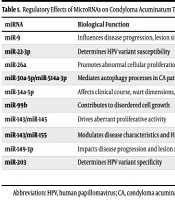
MicroRNAs play a pivotal role in CA pathogenesis by regulating cell proliferation, apoptosis, and differentiation. For example, miR-34a-5p is downregulated in CA tissues, while PD-L1 is upregulated, demonstrating an inverse correlation with diagnostic potential (AUC: 0.954) (20). miR-26a overexpression degrades PTEN mRNA, impairing tumor suppression (21). Loss of miR-143 or miR-145 disrupts NRAS/PI3K/AKT signaling (22), and reduced miR-99b elevates IGF-1R expression, further activating PI3K/AKT and driving proliferation (23). Autophagy-related miRNAs, such as miR-30a-5p and miR-514a-3p, are diminished in CA, while autophagy proteins (Atg5, Atg12, Atg3) are upregulated (24). Additional miRNAs, including miR-22-3p (25), miR-31, miR-9 (26), miR-155, and miR-203 (27), correlate with wart size, HPV subtype, and recurrence, though their precise mechanisms require further study (Table 1).

Table 1. Regulatory Effects of MicroRNAs on Condyloma Acuminatum Through Host Protein Modulation
miRNABiological FunctionMolecular TargetRef
miR-9 Influences disease progression, lesion size, and HPV strain specificityHK2(28)
miR-22-3p Determines HPV variant susceptibilityVEGF(29)
miR-26a Promotes abnormal cellular proliferationPTEN(30)
miR-30a-5p/miR-514a-3pMediates autophagy processes in CA pathogenesisAtg5, Atg12, Atg3(31)
miR-34a-5p Affects clinical course, wart dimensions, HPV subtype, and diagnostic potentialPD-L1(32)
miR-99bContributes to disordered cell growthIGF-1R(24)
miR-143/miR-145 Drives aberrant proliferative activityNRAS, PI3K p110α, and phosphorylated AKT(33)
miR-143/miR-155 Modulates disease characteristics and HPV strain specificityNRAS, PI3K p110α, and phosphorylated AKT(34)
miR-149-3p Impacts disease progression and lesion morphologyHE4(35)
miR-203 Determines HPV variant specificityp63 and Survivin(36)

Abbreviations: HPV, human papillomavirus; CA, condyloma acuminatum; HK2, hexokinase 2; VEGF, vascular endothelial growth factor; PTEN, phosphatase and tensin homolog; Atg, autophagy-related proteins; PD-L1, programmed death-ligand 1; IGF-1R, insulin-like growth factor 1 receptor; HE4, human epididymis protein 4; MicroRNAs, miRNA, microRNA.

3.2. Role of MicroRNAs in Syphilis

Syphilis, caused by Treponema pallidum, progresses through distinct clinical stages (37). Beyond traditional serological tests (28), miRNAs show promise for early detection and monitoring. miR-338-5p is elevated in latent syphilis and associated with T-cell receptor signaling (38). Differential expression of miR-195-5p, miR-223-3p, and miR-589-3p distinguishes serofast from cured patients (39). Mechanistically, miR-101-3p downregulates TLR2, reducing cytokine production in macrophages (31), while miR-142-3p impairs phagocytosis in dendritic cells and macrophages during secondary syphilis (35) (Table 2).

Table 2. MicroRNAs Modulate Syphilis Infection by Regulating Host Proteins
miRNABiological FunctionMolecular TargetRef
miR-101-3p Suppresses cytokine production in macrophagesTLR2 3' UTR(4)
miR-142-3p Enhances syphilis disease progressionDC(6)
miR-195-5p/miR223-3p, mir-598-3p Serves as diagnostic biomarker and treatment response predictorMultiple gene targets(40)
miR-338-5p Identifies serofast patients and aids in latent syphilis diagnosisRANBP17, XPO1, and XPO6(2)

Abbreviations: TLR2, toll-like receptor 2; UTR, untranslated region; DC, dendritic cells; RANBP17, RAN binding protein 17; XPO1, Exportin 1; XPO6, Exportin 6; miRNA, microRNA.

3.3. Role of MicroRNAs in Gonorrhea

Gonorrhea, caused by Neisseria gonorrhoeae, affects millions annually, with rising antimicrobial resistance (33, 41). Bacterial lipo-oligosaccharide (LOS) induces miR-146a overexpression in monocytes, inhibiting NF-κB via IRAK1/TRAF6 and suppressing TNF-α and IL-1β production, which may facilitate bacterial persistence (42). Reduced miR-718 in infected macrophages enhances PI3K/AKT signaling via PTEN downregulation, dampening inflammatory responses and increasing host susceptibility (43).

3.4. Role of MicroRNAs in Genital Chlamydia trachomatis Infection

The CT infections are often asymptomatic but can lead to pelvic inflammatory disease and infertility (36, 44). Dysregulated miRNAs influence susceptibility and outcomes. miR-146a and miR-155 alter vaginal microbiota and T-cell function (45). Symptomatic infections show elevated miR-142 and miR-147, while asymptomatic cases upregulate miR-449c, miR-6779, and miR-519d (46). Experimentally, miR-378b deficiency impairs bacterial clearance but reduces inflammation (47). miR-30c-5p modulates mitochondrial dynamics via Drp1, inhibiting CT replication (48), and miR-135a regulates CD4+ T-cell trafficking through the CXCL10/CXCR3/CCR5 axis (30) (Table 3).

Table 3. Micro RNAs Modulate Genital Chlamydia Infection by Regulating Host Proteins
miRNABiological FunctionMolecular TargetRef
miR-30c-5pImpairs bacterial growth and alters mitochondrial dynamicsTumor protein p53(19)
miR-135aModulates immune cell trafficking and regulatory functionsCXCL10(23)
miR-142/miR-147/miR-449c/miR-6779/miR-519d/miR-449a/miR-2467Potential biomarkers for tracking disease progressionMultiple gene targets(44)
miR-146a/miR-155Alters vaginal microbial environmentNot specified(45)
miR-378bRegulates CT replication and influences reproductive complicationsEMT markers(46)

Abbreviations: CXCL10, C-X-C motif chemokine ligand 10; EMT, epithelial-mesenchymal transition; miRNA, MicroRNA.

4. Discussion

MicroRNAs serve as master regulators of cellular processes, including differentiation, apoptosis, and signaling, and are increasingly recognized for their roles in STD pathogenesis (5, 49). Their ability to modulate immune responses and pathogen persistence underscores their potential as biomarkers and therapeutic targets (50).

In HPV infection, miRNAs such as miR-34a-5p and miR-26a disrupt PI3K/AKT and MAPK signaling, promoting epithelial proliferation and immune evasion (20, 51). Similarly, in gonorrhea, miR-146a and miR-718 fine-tune NF-κB and PI3K/AKT pathways, influencing bacterial survival and host inflammation (42). Syphilis presents a unique challenge with the serofast state, where miRNAs like miR-338-5p and miR-142-3p modulate TLR pathways and phagocytic functions, impairing clearance of Treponema pallidum (35, 38). In chlamydia infection, miRNAs coordinate immune cell recruitment and bacterial containment through mitochondrial regulation and chemokine signaling (30, 48).

A unifying theme across these infections is miRNA-mediated regulation of key pathways such as PI3K/AKT, TLR/NF-κB, and autophagy. These interactions highlight conserved mechanisms of host-pathogen interplay and suggest broad therapeutic potential. However, translational applications require deeper mechanistic insights and validation in larger clinical cohorts (52).

5. Conclusion

This review underscores the central role of miRNAs in regulating immune responses and signaling pathways in STDs. While significant progress has been made in identifying dysregulated miRNAs and their targets, challenges remain in translating these findings into clinical practice. Future research should focus on:

-Elucidating precise mechanistic networks through integrated omics approaches

-Validating miRNA biomarkers in diverse, large-scale clinical populations

-Developing targeted miRNA-based therapies for enhanced STD management

By bridging molecular insights with clinical applications, miRNA research holds promise for advancing diagnostic accuracy, therapeutic precision, and preventive strategies in STD care.
Footnotes

References

  • 1.
    Bachmann LH, Barbee LA, Chan P, Reno H, Workowski KA, Hoover K, et al. CDC Clinical Guidelines on the Use of Doxycycline Postexposure Prophylaxis for Bacterial Sexually Transmitted Infection Prevention, United States, 2024. MMWR Recomm Rep. 2024;73(2):1-8. [PubMed ID: 38833414]. [PubMed Central ID: PMC11166373]. https://doi.org/10.15585/mmwr.rr7302a1.
  • 2.
    Jia X, Wang Z, Liu X, Zheng H, Li J. Peripheral blood mononuclear cell microRNA profiles in syphilitic patients with serofast status. Mol Biol Rep. 2020;47(5):3407-21. [PubMed ID: 32333247]. https://doi.org/10.1007/s11033-020-05421-7.
  • 3.
    Villarreal DD, Babalola CM. Expanding Horizons in Syphilis Treatment: Challenges, Advances, and Opportunities for Alternative Antibiotics. Curr HIV/AIDS Rep. 2025;22(1):22. [PubMed ID: 40074945]. [PubMed Central ID: PMC11903563]. https://doi.org/10.1007/s11904-025-00725-4.
  • 4.
    Huang T, Yang J, Zhang J, Ke W, Zou F, Wan C, et al. MicroRNA-101-3p Downregulates TLR2 Expression, Leading to Reduction in Cytokine Production by Treponema pallidum-Stimulated Macrophages. J Invest Dermatol. 2020;140(8):1566-1575 e1. [PubMed ID: 31930972]. https://doi.org/10.1016/j.jid.2019.12.012.
  • 5.
    Conley J, Genenger B, Ashford B, Ranson M. Micro RNA Dysregulation in Keratinocyte Carcinomas: Clinical Evidence, Functional Impact, and Future Directions. Int J Mol Sci. 2024;25(15):8493. https://doi.org/10.3390/ijms25158493.
  • 6.
    Yang Z, Yang X, Gan Z, Yuan L, Liu W, Si C. Genome-Wide MicroRNA Analysis of Peripheral Blood Mononuclear Cells Reveals Elevated miR-142-3p Expression as a Potential Biomarker for Secondary Syphilis. Biomed Res Int. 2021;2021(1):5520053. [PubMed ID: 34337017]. [PubMed Central ID: PMC8317471]. https://doi.org/10.1155/2021/5520053.
  • 7.
    Morgan MK, Decker CF. Gonorrhea. Dis Mon. 2016;62(8):260-8. [PubMed ID: 27107780]. https://doi.org/10.1016/j.disamonth.2016.03.009.
  • 8.
    Khosrojerdi M, Azad FJ, Yadegari Y, Ahanchian H, Azimian A. The role of microRNAs in atopic dermatitis. Noncoding RNA Res. 2024;9(4):1033-9. [PubMed ID: 39022685]. [PubMed Central ID: PMC11254505]. https://doi.org/10.1016/j.ncrna.2024.05.012.
  • 9.
    Stracker N, Williford SL, Gilliams E, Rives S, Page KR, Hamill MM, et al. Factors Associated With Chlamydia and Gonorrhea Treatment Completion Among Sexual Health Clinic Patients, Baltimore City, Maryland; 2018 to 2019. Sex Transm Dis. 2023;50(5):265-73. [PubMed ID: 36728272]. https://doi.org/10.1097/OLQ.0000000000001770.
  • 10.
    Savitskaya VY, Monakhova MV, Iakushkina IV, Borovikova ,I, Kubareva EA. Neisseria gonorrhoeae: DNA Repair Systems and Their Role in Pathogenesis. Biochemistry (Mosc). 2022;87(9):965-82. [PubMed ID: 36180987]. https://doi.org/10.1134/S0006297922090097.
  • 11.
    Liu M, John CM, Jarvis GA. Induction of endotoxin tolerance by pathogenic Neisseria is correlated with the inflammatory potential of lipooligosaccharides and regulated by microRNA-146a. J Immunol. 2014;192(4):1768-77. [PubMed ID: 24442429]. https://doi.org/10.4049/jimmunol.1301648.
  • 12.
    Kalantari P, Harandi OF, Agarwal S, Rus F, Kurt-Jones EA, Fitzgerald KA, et al. miR-718 represses proinflammatory cytokine production through targeting phosphatase and tensin homolog (PTEN). J Biol Chem. 2017;292(14):5634-44. [PubMed ID: 28209713]. [PubMed Central ID: PMC5392559]. https://doi.org/10.1074/jbc.M116.749325.
  • 13.
    G. B. D. Disease, Injury I, Prevalence C. Global, regional, and national incidence, prevalence, and years lived with disability for 328 diseases and injuries for 195 countries, 1990-2016: a systematic analysis for the Global Burden of Disease Study 2016. Lancet. 2017;390(10100):1211-59. [PubMed ID: 28919117]. [PubMed Central ID: PMC5605509]. https://doi.org/10.1016/S0140-6736(17)32154-2.
  • 14.
    Kreisel KM, Spicknall IH, Gargano JW, Lewis FM, Lewis RM, Markowitz LE, et al. Sexually Transmitted Infections Among US Women and Men: Prevalence and Incidence Estimates, 2018. Sexually Transmitted Diseases. 2021;48(4):208-14. https://doi.org/10.1097/olq.0000000000001355.
  • 15.
    Zhu GD, Cao XJ, Li YP, Li JX, Leng ZJ, Xie LM, et al. Identification of differentially expressed genes and signaling pathways in human conjunctiva and reproductive tract infected with Chlamydia trachomatis. Hum Genomics. 2021;15(1):22. [PubMed ID: 33875006]. [PubMed Central ID: PMC8056519]. https://doi.org/10.1186/s40246-021-00313-8.
  • 16.
    Li X, Xing X, Wen L. The relationship between HPV infection on vaginal microecological imbalance and the expression of miR-146a and miR-155. J Pathog Biol. 2022;17(7):818-22.
  • 17.
    Batteiger TA, Spencer N, Washam CL, Byrum S, Eledge M, Batteiger BE, et al. Endocervical miRNA Expression Profiles in Women Positive for Chlamydia trachomatis with Clinical Signs and/or Symptoms Are Distinct from Those in Women Positive for Chlamydia trachomatis without Signs and Symptoms. Infect Immun. 2020;88(10). [PubMed ID: 32690634]. [PubMed Central ID: PMC7504953]. https://doi.org/10.1128/IAI.00057-20.
  • 18.
    Benyeogor I, Simoneaux T, Wu Y, Lundy S, George Z, Ryans K, et al. A unique insight into the MiRNA profile during genital chlamydial infection. BMC Genomics. 2019;20(1):143. [PubMed ID: 30777008]. [PubMed Central ID: PMC6379932]. https://doi.org/10.1186/s12864-019-5495-6.
  • 19.
    Yang Y, Lei W, Zhao L, Wen Y, Li Z. Insights Into Mitochondrial Dynamics in Chlamydial Infection. Front Cell Infect Microbiol. 2022;12:835181. [PubMed ID: 35321312]. [PubMed Central ID: PMC8936178]. https://doi.org/10.3389/fcimb.2022.835181.
  • 20.
    Rajman M, Schratt G. MicroRNAs in neural development: from master regulators to fine-tuners. Development. 2017;144(13):2310-22. [PubMed ID: 28676566]. https://doi.org/10.1242/dev.144337.
  • 21.
    Caporali A, Anwar M, Devaux Y, Katare R, Martelli F, Srivastava PK, et al. Non-coding RNAs as therapeutic targets and biomarkers in ischaemic heart disease. Nat Rev Cardiol. 2024;21(8):556-73. [PubMed ID: 38499868]. https://doi.org/10.1038/s41569-024-01001-5.
  • 22.
    Grennan D. Genital Warts. JAMA. 2019;321(5):520. [PubMed ID: 30721297]. https://doi.org/10.1001/jama.2018.20181.
  • 23.
    Keck J, Chambers JP, Yu JJ, Cheng X, Christenson LK, Guentzel MN, et al. Modulation of Immune Response to Chlamydia muridarum by Host miR-135a. Front Cell Infect Microbiol. 2021;11:638058. [PubMed ID: 33928045]. [PubMed Central ID: PMC8076868]. https://doi.org/10.3389/fcimb.2021.638058.
  • 24.
    Li J, Fang R, Gong Q, Wang J. miR-99b suppresses IGF-1R expression and contributes to inhibition of cell proliferation in human epidermal keratinocytes. Biomed Pharmacother. 2015;75:159-64. [PubMed ID: 26297545]. https://doi.org/10.1016/j.biopha.2015.07.013.
  • 25.
    Gao Y, Yang M, Wei L, Liang X, Wu F, Huang Y, et al. miR-34a-5p Inhibits Cell Proliferation, Migration and Invasion Through Targeting JAG1/Notch1 Pathway in HPV-Infected Human Epidermal Keratinocytes. Pathol Oncol Res. 2020;26(3):1851-9. [PubMed ID: 31781973]. https://doi.org/10.1007/s12253-019-00782-2.
  • 26.
    Sabnam S, Pal A. Relevance of Erk1/2-PI3K/Akt signaling pathway in CEES-induced oxidative stress regulates inflammation and apoptosis in keratinocytes. Cell Biol Toxicol. 2019;35(6):541-64. [PubMed ID: 30805762]. https://doi.org/10.1007/s10565-019-09467-7.
  • 27.
    Mehta N, Bhari N, Gupta S. Asian guidelines for syphilis. J Infect Chemother. 2022;28(8):1084-91. [PubMed ID: 35527175]. https://doi.org/10.1016/j.jiac.2022.04.023.
  • 28.
    Zhao S, Wu T, Lu X, Fu M. Relationship between miR-9 and HK2 expression and clinicopathologic features and HPV infection types in condyloma acuminatum tissue. Chinese J Dermatovenereol. 2023;37(8):934-40.
  • 29.
    Wang R LJ. Clinical signifcance of microRNA-22-3p expression in skin lesions of condyloma acuminatum. Chinese Journal of Human Sexuality. 2020;29:(42-146).
  • 30.
    Hu Y, Hu E, Su X, Chen X, Tao X, Ren X. Molecular mechanism of microRNA-26a regulation of phosphatase and tensin homolog gene in condyloma acuminatum and penile squamous cell carcinoma. J Int Med Res. 2021;49(7):3000605211014380. [PubMed ID: 34232796]. [PubMed Central ID: PMC8267046]. https://doi.org/10.1177/03000605211014379.
  • 31.
    Wu S, Lu D, Zheng X, Xu J, Li Z, Deng L, et al. Dysregulation of autophagy-associated microRNAs in condyloma acuminatum. Infect Genet Evol. 2021;93:104878. [PubMed ID: 33905885]. https://doi.org/10.1016/j.meegid.2021.104878.
  • 32.
    Kong YL YTSYD. expression and clinical signifcance of miR-34a-5p and PD-L1 in the skin lesions of patients with condyloma acuminatum. Chinese Journal of Human Sexuality. 2022;;33:(45-150).
  • 33.
    Liu X, Zhang Y, Wang S, Liu G, Ruan L. Loss of miR-143 and miR-145 in condyloma acuminatum promotes cellular proliferation and inhibits apoptosis by targeting NRAS. R Soc Open Sci. 2018;5(8):172376. [PubMed ID: 30225000]. [PubMed Central ID: PMC6124073]. https://doi.org/10.1098/rsos.172376.
  • 34.
    Hong S WJ. expression changes of mik143 and miko55 in the skin lesions of patients with condyloma acuminatumland their clinical sionifcance. Chinese Journal of Human Sexuality. 2021;30(03-106).
  • 35.
    Li S, Wang M, He M, Xu Y, Li C, Huang Y, et al. MicroRNAs as Potential Biomarkers for the Diagnosis, Treatment, and Prognosis of Sexually Transmitted Diseases: Recent Advances and Future Directions. Dermatologic Therapy. 2024;2024(1). https://doi.org/10.1155/2024/7835561.
  • 36.
    He B, Wu Y, Yang Q, Ye E, Xiang T, Wang X, et al. Expression of miR-203 and Its Target Genes in Condyloma Acuminatum and Their Relationships With Clinical Recurrence. Future Virology. 2023;18(13):855-63. https://doi.org/10.2217/fvl-2023-0086.
  • 37.
    Peng RR, Shang SX, Zhao LS, Long FQ. MiR-216a-5p-containing exosomes suppress rTp17-induced inflammatory response by targeting TLR4. Biosci Rep. 2019;39(8). [PubMed ID: 31358689]. [PubMed Central ID: PMC6684949]. https://doi.org/10.1042/BSR20190686.
  • 38.
    Sindhuja T, Bhari N, Gupta S. Asian guidelines for condyloma acuminatum. J Infect Chemother. 2022;28(7):845-52. [PubMed ID: 35341674]. https://doi.org/10.1016/j.jiac.2022.03.004.
  • 39.
    Fu H, Wu C, Xu T, Zhao W, Jiang L, Shan S. MicroRNA-22-3p suppresses hair regrowth in androgenetic alopecia by targeting chloride intracellular channel 4. Biochim Biophys Acta Mol Cell Res. 2025;1872(8):120033. [PubMed ID: 40752592]. https://doi.org/10.1016/j.bbamcr.2025.120033.
  • 40.
    Huang T, Zhang J, Ke W, Zhang X, Chen W, Yang J, et al. MicroRNA expression profiling of peripheral blood mononuclear cells associated with syphilis. BMC Infect Dis. 2020;20(1):165. [PubMed ID: 32087699]. [PubMed Central ID: PMC7036247]. https://doi.org/10.1186/s12879-020-4846-x.
  • 41.
    Deng S, Wang M, Wang C, Zeng Y, Qin X, Tan Y, et al. p53 downregulates PD-L1 expression via miR-34a to inhibit the growth of triple-negative breast cancer cells: a potential clinical immunotherapeutic target. Mol Biol Rep. 2023;50(1):577-87. [PubMed ID: 36352176]. https://doi.org/10.1007/s11033-022-08047-z.
  • 42.
    Tuddenham S, Hamill MM, Ghanem KG. Diagnosis and Treatment of Sexually Transmitted Infections: A Review. JAMA. 2022;327(2):161-72. [PubMed ID: 35015033]. https://doi.org/10.1001/jama.2021.23487.
  • 43.
    Jin J, Wang Z, Liu Y, Chen J, Jiang M, Lu L, et al. miR-143-3p boosts extracellular vesicles to improve the dermal fibrosis of localized scleroderma. J Autoimmun. 2025;153:103422. [PubMed ID: 40273600]. https://doi.org/10.1016/j.jaut.2025.103422.
  • 44.
    Hussein Al-Tememy AZA, Alshukri MS, Gatea AK. Endocervical miRNA-142 expression in patients with pelvic inflammatory disease positive for Chlamydia trachomatis. Medical Journal of Babylon. 2024;21(1):101-5. https://doi.org/10.4103/mjbl.Mjbl_280_23.
  • 45.
    Fu J, Zhang H. Meta-analysis of the correlation between vaginal microenvironment and HPV infection. Am J Transl Res. 2023;15(2):630-40. [PubMed ID: 36915746]. [PubMed Central ID: PMC10006789].
  • 46.
    Howard S, Richardson S, Benyeogor I, Omosun Y, Dye K, Medhavi F, et al. Differential miRNA Profiles Correlate With Disparate Immunity Outcomes Associated With Vaccine Immunization and Chlamydial Infection. Front Immunol. 2021;12:625318. [PubMed ID: 33692799]. [PubMed Central ID: PMC7937703]. https://doi.org/10.3389/fimmu.2021.625318.
  • 47.
    O'Brien J, Hayder H, Zayed Y, Peng C. Overview of MicroRNA Biogenesis, Mechanisms of Actions, and Circulation. Front Endocrinol (Lausanne). 2018;9:402. [PubMed ID: 30123182]. [PubMed Central ID: PMC6085463]. https://doi.org/10.3389/fendo.2018.00402.
  • 48.
    Zhong Y, Song W, Wang Q, Liang K, Zeng K. Integrative Analysis of LncRNAs and miRNAs, Revealing Key Biomarkers of Condyloma Acuminata. Search Square. 2021;Preprint. https://doi.org/10.21203/rs.3.rs-957089/v1.
  • 49.
    Tao S, Cao P, Jin M, Suo P, Chen Y, Li Y. Integrated analysis of long non-coding RNAs and mRNAs associated with condyloma acuminatum. J Dermatol. 2024;51(5):671-83. [PubMed ID: 38421728]. https://doi.org/10.1111/1346-8138.17133.
  • 50.
    Dombrowski JC. Chlamydia and Gonorrhea. Ann Intern Med. 2021;174(10):ITC145-60. [PubMed ID: 34633834]. https://doi.org/10.7326/AITC202110190.
  • 51.
    Saliminejad K, Khorram Khorshid HR, Soleymani Fard S, Ghaffari SH. An overview of microRNAs: Biology, functions, therapeutics, and analysis methods. J Cell Physiol. 2019;234(5):5451-65. [PubMed ID: 30471116]. https://doi.org/10.1002/jcp.27486.
  • 52.
    Unemo M, Lahra MM, Cole M, Galarza P, Ndowa F, Martin I, et al. World Health Organization Global Gonococcal Antimicrobial Surveillance Program (WHO GASP): review of new data and evidence to inform international collaborative actions and research efforts. Sex Health. 2019;16(5):412-25. [PubMed ID: 31437420]. [PubMed Central ID: PMC7035961]. https://doi.org/10.1071/SH19023.

Crossmark
Crossmark
Checking
Share on
Cited by
Metrics

Purchasing Reprints

  • Copyright Clearance Center (CCC) handles bulk orders for article reprints for Brieflands. To place an order for reprints, please click here (   https://www.copyright.com/landing/reprintsinquiryform/ ). Clicking this link will bring you to a CCC request form where you can provide the details of your order. Once complete, please click the ‘Submit Request’ button and CCC’s Reprints Services team will generate a quote for your review.
Search Relations

Author(s):

Related Articles