
1. Background
In recent years, three key variables for optimal motor learning have been identified as optimal theory (1): Two motivational factors (enhanced expectancies (EE) and autonomy) and one attentional factor (external focus of attention (EF)). According to the conducted studies, it has been observed that learner expectations can be enhanced through various methods (2-4). In several studies, the increase in expectancy was due to feedback provided on trials with relatively small errors rather than larger errors, which subsequently facilitated learning (5, 6). Additionally, providing positive social-comparative feedback (false) can increase motor learning (7, 8).
Another motivational factor, autonomy, has also been identified as an important variable in research. This factor, which is usually called self-controlled practice in motor learning literature (9), includes practice conditions that support learners' need for autonomy. This factor, like EE, has consistently been shown to have a positive influence on motor skill learning (10). For example, allowing learners to use assistive devices (11, 12), the order of using assistive devices (13, 14) and the extent of practice (15) promote effective learning more than other factors. Being autonomous is a fundamental psychological need (16, 17). Research has demonstrated that conveying AS through choice or language can enhance individuals' motivation, performance, and learning (18, 19). Even incidental or task-irrelevant choices have been shown to provide learning benefits (20, 21).
The third variable of the optimal theory is the EF, which has been shown to enhance motor learning both independently (22) and when combined with the previous two variables in various experiments (23-26). The EF can be directed toward the movement of sports equipment (e.g., racquet and ball), the path the ball takes to reach the target, or even the target itself. In contrast, studies comparing the internal focus of attention and control conditions have revealed the benefits of EF in various experimental studies. These benefits have been observed in performance and motor learning at different expertise levels and age groups. A recent meta-analysis study has been conducted in the field of attentional focus, providing a thorough investigation of this variable (27).
In review of literature, studies have focused on the effects of each factor on individuals, with previous studies demonstrating that a single factor of optimal theory facilitates motor skill learning and performance improvement in both novice (11, 28) and skilled (29-31) athletes. In recent years, several studies have shown that the combination of two optimal factors can be effective in increasing motor learning. In some of the methods implemented in these studies, the EF and the presentation of fake social-comparative feedback have been utilized in the task of throwing to the target (19, 32). Additionally, a combination of AS, EE in choosing the color of the ball (32) and allowing participants the choice to use their dominant hand in certain blocks with the combination of EF, AS factors has been tested (21).
Although previous studies have shown the benefits of performance and motor learning improvement with two factors of the OPTIMAL theory, few studies have examined all three factors of this theory (25, 26, 33-36). Especially, the incidental or task-irrelevant choices have not been evaluated simultaneously with two optimal factors (EF, EE). While there are conflicting results regarding the positive impact of task-irrelevant and relevant choices (20, 21, 37), there is no mention of investigating the additional effects of optimal factors associated with such choices. In a study where participants in the AS group were allowed to choose the color of the dart flight for the task of throwing darts with their non-dominant hand, no significant effect on motor performance or learning was observed (37).
The motivational and attentional focus factors of the OPTIMAL theory have been extensively studied across various types of performers, including different skill levels and age groups, and most of them have demonstrated improved movement performance. However, it has not yet been fully established whether implementing optimal factors with task-irrelevant choices can enhance novice participants' performance and motor learning during the putting golf aiming task.
2. Objectives
The main objective of the present study was to determine whether OPTIMAL theory factors along with what types of choices can improve performance accuracy and learning during a golf task. The participants were divided into two groups: The OPTIMAL group with irrelevant choice and the OPTIMAL group with relevant choice, both groups incorporated all three OPTIMAL factors. We hypothesized that compared to the irrelevant choice group, the relevant choice group would show significant improvements due to the increase in the participant's perception of autonomy.
3. Methods
3.1. Subjects
Twenty-four undergraduate students (14 females, 10 males) from Urmia University with a mean age of 22.3 ± 1.4 participated in this study. Ethical approval was obtained from the university review board. Informed consent was obtained from all participants before the data collection began. All the participants had no previous experience in the golf task and were not aware of the purpose of the study.
3.2. Apparatus and Task
To perform the task, participants were instructed to attempt 2-meter putts on a circular target with a standard hole diameter of 10.8 cm. The putting task was performed on the artificial turf of the indoor green surface (800 x 200 cm). To measure the putting accuracy in line with previous studies, four larger concentric circles with diameters of 30, 50, 70, and 90 cm were drawn around the central hole cup in different colors (24). Golf putts that successfully landed in the central hole cup are awarded five points. Respectively, four, three, two, and one points were recorded if the ball stopped in one of the farther zones. Whenever the ball came to a stop on any of the lines of the concentric circles, it scored higher than the two adjacent zones for the trial. Finally, any ball that rested outside the largest circle during the test was given zero points. All participants used the same brand of putter (lamkin) and standard-size golf balls.
3.3. Procedure
The participants were randomly divided into one of two optimal groups based on task-related choice or task-irrelevant choice. Before starting the experiment, the examiner demonstrated the basic golf putting technique (regarding grip, ball position, Trunk side bent, and leg position) to each participant in the two groups. After watching the demonstration and receiving the basic instructions, the participants were told to perform the putts with as much accuracy as possible. Then, both groups completed a pre-test of 20 trials under the same conditions and immediately after that, they performed the acquisition phase, which consisted of 60 trials (three blocks of 20 trials). The conditions of all 3 factors (EF, EE and AS) of the task-related choice optimal group and the conditions of two factors (EF and EE) of the task-irrelevant choices optimal group were implemented according to the study of An et al (24) (Figure 1). For a task-irrelevant choice, the participants were given the option to hang one of two art paintings on the laboratory wall while performing the practices (20). Each factor of the optimal theory was implemented in two blocks of 10 trials (i.e. 60 trials in total). 24 hours after the acquisition phase, all participants performed a retention test consisting of 10 trials without OPTIMAL theory instructions in the same way as the pre-test. In the pre-test, acquisition (except AS blocks) and retention phases of the experiment, both groups used white golf balls. Between blocks, participants were given a one-minute break.
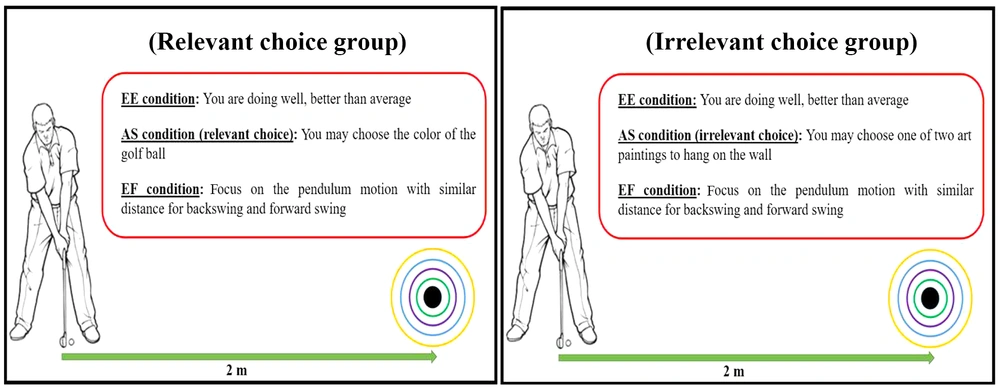
Figure 1.
Instructions for both optimal groups
3.4. Data Analysis
Shapiro-Wilk test was used to evaluate the normality of data distribution according to the number of samples (N = 24). According to the research methodology for analyzing golf putting accuracy learning, a 2 x 3 Mixed ANOVA was used to determine the main effect of time, group, and interaction. Paired t-test was used to examine the within-group comparisons. Data analysis was conducted at a significance level of P ≤ 0.05 using SPSS version 27 and Excel software 2016.
4. Results
The results of Table 1 demonstrate that the main effects of time and group (P ≤ 0.05) are significant. Due to the significant difference, a paired t-test was conducted to compare the effects in each group, and the results are presented in Table 2.
Table 1.
Mixed ANOVA Results
| Source | Type III Sum of Squares | df | Mean Square | F | Sig. | Partial Eta Squared |
|---|---|---|---|---|---|---|
| Time | 11.84 | 2 | 5.92 | 44.19 | 0.001 | 0.67 |
| Group | 1.59 | 1 | 1.59 | 6.72 | 0.017 | 0.23 |
| Time*group | 0.36 | 2 | 0.18 | 1.34 | 0.27 | 0.06 |
The obtained data demonstrated that there is a significant difference from pre-test to acquisition and from pre-test to retention in both groups. However, no significant effect was observed from acquisition to retention test, in the sense that both relevant and irrelevant choices have a positive effect on the acquisition and retention test of the putting performance. Therefore, Paired t-test and independent t-test were used to compare the paired effect between and within groups and presented as a post hoc test.
Table 2.
Paired t-Test Results
| Group | Mean ± SD | t | df | Sig. |
|---|---|---|---|---|
| Irrelevant | ||||
| Pre-test-acquisition | -0.758 ± 0.676 | -3.89 | 11 | 0.003 |
| Pre-test- retention | -0.650 ± 0.452 | -4.98 | 11 | 0.000 |
| Acquisition-retention | 0.108 ± 0.485 | 0.774 | 11 | 0.456 |
| Relevant | ||||
| Pre-test-acquisition | -1.083 ± 0.572 | -6.57 | 11 | 0.000 |
| Pre-test-retention | -0.917 ± 0.295 | -10.77 | 11 | 0.000 |
| Acquisition-retention | 0.167 ± 0.545 | 1.06 | 11 | 0.312 |
The results of the t-test showed that there is no significant difference between the two groups in the pre-test, but in the acquisition and retention stage, a significant difference is observed between the two groups (Table 3). Figure 2 shows the trend of golf swing performance changes from pre-test to post-test by group.
Table 3.
Independent t-Test Results
| Variables | t | df | Sig. |
|---|---|---|---|
| Pre-test | -0.633 | 22 | 0.534 |
| Acquisition | -2.278 | 22 | 0.033 |
| Retention | -2.351 | 22 | 0.028 |
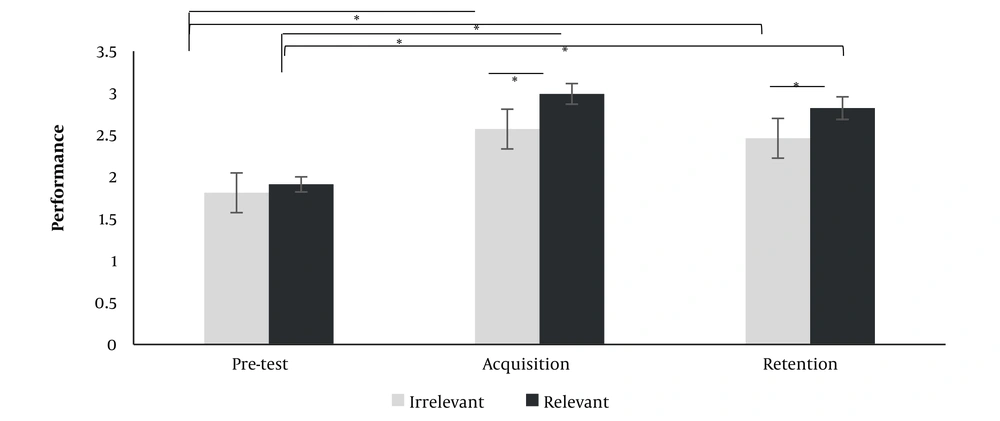
Figure 2.
Mean and Std. error mean of the groups
5. Discussion
According to the mean, it is clear that the relevant choice group performed better than the irrelevant choice group in acquisition and retention. Generally, it was found that the choice in both ways (relevant and irrelevant) can enhance the golf putting performance, and in the meantime, relevant choices are more effective. Based on optimal theory, a reasonable assumption that can enhance learning in this process is that the typical learning outcomes associated with the practice variable, where learners are given choices, become irrelevant or diminished by autonomy support (AS) (37). For example, by referring to the schema theory that the motor learning variable of practice variability compared constant practice conditions with variable practice conditions, a key prediction has been revealed that constant practice is inferior to variable practice (38). Therefore, it is assumed that certain practice schedules can diminish learning, but in the present study, the results demonstrate that by giving control to the learners, the learning disadvantages of adopting an inferior constant practice schedule can be diminished under the conditions of AS.
External focus of attention, EE, and AS are considered key factors in optimal motor learning theory (1). Recent behavioral studies have provided significant evidence showing that the combinations of two or all three factors of the OPTIMAL theory can enhance learning relative to the presence of only one, or none of these factors are used (19, 24, 26, 32-34). However, in other studies investigating the AS factor, it has been concluded that the benefits of choice can be effective only under conditions related to the task or practice (37). Even in situations related to training choice over feedback schedules (39) and the choice of feedback (40), it has been found that it does not affect performance and motor learning. The hypothesis of the present study is whether the addition of task-irrelevant choices can neutralize the benefits of consecutively utilizing optimal factors compared to the condition of consecutive use of optimal factors but with task-related choices.
Consistent with our hypothesis, the practice condition that included EF, EE, and AS with task-related choices was more effective for learning compared to the condition that included only a difference in the autonomy-supportive variable (irrelevant choice). Learning a novel throwing task has been demonstrated to EE (41), EF (42, 43), and AS (13, 44), as well as under a combination of these motivational and attentional focus factors (21, 26, 32, 33). In addition, the results of the retention test show that there has been a significant improvement in targeting accuracy in both groups compared to the pre-test. These findings are consistent with a previous study on golf performance optimization (24).
Also, in the previous studies that performed the throwing task, similar results were demonstrated in the retention and transfer tests when participants benefited from two optimal factors compared to one optimal factor or control conditions (19, 32). Furthermore, when all three optimal factors were provided, throwing accuracy was higher than when only two factors were given (26, 33). However, there is evidence that does not support the OPTIMAL theory's benefits. In one study that assessed all three key factors in skilled softball players, there was no improvement in throwing accuracy performance between the two groups (optimized and control group) (35). Specifically, there have been reports of inconsistency with the OPTIMAL theory in the EE (45) and AS (37, 39, 40) factors. One of the main hypotheses from the obtained results suggests that learning under optimal conditions may be associated with errors (46) and only modest success during practice (47).
Although recent experiments have raised questions about the effectiveness of OPTMAL theory in providing AS to enhance learning and motor performance, it still holds merit in the broader perspective that coaches and therapists can support learners' autonomy by offering choices. There is a wealth of evidence supporting the idea that providing AS can have a motivating effect on humans (48). Considering that the optimal group with task-related choices compared to the optimal group with task-irrelevant choices increased performance by a small amount, the motivational factors that directly or indirectly contribute to these effects should be checked during the implementation of the practices.