1. Background
Intellectually disabled children have general intelligence scores lower than average (IQ scores of 70 or lower), including approximately 2% to 3% of individuals in any given society (1). These children are classified under the diagnostic category of neurodevelopmental disorders, encompassing impairments in cognitive, conceptual skills, social skills, and practical skills (2). Intellectually disabled children struggle with retaining and remembering information. Their primary challenges lie in their working memory and long-term memory, and the more abstract the information, the greater their difficulties will be (3). Working memory is the ability to retain information within the mind while performing complex tasks. It includes the ability to monitor and assess cognitive processes and serves as the mental system responsible for temporarily storing and processing information to accomplish a series of complex cognitive tasks (4). The formation and maintenance of memory are associated with encoding, consolidation, retrieval, and reconsolidation processes (5). On the other hand, memory is considered one of the indicators of intelligence; however, in reality, it is the primary foundation of intelligence (6). Today, working memory is a crucial subject that receives considerable attention and has captivated the interest of many researchers (7). Memory, as a cognitive function, progresses during childhood development. Children spend more time processing cognitive information and recalling it than adults. It seems that factors like the speed of memory-related processes (encoding, consolidation, and retrieval) are responsible for the processing speed of information in children rather than environmental factors (8). on the other hand, the consolidation of memory is a time-dependent process in which motor memory becomes more stable over time. From a neurobiological perspective, during the learning and practice of a motor skill, encoding and memory consolidation processes take shape. With more practice and repetition, the reconsolidation process becomes stronger. In other words, newly acquired memory is initially influenced by consolidation mechanisms and later becomes engaged in reconsolidation mechanisms (9). Research results suggest that motor skill interventions may improve executive functions (8, 10). For example, Sheikh et al. demonstrated that Spark exercises improved the visual-spatial working memory of intellectually disabled children (11). Additionally, Jalil-Abkenar et al. found that the Arsh leisure activity program enhanced the working memory of intellectually disabled students (12). Sports can be categorized into various types based on factors like training methods and playing styles. Voss et al. classify sports into static, tracking, and strategic categories (13). Considering the hypothesis of broad skill transfer, different cognitive demands of various sports and the accumulation of experience through their evident practice should lead to differences in cognitive performance. According to this classification, study findings indicate that strategic athletes exhibit better executive performance (e.g., inhibition and switching) compared to static athletes (14). Furthermore, strategic athletes likely have higher cognitive demands in visual-spatial working memory since they process more visual-spatial information (teammates, opponents, field positions, and the ball) compared to other types of sports (15). For example, Crova et al. showed that tennis exercises, compared to aerobic exercises, led to greater improvements in working memory and inhibitory response in overweight children (16). Additionally, in another study, due to higher cognitive loads, team games significantly improved cognitive flexibility in children compared to aerobic exercises (17).
Table tennis is a technical and tactical sport that requires a complex combination of physical abilities, such as strength, power, speed, agility, aerobic and anaerobic capacity, and neuromuscular coordination (18). In table tennis, players repeatedly hit a ball on a relatively small table, controlling its spin, speed, and placement to make it difficult for the opponent to return successfully (19). That is, for effective performance, a player must predict the opponent's shot, recognize meaningful cues in the game, make split-second decisions about which action to take, and manage the appropriate response within serious time constraints (20). Mistakes in returning the ball result in the opponent scoring a point in a rally, making victory in the game more challenging. Given these constraints, it is logical to assume that a higher level of cognition is crucial for successful performance in table tennis (21). Considering that there have been few studies on the role of table tennis in improving the working memory of educable intellectually disabled children, there is a clear lack of empirical research on the impact of table tennis on the working memory of such students.
The current research seeks to answer the question of whether table tennis exercises improve the working memory of intellectually disabled children.
2. Methods
2.1. Subjects
The research design employed in this study was a semi-experimental design, incorporating a pretest, posttest, and a control group. The statistical population consisted of all educable intellectually disabled female students in Galikesh County. A convenience sampling method was used to select a sample of 30 students between the ages of 9 and 15. These participants were then randomly assigned to either the experimental or control group, with each group consisting of 15 participants. The sample size for each group was determined by taking into account a confidence level of 95%, a statistical power of 0.8, and the observed standard deviation obtained from previous research. The formula proposed by Cohen (1970) was used for sample size calculation, resulting in 15 participants assigned to each group. The design of this research has been approved by the Ethics Committee of Payam Noor University.
2.2. Apparatus and Task
Daneman and Carpenter's Working Memory Test: This test consists of 27 sentences. These 27 sentences are divided into 6 sections, with 2, 3, 4, 5, 6, and 7 sentences in each section, respectively (22). In each section, the participants are required to listen to the sentences, which are relatively challenging and unrelated to each other, and then perform 2 tasks: Determining whether the sentence is semantically correct or not and recalling the last word of each sentence. The first part of the test assesses processing capacity, while the second part assesses retention. To score the Working Memory Test, the number of correct answers in each section is divided by the total number of sentences, and then the scores from each section are summed and divided by 2. This test has high validity; thus, its correlation with the test of real questions is 0.72, and the correlation with the test of pointed pronouns is 0.9. Regarding the reliability of this test, a reliability coefficient of 0.85 was obtained in a study conducted on 119 third-grade middle school students (22).
2.3. Procedure
In the implementation phase, the necessary correspondence and coordination were initially conducted to introduce the researcher to the exceptional schools in Galikesh. After determining the participants, detailed explanations about the research process and the benefits of participation were provided, and written consent was obtained from the parents of the students. Participants were assured of their ethical considerations and informed that they could withdraw from the study at any time, and all information would be kept confidential. Afterward, based on the coordinated efforts, a specific schedule was set for conducting the tests and participating in the intervention program. The data collection process involved conducting a pretest of working memory for both groups; then, the participants were randomly assigned to the experimental and control groups. The experimental group engaged in table tennis exercises for 8 weeks (3 sessions per week), each lasting 60 minutes. During this period, the control group only engaged in their daily activities. The training program for the table tennis group was designed in accordance with studies conducted by Pan et al. (23) and Tsai (24). The table tennis sessions included warm-up (5 minutes), teaching basic table tennis skills and advanced skills (25 minutes), group games and table tennis situations (25 minutes), and cooling down (5 minutes). Initially, basic table tennis skills were gradually taught, including ball and racket handling, basic forehand and backhand strokes, forehand and backhand practice rallies, serving (forehand and backhand serves), and returning the coach's strokes, as well as proper foot movement and positioning (e.g., ready position, 1-legged footwork, 2-legged footwork, and cross-step footwork). Afterward, participants engaged in designed games to practice their table tennis skills. After the last session, a posttest of working memory was administered to all participants, and the results were recorded for further analysis.
2.4. Data Analysis
In the data analysis, the Shapiro-Wilk test was used to assess the normality of data distribution, and analysis of covariance (ANCOVA) tests were applied. All analyses were conducted with a 95% confidence level using SPSS version 22.
3. Results
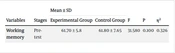
Table 1 displays the descriptive statistics for the research variables and provides a summary of the results of ANCOVA to analyze the effect of independent variables on dependent variables. To conduct between-group comparisons, the assumptions required for using ANCOVA (normality of data distribution, homogeneity of variances, linearity of the relationship between the dependent variable and covariates, and homogeneity of regression slopes) were first examined. The results of the Shapiro-Wilk test showed that the data distribution related to working memory is normally distributed. The Levene's test results indicated that the variances of working memory data in both the pre- and posttest are homogeneous. Additionally, the scatter plots of the variables demonstrated a linear relationship between the covariates and dependent variables. To examine the homogeneity of regression slopes, ANCOVA was conducted to assess the lack of a statistically significant interaction between independent variables (group) and covariates (pretest levels). The results showed that the interaction effect of the group and the covariate on working memory is not statistically significant. Given the fulfillment of assumptions, ANCOVA was employed for between-group comparisons, with the (experimental/control) group variable as the independent variable, working memory levels as the dependent variable, and pretest values as the control variable (covariate). The research findings regarding working memory indicated that after controlling for the pretest effect, the group effect on working memory was statistically significant (P < 0.001; F = 0.07). The mean values of the groups in the posttest suggest that the working memory performance in the experimental group is significantly higher than that of the control group (Table 1).
Table 1.
The Results of ANCOVA
| Variables | Stages | Mean ± SD | F | P | η2 | |
|---|---|---|---|---|---|---|
| Experimental Group | Control Group | |||||
| Working memory | Pre-test | 61.70 ± 5.8 | 61.80 ± 7.65 | 31.580 | 0.100 | 0.326 |
4. Discussion
The aim of this research was to investigate the effect of table tennis exercise on the working memory of educable intellectually disabled students. Motor experiences and physical activities are known to enhance cognitive processes. In other words, based on Piaget's theory, exploration of the environment and interaction with the surrounding environment can impact cognitive processes (25). Accordingly, the results obtained in this study demonstrated that table tennis exercises have a significant impact on the working memory of students. These findings indicate that table tennis exercises have a positive effect on students' working memory. Consistent with the findings of the present study, various studies using different types of physical activities have shown the effectiveness of exercise programs in improving working memory. These include the effects of gymnastic exercises (26), active games (27), skill-based exercises (28), aerobic exercises (29), selected games (30), and spark exercises (11). Previous studies have shown that due to their different cognitive requirements, different sports can create differences in the transfer of cognitive skills, including working memory function (15). Among various sports, strategic disciplines require more cognitive skills. Table tennis is considered one of these strategic disciplines in which individuals must simultaneously process information about teammates, opponents, court and ball positions, and often a variety of situations. Furthermore, cognitive task training and exercises can improve cognitive performance (31, 32). Therefore, the improvement in working memory due to table tennis exercises can be attributed to the enhancement of participants' cognitive skills.
The results of some studies are not consistent with the findings of the current research. For example, certain studies have demonstrated that exercises focusing on closed motor skills do not have a significant impact on working memory (33, 34). The lack of effect observed in this type of skill exercise on working memory can be attributed to the nature of these skills. Closed motor skills involve a relatively stable environment, and the performer pre-selects and organizes movements without being under time pressure. They execute these movements without the need for modifications (28). This factor makes it easier for the performer to engage in stimulus selection and response selection processes, resulting in lower cognitive processing demands on working memory. In line with the findings of the current research, a significant body of research indicates that physical activity induces specific changes in the functioning of the nervous system and enhances processes related to learning and memory. It is highly likely that these effects can be attributed to changes occurring in hippocampal neuroplasticity, such as neuron proliferation, long-term potentiation, and particularly an increase in brain-derived neurotrophic factor (BDNF) resulting from participation in physical activities (35). BDNF, a neurotrophin abundantly present in the brain, exhibits high activity levels in the hippocampus and prefrontal cortex, both of which are crucial areas for learning, memory, and cognitive processes. Additionally, BDNF plays a significant role in brain growth, synapse formation, regulation of neurotransmitters, and enhancing learning and memory processes while also providing protection for nerve cells against neurodegeneration. A deficiency in BDNF impairs long-term potentiation in the hippocampus. However, this synaptic dysfunction can be rectified through the upregulation or expression of high levels of BDNF (35). BDNF also plays a key role in the survival of midbrain dopamine neurons. Moreover, it acts as a noteworthy neurotransmitter in regulating attention and cognitive performance (36).
On the other hand, evidence suggests that there may be a potential interaction between exercise, developmental stages, and the medial temporal lobe memory system (35). In general, significant research indicates that behavioral manipulation during critical stages of life can have long-term and impactful consequences. The persistence of physical activity during childhood and adolescence, a period characterized by heightened neural plasticity, may lead to long-term alterations contrary to its transitory effects in adulthood. These consequences may be associated with significant functional and morphological reorganization observed in childhood and adolescent brain regions, such as the medial temporal lobe and the hippocampus, playing a role in learning and memory. Exercise stimulates neural plasticity and cortical pathways while simultaneously reducing the learning threshold in brain regions involved in cognitive experiences (35).
Like any study, the present research faced limitations that necessitate caution when interpreting and generalizing the results. Due to logistical challenges, the study employed convenience sampling to ensure a more accurate generalization of results to the research population.
4.1. Conclusions
Moreover, the results of this research are generalizable to intellectually disabled students aged 9 to 15 in Galikesh County, and if necessary, extending these findings to other intellectually disabled students should be done cautiously and with sufficient knowledge. Considering the theoretical framework, the findings, and the existing limitations, it is recommended that this research be conducted in other geographical regions and diverse cultural backgrounds, with a larger sample size, if possible. Additionally, neuroimaging techniques should be employed for a more in-depth investigation of the impact of different types of sports on memory.