
1. Background
Collaborative learning can be considered a cooperative situation where the goal achievement of one individual positively correlates with that of their partner or peer (1). In the Dyadic practice method, which incorporates equal proportions of physical and observational practice, two novices are paired and alternate between performing and observing the desired skill (2). Specifically, when one novice is learning, the other observes and imitation those strategies during their subsequent attempts, capitalizing on observational learning. One component of dyadic practice is observation, whereby the observer perceives movement problem-solving strategies by evaluating consistent movement patterns in the model (3). dyadic practice protocols involve simultaneous, intermittent, or parallel practice (4). Research shows both dyadic practice formats produce effective and efficient learning outcomes compared to individual practice (5). In intermittent protocols, distinct roles like evaluator or executor are assigned during practice sessions. Playing the evaluator role appears beneficial for cognitive processing and skill acquisition, as the individual must judge and compare the model to their own performance. Examining various cooperative protocols across fields suggests dyadic practice, whether simultaneous or intermittent, enhances practice efficiency compared to individual learning Previous research has demonstrated the benefits of dyadic (6). Shea et al. (7) found dyadic practice increased both the efficiency and effectiveness of learning balance meter skills compared to individuals. Additionally, detecting errors was enhanced when combining observations of expert and novice models versus a single model (8). Parvinpour et al.'s (2) findings supported dyadic practice as a suitable method for teaching rope skills and swimming. Benefits included cost-effectiveness via reduced space and energy requirements. Ghaeni and Nikravan (9) also reported dyadic practice yielded the greatest impact on Hian shodan kata performance and retention versus individual practice. Examining peer ability in dyads, Siavashi et al. (4) showed novice-expert pairings optimized table tennis skill learning, as novices benefited from observing optimal technique and problem-solving strategies. This suggests dyadic practice facilitates observational learning when dyadic practice with a more proficient partner. However, another approach that has recently received attention in collaborative exercises is assigning distinct evaluator or performer roles. It seems Implementation of these roles in dyadic practice may significantly impact individuals' performance (10). This means that the type of skill and related characteristics can also be effective in participatory training. For example, in relation to the skill of throwing darts Makki et al (11) showed that by paying attention to kinematics indices of darts in skilled individuals, trainers can extract and use appropriate technical strategies to improve the performance of beginner launchers. Thacker (10) investigated the evaluator and performer roles in dyadic jumping and tumbling skills. Their results found students in the evaluator role performed the jumping skill better than those in the performer role, yet no differences emerged between groups for tumbling. However, Rafiei Milajerdi and Katz (12) also examined performance order effects and found individuals in evaluator roles demonstrated superior ball pickup skills versus performers. Therefore, while dyadic practice and assigning roles has benefits, the effectiveness of prioritizing evaluator versus performer roles, especially examining functional role order, remains less studied. Most past research has focused on accuracy and performance outcomes of various skills, with limited investigation of kinematic patterns (2, 4, 10). However, Forbes and Hamilton (13) showed participants encode partner kinematics, even when detrimental to their own performance. It is posited collaborative learning advantages will be elucidated through skill kinematics.
2. Objectives
The current study aimed to address these gaps by investigating the impact of the order of performance assignment in dyads on dart throwing accuracy and kinematics. This will provide novel insight into optimizing role ordering within collaborative motor learning paradigms.
3. Methods
3.1. Subjects
First, students of Tehran University were invited to participate in the research. Among the volunteers, 48 right-handed female students (In accordance with G*power α = 0.05, power = 0.8, effect size = 0.25) (Mean age = 21.71, SD = 1.14) completed informed consent form to participate in the study.
Participants were randomly assigned to individual group (IG) as the control group (n = 16), the first-evaluators group (FEG) (n = 16), and the first-performers group (FPG) (n = 16) that these two groups were paired in the form of collaborative training (n = 16 paired subject).
3.2. Procedures
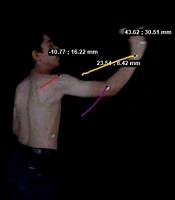
The ethics code was taken from the Sports Science Research Institute with code IR.SSRC.REC.1402.212. All participants, after being trained on how to hold the dart, trained on throwing technique, performed 5 trials throws. In the pre-test phase, participants performed 10 throws and all information related to throw accuracy and kinematics of the elbow and shoulder were recorded by a High-speed camera (Casio Ex-ZR1200) (240 frames per second) mounted on a tripod on the right side of the participants. To collect kinematic data, reflective markers were used to be attached at anatomical landmarks of wrist (radial styloid process of wrist), elbow (olecranon), shoulder joints (acromion), and base of little finger) and Kinovea motion analysis software was used to analyze kinematic characteristics (4). In the collaborative training, individuals took their appropriate positions based on their roles as the FEG or FPG. The FPG started throwing 6 sets of 10 dart throws with a 1-minute rest interval between blocks, while their peer simultaneously assessed dart throwing skills via checklist.
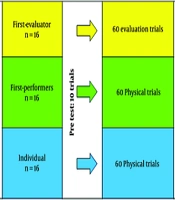
After completing 60 trials (5), the post-test 1 was taken from the FPG and immediately from the FEG with 10 trials. Then the roles of the individuals were switched and the second post-test was performed under the same conditions. Participants in the IG first performed 10 throws in the pre-test and after 60 trials, performed the post-test 1 with 10 throws, and after 5 minutes of rest, performed the second set of 60 practice trials. Then the post-test 2 was conducted (Figure 1).
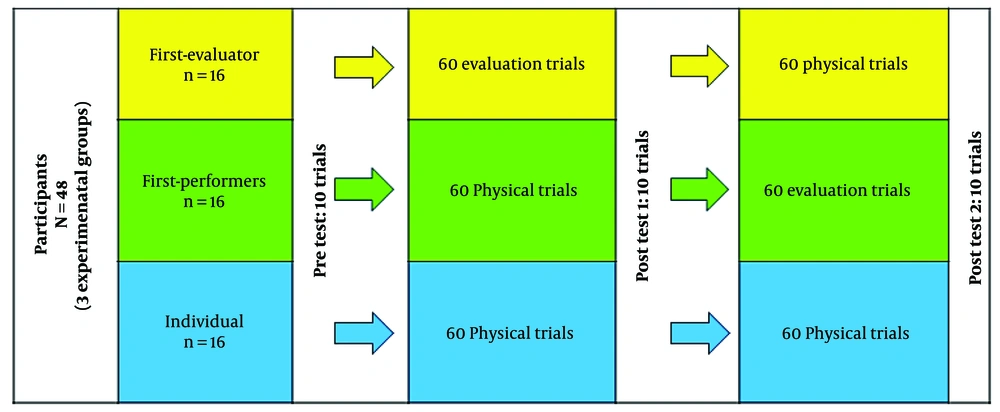
Figure 1.
Research procedure
3.3. Data Analysis
To evaluate the behavioral outcome of performance (accuracy), two criteria were calculated: Mean radial error (RE) and bi-dimensional variable error (BVE) using the following formulas:
k = sum of the trials; i = the trial number; Xc & Yc= Mean x, y
The kinematic variables of dart throwing included elbow release angle (elbow angle at release), elbow joint range of motion (the angular difference between maximum elbow flexion and elbow angle at release), and average angular velocity of the elbow (the angular difference between maximum elbow flexion and elbow angle at release divided by the throw duration) which were extracted using Kinovea software and calculated in Excel software.
In this study, normal distribution of data in each variable was evaluated using the Shapiro-Wilk test and homogeneity of variances using the Levene test. To examine the significant between-group differences in the pre-test in each variable, one-way ANOVA was used. Then, 3 (group) × 3 (test) Mixed ANOVA was used. Statistical analysis was performed using SPSS software at the significance level of P ≤ 0.05.
4. Results
Table 1 shows the descriptive statistics of the research variables for the participants.
Table 1.
Descriptive Statistics of Dart Throwing Variables by Group
| Group | RE (cm) | BVE (cm) | Release Angle (deg) | Elbow Range of Motion (deg) | Average Angular Velocity |
|---|---|---|---|---|---|
| IG | |||||
| Pre test | 14.76 ± 3.11 | 4.57 ± 1.05 | 132.54 ± 16.05 | 91.06 ± 10.82 | 550.12 ± 48.63 |
| Post-test 1 | 12.22 ± 3.38 | 4.61 ± 1.99 | 136.99 ± 12.86 | 93.32 ± 10.56 | 553.32 ± 56.49 |
| Post-test 2 | 11.43 ± 2.65 | 3.75 ± 0.99 | 137.11 ± 12.69 | 94.34 ± 10.83 | 563.71 ± 542.27 |
| FEG | |||||
| Pre test | 16.01 ± 4.06 | 5.15 ± 1.50 | 123.86 ± 13.29 | 88.76 ± 13.14 | 496.03 ± 58.24 |
| Post-test 1 | 14.69 ± 2.94 | 4.75 ± 0.99 | 125.77 ± 12.65 | 89.29 ± 14.76 | 492.54 ± 52.00 |
| Post-test 2 | 11.64 ± 3.82 | 3.77 ± 1.24 | 128.87 ± 13.53 | 91.70 ± 11.822 | 543.96 ± 57.75 |
| FPG | |||||
| Pre test | 17.03 ± 3.89 | 5.51 ± 1.21 | 121.60 ± 18.88 | 84.76 ± 16.62 | 515.62 ± 100.01 |
| Post-test | 13.22 ± 2.42 | 4.56 ± 1.28 | 124.43 ± 16.99 | 86.60 ± 14.88 | 517.26 ± 104/22 |
| Post-test 2 | 14.68 ± 3.80 | 4.62 ± 1.23 | 123.41 ± 14.38 | 84.86 ± 12.53 | 491.80 ± 153.54 |
Abbreviations: IG, individual group; FEG,First-evaluator group; FPG, first-performer group; RE, radial error; BE, bivariate error.
The results of the Shapiro-Wilk test showed that the data were normally distributed (P > 0.05). The results of the one-way ANOVA test also showed no significant difference between the groups in the pre-test for any of the RE (F (47, 2) = 1.5, P = 0.23), BVE (F (47, 2) = 1.4, P = 0.24), release angle (F (47, 2) = 2, P = 0.14), range of motion of the elbow joint (F (47, 2) = 0.8, P = 0.42), average angular velocity (F (47, 2) = 2.2, P = 0.11).
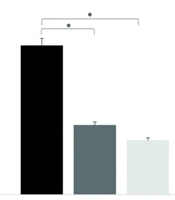
The results of the 3*3 Mixed ANOVA for the RE showed a significant main effect of test and interaction test*group. The main effect of the group was not significant (Table 2). The results of pairwise comparisons showed that in the IG, a significant decrease in RE from pre-test to post-test 1 (P = 0.035) and post-test 2 (P = 0.003). However, there was no significant difference between post-test 1 and 2 (P = 1.00). In the FEG, there was a significant decrease in RE from pre-test to post-test 2 (P < 0.001) and post-test 1 to 2 (P = 0.005). In FPG, there was a significant decrease in RE from pre-test to post-test 1 (P < 0.001) and post-test 2 (P = 0.04). There was no significant difference between post-test 1 and 2 (P = 0.33). Also, in between-group comparisons and in post-test 2, FPG had higher RE than the IG (P = 0.033). However, there was no significant difference between the FEG and the IG (P > 0.05) (Fifure 2).
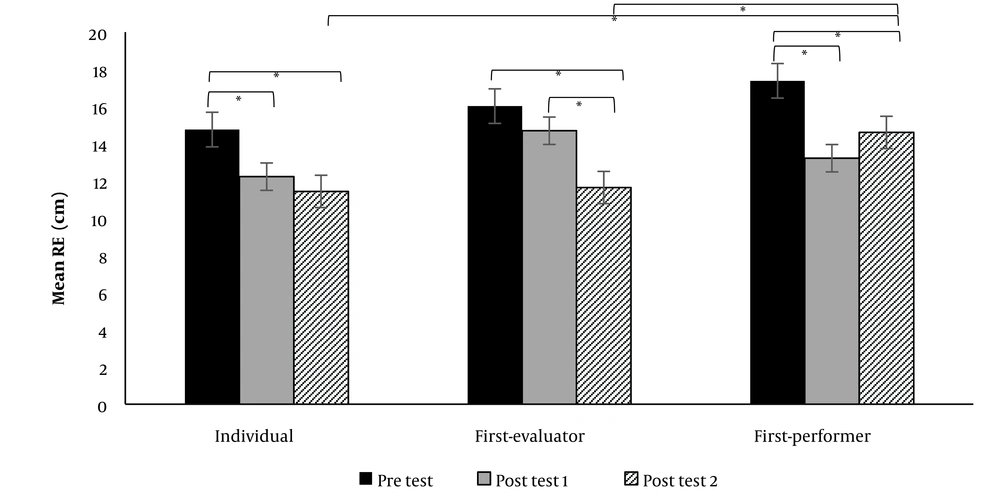
Figure 2.
Mean RE of the groups. *: P ≤ 0.05.
For the BVE, the results showed a significant main effect of test, but the interaction of test*group and the main effect of the group were not significant (Table 2). The results of pairwise comparisons of the main effect of test showed a significant decrease in BVE from pre-test to post-test 2 (P < 0.001) and from post-test 1 to 2 (P = 0.02).
For the release angle, the main effect of test and group were significant, but the interaction effect test*group was not significant (Table 2). The results of pairwise comparisons of the main effect of test showed a significant increase in release angle from pre-test to post-test 1 (P = 0.008) and post-test 2 (P = 0.01), but there was no significant difference between post-test 1 and 2 (P = 0.001). Also, the results showed that the average release angle of the IG was not significantly different from the FEG (P = 0.19), but the average release angle of the IG was higher than the FPG (P = 0.04).
For the range of motion and average angular velocity variables, none of the main effects of test, group and test*group interaction were significant (Table 2).
Table 2.
3*3 Mixed ANOVA Results for all Variables
| Variables | Df | F | Sig. | μ2 |
|---|---|---|---|---|
| RE | ||||
| Test | (2,90) | 21.14 | <0.001 | 0.32 |
| Group | (2,45) | 2.78 | 0.072 | 0.11 |
| Test * group | (4,90) | 21.14 | 0.025 | 0.32 |
| BVE | ||||
| Test | (2,90) | 11.66 | <0.001 | 0.20 |
| Group | (2,45) | 1.27 | 0.29 | 0.05 |
| Test * group | (4,90) | 1.22 | 0.3 | 0.05 |
| Release angle | ||||
| Test | (2,90) | 6.70 | 0.002 | 0.13 |
| Group | (2,45) | 3.37 | 0.04 | 0.13 |
| Test * group | (4,90) | 0.84 | 0.5 | 0.36 |
| Range of motion | ||||
| Test | (2,90) | 1.83 | 0.16 | 0.03 |
| Group | (2,45) | 1.52 | 0.22 | 0.06 |
| Test * group | (4,90) | 0.71 | 0.58 | 0.03 |
| Angular velocity | ||||
| Test | (2,90) | 0.79 | 0.45 | 0.01 |
| Group | (2,45) | 1.88 | 0.16 | 0.07 |
| Test * group | (4,90) | 42.2 | 0.054 | 0.09 |
5. Discussion
Dyadic practice is one of the novel methods for teaching motor skills that seems to have the characteristics of an optimal learning environment by utilizing observational and participatory learning approaches. What is important in this study is the effect of priority of evaluation and implementation (performance order) in a dyadic learning model on the accuracy and kinematic indices of dart throwing skill. The findings of the present study showed that in the post-test, the FPG had more RE than the IG and the FPG had more RE than the FEG, but there was no significant difference between the FEG and IG. Considering that participant in the FEG had fewer physical trials compared to the IG and in fact 50% of their physical trials were replaced with observational trials, it can be said that priority the role of evaluator assignment in collaborative training is important. Dyadic practice method is more cost-effective than the individual method in terms both the number of physical efforts and the time required for practice, particularly in the early stages of learning where too much physical training leads to fatigue of novices, which may reduce the effectiveness of practice. Replacing half of the physical trial with observational learning using the dyadic practice method maybe increases effectiveness of practice. These results show the efficiency of collaborative training in motor skill.This result is consistent with Shea et al.'s (7) research on the balance board task, Parvinpour et al.'s (2) findings on rope tying skill, Ghaeni and Nikravan's (9) research on karate Performance, Siavashi et al.'s (4) research on table tennis forehand skill, and Panzer et al.'s (14) research on visuomotor tracking task.
The kinematic indices results showed that in the release angle, the IG was higher than the FPG but did not have a significant difference with the FEG. This means that in the dyadic condition participants in the first-evaluator role opened up their elbow joint to the same extent as the IG through observing and evaluating their peer through key points of the movement pattern. Considering the lower RE of these two groups, it can be said that increasing the release angle of elbow joint was done for better performance. These findings are consistent with the results of Makki et al.'s (11) study, which showed skilled throwers opened their elbow joint much more widely at the end of motion probably doing so to throw the dart with greater acceleration towards the target. In dyadic practice, the participants in the first-evaluator role are involved in problem-solving activities similar to those encountered by the executor through observing and evaluating their peer performance (2). Scully and Newell (15) stated that the observer during observation of the model directly acquires the movement-related information and uses it to create motor skill coordination. According to Fitts and Posner's learning stages model, the learner in the first stages of learning is involved in cognitive problem solving and acquiring the initial coordination pattern. At this stage, the mental process is fully active and the learner is faced with a lot of information that instructions or observation of movement patterns facilitates the acquisition of skill coordination pattern (3). As a result, the FEG faced fewer cognitive challenges during onset their physical training. On the other hand, the weaker performance of the FPG compared to the IG can be inferred from less physical trials than the individual group, the lack of the advantage of instructions and observational learning for cognitive problem solving at the beginning of the practice. Therefore, priority the of first-evaluator roles in a dyadic learning approach can be effective in improving performance. These results are consistent with the findings of Thacker (10) and Rafiee Milajerdi and Katz (12) showed that the order of roles significantly affected individuals' performance and those who were as first-evaluators performed better than the first-performer group.
However, some studies failed to demonstrate the effectiveness of dyadic practice compared to individual practice. In Crook's study (16), participants trained a computer software program individually and dyadic, with results showing learning retention is higher when individuals learn individually. Rader et al. (17) also showed no significant difference between dyadic practice and individual practice groups in learning a complex medical skill. Therefore, dyad training may be more effective on gross motor skills which differed from this study; because of this research skill is part of fine motor skills.
Considering that in the present study only accuracy and kinematic indices of dart throwing were examined, it is recommended in future studies to use brain activity recording devices to gain more comprehensive cognitive information and better understand the cognitive and perceptual interactions between evaluator and performer during observation of the movement pattern. The findings of this study support the benefits of observational learning in the early stages of learning and use of the collaborative practice approaches. Also, showed that prioritizing the roles of individuals at the beginning of practice can influence motor performance in a dyadic approach.