
1. Background
The dominant hand is often considered to be determined by the direction of hemispheric specialization for the different processes involved in controlling movement (1, 2). The dominant hand is connected to the structural asymmetry of motor areas in movement planning (3). The question that has occupied people's minds is: What environmental factors influence lateral dominance? Asymmetry can be caused by lack of training or exacerbated by training (4). Researchers (4) believe that sleep affects learning and memory, but the extent of the effect of sleep on the process of behavioral processing in the right and left hemispheres of the brain is unknown. Research (5) shows that the productivity of a training course for learning cognitive or movement tasks increases after a night's sleep. Night sleep is not only necessary for creating new learning paths and consolidating and improving memory in the brain, but it also plays a vital role in speeding up the functioning of these paths.
Previous studies (5, 6) have examined hippocampal activity during both wakefulness and post-sleep periods when participants were exposed to names or faces, with particular attention to laterality effects. Small et al. (5) specifically measured hippocampal activity during name-hearing and face-viewing tasks across wake and sleep states while accounting for lateral dominance. Their findings revealed no hemispheric asymmetry in hippocampal activity during either the encoding or retrieval phases of these stimuli. Similarly, no hemispheric asymmetry was detected in hippocampal activity during word recognition tasks. This suggests that observed asymmetries in behavioral responses may instead reflect sleep-dependent modifications in reactivity patterns.
Research demonstrates that while sleep enhances memory consolidation for various stimuli, it shows particularly strong effects for semantically related words (6). Kurien et al. (7) extended these findings by examining hemispheric memory processing during sleep, confirming sleep's significant influence on learning and memory. However, the specific mechanisms of how sleep affects behavioral processing differentially across hemispheres requires further investigation. Building on this work, subsequent studies (7, 8) suggest that sleep promotes the activation of novel word representations, facilitating access to left-hemisphere long-term memory systems while potentially strengthening bilateral semantic networks. Of particular note, Kurien et al.'s (7) investigation of sleep-related hemispheric asymmetry in memory formation points to greater right-hemisphere involvement in sleep-mediated consolidation. These findings have prompted the development of several theoretical frameworks to account for observed asymmetries in memory transfer processes (8).
Theoretical models in this domain are grounded in two fundamental principles: (1) The functional specialization of cerebral hemispheres, and (2) the crossed pathways of the limb motor system. Each hemisphere demonstrates distinct specialization patterns and activity-dependent characteristics in movement control. Specifically, the left hemisphere primarily processes movement execution and torque forces, while the right hemisphere contributes to spatial memory development (9). Extant research has extensively investigated behavioral patterns, emotional processing, personality traits, neuroanatomical differences, and motor task performance in both right- and left-handed individuals. Recent neurophysiological studies examining the neural mechanisms of laterality and motor sequence processing in both handedness groups provide compelling empirical evidence for functional specialization in both right-dominant and left-dominant populations. These studies particularly highlight the left hemisphere's specialization for motor sequence organization and execution (10). Notably, this research demonstrates that hemispheric asymmetry in motor sequence control operates independently of hand preference. While previous findings emphasized the dominant hand's advantage in sequence execution, contemporary neuroscience reveals that memory architecture (particularly encoding processes) and skill acquisition mechanisms play equally vital roles in human motor memory formation (9, 10).
2. Objectives
While humans demonstrate a remarkable capacity for rapid adaptation and simultaneous skill execution, the specific roles of lateral dominance and sleep in motor memory performance remain poorly understood. This study aims to determine whether sleep and lateral dominance interact to influence memory consolidation or function as independent processes. Given the limited research in this area, coupled with inconsistent existing findings and the theoretical significance of this topic for psychological science, developmental processes, motor control, and skill acquisition, a systematic investigation is warranted. This research has the potential to provide new insights into the workings of human memory and the factors that influence it. In today’s world, where stress, sleep deprivation, and cognitive challenges are increasingly prevalent, the findings could lead to advancements in learning techniques, sleep optimization, and the treatment of memory disorders. If specific sleep patterns or characteristics of lateral superiority are found to impact memory performance, more effective training or treatment programs could be developed.
3. Methods
3.1. Subjects
The sample size was calculated using G Power software, with 48 participants (n = 12 per group) required to achieve a test power of 0.8, an alpha level of 0.05, and an effect size of 0.25. Twenty-four left-handed and 24 right-handed students were purposefully selected based on the following inclusion criteria alertness and good mental/physical health, good sleep quality, ability to perform basic daily activities independently, absence of cognitive impairments, stress, or anxiety, no use of medication, alcohol, caffeine, or drugs.
3.2. Apparatus and Task
3.2.1. Demographic Questionnaire
A standardized demographic questionnaire collected participant information, including age, physical health status, absence of visual impairments, and lack of prior experience with two-choice reaction time tasks.
3.2.2. Handedness Inventory Questionnaire
The Edinburgh Handedness Questionnaire consists of four sections assessing hand, foot, ear, and eye dominance. The hand dominance section includes ten questions evaluating lateralization by asking participants (or their caregivers) which hand (right, left, or both) they preferentially use for specific tasks. In the study by (11), the questionnaire demonstrated high reliability (Cronbach's α = 0.92) along with acceptable content and construct validity.
3.2.3. Pittsburgh Sleep Quality Index Questionnaire
Developed in 1989 by Buysse et al. at the University of Pittsburgh's Psychiatric Institute, this questionnaire uses a four-point Likert scale (0 - 3) to assess sleep quality. It was employed to exclude participants with poor sleep quality or insufficient sleep duration. Farrahi Moghaddam et al. (12) reported good reliability (Cronbach's α = 0.7-0.85) and acceptable content and construct validity for this instrument.
3.2.4. Two-Choice Reaction Time Task
The RT-888 (Sina Azmonyar Company, Iran) is an automated two-choice reaction time measurement device. It presents continuous red and green light stimuli while recording response times with 0.001-second precision. Participants respond using dedicated keys: Red (right hand) and green (left hand). During the 10-minute test session, the device automatically records both response times and error counts.
3.2.5. Serial Color-Matching Task
The task was administered using Tscope software running on a Pentium 4 computer with a 17-inch color monitor. Each trial consisted of three small colored squares (2 × 2 cm; 1.91° × 1.91° visual angle) displayed centrally on a white background with 0.48° gaps between them, after 600 ms, these were replaced by a large colored square (17 cm side; 15.82° visual angle). Participants were instructed to match the colors of the small squares with the large square's color. Responses were recorded via a response box with four buttons; button 1: No matches, button 2: One match, button 3: Two matches, and button 4: Three matches. Each trial ended after a response (or after 3,000 ms maximum), followed by disappearance of the large square, a 200-ms black fixation cross. initiation of the next trial. The display was positioned 60 cm from participants (13).
3.2.6. Experimental Groups
The study included four experimental groups (n = 12 per group): Right-handed individuals performing the task with their dominant right hand (R-R), right-handed participants performing with their non-dominant left hand (R-L), left-handed individuals performing with their dominant left hand (L-L), and left-handed participants performing with their non-dominant right hand (L-R).
3.3. Procedures
All participants were initially screened using the Pittsburgh Sleep Quality Index (PSQI) to exclude those with significant sleep disturbances, ensuring a sample that could benefit from natural sleep effects. A total of 48 eligible participants were selected based on predefined criteria and randomly assigned to the four groups. During the acquisition phase, each participant completed 180 trials of a serial color matching task (divided into 9 blocks of 20 trials) using their assigned hand, with one-minute rest intervals provided after every three blocks.
Following training, transfer test was assessed with doing two choice reaction time task at three time points: Immediate (20 trials), after a 15-minute break (20 trials), and 24 hours later (another 20 trials) under identical conditions. The 24-hour transfer test was conducted approximately two hours after waking to account for sleep effects, with participants instructed to avoid strenuous physical activity between sessions. This design enabled performance comparisons both before and after sleep while maintaining matched intervals for daytime controls.
3.4. Data Analysis
Employed a 4 (experimental groups) × 3 (assessment phases) mixed ANOVA to examine the effects of lateral dominance and sleep on motor memory consolidation . All analyses were conducted using SPSS version 20, with statistical significance set at P < 0.05.
4. Results
The mixed ANOVA results for the acquisition phase revealed a significant main effect of acquisition blocks (F(df2, 88) = 5.563, P = 0.005, η2 = 0.112). Bonferroni post hoc tests indicated significant improvement in average reaction times between: The first (M = 560.708 ms) and second blocks (M = 523.458 ms) (P = 0.003) and the first and third blocks (M = 505.896 ms) (P = 0.020). Neither the main effect of group (F(df3, 88) = 0.464, P = 0.709, η2 = 0.031) nor the group × training blocks interaction (F(df3, 88) = 20.007, P = 0.99, η2 = 0.001) reached significance. As shown in Figure 1, all four groups demonstrated improved performance in the third training block compared to the first, with L-L and R-R groups showing the best performance, respectively.
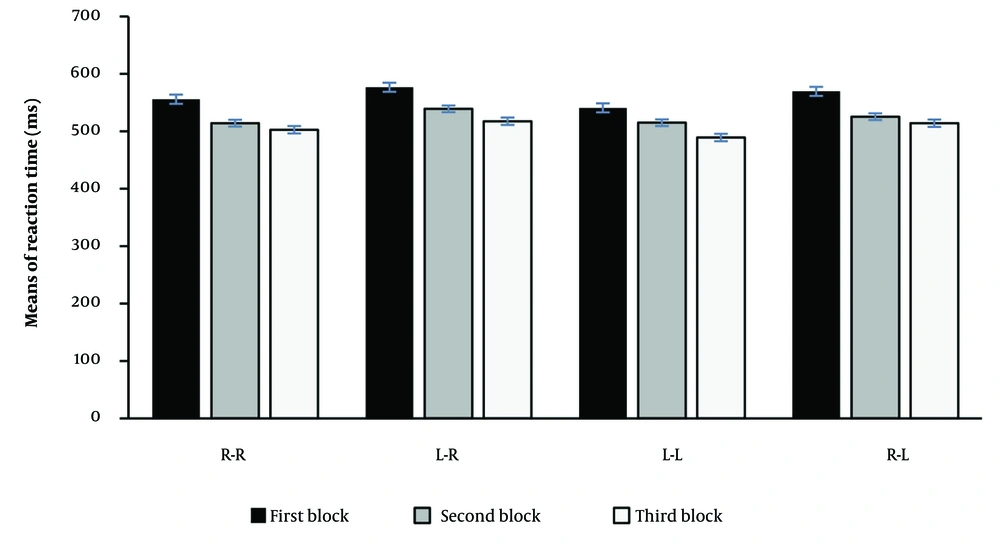
Figure 1.
Performance of experimental groups across acquisition phase blocks; the mean reaction time is associated with performance in the serial color-matching task during the acquisition blocks (abbreviations: R-R, right handed group that performed with their right hand; R-L, right handed group that performed with their left hand; L-L, left handed group that performed with their left hand; L-R, left handed group that performed with their right hand).
A 3 (evaluation phases) × 4 (group) mixed-model ANOVA was conducted to compare the mean transfer times across experimental groups in: (1) The immediate transfer test, (2) 15-minute transfer test, and (3) 24-hour transfer test. The analysis revealed a significant main effect of evaluation phases (F (2, 88) = 27.257, P = 0.001, η2 = 0.383). Bonferroni post hoc tests indicated significant pairwise differences (all P < 0.05) between: The immediate transfer test (M = 26.626), the 15-minute transfer test (M = 29.902), the 24-hour transfer test (M = 24.322). The 24-hour transfer test showed the lowest mean reaction time, demonstrating significant improvement compared to both the immediate transfer test and the 15-minute transfer test. The mean reaction time in the immediate transfer test (M = 26.626) was significantly better than in the 15-minute transfer test (M = 29.902). The main effect of group was significant (F (3, 88) = 936.2, P = 0.004, η2 = 0.167). Bonferroni post hoc tests revealed significant pairwise differences (P < 0.05) between: R-R and R-L groups, L-L and L-R groups. The L-L group showed the lowest mean reaction time (M = 25.619), outperforming R-L group (M = 28.223), R-R group (M = 26.547), L-R group (M = 27.410). The group × phase interaction effect was non-significant across evaluation phases (F (6, 88) = 1.377, P = 0.233, η2 = 0.086). As illustrated in Figure 2, all groups performed better in 24-hour transfer tests than in both 15-minute transfer tests and the immediate transfer test, L-L and R-R groups demonstrated superior performance compared to R-L and L-R groups.
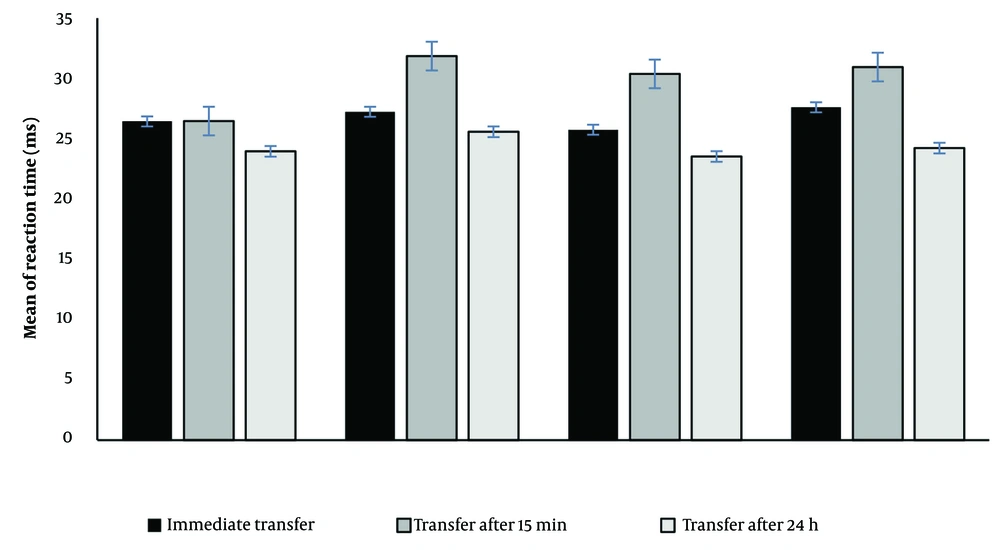
Figure 2.
Performance of groups in transfer tests (immediate, after 15 minutes and 24 hours); the mean reaction time is linked to performance in the Two-Choice Reaction Time Task during the transfer tests (abbreviations: R-R, right handed group that performed with their right hand; R-L, right handed group that performed with their left hand; L-L, left handed group that performed with their left hand; L-R, left handed group that performed with their right hand).
5. Discussion
The aim of the present study was to investigate the effects of lateral dominance and sleep on motor memory consolidation. The findings from the acquisition phase revealed that participants in all four groups performed better in the last acquisition block compared to the first training block. Additionally, both the left-hand dominant and right-hand dominant groups demonstrated superior performance over the non-preferred hand training groups. Regarding the effect of lateral dominance on motor memory consolidation after a 15-minute interval, the results indicated a decline in consolidation during the delayed transfer test compared to the immediate transfer test, suggesting the occurrence of inhibition. The results investigating the effect of lateral dominance on motor memory consolidation over a 24-hour interval revealed enhanced consolidation after 24 hours compared to the immediate transfer test, with improved memory performance following nighttime sleep. These findings align with (14), who demonstrated that response timing in a timed sequential motor task improves after a night's sleep, facilitating and accelerating the consolidation process (14). Sleep promotes the prolonged retention of information acquired during wakefulness and strengthens its transfer into long-term memory. Furthermore, Walker’s memory consolidation hypothesis suggests that memory consolidation occurs predominantly during sleep (15). Thus, if students sleep after studying, their performance the next day is likely to improve due to the consolidation of learned information.
During sleep, the right hemisphere demonstrates greater activity than the left hemisphere. Since the left hemisphere is more active during wakefulness, it enters sleep earlier due to its need for restoration (16). Bradshaw further suggested that right hemisphere dominance, along with left-hand dominance, results in faster response times (17). Additional studies have revealed hemispheric asymmetry during sleep, supporting the notion of right hemisphere dominance during this state (18). Consequently, lateral superiority and right hemisphere dominance may provide an advantage for left-handed individuals. However, these findings contrast with the work of Maquet et al., who reported no observable differences between hemispheres during (19).
However, the findings of the present study contrast with those of Debiec et al., who reported that nighttime sleep does not enhance movement sequence learning beyond post-training levels (20). This discrepancy may stem from several methodological differences between the studies: Training Protocols, our study employed spaced training, while Debiec et al. used massed training (a single prolonged session), potentially yielding different consolidation outcomes. Our extended, repetitive training protocol may have established stronger memory traces, making sleep-related benefits more detectable. Interference Effects, In Debiec et al.'s study, participants performed interfering motor tasks before sleep, which might have disrupted consolidation processes. Testing Intervals, differences in assessment timing (immediate vs. 24-hour post-sleep) could influence the observation of performance gains. Task Characteristics, the studies employed fundamentally different learning paradigms - Debiec et al. focused on explicit recall (conscious effort), whereas our study emphasized procedural/implicit learning. This critical distinction likely explains the divergent patterns of sleep benefits observed (20).
When individuals use their left hand to perform activities, their right hemisphere becomes activated. This increased right hemisphere activity shifts the cognitive balance toward divergent thinking and unconventional encoding, which may enhance memory performance (21). These findings align with research by Leinen et al., who demonstrated that both right-handed and left-handed individuals show improved skill performance during the acquisition phase (22).
In a study investigating hemispheric asymmetry in motor memory during recognition tests after learning movement sequences, Leinen et al. found that both right-handed and left-handed participants showed similar performance improvements during the learning phase. Specifically, reaction times were shorter when the trained stimulus appeared in the right visual field for both left dominant and right-dominant individuals (22).
Tejavibulya et al. (3) examined asymmetry in reaching skill control and found that left-handed individuals demonstrated shorter reaction times with their left hand compared to right-handed individuals. Their study also revealed that the dominant hand executes movements faster than the non-dominant hand, underscoring the impact of lateral dominance on motor skill learning (3). Right-handedness is frequently associated with the left hemisphere's specialization in precise movement control (23, 24). Conversely, the left hand's advantage in movement preparation suggests the right hemisphere's involvement in early spatial processing (16). The current study's findings regarding left and right superiority contrast with those of Potter and Graves (17). Both Potter and Graves and Schmidt et al. attributed left-handers' superior performance to a larger corpus callosum, which facilitates enhanced communication and efficiency among neuro motor brain regions (17, 18).
The study by Boulinguez et al. (4) demonstrated that both right-handed and left-handed individuals processed slightly different stimuli faster in their left hemisphere than in their right hemisphere. Right-handed participants showed faster stimulus processing than left-handed individuals, potentially due to greater cerebral asymmetry in right-handed individuals. These findings contrast with the results of the current study.
Another study maintain that lateral dominance, hand preference, and memory are closely linked to brain activity and hemispheric function. Multiple studies have established a relationship between hand dominance and cognitive abilities. Janacsek et al. similarly examined lateral dominance and procedural memory, with results supporting the memory model that proposes right hemisphere involvement in encoding and retrieving non-verbal and auditory information. These researchers concluded that memory performance is influenced by age-related differences and information type in both right-handed and left-handed individuals. They also found no distinct superior systems or structures in either right-handed or left-handed people (8).
Research findings demonstrate that participants in superior hand groups outperformed those in inferior hand groups during both acquisition and transfer phases. Most individuals exhibit hand preference when performing everyday motor skills, with the preferred hand typically demonstrating dominance for precise and rapid motor sequences (18).
Skill learning occurs not only during practice and repetition sessions, but also during rest intervals between efforts within training sessions and between sessions. The current study's results revealed that left-handed individuals showed superior performance in motor memory tasks, suggesting that trainers should incorporate considerations of lateral dominance when designing training programs and rehabilitation strategies.
Future research should investigate the effects of hemispheric dominance, nighttime sleep, and midday naps on motor skill consolidation and reconsolidation across different age groups, genders, and sports disciplines. This study has two primary limitations: First, it did not examine potential gender differences in the analysis; second, as the research focused solely on young adults, the findings cannot be generalized to other age groups (children, adolescents, middle-aged, or elderly populations).