
1. Background
The humanistic approach emphasizes the uniqueness and importance of individuals, highlighting their creativity and energy. Emerging in the 1960s and 1970s, this approach allows for personalized learning experiences that cater to individual needs and interests, in contrast to traditional one-size-fits-all teaching methods (1). In physical education, the humanistic approach has gained attention, with the teaching personal and social responsibility (TPSR) model introduced by Hellison (2). Research has shown that implementing a humanistic approach in physical education can enhance motivation, mood (3), physical fitness (4, 5), self-efficacy, enjoyment (6), and responsibility (7). A recent study further demonstrated that students' social behaviors improved when guided by instructors utilizing a humanistic approach (8).
On the other hand, some students in physical education classes have special interests and needs that require additional attention. Some children are just quieter and like to keep to themselves. They might feel a little nervous or uncomfortable in big groups or around new people, as well as a tendency to withdraw and avoid participating in group activities (9). This group of children are shy individuals (10) Shy children are often overlooked by teachers because they do not cause disruptions in the classroom (11). Shyness is increasingly recognized as an emotional and interpersonal problem for children at elementary school and it impacts their educational attainments as well as their adjustment (12).
In a sports context, coaches consider shy behavior to be more problematic than unsociable or verbally exuberant behavior. They believe that shy children may face more negative social and developmental consequences. Coaches also express more concern in response to shy behavior but are less likely to intervene in addressing shyness (13). Individuals with high shyness scores significantly less frequently engaged in vigorous physical activity and participated in sports teams (14). Greater levels of shyness were associated with increased feelings of loneliness, and shyness remains a significant concern as children transition into adolescence (15). Lonely children may lack the social and physical skills necessary to interact effectively and function in groups. This could perpetuate a cycle of poor social interaction, rejection, withdrawal, reduced physical activity, and reduced physical fitness (16). Results suggest that physical fitness is associated with lower levels of loneliness and greater social competence (17). There is a strong negative correlation between shyness and students' participation in learning basic psychomotor skills (18).
Shyness is a common trait among children, with a prevalence of 40% to 50% (19), leading to potential avoidance of social interactions and physical activities due to fear of negative judgment (13). This avoidance can impact their engagement in physical activities (18) and decrease the benefits they could gain from being physically active (20-23), ultimately increasing their cardiometabolic risks in adulthood (24). Shy children require additional support in the classroom and various approaches to help improve their emotional and social development (25). While research has focused on interventions to reduce shyness and improve the well-being of shy children (26), there is limited investigation into the effects of approach-oriented interventions on the physical fitness of shy children.
2. Objectives
This study aims to determine if providing a physical education course with a humanistic approach can impact the physical activity and physical fitness in shy children.
3. Methods
3.1. Subjects
The study focused on 9 to 10-year-old elementary school girls from Tehran city who were selected based on their shyness levels using the Chick- Briggs shyness Scale (1976). The participants were chosen randomly from a school and had a shyness score above 42 (cut point 42). Thirty girls were selected for the study and were unfamiliar with TPSR, in good health, and had parental consent.
3.2. Apparatus and Task
Five measures were taken into account to assess physical fitness, which included cardiorespiratory endurance (540-meter Runs; AAHPERD, 1976), agility (9*4 shuttle run test; AAHPERD, 1976), muscular endurance [Prone plank; (27) ], muscular strength [Hand Grip Strength Test; (28) ], and flexibility (Sit and Reach Test; AAHPERD, 1980). Additionally, the Children's Physical Activity Questionnaire was employed to assess the extent of physical activity (29).
3.3. Procedure
Before the research and experimental intervention began, participants were randomly assigned to two equal groups: An experimental group and a control group. All participants underwent relevant measurements prior to the intervention. The experimental group participated in physical education activities using a humanistic approach based on the teaching personal and social responsibility model created by Hellison (3, 4). The control group continued their regular daily activities with no interference. The training program consisted of 90-minute sessions divided into three parts: Warm-up and introduction, main exercises, and cool-down. Activities were conducted in a circular training setup with multiple stations featuring various perceptual and motor tasks. The educational environment was designed according to game-oriented educational principles, incorporating a variety of equipment such as stepping stones, foam bricks, ropes, and more. The program was structured over six months, progressively arranged based on motor learning principles from easy to difficult tasks (30). To ensure effective implementation of the TPSR program, the TARE (Tool for Assessing Responsibility-Based Education) was used to evaluate the program's strategies in physical education classes (31). A supervisor monitored each training session, providing feedback to the instructor for necessary adjustments. Workshops were also held to address questions and concerns regarding the model's implementation, ensuring that essential guidelines were communicated before the course began and that continuous feedback was provided throughout the program.
3.4. Data Analysis
2*2 mixed ANOVA was utilized to compare two experimental and control groups at two pre-test and post-test phases. The assumptions such as variance homogeneity were assessed with Levene's test, and covariance matrix homogeneity was assessed with Box's M test. The statistical analyses were performed using SPSS Statistics software (version 26) and significance was assessed at P ≤ 0.05.
4. Results
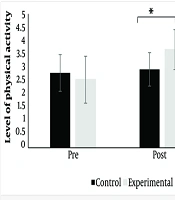
Table 1 shows the results of 2*2 mixed ANOVA for physical fitness and attitude towards physical activity. Finding on physical activity levels revealed a significant phase effect and interaction effect between phase and group. However, no significant effect was observed in the group. Pairwise comparisons indicated no significant difference (P > 0.05) between the experimental and control groups in the pre-test, but a significant difference was observed in the post-test (P < 0.001) (Figure 1).
Table 1.
Results of the 2*2 Mixed ANOVA for Physical Fitness and Attitude Towards Physical Activity
| Variables | df | F | Sig. | μ2 |
|---|---|---|---|---|
| Cardiorespiratory endurance | ||||
| Phase | (1, 28) | 0.717 | 0.404 | 0.025 |
| Group | (1, 28) | 0.370 | 0.548 | 0.013 |
| Phase × group | (1, 28) | 1.992 | 0.169 | 0.066 |
| Agility | ||||
| Phase | (1, 28) | 1.340 | 0.257 | 0.046 |
| Group | (1, 28) | 1.463 | 0.237 | 0.050 |
| Phase × group | (1, 28) | 0.384 | 0.541 | 0.013 |
| Muscular endurance | ||||
| Phase | (1, 28) | 5.649 | 0.025 | 0.168 |
| Group | (1, 28) | 1.721 | 0.200 | 0.058 |
| Phase × group | (1, 28) | 22.122 | 0.000 | 0.441 |
| Muscular strength | ||||
| Phase | (1, 28) | 0.060 | 0.808 | 0.002 |
| Group | (1, 28) | 1.136 | 0.296 | 0.039 |
| Phase × group | (1, 28) | 0.009 | 0.926 | 0.000 |
| Flexibility | ||||
| Phase | (1, 28) | 0.402 | 0.531 | 0.014 |
| Group | (1, 28) | 11.084 | 0.002 | 0.284 |
| Phase × group | (1, 28) | 9.522 | 0.005 | 0.254 |
| Physical activity level | ||||
| Phase | (1, 28) | 44.383 | 0.000 | 0.613 |
| Group | (1, 28) | 0.954 | 0.339 | 0.33 |
| Phase × group | (1, 28) | 27.686 | 0.000 | 0.497 |
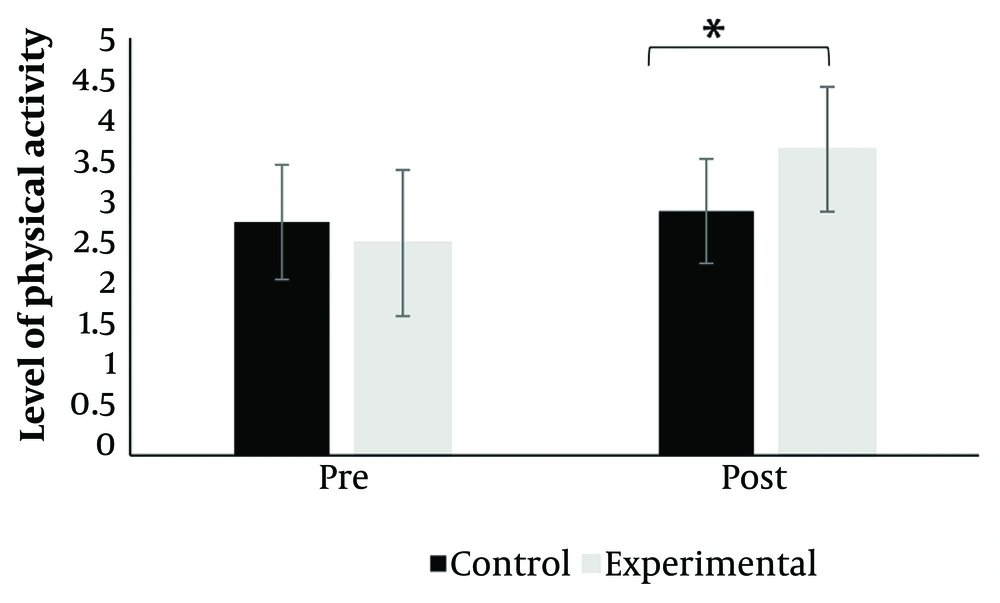
Figure 1.
Level of physical activity in two groups at different phases; *: P ≤ 0.05
For the muscular endurance, the results indicated the interaction effect was significant. Pairwise comparisons revealing no difference between the two groups in the pre-test (P = 0.61), but a significance difference in the post-test phase (P = 0.002) (Figure 2). Examining flexibility revealed that the main effect of group and the interaction effect were both statistically significant, whereas the main effect of phase did not reach statistical significance. Pairwise comparisons showed there was no significant difference between the two groups in the pre-test (P = 0.759), but exprimental group had a higher flexibility in the post-test (P < 0.001) (Figure 3).
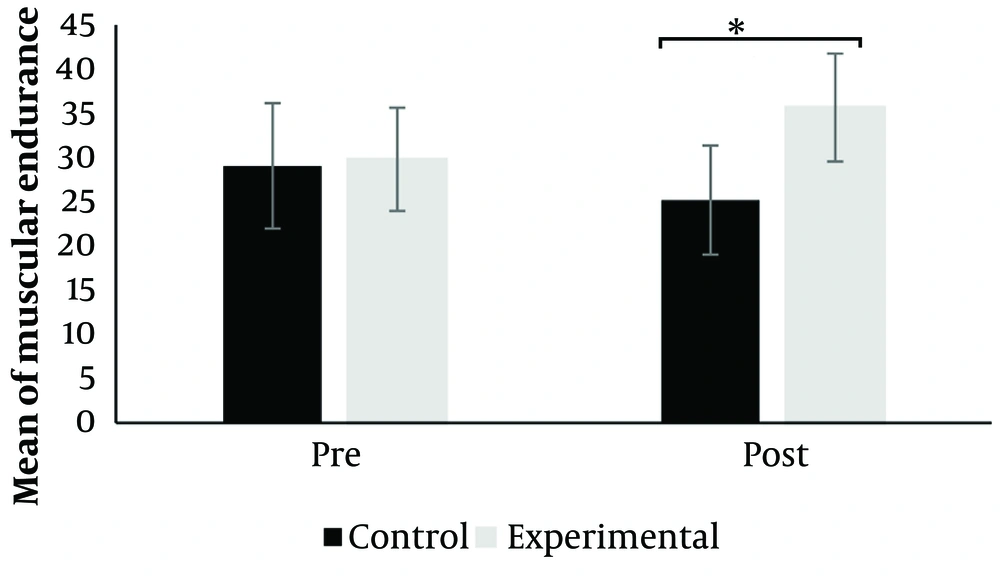
Figure 2.
Level of muscular endurance in two groups at different phases; *: P ≤ 0.05
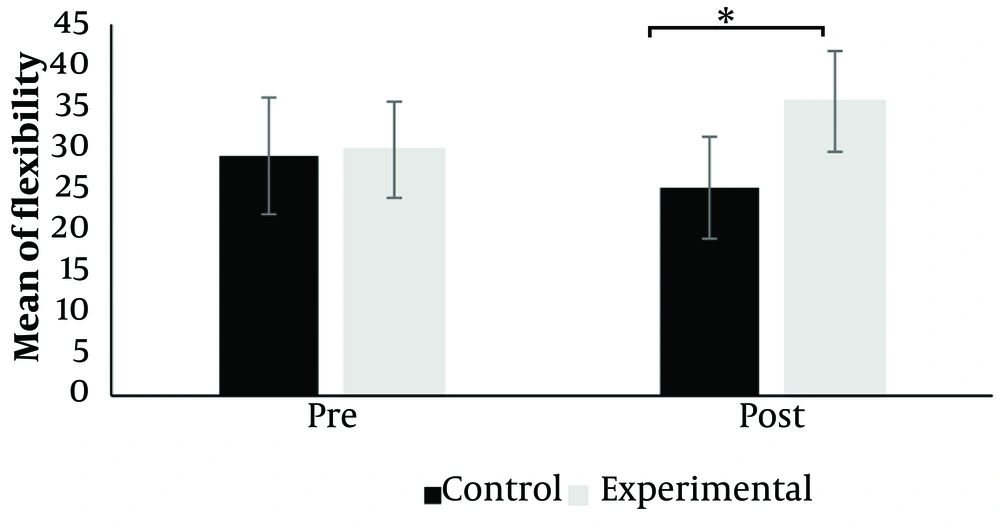
Figure 3.
Level of flexibility in two groups at different phases; *: P ≤ 0.05
Other components of physical fitness including cardiorespiratory endurance, agility, and muscular strength were not significant.
5. Discussion
The study demonstrated that implementing a humanistic approach in physical education programs results in significant improvements in flexibility, and prone plank aspects of physical fitness in shy children. The current study, consistent with prior research (7), demonstrated a significant improvement in the mascular endurance and flexibility component of physical fitness in the experimental group compared to the control group. Physicality is an issue for shy children (18) because they tend to shy away from participating in physical activities, being withdrawn and cautious (12, 16). Hence, this finding implies that appropriate educational strategies can assist shy children in developing greater physical fitness and engaging in physical endeavors with enhanced motivation, self-efficacy and enjoyment (5, 8, 32).
However, in line with previous research (6), no significant difference was observed between the two groups in cardiorespiratory endurance, agility and muscle strength. Shy children may have different reactions to physical activity depending on their unique physical and psychological characteristics, resulting in varying results in cardiorespiratory fitness. Shy children experience higher levels of anxiety compared to their peers (11), leading to potential physiological implications (33). An anxious individual's elevated heart rate and blood pressure lead to decreased efficiency in physical activities, resulting in reduced cardiorespiratory endurance. Anxiety can also cause shallow and fast breathing, which can decrease oxygen supply to the muscles and lower cardiorespiratory endurance. Anxiety-induced muscle tension may be the next factor to negatively impact cardiovascular endurance. Long-term stress changes metabolism by enhancing the degradation of glycogen and fat reserves (34). Although it can offer a fast energy boost, it also results in the exhaustion of these reserves, leading to premature fatigue during endurance exercises. Moreover, the psychological impact of shyness-induced anxiety should not be overlooked. Experiencing stress or anxiety can increase the feeling of effort and discomfort during exercise. A higher sense of exertion can lead to reduced capacity for physical activity and earlier cessation of exercise, ultimately reducing endurance. Anxiety can hinder focus and concentration (35), making it challenging to uphold proper form and technique while working out. Inefficient form and technique can lower movement efficiency, requiring more energy and reducing endurance. The same could apply to the lack of significance in agility and strength. In addition, the humanistic approach's structure might not offer enough intensity and frequency to enhance agility and muscle strength, and it may necessitate utilizing weights to see improvements in muscle strength. It is also possible that the measurement instruments utilized in the current research failed to pick up on subtle advancements and the evaluation circumstances were not conducive for shy children. A humanistic approach focuses more on enjoyment, personal growth, and social interaction, which may not provide the necessary conditions for improvements in cardiorespiratory endurance, agility, and muscular strength. To improve cardiorespiratory endurance, there needs to be regular and structured exercises of relatively high intensity that are followed seriously. Shy children tend to gravitate towards activities that align with their skills, leading to less intense physical activity that is important for strengthening cardiovascular endurance. Possibly merging clinical therapies with humanistic-based physical activities could be an all-encompassing approach to assisting children dealing with shyness.
In this study, it was shown that an educational program with an emphasis on individual and social responsibility, promoted the daily physical activity of the experimental group, which is in line with past research (6-8). In any case, flexibility and muscle endurance in shy children significantly improved through the presentation of physical exercises with a humanistic approach in this study. Increased flexibility results in a wider range of motion within the joints, which ultimately makes participating in physical activities more effortless and enjoyable. Children who are shy may feel more comfortable participating in physical activities if they have flexible muscles and joints that are less likely to get injured. Engaging in flexibility exercises assists in developing a deeper comprehension of body mechanics and movements, resulting in heightened body awareness and self-confidence. As children enhance their flexibility, they experience a feeling of achievement that can enhance their self-confidence and motivate them to engage more in physical activities. Children can engage in physical activities for a longer duration without feeling fatigued thanks to improved muscle endurance, which makes exercise more pleasant and less daunting. Enhanced muscle endurance plays a key role in overall physical preparedness, which is essential for maintaining healthy growth and development. Due to the negative relationship between shyness, sports participation and physical fitness (18, 25), the findings of the current study are crucial as they can help teachers and coaches better understand and assist this group of children.