


1. Background
Educational institutions must address all dimensions of human development to foster growth and well-being. The role of physical activity in enhancing physical, physiological, educational, social, and psychological functions, as well as promoting physical literacy, is of paramount importance (1). The most critical factor for enhancing physical literacy is the approach of teachers and coaches towards education. Langmuir (2) argues that physical education in schools worldwide has been marginalized, resulting in learners missing opportunities to develop essential skills necessary for maintaining an active lifestyle. Whitehead defines physical literacy as "the motivation, confidence, physical competence, knowledge and understanding, and responsibility to engage in physical activities for life". Progress in physical literacy can influence an individual's intrinsic value regarding the physical domain and enhance problem-solving skills, creative abilities, interpersonal skills, and overall quality of life (3-5), while sports education enhances the emotional-social domain of physical literacy and reduces negative motivational climates (6), and physical literacy as a promoter of health and motor competence while evolving towards a more comprehensive understanding have been identified (7). Among various teaching methods, traditional approaches have predominantly relied on linear instructional strategies, which are often teacher-centered and emphasize repetition and practice. These methods typically utilize prescriptive instructions to teach motor skills, often relying on demonstrations to provide learners with a visual model. However, such strategies tend to overlook individual differences, failing to account for the fact that humans are complex beings operating within a non-linear system. In this system, movement emerges from the dynamic interactions between individual constraints, environmental factors, and task demands (8, 9). Conversely modern teaching methods based on non-linear approaches rooted in ecological psychology and dynamic systems theory presents an innovative framework for coaching practice. The foundation of non-linear teaching lies in manipulating constraints that interactively influence individuals within their environment and task contexts, enabling them to discover diverse movement patterns. In this approach, coaches design tasks that encourage individuals to explore and identify various movement patterns, ultimately determining which pattern aligns best with their unique constraints (10). Therefore, the non-linear educational curriculum is founded on five fundamental educational principles: (1) The design of learning experiences; (2) maintaining the integration of perception and movement during skill execution; (3) the necessity of external focus to support the acquisition of creative and functional motor skills; (4) the application of constraints; and (5) the alteration of task constraints throughout the learning process to foster stable movement (11). Considering the principles of non-linear instructional design, students can be placed at the center of the learning environment while training in a sport. The psychological benefits of this learning approach, combined with careful manipulation of the environment by the teacher, can guide students towards developing self-regulatory processes in emotionally and motivationally charged situations (12, 13). Additionally, in a non-linear framework, developing competencies such as high self-confidence, communication skills, collaboration, as well as critical and innovative thinking among students is emphasized (14). In this non-linear approach, training is dependent on practice and the methods used by teachers to enhance learning; however, non-linear instruction transcends mere educational principles; it is rooted in complex dynamic systems theory based on constraints; therefore, coaching and practice should not solely pursue "correct" movements but rather provide learners with opportunities to adapt their behaviors to various challenging conditions (15). On another note, learning and practicing motor skills form the foundation for developing physical literacy. Research indicates that without developing physical literacy, children and adolescents tend to disengage from physical activities during leisure time and opt for sedentary pastimes. Often, students report that a lack of play skills is their primary reason for avoiding sports and physical activities. To mitigate this issue, there is a pressing need to develop and enhance students' physical literacy (16, 17). Given the passive engagement of students in teacher-centered classrooms today, the implementation of non-linear methods that emphasize problem-solving and student-centered learning is essential. Furthermore, track and field serves as a foundational sport for children under the age of 14, providing a valuable introduction to physical activity and skill development (18). This age range — specifically between 8 to 12 years — is considered optimal for developing physical literacy (19), underscoring the necessity of selecting track events. Ultimately, due to limited literature regarding the impact of non-linear teaching methods on children's physical literacy and existing studies focusing on its effects on psychological factors such as intrinsic motivation (20), physical competencies (14), motor skills (21, 22), fundamental skills (23), as well as the importance of constraint-based approaches in school education (24), there is a felt need for this research. Developing physical literacy within schools and other educational settings necessitates effective innovative teaching methods alongside comprehensive collaboration between parents and schools.
2. Objectives
Consequently, this study aims to address whether the non-linear teaching method in hurdle events impacts the physical literacy of female students in Qom city.
3. Methods
3.1. Subjects
This study uses a quasi-experimental design with applied objectives, employing a pre-test and post-test framework with a control group. Nafiseh Elementary School, serving students aged 9 - 10, was selected for the research. The sample size was calculated using G*Power software, based on a between-group factorial design (2 groups) and a within-group factor (2 measurement phases), with an effect size of 0.5, an alpha level of 0.05, and a power of 0.80, estimating 34 participants. Ultimately, 40 students were randomly chosen and assigned into two groups — 20 in the non-linear teaching group and 20 in the control group — based on pre-test scores.
3.2. Apparatus and Task
3.2.1. Canadian Physical Literacy Assessment
The evaluation of this research was conducted using the Canadian Physical Literacy Assessment (CAPL-2), evaluates physical literacy based on four fundamental components: Physical competence, daily behavior, motivation and confidence, as well as knowledge and understanding, utilizing tests or questionnaires tailored for physical literacy assessment. The validity and reliability of this tool have been confirmed in Iran by Nikkhoo and Kalori (25), who concluded that the physical literacy questionnaire possesses apparent, content, and developmental validity (r = 337). Internal consistency reliability for the Persian version of the Canadian Physical Literacy questionnaire yielded a Cronbach's alpha coefficient of 0.70, while test-retest reliability indicated a coefficient of 0.73 (25).
The execution method for CAPL-2 includes:
3.2.1.1. Daily Behavior Evaluation
The daily behavior range includes average daily step counts recorded over seven consecutive days (19).
3.2.1.2. Physical Competence Assessment
Physical competence assessment measured using skill tests, fitness assessments, and ultimately combines scores from all areas to derive an overall measure of physical competence +pacer score +CAMSA score. The CAMSA skill test evaluates motor skills and agility, encompassing the following components: (1) Fundamental motor skills, (2) combined skills, and (3) interlimb coordination. Scoring in this test is based on both the quality of skill execution and the total time taken to complete all items (Figures 1 and 2). Time and skill scores are weighted similarly. In executing the CAMSA protocol based on existing resources (19).
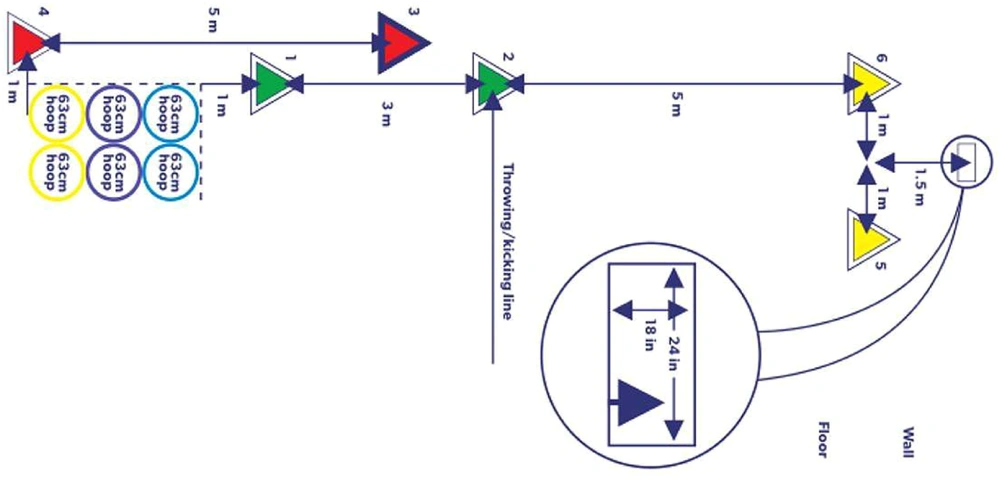
Figure 1.
CAMSA test plan
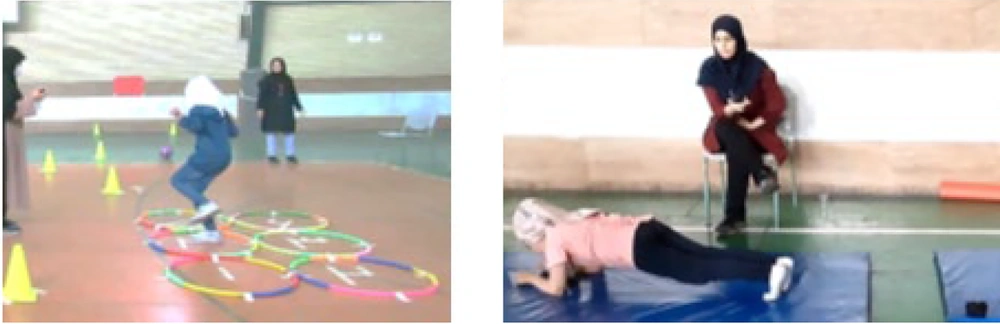
Figure 2.
How to perform the CAMSA test
The 15 m/20 m PACER test (progressive aerobic cardiovascular endurance run) (26) involves participants running back and forth along a 20-meter course.
Core Strength is assessed to evaluate muscular endurance and resistance by plank position (27). Participants begin the movement by lowering themselves onto their forearms (plank position).
3.2.1.3. The Motivation and Self-confidence
The motivation and self-confidence range in CAPL-2 is evaluated through 12 items in the self-report questionnaire (28).
3.2.1.4. Knowledge and Understanding
Knowledge and understanding of the benefits of exercise, physical fitness, health perception, and the use of safety equipment during physical activities are assessed using the Physical Literacy Questionnaire (knowledge and understanding section) (29). The questions assess learners' understanding of Canadian guidelines for physical activity and sedentary behavior, relevant terminology, definitions of health, and recommended safety practices (28).
3.3. procedure
The intervention protocol was carried out in the summer of 2023. The skill acquisition process and the non-linear intervention protocol consisted of a total of 12 sessions, each lasting 45 minutes, designed around non-linear training exercises. Students practiced hurdle crossing using a non-linear approach (23, 30) and implemented the intervention protocol based on available resources (18) (Figure 3).
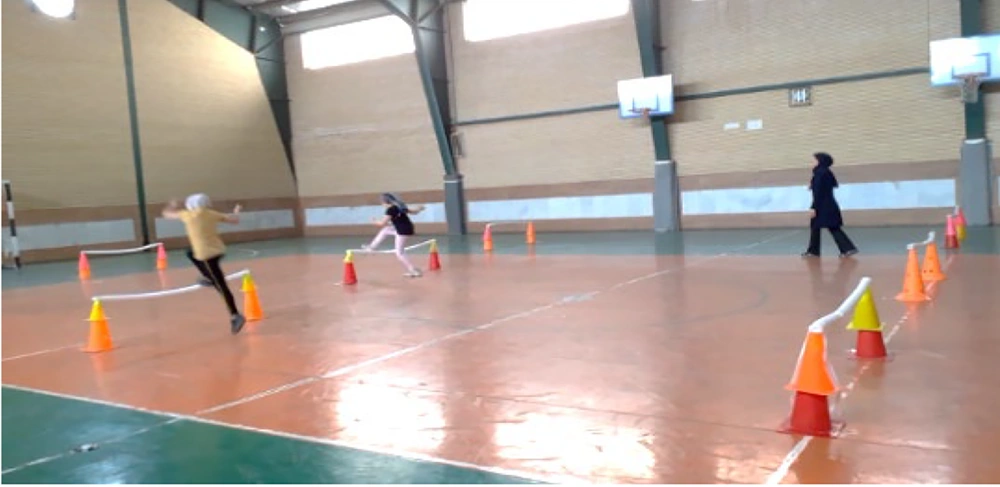
Figure 3.
How to implement non-linear intervention (crossing the athletics obstacle)
Each session began with a 5-minute warm-up involving various group games, followed by 40 minutes of non-linear exercises conducted applying task constraints (31) (Table 1). The control group engaged in routine school activities in physical education class.
Table 1.Non-linear Intervention Protocol
| Education Center | Activity | Non-linear Pedagogy |
|---|---|---|
| Passing over obstacles in a state where both feet are guides. (Sessions 1 - 6) | Activity 1: Adjusting the distance between obstacles in this activity, we will modify the distance between obstacles. Initially, participants will jump over cones, and we will gradually increase the height of the cones. We will use flexible obstacles that easily fall upon contact to ensure safety and encourage confidence in participants. The obstacles will be arranged such that participants take three steps between them using their guiding foot. Next, the obstacles will be positioned to require four steps between them, utilizing the supporting foot. Finally, we will set up the obstacles to allow for five steps between them, where participants will cross using their guiding foot but take longer strides. | Individual differences are taken into account, allowing students to return and discover the movement pattern that is most suitable for them. Manipulating the running surface enables athletes to find the optimal positioning of their limbs. |
| Running rhythm among obstacles. (Sessions 7 - 12) | Activity 2: Modifying the rhythm in this activity, we will modify the rhythm by positioning obstacles at equal intervals from one another. Participants will take part in a musical and rhythmic game centered around a four-step sequence (e.g., "one, two, three, up"). To add complexity and excitement, we will introduce sudden changes in rhythm or sound. For instance, the timing may abruptly shift to a five- or six-step sequence, accompanied by a faster tempo and louder sound. This variation will challenge participants to adapt quickly and enhance their rhythmic awareness. | We teach students to coordinate their movements with various constraints. The game "wolf and the moon" helps learners focus externally on the outcome (in other words, to run faster) rather than concentrating on the form of their movements. Adaptability: We modify the ability to adapt to unexpected environmental changes through activities such as musical steps, which introduce variability into the training. This approach assists athletes in maintaining their rhythm and timing despite environmental changes. |
3.4. Data Analysis
Initially, the Shapiro-Wilk test was used to determine the normality of data distribution, and Levene test was employed to assess the homogeneity of variances. For data analysis, the Wilcoxon signed-rank test were used for within-group comparisons when normality assumptions were not met, while the Mann-Whitney U test was utilized to compare the performance of the experimental group against the control group. Additionally, for variables that satisfied the normality assumption, a parametric two-way ANOVA was conducted to compare group performances under different conditions.
4. Results
4.1. Plank Test
The Wilcoxon signed-rank test revealed no significant improvement in the control group from pre-test to post-test (Z = -0.99, P = 0.32). In contrast, the experimental group showed a significant improvement (Z = -3.84, P < 0.001). The Mann-Whitney U test indicated no significant difference between the groups at pre-test (U = 214, P = 0.878), but at post-test, the experimental group outperformed the control group (U = 127, P = 0.018).
4.2. Pacer Test
The Wilcoxon signed-rank test showed no significant improvement in the control group from pre-test to post-test (Z = -1.10, P = 0.27), while the experimental group demonstrated significant improvement (Z = -3.74, P = 0.002). The Mann-Whitney U test revealed no significant difference between the groups at pre-test (U = 187, P = 0.38), but at post-test, the experimental group scored significantly higher than the control group (U = 112, P = 0.006).
4.3. CAMSA Test
A significant main effect of time was observed (F (1,40) = 75.53, P < 0.001, η2 = 0.65), indicating overall improvement from pre-test to post-test. The main effect of group was not significant (P = 0.26), but a significant interaction effect between group and time was found (F (1,40) = 4.61, P < 0.001, η2 = 0.27). Bonferroni post-hoc tests confirmed no significant differences between groups at pre-test, but the experimental group outperformed the control group at post-test.
4.4. Physical Competence
The Wilcoxon signed-rank test indicated that the control group showed improvement from pre-test to post-test (Z = -2.19, P = 0.028), while the experimental group demonstrated significant progress (Z = -4.37, P < 0.001). Between-group comparisons revealed no significant differences at pre-test (U = 213, P = 0.90), but the experimental group significantly outperformed the control group at post-test (U = 106, P = 0.004).
4.5. Daily Behavior
The Wilcoxon signed-rank test showed significant improvement in both the control group (Z = -2.11, P = 0.035) and the experimental group (Z = -3.11, P = 0.002) from pre-test to post-test. However, between-group comparisons revealed no significant differences at pre-test (U = 196, P = 0.54) or post-test (U = 189, P = 0.43).
4.6. Knowledge and Understanding
The Wilcoxon signed-rank test indicated no significant improvement in the control group from pre-test to post-test (Z = -0.42, P = 0.68), while the experimental group showed significant improvement (Z = -2.22, P = 0.026). Between-group comparisons revealed no significant differences at pre-test (U = 206, P = 0.72) or post-test (U = 189, P = 0.43).
4.7. Motivation and Self-confidence
A significant main effect of time was observed (F (1,40) = 16.61, P < 0.001, η2 = 0.29), indicating improvement in both groups from pre-test to post-test. However, the main effect of group (P = 0.87) and the interaction effect between group and time (P = 0.82) were not significant.
4.8. Overall Physical Literacy
A significant main effect of time was found (F (1,40) = 90.90, P < 0.001, η2 = 0.69), showing improvement in participants' scores from pre-test to post-test. The main effect of group was not significant (P = 0.26), but a significant interaction effect between group and time was observed (F (1,40) = 26.17, P < 0.001, η2 = 0.40). Bonferroni post-hoc tests revealed no significant differences between groups at pre-test, but the experimental group achieved significantly higher scores than the control group at post-test.
5. Discussion
The aim of this study was to investigate the effect of non-linear training on hurdle crossing skills in track and field among female students in Qom. This finding is consistent with Chow and Atencio (32) and Newell et al. (33), Behan et al. (34) results. To achieve this, the performance of the non-linear training group was compared with that of the control group. The results indicated that non-linear training significantly impacted physical competence, including fitness and motor skill assessments. Several potential reasons can be proposed for these findings. First, non-linear training emphasizes variability in movement patterns and encourages learners to discover movement solutions independently (e.g., through manipulating task constraints). This focus may partly explain why the non-linear training group demonstrated significant improvements in executing motor skills. In other words, functional variability in movement is a key feature of non-linear training aimed at enhancing performance and motor learning, which may facilitate better acquisition of motor skills through improved coordination resulting from this variability (32). Given that this type of training highlights the essential role of perturbation within the perceptual-motor system (the presence of noise and movement variability) in facilitating exploratory learning and expanding an individual's perceptual-motor space (33), the findings can likely be attributed to an increase in creative movement and functional variability. Furthermore Behan et al. (34) have consistently shown a positive relationship between physical fitness and motor competence. Specifically. The findings of the present study regarding improvements in motor skill competence and physical fitness performance resulting from non-linear training methods are therefore logical and consistent with existing literature like Chow and Atencio (32), Newell et al. (33) and Behan et al. (34). Additionally, it is possible that improvements in physical fitness among individuals receiving non-linear training are mediated by psychological factors such as perceived motor competence, which has been shown to play a moderating role in enhancing motor skill competence and physical fitness across numerous prior studies. The most significant finding of this research is that non-linear training methods led to an overall increase in physical literacy compared to the control condition. Research has demonstrated that enhanced physical literacy correlates significantly with various components, including motor performance, daily activity levels, academic performance, cognitive function, and social interaction. Regarding motivation and self-confidence as well as the knowledge and understanding components, although no differences were observed between groups, the experimental group showed significant improvement from pre-test to post-test in this domain. The research of Yaali et al. (20) and Lee et al. (14) is inconsistent with the results of the study in the motivation and self-confidence component. Possible reasons include the difference in the age of the subjects and the difficulty of the tasks. Kirk (35) results is consistent with the the results of study in the knowledge and understanding component. Overall, knowledge and understanding form the foundation of literacy in any field. Similarly, physical knowledge and understanding constitute the basis for physical literacy. Moreover, it has been suggested that acquiring knowledge and understanding through activities is a characteristic feature of athletes with high levels of physical literacy (35). Given that participants in the non-linear training group were engaged in a sporting task, their increased knowledge and understanding compared to pre-test may stem from their experience with hurdle crossing activities. This finding is consistent with Mendoza-Munoz et al. (36) and Demetriou et al. (37) results. They have suggested that enhancing aspects related to physical literacy, including knowledge and understanding, can encourage individuals to participate more actively in movement and sports activities. Furthermore, when children spend more time engaged in physical education and general physical activities at school, there are no negative consequences for their cognitive performance. Additionally, integrating advancements into activity-friendly environments suggests that sport-oriented schools represent a promising approach to increasing levels of physical activity while reducing sedentary time among children during school hours. It has been recommended that future long-term assessments of sport-oriented schools are necessary to obtain valid results regarding their impact on students (37).
Since the Research limitations included the individual differences, previous motor experiences, psychological, nutrition and sleep status of the students, it can be concluded, findings from this study indicate that non-linear training methods can lead to significant improvements in overall physical literacy, particularly in physical competence.
