


1. Background
Previous studies have reported that stretching exercises can improve flexibility (1-6). Warneke and Lohmann (7) reported that stretching exercises performed more than 60 seconds lead to impaired maximal strength when tested in isolation, neither speed performance tasks such as jumping or sprinting, nor explosive strength/rate of force development showed significant reductions. Also, some studies have reported the lack of impact of dynamic stretching on performance (7, 8). In general, various stretching exercises such as static, ballistic, proprioceptive neuromuscular facilitation (PNF), and vibration are used to increase muscle flexibility (1-3). Lima et al., (9) reported that the results of four weeks of static stretching exercises were better than PNF exercises. According to some studies, vibration stretching exercises are more effective than other methods in developing muscle flexibility (10, 11). Previous studies also have reported that stretching exercises can lead to improved balance and subsequently reduce the incidence of falls and sports injuries. Therefore, stretching exercises can be considered as a training method to prevent sports injuries. Behm et al. concluded that both acute and chronic stretching positively improve balance and prevent injury (4).
Recently, more attention has been paid to the use of periodized exercise to improve sports performance. Periodized exercise programs are adopted to create greater adaptation while avoiding overtraining. These types of exercise programs are mostly used for strength and power factors. Lima et al. (9), as the closest work to the current research, concluded that periodized and non-periodized stretching exercises reduce hamstring muscle stiffness and increase performance but, they did not investigate factors such as static and dynamic balance, and only examined the effect of eight weeks and did not examine the effect of four and six weeks. Therefore, according to the previous studies, there is no agreement about the best stretching method among the researchers. In addition, no research has investigated the effect of the number of weeks of periodized and non-periodized stretching exercises on static and dynamic balance and hamstring flexibility.
2. Objectives
The purpose of this study was to investigate the effect of periodized and non-periodized stretching protocols on static and dynamic postural control and hamstring flexibility.
3. Methods
3.1. Subjects
This study was a semi-experimental method with a repeated measure design. The statistical population was physical education students of Sulaymaniyah University from Iraq. Forty-five male physical education students (Using G*Power software, effect size 0.5, alpha 0.05, power 0.08 with a 10% drop probability) in three groups (15 control, 15 periodized stretching, and 15 non-periodized stretching) were selected as a statistical sample randomly. The inclusion criteria were an age range of 18 - 25 years, absence of defects in hearing, vision, and somatosensory system (1, 3), and being a male student of physical education at Sulaymaniyah University of Iraq. The exclusion criteria was the absence of more than two sessions in the exercise program.
3.2. Procedure
3.2.1. Collecting Data
At first information about the anthropometric characteristics and the consent form to participate in the study were obtained. The stork test was utilized to evaluate static balance. The subject repeated this test twice and the average of the repetitions was utilized to investigate (12). Previous research reported the stork test had good validity for the investigation of the static balance (12) also, our reliability results presented a good test-retest interrater reliability (ICC = 0.85 - 0.90) for this test.
Also, the Y balance test was utilized to evaluate dynamic balance. This test also was repeated twice for each direction and the average of the repetitions was divided by the length of the leg (distance from the anterior superior iliac spine to the medial malleolus) and then multiplied by 100 to obtain the reach distance as a percentage of the length of the leg. After explaining how to perform this test, to familiarize the subject with the test, they are asked to repeat each of the parts 6 times (12). Previous research reported the Y balance test had good validity for the assessment of the dynamic balance (12) also, our reliability results presented a good test-retest interrater reliability (ICC = 0.79 - 0.89) for the Y balance test. Finally, the sit and reach test were used to evaluate hamstring flexibility. The subject repeated this test twice and the mean of the repetitions was utilized to assess (13). Our reliability results presented a good test-retest interrater reliability (ICC = 0.89 - 0.92) for the sit and reach test. In the first session, the pre-test of one of the evaluation tests was randomly taken, and then periodized and non-periodized stretching exercises protocol for each group was performed. After four and six weeks of training protocol, the relevant post-tests were taken.
3.2.2. Stretching Exercise Program
The exercises consisted of 9 stretches that were performed for six weeks and three sessions per week in periodized (Table 1) and non-periodized (Table 2). The meaning of non-periodized stretching is that all nine stretches were performed in each training session, but in periodized stretching, the stretching exercises were periodized. The control group did not do any exercise program. Exercises include; sitting toe touch on the bench (Figure 1A), sitting toe touch (Figure 1B), lying hamstrings (Figure 1C), hip flexors kneeling (Figure 1D), Hip Flexors stretching (Figure 1E), prone quadriceps (Figure 1F), pushing the wall (Figure 1G), standing on a bench (Figure 1H), sitting and pulling (Figure 1I) (14).
Table 1.Training Protocol for Periodized Stretching Group
| Training Session | Week 1 - 2 | Week 3 - 4 | Week 5 - 6 |
|---|---|---|---|
| Session 1 | Two set at max POD (3 exercises) | Two set at max POD (6 exercises) | Two set at max POD (9 exercises) |
| Session 2 | Two set at max POD (3 exercises) | Two set at max POD (6 exercises) | Two set at max POD (9 exercises) |
| Session 3 | Two set at max POD (3 exercises) | Two set at max POD (6 exercises) | Two set at max POD (9 exercises) |
Abbreviation: POD, point of discomfort.
Table 2.Training Protocol for Non-periodized Stretching Group
| Training Session | Week 1 - 2 | Week 3 - 4 | Week 5 - 6 |
|---|---|---|---|
| Session 1 | Two set at max POD (9 exercises) | Two set at max POD (9 exercises) | Two set at max POD (9 exercises) |
| Session 2 | Two set at max POD (9 exercises) | Two set at max POD (9 exercises) | Two set at max POD (9 exercises) |
| Session 3 | Two set at max POD (9 exercises) | Two set at max POD (9 exercises) | Two set at max POD (9 exercises) |
Abbreviation: POD, Point of discomfort.
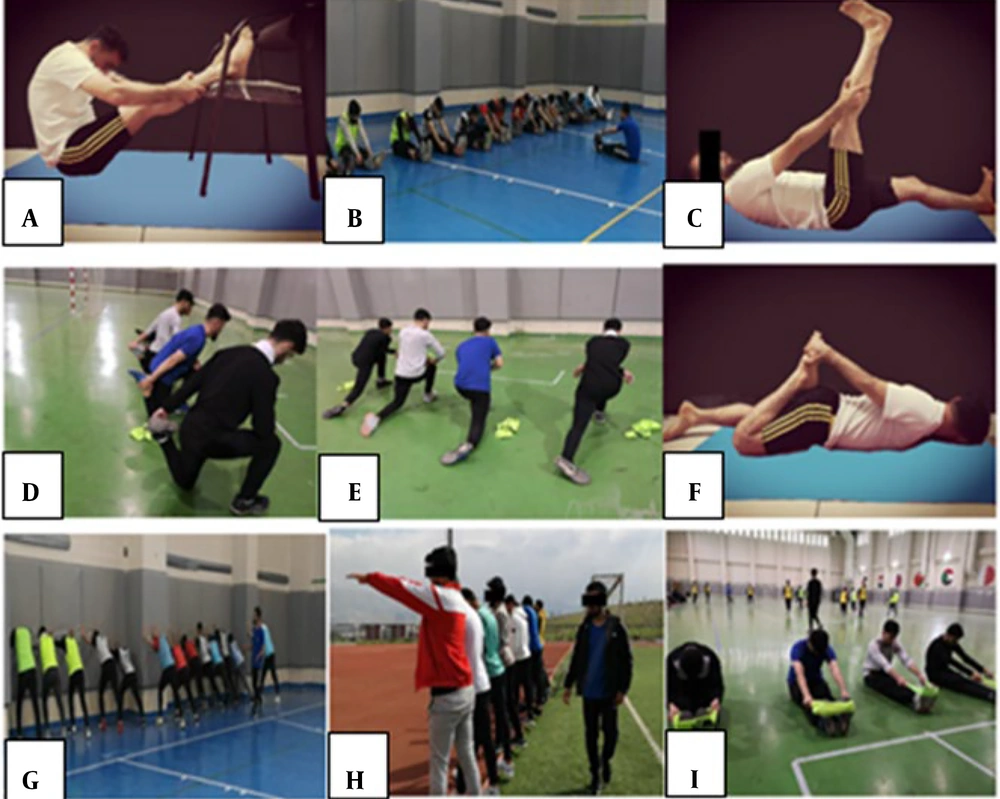
Figure 1.
Stretching exercises
3.3. Data Analysis
The Shapiro-Wilk test was utilized to investigate the normality of the all data. ANOVA with repeated measures was used to compare the effects within and between groups. Additional post-hoc comparisons were carried out using the Bonferroni test for multiple comparisons.
4. Results
The demographic characteristics of the subjects are presented in Table 3. The mean and standard deviation of the stork test (Table 4), dynamic balance (Table 5), and hamstring flexibility (Figure 2) are presented.
Table 3.Demographic Characteristics of Subjects
| Groups | Age (y) | Mass (kg) | Height (cm) | Leg Length (cm) |
|---|---|---|---|---|
| Control | 22.4 ± 5.1 | 74.06 ± 4.4 | 175.1 ± 4.9 | 89.8 ± 3.2 |
| Periodization | 22.3 ± 5.2 | 75.6 ± 4.2 | 175.4 ± 4.2 | 89.6 ± 2.9 |
| Non-periodization | 22.91 ± 5.3 | 74.6 ± 5.1 | 176.8 ± 5.1 | 91.3 ± 3.8 |
Table 4.Mean and Standard Deviation of Stork Test (Second)
| Groups and Leg | Pre-test | 4 Week | 6 Week |
|---|---|---|---|
| Control | |||
| Dominance | 11.4 ± 4.3 | 10.9 ± 6.5 | 10.9 ± 6.9 |
| Non-dominance | 5.6 ± 1.1 | 5.7 ± 2.3 | 6.1 ± 3.7 |
| Periodization | |||
| Dominance | 11.5 ± 4.9 | 10.8 ± 5.3 | 12.9 ± 5.1 |
| Non-dominance | 5.7 ± 3.1 | 6.7 ± 3.5 | 8.5 ± 3.3 |
| Non-periodization | |||
| Dominance | 11.9 ± 5.1 | 12.7 ± 8.1 | 14.1 ± 8.3 |
| Non-dominance | 81 ± 6.9 | 8.8 ± 7.1 | 9.2 ± 6.8 |
Table 5.Mean and Standard Deviation of Dynamic Balance Test (cm)
| Variables and Direction | Pre-test | 4 Week | 6 Week |
|---|---|---|---|
| Control | |||
| Dominance | |||
| Anterior | 83.6 ± 3.6 | 83.2 ± 4.7 | 82.65 ± 4.3 |
| Posteromedial | 94.7 ± 3.7 | 94.1 ± 4.4 | 89.4 ± 5.6 |
| Posterolateral | 92.5 ± 5.7 | 92.8 ± 6.1 | 88.6 ± 6.1 |
| Non-dominance | |||
| Anterior | 81.1 ± 7.1 | 79.8 ± 5.1 | 76.6 ± 6.1 |
| Posteromedial | 90.3 ± 4.8 | 90.2 ± 4.9 | 89.4 ± 5.6 |
| Posterolateral | 87.2 ± 9.7 | 90.1 ± 6.3 | 88.6 ± 6.1 |
| Periodization | |||
| Dominance | |||
| Anterior | 82.1 ± 5.6 | 83.9 ± 5.8 | 85.4 ± 6.1 |
| Posteromedial | 91.6 ± 6.6 | 93.2 ± 6.6 | 92.2 ± 6.7 |
| Posterolateral | 90.5 ± 5.5 | 91.2 ± 5.6 | 90.1 ± 6.2 |
| Non-dominance | |||
| Anterior | 80.2 ± 5.6 | 81.9 ± 5.7 | 82.7 ± 5.7 |
| Posteromedial | 89.8 ± 6.3 | 91.3 ± 6.8 | 92.2 ± 6.7 |
| Posterolateral | 87.2 ± 6.4 | 89.9 ± 6.9 | 90.1 ± 6.2 |
| Non-Periodization | |||
| Dominance | |||
| Anterior | 82.1 ± 9.1 | 84.4 ± 5.6 | 84.7 ± 5.6 |
| Posteromedial | 93.7 ± 4.4 | 94.3 ± 4.4 | 92.7 ± 5.1 |
| Posterolateral | 94.3 ± 4.1 | 95.1 ± 3.9 | 94.3 ± 3.3 |
| Non-dominance | |||
| Anterior | 81.2 ± 6.1 | 81.7 ± 6.1 | 82.5 ± 5.8 |
| Posteromedial | 91.7 ± 5.9 | 92.2 ± 5.3 | 92.7 ± 5.1 |
| Posterolateral | 93.2 ± 3.6 | 94.1 ± 3.6 | 94.3 ± 3.3 |
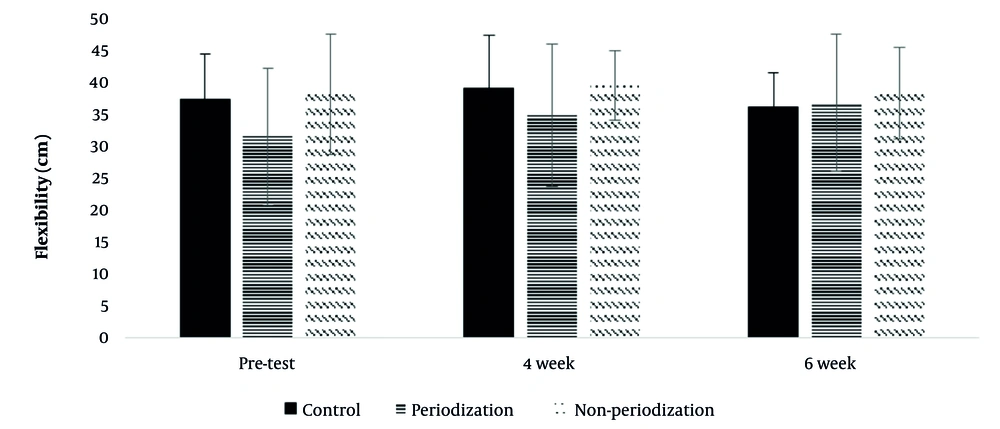
Figure 2.
Mean and standard deviation of hamstring flexibility (cm)
The findings revealed that both the duration of stretching exercises (weeks) (F = 17.7, P = 0.001) and leg dominance (dominant vs. non-dominant) (F = 72.06, P = 0.001) significantly affected static balance. Post hoc Bonferroni tests indicated significant differences between pre-test and 6-week results (P = 0.001) and between 4-week and 6-week results (P = 0.001), but no significant difference was found between pre-test and 4-week results (P = 0.08). Furthermore, intergroup comparisons showed no significant differences in static balance following the stretching intervention (F = 0.83, P = 0.43).
Regarding dynamic balance, leg dominance and stretching duration (F = 94.7, P = 0.001) had a significant effect. Bonferroni tests demonstrated a significant difference between pre-test and 6-week results (P = 0.001), but not between pre-test and 4-week (P = 0.08) or between 4-week and 6-week results (P = 0.07). Intergroup analysis also revealed no significant differences in dynamic balance post-intervention (F = 1.26, P = 0.29).
Finally, the number of stretching weeks significantly influenced hamstring flexibility (F = 4.26, P = 0.017). However, no intergroup differences were observed after the intervention (F = 0.99, P = 0.37). Bonferroni tests indicated a significant improvement between pre-test and 6-week measurements (P = 0.01), but not between pre-test and 4-week (P = 0.1) or between 4-week and 6-week results (P = 0.12).
5. Discussion
This study examined the effects of periodized versus non-periodized stretching exercises on static and dynamic balance and flexibility. The results revealed that both training duration (number of weeks) and limb dominance significantly influenced static balance. Specifically, post-hoc comparisons demonstrated significant improvements between pre-test and 6-week measurements, as well as between 4-week and 6-week measurements. Additionally, static balance performance was significantly better in the dominant leg compared to the non-dominant leg. The results of this section with the results of Yildiz et al. (15) are aligned and misaligned with Hegishte and Kumar (16). The reason for this disparity may be due to the type of training protocol and research subjects, because in this research the subjects were physical education students, while in the research of Hegishte and Kumar (16), the subjects were collegiate-level badminton players .
Also, findings indicated the number of weeks of stretching exercises, dominance, and non-dominance leg, had a significant effect on the dynamic balance. On the other hand, the results showed that there was a significant difference between the pre-test results with 6 weeks, but there was no significant difference between the pre-test results with 4 weeks and the 4-week results with 6 weeks. The presence of significance after 6 weeks indicates that at least 6 weeks are needed for stretching exercises to affect dynamic balance, and this point can be taken into consideration by sports trainers and rehabilitation specialists. The findings of this section are consistent with the research of Behm et al., (4); and Tong et al., (17) such that stretching exercises have led to the improvement of dynamic balance and inconsistent with Hidayatullah et al., (18) which may be due to different protocols combining stretching exercises with other programs such as massage, yoga training program, etc. and different measurement tools and subjects. Among the possible reasons for improving balance and even flexibility (which will be explained), it may be related to the increase in neural adaptations caused by training, such as the use of more and more efficient nerve units, reorganization in the sensory cortex, increasing efficiency and ability of synaptic junctions, the tendency to increase the activation of the nervous system, the reduction of inhibitory nerve reflexes, the reduction of the resistance of the nerve pathways to the transmission of impulses, and the improvement and facilitation of the transmission of the inputs of each of the senses. The improvement of dynamic balance can also be due to better division and more attention to the desired movement task training based on special tasks can lead to more focus on that movement task.
Finally, findings showed that the number of weeks of stretching exercises has a significant effect on hamstring flexibility. On the other hand, the results showed that there was a significant difference between the pre-test results with 6 weeks, but there was no significant difference between the pre-test results with 4 weeks and the 4-week results with 6 weeks. The presence of significance after 6 weeks indicates that at least 6 weeks are needed for stretching exercises to affect flexibility, and this point can be taken into consideration by sports trainers and rehabilitation specialists. The findings of the present study were inconsistent with the results of Chapman-Lopez et al., (19), But the results of Menek M and Menek B (20) were aligned. Probably, the reason for the difference between the results of the present study and the results of Chapman-Lopez can be attributed to the duration of the training protocol, the difference in the chosen method of periodized and non-periodized stretching, as well as paying attention to the fact that 30 seconds of periodized and non-periodized stretching to increase flexibility is not enough, also, in most of the researches, the statistical population included sports elites, while the statistical population included in the present study included physical education and sport sciences students.
The findings demonstrate that both training duration and limb dominance significantly influence balance and flexibility outcomes, with six weeks of stretching proving optimal for measurable improvements and dominant limbs showing greater enhancements in both static and dynamic balance. While no significant differences emerged between periodized and non-periodized stretching protocols, the results confirm that both approaches effectively improve balance and flexibility measures. These findings suggest that practitioners can implement either stretching modality with confidence, though programs should incorporate a minimum six-week intervention period to achieve meaningful results. The comparable efficacy of both methods provides valuable flexibility in training program design while ensuring consistent improvements in key performance metrics.
