


1. Background
Crossfit training integrates gymnastic movements with weightlifting. Most injuries during CrossFit occur during weightlifting or powerlifting exercises. In sports like weightlifting, the shoulder and back are among the most commonly reported injury sites (1). From a biomechanical point of view, a lack of optimal muscle strength and flexibility may cause injury. It is known that greater physiological stress and fatigue lead to a greater risk of injury. Several studies have described the effects of exercise-induced fatigue on reduced joint stability, changes in muscle activity, changes in balance, and muscle function (2). Specifically for shoulder injuries, a relationship has been found between reduced rotational strength and the incidence of shoulder injuries in overhead and throwing athletes (1). This situation agrees with the belief that high-performance sports put athletes at risk of injury (3).
The shoulder joint has the largest range of motion among the joints of the body, and this range of motion requires the proper performance of the scapular stabilizer muscles and the rotator cuff muscles, which naturally keep the head of the humerus in the glenoid fossa during functional activities (4). Based on the examination and evaluation of the condition of the shoulder girdle of people, it has been observed that shoulder asymmetry, the most common postural disorder, is due to the insufficiency of the muscles of the shoulder girdle such as the trapezius, rhomboids, levator scapula muscle, sternum-sternum-pectoral muscle and other muscles (5). Gillet et al. (6) reported that the existence of a history of injury in professional tennis athletes can change the balance between mobility and stability in the joint and it is necessary for the coaches and team physicians to provide complementary and appropriate exercises for the dominant and non-dominant limbs in these athletes. Also, the research of Daneshjoo and Hosseini (4) states that volleyball players with uneven shoulders have a limited range of motion. They noted a significant difference between the strength and range of the internal and external rotator muscles of the dominant and non-dominant hand of people with uneven shoulders, but no significant difference was observed between the dominant and non-dominant hand of the symmetrical shoulder group.
Musculoskeletal screening tests are designed to identify risk factors so that measures can be taken to prevent injury (7). Functional movement screening test (FMS) and Y-balance test (Y-balance) are two injury risk screening tools that can be used to check the performance and stability of the shoulder girdle (7). The FMS is used to identify deficits and asymmetry of movements (8), and the Y-balance test is used to evaluate dynamic balance (9). Both tests require minimal time to administer, have good reliability, and have been shown to correlate with injury risk. From the perspective of injury prevention and performance, it is important to know whether FMS score and shoulder girdle stability differ in CrossFit athletes with and without shoulder asymmetry, so that individual performance and injury risk thresholds can be determined.
2. Objectives
Considering that shoulder asymmetry can cause changes in the balance and performance of shoulder girdle muscles, the present study aimed to investigate the FMS score and shoulder girdle stability as determinants of injury risk in CrossFit athletes with and without shoulder asymmetry.
3. Methods
3.1. Subjects
This cross-sectional study examined male CrossFit athletes selected through convenience sampling (n = 60). Participants were divided into two groups based on scapular asymmetry (with asymmetry, n = 23; without asymmetry, n = 37) after providing informed consent and meeting inclusion criteria: No visual system impairment, recent injuries (past year), neurological disorders, postural abnormalities, prior surgeries or fractures (spine/limbs), or congenital spinal abnormalities (10). Exclusion criteria comprised injuries during the study, withdrawal of consent, illness onset during participation, or medical contraindications. Before evaluating the relevant tests in the first session, brief explanations were given to familiarize participants with the test process and study objectives. Each person was given necessary explanations and instructions related to the implementation of each test, and the individuals performed the tests once on a trial basis.
3.2. Apparatus and Task
3.2.1. Functional Movement Screen Test
The FMS test (Figure 1) includes the following: "deep squat", "hurdle step", "inline lunge", "shoulder mobility", "active straight leg raise", "trunk stability push up" and "rotary stability ". All the items were performed 3 times and the individual's best record was recorded. The total FMS score is the sum of all 7 items, which gives a maximum of 21 points. A 4-point rating system is used to evaluate the movement quality. A score of "3" describes the correct performance of the movement pattern, "2" indicates that the subject needs compensatory movements to perform the movement, and a score of "1" is given when the person is unable to perform the movement pattern. In cases where subjects feel pain while performing an item, a score of "0" is given (11, 12).
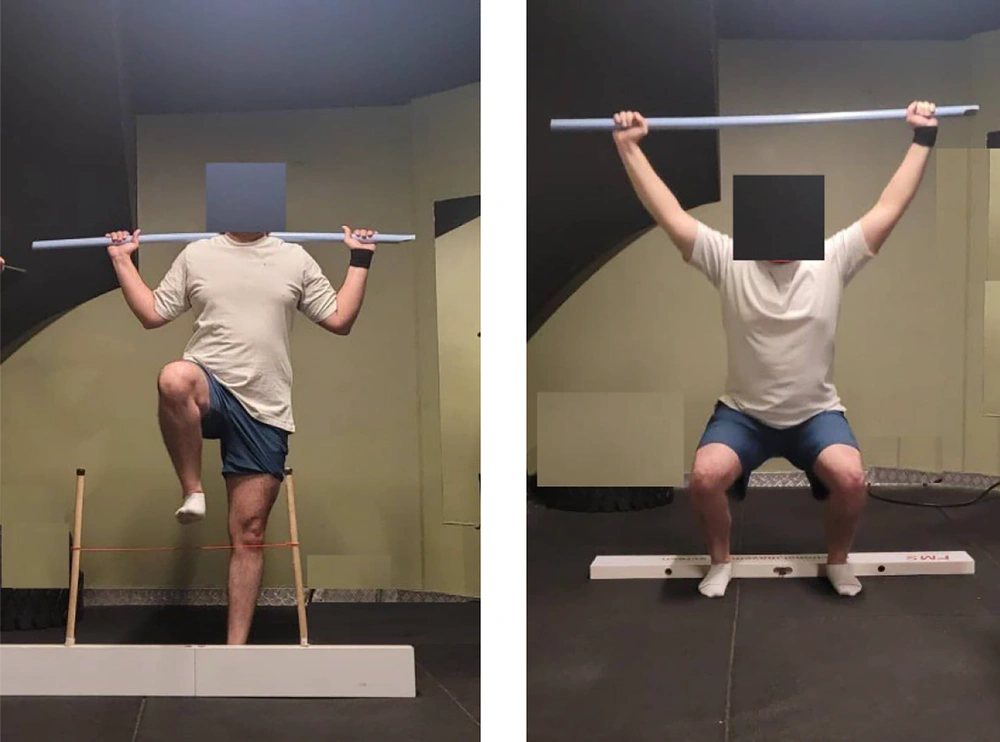
Figure 1.
Participants perform the functional movement screen (FMS) test.
3.2.2. Y-Balance Test
To perform the upper extremity Y-balance test, the subject was asked to stand on the palms of the hands (thumb attached to the index finger and elbows in an open position) and toes (without shoes) in the starting position, similar to the Swedish swimming movement. Keep the spine and lower limbs in the same line. The location of the thumb was marked by a line and the feet were shoulder width apart. In this situation, the person was asked to reach with his free hand in internal, lower-external and upper-external directions respectively and to the farthest possible place by maintaining the position of the support hand, trunk and legs. To be able to compare with other people, the reach values were normalized with the length of the upper limb (the distance from the spinous appendage of the seventh cervical vertebra to the end of the longest finger in the position of 90 degrees of shoulder rotation and elbow, wrist, and finger extension). The act of reaching in all three directions was done consecutively, without rest and without the free hand contacting the ground. After completing each round of reaching in three directions, the person was allowed to place the free hand on the ground and rest and do this process for three rounds (13). Suppose in every round the person's fixed hand is separated from the flat surface. In that case, the free hand hits or rests on the ground or the indicator, or the person cannot return to the starting position by controlling the free hand and his balance is disturbed, or any of the legs would leave the ground, the cycle would be repeated. In each direction, the maximum amount of achievement was recorded and to calculate the overall composite score, it was included in the formula related to the test (13).
3.2.3. Scapula Asymmetry
Studies have determined the position of the scapula, the natural alignment of the shoulder joint and its condition, and various tests have been used. One of the tests that can be used to measure the position of the scapula bone is the lateral scapula slip test (LSST), first proposed by Kibler. Kibler stated that the distance between the edges of the scapula and the spine can determine decreased stability and unfavorable alignment of the scapula (14).
3.3. Data Analysis
The Shapiro-Wilk test was used to assess data normality. Since the data for FMS and right/left Y-balance tests were non-normal (scapular asymmetry group: P = 0.008, P = 0.001, P = 0.001; non-asymmetry group: P = 0.006, P = 0.001, P = 0.001, respectively), non-parametric Mann-Whitney U tests were employed to compare intergroup differences in FMS and Y-balance performance. All analyses were conducted using SPSS 26, with statistical significance set at P ≤ 0.05.
4. Results
The mean and standard deviation of the subjects' characteristics are presented in Table 1. According to the results of Table 1, the FMS scores of the scapular asymmetry group were lower than the group without scapular asymmetry, but the results of the Mann-Whitney U test showed that FMS did not differ significantly between the scapular symmetry and scapular asymmetry groups (P = 0.3). The results of the Y-balance test of the right and left hand in CrossFit athletes show that the scores of the athletes without scapular asymmetry are high, but the results of comparing the two groups showed that there is no significant difference (P = 0.42; P = 0.28; respectively) (Table 2).
Table 1.Descriptive Characteristics of Participants a
| Variables | Without Scapular Asymmetry (n = 37) | Scapular Asymmetry (n = 23) |
|---|---|---|
| Age (y) | 30.51 ± 8.12 | 27.39 ± 6.94 |
| Height (cm) | 181.75 ± 9.21 | 179.28 ± 11.53 |
| Weight (kg) | 81.70 ± 11.39 | 84.30 ± 12.77 |
| FMS | 17.46 ± 1.85 | 17.17 ± 2.93 |
| Right Y-balance | 91.81 ± 28.19 | 75.34 ± 27.03 |
| Left Y-balance | 91.97 ± 27.79 | 76.82 ± 28.95 |
Abbreviation: FMS, functional movement screening test.
a Values are expressed as mean ± SD.
Table 2.Comparison Results of Functional Movement Screening Test Score and Shoulder Girdle Stability Between the Groups
| Variables | Mann-Whitney U | Wilcoxon W | Z | P-Value |
|---|---|---|---|---|
| FMS | 359 | 635 | -1.02 | 0.3 |
| Right Y-balance | 373.5 | 649.5 | -0.79 | 0.42 |
| Left Y-balance | 355.5 | 631.6 | -1.06 | 0.28 |
Abbreviation: FMS, functional movement screening test.
5. Discussion
This study investigated the FMS score and shoulder girdle stability as determinants of injury risk in Cross-fit athletes with and without scapular asymmetry. The research results showed no significant difference between FMS and Y-balance test of right and left hand between Cross-fit athletes with and without shoulder asymmetry.
The spine's alignment and the scapula's natural position affect the shoulder girdle's performance. The basis of this relationship between vertebral column alignment, scapular position, and shoulder girdle function is related to at least two factors: During arm movements, the scapula must provide a stable base for glenohumeral joint movements and at the same time be mobile relative to the position of the arm throughout the range of motion (15, 16). Changing the position of the scapula and shoulder is associated with the imbalance of the rotator cuff muscles and scapular stabilizers, and the alignment of the bone parts of the vertebral column, scapula, clavicle, and arm may change directly through the muscle connections between them (17, 18). Scapular asymmetry can cause changes in range of motion, sense of position, and muscle imbalance. Muscular imbalances may be latently caused by proprioceptive input changes or abnormal joint posture or movement. These changes cause shortness (excessive tonicity) or weakness (inhibition) of muscles and cause local muscle imbalance. In addition to bone misalignment, it also affects the length of muscles, and in this way, it can affect the muscle's ability to produce tension and reduce performance (16, 18, 19).
The movements performed in Cross-fit are technically complex (20). These exercises require the ability of the neuromuscular system to produce a series of high-intensity muscle contractions (21). In addition, Cross-fit athletes need sufficient flexibility in the upper limb for movement phases that require a high range of motion (22, 23). Shoulder girdle injuries are also caused by the technical implementation of exercises that require a high range of motion and stability of the joint complex. The biomechanical benefits enabled by an optimal range of motion inherent in Cross-fit exercises reduce stress and joint loads during movement, which can minimize the negative changes in joint tissues observed in athletes with overhead activity. As a result, the biological capacity of joint tissue remains constant (24).
The results of the present study showed that the FMS score and shoulder girdle stability in Cross-fit athletes with and without scapula asymmetry did not differ significantly. However, the FMS score and shoulder girdle stability were lower in the group with scapula asymmetry. Therefore, it was observed that the asymmetry in the shoulders had no effect on the amount of muscle activity and stabilization of the shoulder girdle, and the contraction pattern of these muscles was the same in Cross-fit athletes with and without shoulder asymmetry. Also, there was no significant difference in predicting the probability of injury in the two groups. According to the results, shoulder asymmetry in these athletes is probably not the factor affecting the strength of shoulder girdle muscle contraction. In this regard, Akinoglu et al. concluded in their research that there is no significant difference between the two groups of athletes with and without scapular symmetry in terms of shoulder strength and proprioception (25), which was consistent with the results of the present study. Also, Turgut and Baltaci study on the effect of lack of flexibility on scapular asymmetry in people with and without shoulder pain showed that lack of flexibility of the pectoralis minor and posterior capsule had a positive significant relationship with the symmetry angle in the resting position separately for both shoulder group has symmetry and asymmetry. However, no significant relationship was found between lack of flexibility and asymmetry during arm elevation and descent for both asymptomatic and symptomatic groups (26).
On the other hand, Hadzic et al. (27) results, which investigated shoulder strength asymmetry in elite volleyball players, showed that in male volleyball players, regardless of playing position, skill level, or previous shoulder injury, the ratio of external to internal rotation strength of the shoulder superior was less. This ratio was lower in female players only in those with a higher skill level. In addition, Daneshjoo and Hosseini (4) stated that muscle strength was higher in volleyball players with uneven shoulders, and the range of motion of the shoulder rotator muscles of volleyball players with uneven shoulders was limited. Also, the difference in strength and range of motion of the shoulder between the dominant and non-dominant hand was significant in the asymmetric shoulder group, but no significant difference was observed in the symmetrical shoulder subjects, which was inconsistent with the results of this research. It should be noted that shoulder asymmetry was examined in this study and scapular asymmetry was not mentioned. Wang and Cochrane (28) investigated the issue of mobility disorder, muscle imbalance, muscle weakness, scapular asymmetry and shoulder injury in elite volleyball athletes. The results showed that the active range of shoulder internal rotation and external rotator strength in the dominant arm it was significantly less than the non-dominant arm, but the internal rotators were significantly stronger. There was a relationship between shoulder muscle imbalance, balance and dominant arm and shoulder rotator muscle strength. It was reported that rotator cuff strength imbalance may play an important role in shoulder injuries in high-level volleyball players. The reason for the difference between the research results can be related to the difference in the sport of the people participating in the research, examining the shoulder instead of the scapular, the difference in their training history, and the way of evaluating the investigated variables.
By observing the results and examining the findings of the studies, it seems like this, performing movements in different ranges of motion in Cross-fit exercises can help prevent the occurrence of compensatory movements, muscle imbalance, and insufficient movement execution. It is likely to minimize the negative effect of existing imbalances caused by asymmetry of the scapular, which are considered to be frequent factors and mechanisms of injuries (24, 29). On the other hand, studies have suggested that to prevent limitation of the range of motion, performing strength exercises with full range of motion of the joint as an important factor, but with moderate loads can be helpful (30). Cross-fit exercises are also among the exercises in which the athlete often performs movements with body weight and different loads in the full range and different joint angles, and all muscle groups are activated in different directions. Due to this, this amount of variation in movements in complete and different ranges of motion probably makes the presence of scapular asymmetry ineffective in the FMS score and shoulder joint stability in the group with scapular asymmetry. Therefore, this sport can probably reduce the severity of injury risk factors in people.
5.1. Conclusions
In summary, the diverse movement patterns and emphasis on full range of motion in Cross-fit training may help maintain shoulder girdle stability and function despite scapular abnormalities. However, as Cross-fit remains a relatively new discipline with limited research on FMS scores and shoulder stability in its athletes, further investigation is warranted to establish definitive conclusions. Future studies should employ advanced laboratory assessments and more precise exercise classification to examine muscular activation patterns and their impact on shoulder-scapular-upper limb kinematics in Cross-fit athletes.
