


1. Background
Sport is widely acknowledged for its positive impact on both physical and mental health (1, 2). Beyond enhancing physical fitness, regular participation in sport contributes to improved emotional well-being, including reductions in stress, anxiety, and depression (3-5). However, the psychological outcomes of sport participation can vary depending on several contextual factors, chief among them being the type of sport and the performance level of athletes.
Performance level, typically categorized as professional or amateur, plays a key role in shaping athletes’ psychological states. Professional athletes often face higher levels of stress due to intense training and competition, which may lead to increased emotional fatigue (6, 7). In contrast, amateur athletes generally engage in sport for enjoyment and may experience less emotional strain.
The type of sport, whether team-based or individual, also influences athletes' emotional experiences. Team sports promote social interaction and support, which can enhance emotional expressiveness and reduce stress. On the other hand, individual sports may foster greater self-focus and emotional suppression (8, 9).
Emotional fatigue, defined as a sense of psychological exhaustion caused by prolonged stress, is a prevalent issue among athletes, particularly professionals, and can negatively impact both performance and quality of life (10). In contrast, emotional expressiveness, or the ability to communicate one’s emotions, is associated with better mental health and social relationships (11, 12). Some studies suggest that team athletes exhibit higher emotional expressiveness due to the inherently social nature of their sport, whereas individual athletes may struggle with emotional communication (13-16).
Although previous research has explored the general psychological benefits of sport, few studies have simultaneously examined the combined effects of sport type and performance level on emotional fatigue and emotional expressiveness. Addressing this gap, the current study investigates how these two factors interact to influence emotional outcomes in athletes.
In addition to coaching support, environmental factors and competitive conditions play a significant role in determining emotional fatigue levels in athletes. A study conducted by Vitoria et al. (17) revealed that professional athletes experience higher levels of emotional fatigue compared to amateurs due to intense competition, rigorous training schedules, and social pressures. This study, carried out during the COVID-19 quarantine period, found that the absence of competition and social interactions during this time exacerbated symptoms of emotional fatigue among professional athletes. In contrast, amateur athletes, not reliant on intense competitions, faced fewer challenges in this regard.
These findings indicate that sport type can also influence the levels of emotional fatigue and emotional expressiveness in athletes. Despite these studies, significant research gaps remain in this area. Many previous investigations have focused solely on examining either sport level or sport type independently, with few studies exploring the interactive effects of these two variables. Therefore, the present study aims to examine the impact of sport level (professional and amateur) and sport type (team-based and individual) on emotional fatigue and emotional expressiveness.
The results of this study can assist coaches, sports psychologists, and policymakers in designing more effective training and support programs to reduce emotional fatigue and enhance emotional expressiveness in athletes. However, most of these studies have separately addressed the effects of sport level or type, and fewer investigations have simultaneously examined the combined impacts of sport level (professional and amateur) and sport type (team-based and individual) on individuals’ psychological and emotional states.
This research gap highlights the need for further studies in this area. The varying effects of sport level (professional and amateur) on emotional fatigue and emotional expressiveness, as well as the influence of sport type (team-based and individual) on these variables, can enhance our understanding of the psychological impacts of sports at different levels.
2. Objectives
This study aimed to investigate the impact of sport type (team-based and individual) and performance level (professional and amateur) on emotional fatigue and emotional expressiveness in athletes.
3. Methods
3.1. Subjects
The study sample consisted of 80 athletes, equally divided between team sports (football, basketball, and volleyball) and individual sports (bodybuilding, track and field, and parkour), with 40 athletes in each category. Each group was further divided into 20 professional and 20 amateur athletes. The mean age and standard deviation were as follows: amateur team sport athletes (M = 21.8, SD = 2.5), professional team sport athletes (M = 26.3, SD = 3.2), amateur individual sport athletes (M = 22.5, SD = 2.7), and professional individual sport athletes (M = 27.1, SD = 3.5).
3.2. Task and Apparatus
3.2.1. Emotional Expressiveness Questionnaire
This tool is designed to assess and evaluate the role of emotional expressiveness in individual health. Developed by King and Emmons in 1990, the questionnaire contains 16 items and comprises three components: positive emotional expressiveness, intimacy, and negative emotional expressiveness (18). The reliability of this scale was assessed using the internal consistency method and Cronbach's alpha coefficient. In a 2005 study by Rafieinia et al., the overall reliability of the scale was reported to be 0.68 (19).
3.2.2. Maslach Emotional Fatigue Questionnaire
Designed and validated in 1981, the Maslach Burnout Inventory is a widely used tool for measuring stress and burnout. It consists of 22 items evaluating three dimensions: emotional fatigue, depersonalization, and lack of personal accomplishment, primarily within professional settings. It has been extensively used among groups such as nurses, teachers, and healthcare professionals. In this study, emotional fatigue was assessed through items 1, 2, 3, 6, 8, 13, 14, 16, and 20. The reliability coefficient of the emotional fatigue subscale was reported as 0.92 by Maslach (20) and 0.90 by Nazarian (21).
3.3. Procedure
Data collection was conducted in the field using self-report questionnaires. Initially, athletes provided demographic information, including age, gender, sport level, and sport type. They then completed the Emotional Fatigue and Emotional Expressiveness questionnaires. To ensure accuracy and reduce response bias, questionnaires were administered anonymously, in accordance with ethical principles in social research. The collected data were reviewed and prepared for analysis using SPSS software.
3.4. Data Analysis
In the first stage, descriptive statistics such as mean and standard deviation were calculated (Table 1). Due to the non-normal distribution of some variables (Table 2), nonparametric statistical tests were used. The Kruskal–Wallis test assessed significant differences among the groups, and the Mann–Whitney U test was employed for pairwise comparisons.
Table 1.Descriptive Statistics of Research Variables
| Variables | Mean ± SD |
|---|---|
| Team | |
| Professional | |
| EF | 17.25 ± 2.881 |
| EE | 46.50 ± 8.056 |
| Amateur | |
| EF | 36.10 ± 9.738 |
| EE | 49.05 ± 8.413 |
| Individual | |
| Professional | |
| EF | 0.55 ± 0.945 |
| EE | 49.35 ± 8.592 |
| Amateur | |
| EF | 6.70 ± 0.055 |
| EE | 47.20 ± 6.849 |
Abbreviations: EF, emotional fatigue; EE, emotional expressiveness.
4. Results
The results of the Kruskal–Wallis test for emotional fatigue revealed a statistically significant difference among the groups, χ2 (3) = 17.35, P = 0.001, indicating that both sport type (team vs. individual) and performance level (professional vs. amateur) significantly influence levels of emotional fatigue. To further examine these group differences, pairwise comparisons were conducted using Mann–Whitney U tests.
Amateur team athletes reported significantly higher emotional fatigue than professional team athletes (U = 72.00, P = 0.001). Similarly, amateur individual athletes experienced significantly greater emotional fatigue than their professional counterparts (U = 87.00, P = 0.004) (Figure 1). Further Mann–Whitney U tests were conducted separately for team and individual sports to explore within-group differences.
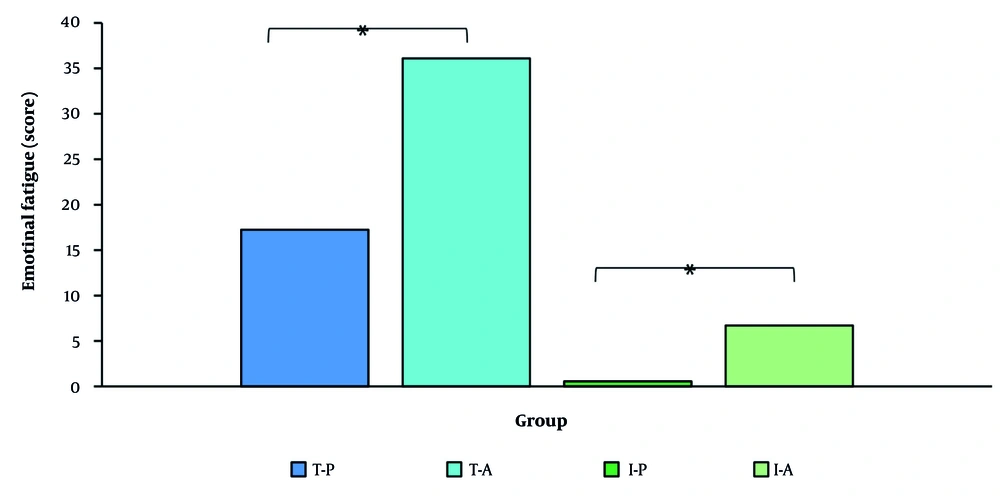
Figure 1.
Mean of the emotional fatigue by group (note: T-P = team-professional; T-A= team-amateur; I-P= individual-professional; I-A= individual-amateur; * P ≤ 0.05)
In team sports, amateur athletes reported significantly higher emotional fatigue than professional athletes (U = 1.500, P < 0.001), whereas no significant difference was found in emotional expressiveness (U = 171.500, P = 0.440). In individual sports, amateur athletes also experienced significantly higher emotional fatigue compared to professional athletes (U = 2.000, P < 0.001), but the difference in emotional expressiveness remained non-significant (U = 159.500, P = 0.272).
These findings confirm that performance level significantly affects emotional fatigue, with amateur athletes reporting greater levels in both team and individual sports (P < 0.001). However, emotional expressiveness does not appear to be influenced by competition level in either sport type.
Regarding emotional expressiveness, no significant differences were observed among the groups, χ2 (3) = 1.65, P = 0.649, suggesting that this variable is not notably affected by either sport type or performance level (Figure 2).
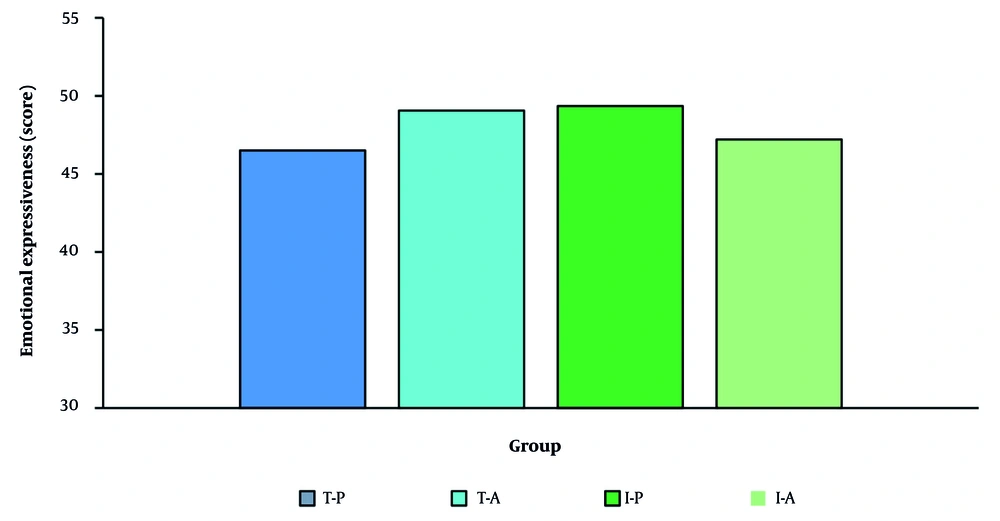
Figure 2.
Mean of the emotional expressiveness by group (note: T-P = team-professional; T-A= team-amateur; I-P= individual-professional; I-A= individual-amateur. No significant differences were found between groups).
5. Discussion
The present study examined the impact of sport type (team-based and individual) and performance level (professional and amateur) on athletes' emotional fatigue and emotional expressiveness.
The results showed that amateur athletes experienced significantly higher levels of emotional fatigue than professional athletes in both team and individual sports. Additionally, amateur team athletes reported greater emotional fatigue compared to individual athletes, indicating that both sport type and competition level contribute to emotional exhaustion in athletes (22).
Previous studies have also indicated that team athletes, due to their broader social interactions and the need for continuous collaboration, are more exposed to stress, which can lead to emotional fatigue (23). However, some research has reported contrasting results, suggesting that individual athletes might experience more stress because they bear full responsibility for their performance and lack the social support provided by teammates. This could result in greater emotional fatigue among individual athletes (24).
Furthermore, the results revealed a significant impact of performance level on emotional fatigue, though this effect varied by sport type. Amateur athletes consistently reported higher levels of emotional fatigue across both team and individual sports. This finding aligns with studies indicating that professional athletes face greater competitive pressures, higher expectations, intense training regimens, and stringent requirements to maintain high-level performance, placing them at a greater risk of emotional fatigue (25). On the other hand, some research suggests that professional athletes might experience lower levels of emotional fatigue compared to amateurs due to better support resources, such as psychological assistance from specialists and advanced stress management techniques (26).
Regarding emotional expressiveness, the results revealed no significant difference between team and individual athletes. This finding contrasts with some previous studies that have suggested team athletes, due to broader social interactions, have greater opportunities to express their emotions and typically display higher levels of emotional expressiveness (27). However, another study highlighted that emotional expressiveness is influenced more by athletes' personality traits, emotional intelligence levels, and competitive experience rather than by the type of sport they engage in (28).
Although professional athletes reported slightly higher levels of emotional expressiveness than amateurs, the differences were not statistically significant in either team or individual sports. This suggests that emotional expressiveness may be influenced more by personal traits such as emotional intelligence, personality, or cultural background, rather than by sport type or performance level alone (29).
One of the limitations of the present study is the sample size, and it is suggested that future studies utilize larger and more diverse samples. Another limitation is the lack of control over personality variables, such as extraversion, neuroticism, and coping strategies, which can influence emotional expressiveness and emotional fatigue but were not examined in this study. Additionally, the use of self-report tools may have been affected by cognitive and social response biases. Therefore, the use of mixed methods (such as physiological assessments and interviews) is recommended for future research.
