
1. Background
The teacher/coach's knowledge is pivotal in facilitating effective learning, skill development, and sustained physical activity (1). While various motor learning methods exist, the teacher's expertise determines their application, outweighing the importance of specific training techniques (2). Given the complexity of sports science, coaching requires deep methodological understanding and adaptive decision-making (3). In this regard, although teachers' knowledge plays an important role in the learning process, the type of instructional approach employed can also significantly influence skill acquisition. Therefore, the present study examines the role of Teaching Games for Understanding (TGfU)-based instruction in enhancing teachers' pedagogical content knowledge (PCK) and its impact on students' performance.
Teacher knowledge is typically discussed in three related forms (1): content knowledge (CK), the subject matter itself; specialized content knowledge (SPK), instructionally oriented expertise such as detecting and correcting movement errors; and PCK, the ability to adapt instruction to learners' needs. Together, CK and SPK provide the foundation, while PCK integrates them to deliver tailored and effective teaching for diverse learners (4). This conceptual distinction highlights the importance of PCK in learning, which has also been confirmed in previous research.
Research across educational disciplines consistently identifies PCK as a decisive factor in teaching effectiveness; however, its development within physical education has progressed unevenly. Earlier studies primarily emphasized the importance of CK, demonstrating that teachers with stronger subject-matter expertise delivered clearer demonstrations and more structured practice environments (5). Subsequent investigations expanded this perspective by showing that CK and SPK workshops enhanced teachers' capacity to diagnose movement errors, provide meaningful feedback, and adapt tasks to learner needs (6-9). Importantly, these studies suggest that CK and SPK improvements alone are insufficient unless they translate into adaptive instructional decisions in real teaching contexts. More recent research therefore shifts the focus toward PCK as the mechanism through which CK and SPK are transformed into learner-centered practice (10). Collectively, the literature indicates a developmental progression from strengthening knowledge bases to operationalizing them pedagogically, yet it stops short of explaining how PCK can be systematically enacted within specific instructional models. This gap is particularly evident in relation to TGfU, whose tactical and learner-centered principles appear theoretically aligned with PCK but remain underexplored in empirical research.
Although prior research demonstrates that CK/SPK workshops improve instructional behaviors and that TGfU enhances tactical awareness and motivation, these lines of inquiry have largely evolved in parallel. Existing studies either focus on developing teachers' knowledge bases or on evaluating game-based instructional models, without examining how teacher knowledge development can be systematically enacted through a specific pedagogical framework. Consequently, it remains unclear whether integrating TGfU within a PCK-oriented professional development structure produces measurable improvements beyond traditional approaches (11). Addressing this gap is essential, as theoretical alignment alone does not guarantee practical effectiveness. Therefore, the present study investigates whether embedding TGfU principles within a structured PCK intervention enhances both coaching behavior and students' futsal shooting performance, thereby empirically linking teacher knowledge development with a concrete instructional model.
2. Objectives
This study aimed to examine whether integrating TGfU with PCK improves futsal shooting performance in 10-year-old students. Futsal was selected because of its tactical nature and popularity in schools, and shooting was chosen as a fundamental and measurable skill. It was hypothesized that TGfU-based PCK would lead to greater shooting accuracy and retention compared with traditional instruction.
3. Methods
3.1. Subjects
The sample size was determined using G*Power (v3.1.9.2) for a 2 × 4 repeated-measures ANOVA, assuming an effect size of 0.25, α = 0.05, and power = 0.80 (12). With four measurement points, the required sample was 24. Accounting for a 20% dropout rate and high attrition in behavioral studies, 38 ten-year-old students were recruited and assigned to control or experimental groups. Demographic information of the participants is shown in Table 1. A physical education teacher with 15 years of experience, interested in innovative methods such as TGfU, conducted the sessions. Participants were eligible if they were healthy according to school health records, enrolled in fourth grade, had no history of musculoskeletal or neurological disorders, and were not participating in any specialized futsal training program. Students with medical restrictions or prior formal futsal training were excluded. Written informed consent was obtained from parents or legal guardians before participation. Ethical approval was secured before data collection.
Table 1.
Descriptive Information of Participants (Mean ± Standard Deviation)
| Variables | Total N = 38 | Control N = 19 | Experimental N = 19 |
|---|---|---|---|
| Age | 10.16 ± 1.165 | 10.12 ± 1.17 | 10.30 ± 1.16 |
| Weight | 32.2 ± 3.55 | 31.26 ± 3.1 | 33.15 ± 4.01 |
| Height | 140.05 ± 6.12 | 141.14 ± 6.14 | 140.96 ± 6.11 |
3.2. Apparatus and Task
Futsal shooting performance was assessed across four test phases using a standardized protocol (13). As shown in Figure 1, participants completed 35 shots from three positions, including stationary shots, shots after dribbling over different distances, shots following right- and left-side passes, and shots after clearing a 40-cm obstacle. Scoring was conducted according to the validated system presented in Figure 1, with the final score calculated as the mean of all attempts (13). The protocol has demonstrated adequate content validity for assessing shooting accuracy in children. In the present study, two trained observers independently recorded and scored all attempts, achieving full agreement and confirming inter-rater reliability.
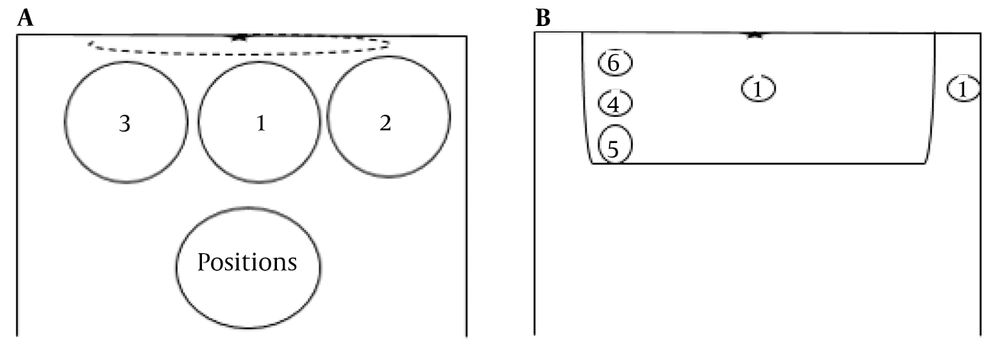
Figure 1.
A, Shooting positions; B, scoring method for futsal shots
Coach behavior was evaluated using a coding framework adapted from previous research (8). Because the original framework was developed in a different linguistic context, the coding categories were translated into Persian and reviewed by a panel of three university faculty members specializing in physical education pedagogy and motor learning to ensure linguistic clarity and content relevance. Minor wording adjustments were made to align the categories with the Persian instructional context while preserving the original conceptual structure. All sessions were video- and audio-recorded and coded independently by two raters holding graduate degrees in motor learning and physical education pedagogy. Before formal coding, both raters completed a calibration session using pilot recordings to ensure a shared understanding of category definitions and coding criteria. Inter-rater agreement exceeded 90%, and discrepancies were resolved through consensus discussion. Although two authors supervised sessions to monitor procedural adherence, they were not involved in behavioral coding or data scoring, thereby minimizing potential observer bias.
The traditional instructional approach followed a linear skill-based progression emphasizing technique refinement before game application (10, 14-18). Each 90-minute session included (1) warm-up (10 - 15 minutes), (2) isolated technical drills focused on shooting mechanics (eg, stationary shots and controlled dribbling-and-shooting sequences), (3) repetitive blocked practice with corrective feedback targeting body positioning and ball contact, and (4) short-sided competitive application at the end of the session. Progression was based on repetition consistency and technical accuracy.
In contrast, the TGfU-based intervention adopted a game-centered structure. Sessions began with modified small-sided games designed to highlight tactical shooting problems (eg, creating space and shooting under defensive pressure). Technical instruction emerged in response to game situations rather than preceding them. Task constraints (field size, number of defenders, and scoring rules) were systematically manipulated to guide decision-making. Feedback emphasized tactical awareness, perception-action coupling, and problem-solving rather than isolated technique correction. Complexity increased progressively by adjusting constraints and defensive pressure across sessions (11). To enhance intervention fidelity, all sessions followed predefined instructional frameworks and were periodically reviewed by the research team to ensure adherence to the intended pedagogical model.
3.3. Procedure
Thirty-eight ten-year-old students were recruited and randomly allocated to either the control or experimental group using a computer-generated random sequence with a 1:1 allocation ratio. To ensure balanced group sizes, assignment continued sequentially according to the random list until each group reached 19 participants. The control group first received 10 sessions of traditional futsal shooting instruction (90 minutes per session), a duration supported by previous research (6). Following this initial phase, the participating teacher completed a structured 6-hour TGfU workshop developed based on contemporary TGfU and PCK literature and reviewed by six university faculty members specializing in sport pedagogy. The workshop consisted of three components: (1) theoretical foundations of TGfU and its relationship with PCK (tactical awareness, learner-centered questioning, and perception-action coupling), (2) practical task design principles, including manipulation of constraints, small-sided game modification, and progression strategies, and (3) applied micro-teaching sessions in which the teacher practiced designing and delivering TGfU-based activities with feedback from the workshop facilitators. The workshop was co-led by a university professor and a certified first-class futsal coach to ensure both theoretical and applied alignment.
The teacher participant was a 42-year-old physical education instructor with 15 years of teaching experience in schools. Although he held a third-grade futsal coaching license, his experience was exclusively in educational settings rather than professional coaching. After completing the TGfU training, the same teacher then delivered 10 parallel sessions of TGfU-based instruction to the experimental group. It should be noted that the two groups did not undergo their instructional phases in parallel. The control group completed its instructional sessions and the full sequence of assessments (pretest, posttest, retention, and transfer) before the teacher attended the TGfU workshop. Only after completion of this phase did the experimental group begin its instructional sessions and subsequent assessments.
Skill acquisition was assessed through a series of tests administered at different time points: a pretest (1 day before intervention), posttest (immediately after intervention), retention test (24 hours postintervention), and transfer test (48 hours postintervention with an added spectator component), following established motor learning assessment protocols (19). This multi-phase testing approach allowed evaluation of both immediate skill improvement and longer-term retention and transfer capabilities.
3.4. Data Analysis
Descriptive statistics were used to summarize participant data and coach behavior. The Kolmogorov-Smirnov test was used to verify data normality. A 2 × 4 repeated-measures ANOVA (SPSS 24, α = 0.05) was used to evaluate intervention effects, with effect sizes (partial η²) interpreted as follows: 0.14, large; 0.06, moderate; and 0.01, small.
4. Results
In total, 250 teacher actions were recorded during 20 training sessions. Of these, approximately 48% were observed in the experimental group (121 actions), and approximately 52% were observed in the control group (129 actions). These results indicate that after participating in the training workshop, the instructor used several more useful and appropriate practices to aid learners. In this regard, the teacher more frequently used constraint manipulation, learning tools, analogies, and signs. However, some actions, such as inappropriate or immature actions and incorrect demonstrations, were reduced. Full information is provided in Table 2.
Table 2.
Results of the Coach's Behavior
| Variables | Control | Experiment |
|---|---|---|
| Words | ||
| Instructions | 12 | 4 |
| Description | 11 | 6 |
| Similes | 0 | 20 |
| The sign | 2 | 19 |
| Feedback | 52 | 11 |
| Display | ||
| Display | 32 | 7 |
| Partially correct display | 3 | 0 |
| Wrong display | 0 | 0 |
| Manipulation of constraints | 0 | 16 |
| Physical help | 1 | 8 |
| Suitability of training | ||
| Mature and appropriate | 4 | 27 |
| Mature and inappropriate | 6 | 2 |
| Immature and appropriate | 6 | 1 |
| Immature and inappropriate | 0 | 0 |
The results of the Kolmogorov-Smirnov test indicated that the data were normal at all levels (P > 0.05). The independent t-test results showed no significant difference between participants in terms of height (P = 0.14), weight (P = 0.16), and age (P = 0.11). The descriptive results for the futsal shot variable are presented in Table 3. Table 3 also shows that a significant group × test interaction was found for shooting accuracy (P = 0.001, ηp² = 0.51), along with a significant main effect of test stage (P = 0.001, ηp² = 0.96). Although no significant between-group difference was observed at pretest (P > 0.05), the experimental group demonstrated significantly higher shooting accuracy at posttest, retention, and transfer stages compared with the control group.
Table 3.
Overview of the Descriptive Test and Composite Variance Analysis Test Results for Futsal Shot a
| Futsal Shot | Control (N = 20) | TGFU (N = 20) | Test | Test × Group |
|---|---|---|---|---|
| Pre-test | 1.52 ± 0.16 | 1.32 ± 0.05 | F = 32.324 | F = 11.02 |
| Post-test | 2.99 ± 1.05 | 5.7 ± 0.19 | P = 0.001 | P = 0.001 |
| Retention | 2.09 ± 0.65 | 4.04 ± 1.01 | ηp² = 0.96 | ηp² = 0.51 |
| Transfer | 2.04 ± .099 | 3.71 ± 0.54 |
a Values are expressed as mean ± SD.
5. Discussion
This study examined the effects of TGfU-focused PCK on students' performance and teachers' instructional behaviors. The findings indicated that the experimental group outperformed the traditional group. Furthermore, following targeted training, the teacher demonstrated improved instructional practices, including more effective constraint manipulation, creative use of analogies and symbols, and a reduction in inappropriate behaviors. These findings corroborate previous research (6-8), confirming the positive impact of PCK development on both teaching quality and student outcomes. In addition, the results align with and extend Heydari et al.'s work on integrating motor learning strategies with PCK, with no contradictory evidence found in the existing literature (10).
The findings suggest that strengthening teachers' PCK may enhance their capacity to adapt instructional strategies to learners' needs and contextual characteristics. Participation in TGfU workshops appears to provide greater flexibility in using approaches such as analogies and constraint-based task design, while reducing reliance on less effective methods. This form of professional development may support more context-sensitive lesson planning rather than uniform instruction. The results are broadly consistent with ecological dynamics perspectives (20), which emphasize consideration of individual, environmental, and task constraints in teaching decisions. However, given the study design, these interpretations should be made cautiously.
Overall, the findings tentatively underscore two important aspects of sports pedagogy. Effective teaching may require not only practical experience but also continued engagement with contemporary pedagogical knowledge (9). The relatively stronger performance observed among students whose teacher attended the TGfU workshop suggests that updated instructional approaches, when thoughtfully implemented, can support learning outcomes. Nevertheless, further research with broader samples and designs is needed before drawing firm conclusions about the wider effectiveness of TGfU-based professional development (10).
This study suggests that integrating TGfU with PCK may support skill acquisition and instructional quality in sports education; however, the conclusions should be interpreted cautiously. The study involved only ten-year-old boys, limiting the extent to which the findings can be generalized to other age groups or to girls. Furthermore, both instructional conditions were delivered by a single teacher using a sequential rather than parallel design. Although this approach reduced variability related to different instructors and reflects common practice in professional development research, it may also have influenced the results. Specifically, teacher learning effects, increased familiarity with the content over time, temporal factors, or expectancy bias could have contributed to the observed improvements, independent of the workshop itself. Future research should therefore include more diverse samples, parallel-group designs, and multiple teachers to strengthen internal validity and clarify the broader applicability of TGfU-based PCK development. From a practical perspective, the implications should be interpreted cautiously. The findings tentatively suggest that structured TGfU-based PCK workshops may support teachers in refining strategies such as constraint manipulation and adaptive task design. However, broader implementation would require carefully designed professional development programs, and further research is needed to examine their effectiveness across diverse contexts.