
1. Background
Balance or postural control refers to the ability to maintain body stability and posture through the coordinated action of sensory systems (visual, vestibular, and proprioceptive), the central nervous system, and the musculoskeletal system (1, 2). Balance is essential for daily activities, and its impairment — especially in adults with increasingly sedentary lifestyles — can lead to serious injuries (3). Moreover, maintaining postural control is vital for participation in social, occupational, and athletic activities (1). Therefore, understanding the mechanisms that influence balance, particularly under sensory-deprived conditions, is of high importance.
Among the sensory systems involved in postural control, vision plays a crucial role by providing information about body position relative to the environment and helping to anticipate perturbations (4, 5). A systematic review by Buscemi et al. (6) emphasized the critical role of vision in balance-related motor and athletic performance. Thus, assessing balance under visual deprivation is an effective way to evaluate how individuals rely on non-visual systems to maintain stability (7). This is particularly relevant in real-life situations where visual input may be absent or compromised. Under such conditions, greater reliance on physical attributes like muscular strength becomes necessary (8).
Regular physical activity and lower extremity strength significantly influence postural control (9). Physical activity improves neuromuscular coordination and increases the responsiveness of sensory receptors, all contributing to stability (9, 10). Furthermore, enhanced strength in the legs and trunk enables more effective corrective responses to balance disturbances. When visual cues are removed, muscular function compensates more effectively in physically active individuals with high fitness levels (11). Studies confirm that higher levels of physical activity and strength improve balance performance both in normal and visually deprived conditions (12, 13). Thus, investigating the link between physical activity, muscular strength, and balance — especially under visual deprivation — can yield insights into compensatory mechanisms of postural control.
Moreover, gender differences may influence these relationships (14), a topic that has received less attention in previous studies. Variations in body composition and physiological traits between men and women can affect balance performance (15). While men generally have greater muscle mass and strength, women may benefit from lower centers of gravity and flexibility in static balance tasks (16). Additionally, men and women respond differently to physical training; men often show greater strength gains, whereas women may respond better to balance-specific training (17, 18). These differences may be more pronounced under sensory deprivation, where reliance on muscular strength and other sensory systems increases (19). Therefore, examining gender differences in the interaction between physical activity, strength, and balance — especially under visual deprivation — can enhance our understanding of postural control and guide targeted interventions, as vision loss may reveal underlying functional differences between men and women (19).
Although numerous studies have examined the relationship between physical activity and postural control, evidence is limited regarding the combined influence of habitual physical activity and lower-limb muscle strength on static balance under visual deprivation in middle-aged adults. Most previous investigations have focused either on athletic populations, often without objective dynamometer assessments of lower-limb strength or force-plate analysis of eyes-closed postural sway. Middle-aged adults represent a critical life stage in which early declines in muscle strength and balance begin to emerge, making the identification of modifiable factors particularly important for fall-risk prevention.
2. Objectives
This study aimed to examine the effect of physical activity level on postural control under visual deprivation in healthy adults. It also explored the relationship between lower limb muscular strength and balance performance. Gender differences in these associations were analyzed to identify potential moderating effects.
3. Methods
3.1. Subjects
This cross-sectional descriptive-analytical study examined the relationships between physical activity, muscular strength, and postural control under visual deprivation in 86 healthy adults (55 men, 31 women; mean age = 44.7 ± 6.95 years). Participants, recruited through convenience sampling from Damghan University networks, were non-athletes not engaged in structured exercise programs and free from cardiovascular, neurological, or musculoskeletal disorders. Exclusion criteria included recent injuries, assistive device use, medications affecting balance or muscle function, and incomplete participation. An a priori power analysis using G*Power 3.1 (f2 = 0.35, α = 0.05, power = 0.95) indicated a minimum sample of 68, but 86 participants were included to ensure adequate power. The study was approved by the Damghan University Ethics Committee (IR.DU.REC.1404.005) and conducted in accordance with the Declaration of Helsinki, with written informed consent obtained from all participants.
3.2. Measurement Instruments
3.2.1. Physical Activity Level
The level of physical activity was assessed using the short form of the International Physical Activity Questionnaire (IPAQ-SF), which evaluates self-reported physical activity over the past 7 days in four categories: Vigorous activities (e.g., aerobics, fast cycling), moderate activities (e.g., regular cycling, doubles tennis), walking (at least 10 minutes continuously), and sitting time on weekdays (20). Total physical activity is calculated by combining the frequency and duration of each category and is expressed in MET-minutes/week. Based on IPAQ scoring guidelines, participants are classified into three levels: Low (minimal activity, not meeting moderate/high criteria), moderate (e.g., 20 min of vigorous activity on 3 days/week, or 30 min of moderate activity or walking on 5 days/week, totaling at least 600 MET-min/week), and high (vigorous activity on at least 3 days totaling ≥ 1500 MET-min/week, or a mix of activities on 7 days totaling ≥ 3000 MET-min/week) (21). The IPAQ-SF is validated internationally for use in adults aged 15 - 69. Craig et al. (21) reported an ICC of 0.76 for test-retest reliability and a mean correlation of 0.30 with accelerometer data, indicating acceptable validity for use in physical activity research.
3.2.2. Postural Control
Postural control was assessed using a piezoelectric force plate (Model DSI, Danesh Salar Iranian Co., Iran), with dimensions 53 × 43 × 8 cm. This platform records static balance by analyzing ground reaction forces produced by shifts in the body’s center of gravity. Data were collected in three axes: Anterior-posterior (Y), mediolateral (X), and vertical (Z), at a sampling frequency of 100 Hz (22). Signals were filtered using a sixth-order Butterworth low-pass filter with a 10 Hz cutoff (22).
Participants stood barefoot on the platform with feet angled at 30 degrees and 5 cm apart at the heels. Static balance was tested under two sensory conditions.
- Eyes open: Participants focused on a fixed target placed 3 meters in front at eye level.
- Eyes closed: The same posture was maintained without visual input.
Each condition lasted 20 seconds, and all tests were performed three times. The average of the three trials was used for analysis. The Sway Index [standard deviation (SD) of center of pressure], sway range (displacement amplitude), and sway velocity were calculated in both test conditions. Additionally, the percentage of time the center of pressure remained within a 5% radius from the equilibrium point was used as an indicator of balance concentration (23).
3.2.3. Muscular Strength
Muscular strength of the lower body was assessed using a Back and Leg Dynamometer, which measures isometric strength of the spinal extensors and leg muscles (hamstrings and quadriceps). Participants stood on the dynamometer platform, grasped the handle with both hands, and pulled vertically with maximum effort while keeping their knees slightly bent and backs straight (24). Each subject performed three maximum efforts, and the highest recorded force (in kg or N) was recorded as the Muscular Strength Index. Rest periods of 30 to 60 seconds were given between attempts to prevent muscular fatigue. Before conducting the test, participants were familiarized with the exercise method, and the device was calibrated according to the manufacturer's instructions (25).
3.3. Procedure
All testing was carried out in the controlled environment of the Sports Sciences Laboratory. After informed consent was obtained, basic demographic data, including age, height, weight, and Body Mass Index (BMI), were recorded using standardized instruments: A wall-mounted stadiometer with 0.1 cm accuracy for height, and a digital scale accurate to 0.1 kg for weight. Participants then completed the IPAQ-SF Questionnaire as a self-report.
Following that, balance tests were conducted. Participants removed shoes and socks and stood barefoot in the standardized posture described above. Tests were conducted in both eyes-open and eyes-closed conditions. To reduce learning and fatigue effects, the test order was counterbalanced and randomized. Each test was repeated three times, with 30 seconds of rest between repetitions.
The muscle strength assessment followed the balance test. Again, three maximal effort trials were completed for each participant with a two-minute rest between repetitions. The tests were supervised directly by a trained researcher to ensure standardization and participant safety. The average of the top three trials in each domain was considered for further statistical analysis.
3.4. Statistical Analysis
In this study, descriptive statistics were used to report participants' characteristics, physical activity levels, balance indices, and lower body strength by gender. Pearson and partial correlations examined relationships between physical activity and balance under open and closed eye conditions, controlling for strength. Linear regression predicted balance from physical activity, and independent t-tests compared variables between men and women. Analyses were conducted using SPSS v22 with a significance level of 0.05.
4. Results
Table 1 presents participants’ anthropometric data. The mean BMI was in the overweight range, with men having a higher BMI than women. Table 2 reports physical activity levels, lower body strength, and balance indices (Sway Index, range, velocity) under eyes-open and eyes-closed conditions by gender. Men had higher physical activity levels and lower sway indices than women.
Table 1.
Mean and Standard Deviation of Demographic and Anthropometric Characteristics of Research Participants a
| Variables | Men | Women | Total |
|---|---|---|---|
| Age | 45.49 ± 7.29 | 42.54 ± 5.8 | 44.69 ± 6.95 |
| Height | 174.56 ± 6.46 | 160 ± 4.31 | 169.31 ± 9.08 |
| Weight | 81.61 ± 11.13 | 60.78 ± 7.16 | 74.1 ± 15.12 |
| BMI | 26.57 ± 3.57 | 23.76 ± 2.66 | 25.56 ± 3.53 |
| Circumferences | |||
| Neck | 39.78 ± 2.62 | 33.19 ± 1.53 | 37.41 ± 3.91 |
| Waist | 99.32 ± 9.66 | 86.43 ± 8.24 | 94.68 ± 11.04 |
| Hip | 105.72 ± 7.37 | 100.14 ± 5.74 | 103.71 ± 7.31 |
Abbreviation: BMI, Body Mass Index.
a Values are expressed as mean ± standard deviation (SD).
Table 2.
Mean and Standard Deviations of Physical Activity Level, Lower Body Strength, and Balance Indices Variables in Eyes-Open and Eyes-Closed Conditions a
| Groups | Physical Activity Level | Lower Body Strength | Eyes Open | Eyes Closed | ||||
|---|---|---|---|---|---|---|---|---|
| Sway | Range | Velocity | Sway | Range | Velocity | |||
| Men | 1107.27 ± 1212.92 | 105.62 ± 33.098 | 3.59 ± 1.5 | 0.58 ± 0.23 | 0.00087 ± 0.00027 | 4.2 ± 1.33 | 0.68 ± 0.21 | 0.0018 ± 0.00078 |
| Women | 924.51 ± 1055.19 | 43.95 ± 2.26 | 3.96 ± 1.71 | 0.5 ± 0.2 | 0.0023 ± 0.0036 | 4.40 ± 1.58 | 0.56 ± 0.16 | 0.0028 ± 0.003 |
| Total | 1041.39 ± 1155.59 | 83.39 ± 42.72 | 3.72 ± 1.58 | 0.55 ± 0.22 | 0.0013 ± 0.0022 | 4.14 ± 1.42 | 0.64 ± 0.2 | 0.0021 ± 0.0019 |
a Values are expressed as mean ± standard deviation (SD).
The results showed that physical activity was significantly correlated with lower body strength (R = 0.282, P = 0.009), and with the Sway Index in both eyes-open (R = -0.54, P = 0.001) and eyes-closed (R = -0.364, P = 0.001) conditions. The relationship between physical activity level and Sway Index, when controlling for BMI under both eyes-open (R = -0.536, P = 0.001) and eyes-closed (R = -0.352, P = 0.001) conditions, as well as when controlling for age under both eyes-open (R = -0.54, P = 0.001) and eyes-closed (R = -0.385, P = 0.001) conditions, was statistically significant. Lower body strength also showed a significant negative correlation with the Sway Index in the eyes-open condition only (R = -0.252, P = 0.019). After controlling for strength, the correlation between physical activity and Sway Index remained significant (R = -0.505 eyes-open; R = -0.327 eyes-closed).
The regression model of participants' balance level (Sway Index) based on physical activity level is significant in both eyes-open and eyes-closed conditions, and physical activity level serves as a significant predictor of participants' balance level in both eyes-open and eyes-closed conditions. Furthermore, based on the coefficient of determination (R2), it can be stated that 29.1% and 13.3% of the variance in participants' sway levels under eyes-open and eyes-closed conditions, respectively, can be explained by participants' physical activity levels (Table 3).
Table 3.
Regression Model of Participants' Balance Level Based on Physical Activity Level
| Condition; Models | Sum of Squares | df | Mean Squares | F | P-Value | R | R2 |
|---|---|---|---|---|---|---|---|
| Eyes open | 131.34 | 0.001 | 0.54 | 0.291 | |||
| Regression | 247.62 | 1 | 247.62 | ||||
| Residual | 421.151 | 84 | 1.803 | ||||
| Total | 668.213 | 85 | - | ||||
| Eyes closed | 131.12 | 0.001 | 0.364 | 0.133 | |||
| Regression | 759.22 | 1 | 759.22 | ||||
| Residual | 931.148 | 84 | 1.773 | ||||
| Total | 681.171 | 85 | - |
Since it is likely that the two variables, BMI and age (in addition to the physical activity level variable), also play a role in predicting individuals' balance levels, multiple regression analysis using the stepwise method was used to predict individuals' balance levels. The results showed that in both eyes-closed and eyes-open conditions, only the variable of physical activity level was entered into the regression equation. This variable alone explained 29% (eyes-open: Sum of squares = 62.47, F = 34.532, P = 0.001) and 13% (eyes-closed: Sum of squares = 22.750, F = 12.831, P = 0.001) of the variability in individuals' balance level. The two variables, BMI (β = 0.029, t = 0.309, P = 0.758) and age (β = 0.015, t = 0.159, P = 0.874), failed to pass the desired criterion and were removed from the model.
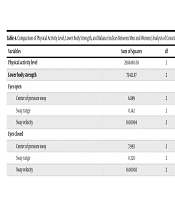
Since the difference between men and women in BMI was statistically significant (P < 0.05), a univariate analysis of covariance (ANCOVA) test was used to compare men and women in the variables of physical activity level, lower body strength, and swing balance indices, controlling for the effect of BMI. As Table 4 shows, the difference between men and women in physical activity level and balance Swing Index (both eyes-open and eyes-closed conditions) is not statistically significant. However, there are significant differences between men and women in lower body strength (in favor of men), Swing Range Index (eyes closed, in favor of men), and swing velocity (eyes open, in favor of women).
Table 4.
Comparison of Physical Activity Level, Lower Body Strength, and Balance Indices Between Men and Women (Analysis of Covariance Test, Controlling Body Mass Index)
| Variables | Sum of Squares | df | F | P-Value |
|---|---|---|---|---|
| Physical activity level | 2988480.08 | 2 | 1.122 | 0.330 |
| Lower body strength | 75412.97 | 2 | 39.239 | 0.001 |
| Eyes open | ||||
| Center of pressure sway | 6.889 | 2 | 1.383 | 0.257 |
| Sway range | 0.142 | 2 | 1.383 | 0.257 |
| Sway velocity | 0.00004 | 2 | 4.354 | 0.016 |
| Eyes closed | ||||
| Center of pressure sway | 7.993 | 2 | 2.027 | 0.138 |
| Sway range | 0.328 | 2 | 4.020 | 0.022 |
| Sway velocity | 0.00002 | 2 | 2.701 | 0.73 |
5. Discussion
This study examined the associations of physical activity level and lower limb muscle strength with static balance under visual deprivation in healthy adults, with attention to gender differences. A significant negative correlation was found between physical activity and postural sway in both eyes-open and eyes-closed conditions, suggesting that higher physical activity is associated with better postural control. Additionally, lower limb strength was significantly associated with balance in eyes-open conditions but not in eyes-closed. Regression analysis confirmed that physical activity could predict balance performance in both visual states. Despite men having greater muscle strength, no significant gender differences were observed in the overall Sway Index, although differences appeared in sub-indices such as sway range and velocity.
These results align with Boussemi et al. (6), who reported that physical activity is associated with better balance in visually impaired individuals. Unlike prior studies focusing on a single variable, this research assessed physical activity, strength, and gender simultaneously, offering a more holistic understanding of balance under sensory constraints. Our findings regarding the predictive value of physical activity (R2 = 0.291 eyes-open; R2 = 0.133 eyes-closed) are notably stronger than those reported by Onofrei and Amaricai, who found weaker associations in young adults (13). This discrepancy may be attributed to our broader age range (35 - 60 years) and more comprehensive assessment methods, including dynamometer-based strength measurements and force-plate analysis.
The observed correlation between physical activity and balance in eyes-closed conditions (R = -0.364) is consistent with Carretti et al. (12), and our study extends these findings by demonstrating that this relationship persists even after controlling for BMI and age. In contrast, Torres et al. (15) reported minimal gender differences in balance performance among young adults, which partially aligns with our findings in the Sway Index but differs from our observations of gender-specific patterns in sway range and velocity.
Regarding muscular strength, our finding that lower body strength correlates with balance only in eyes-open conditions (R = -0.252) differs from Muehlbauer et al., who reported consistent strength-balance associations across various sensory conditions (9). This discrepancy may reflect differences in the populations studied and measurement methods. The lack of significant gender differences in the main Sway Index, despite clear strength disparities (men: 105.62 ± 33.09 kg; women: 43.95 ± 2.26 kg), contrasts with Mocanu et al. (16) and supports the hypothesis by Ray and Wolf (19) that balance control strategies differ fundamentally between genders, with women relying more on sensory integration rather than muscular force alone.
The consistent association between physical activity and balance may reflect neuromuscular and sensory adaptations from regular movement, although these mechanisms were not directly measured in this study. Higher physical activity was associated with better postural control under eyes-closed conditions. This relationship might partly reflect enhanced integration of sensory inputs (9). Under visual deprivation, individuals depend more on non-visual systems. Active individuals may better adapt due to repeated motor experiences that could help develop compensatory strategies (8). Such adaptations might reduce response latency and facilitate corrective postural actions (10).
The strength-balance relationship observed in eyes-open but not eyes-closed conditions indicates that visual input enhances the effectiveness of muscle force in maintaining balance. With visual support, individuals can combine visual feedback with muscular control to manage postural sway more efficiently (26). Additionally, having adequate strength in leg stabilizing muscles, especially the hamstrings and quadriceps, plays an important role in preventing sudden falls in controlled static conditions, because these muscles are involved in stabilizing knee and hip joints against minor body sway (24). However, in the absence of vision, the impact of strength alone may be insufficient, and other sensory systems become more critical (19).
The predictive value of physical activity level, shown in regression analysis, indicates that physical activity remained an independent statistical predictor of balance performance within this sample, but causal influence cannot be inferred (9). Regular physical activity may support neuromuscular mechanisms and movement patterns that facilitate postural corrections, even without visual cues (26). Although causality cannot be confirmed, these findings underscore the potential value of promoting physical activity in fall-prevention programs (10).
Interestingly, no significant gender differences were found in the main Sway Index, despite strength disparities. This implies that balance depends on more than muscular force. Women may benefit from anatomical traits such as a lower center of gravity and greater flexibility, which assist in maintaining static balance (16). Gender-based differences in sway range and velocity may reflect distinct postural strategies — women often employ fine, continuous adjustments, while men rely more on strength-driven corrections (18). Moreover, research suggests that men tend to gain more strength through training, while women may achieve better balance improvements (17). Thus, balance control should be viewed as a multifaceted function influenced by both neuromuscular and anatomical factors (19).
In conclusion, physical activity was significantly associated with better static balance, even under visual deprivation, while lower-limb muscle strength showed an association with balance mainly in eyes-open conditions. Gender differences in balance may be shaped more by anatomical and sensory factors than by strength alone. From a practical perspective, these results highlight the potential value of integrating physical activity promotion and balance-oriented training into fall-prevention programs, with consideration of gender-specific strategies.
Despite these findings, several limitations must be acknowledged, including the cross-sectional design that prevents causal inference, reliance on self-reported physical activity prone to recall bias, and the focus on static balance alone, which restricts generalizability to real-life situations. Future research should therefore use longitudinal or interventional approaches, incorporate both static and dynamic balance assessments, and target at-risk populations such as older adults or those with sensory impairments to clarify causal mechanisms and evaluate the effectiveness of tailored interventions.
Furthermore, our muscular strength assessment was limited to the back and leg dynamometer. While this instrument assesses the strength of spinal extensors and leg muscles, specific and isolated assessments of trunk/core muscles were not performed. Given the critical role of core muscles in postural stability, future studies should include more comprehensive trunk strength assessments, including isometric and isotonic tests for abdominal muscles, obliques, and deep spinal muscles, to provide a more complete picture of the relationship between muscular strength and postural control.
5.1. Conclusions
The study found that physical activity was significantly linked to better static balance even without visual input, while lower-limb strength was mainly related to balance in eyes-open conditions. Gender differences in balance appear to stem more from anatomical and sensory factors than from strength alone. Practically, these results emphasize promoting regular physical activity and balance-focused training in fall-prevention programs, tailored by gender and including exercises that engage proprioceptive and vestibular systems.
However, limitations such as the cross-sectional design, self-reported activity data, and focus on static balance reduce generalizability. Future research should adopt longitudinal designs, assess both static and dynamic balance, and include comprehensive trunk strength measures to clarify causal relationships.