
1. Background
Physical education (PE), physical activity, and sports are recognized as fundamental human rights that should be accessible to all individuals, regardless of ethnicity, gender, language, religion, or social background, and without discrimination (1). However, in many schools worldwide, particularly in socioeconomically disadvantaged areas, PE remains a low-priority subject and is often marginalized in favor of core academic subjects (2). Within the school environment, PE plays a critical role in children’s development by supporting cognitive and physical growth and by serving as a unique social context. Structured physical activities foster social empowerment through peer interaction, cooperation, and the development of prosocial behaviors (3). Unlike general social education, sports-based interactions enhance students’ integration into group settings while supporting physical, cognitive, emotional, and social development. This multifaceted approach promotes holistic growth and supports well-rounded development beyond the acquisition of athletic skills (4, 5).
The United Nations Educational, Scientific and Cultural Organization (UNESCO) has emphasized the need to integrate quality physical education into school curricula and has identified ongoing professional development (PD) for teachers as a key strategy for improving instruction (1). Studies indicate that many teachers hold diverse beliefs regarding the aims of PE, highlighting the importance of PD for effectively supporting student learning (6-8). Teacher PD is a continuous process that aims to improve educators’ knowledge, skills, and attitudes and can help compensate for limitations in pre-service training (8). Active participation in such programs leads to improved instructional practices, enhanced professional collaboration, and increased teacher commitment (9-11). These programs also improve teaching effectiveness and student learning outcomes (12, 13). Although direct longitudinal evidence remains limited, existing literature, ranging from systematic reviews to empirical studies, underscores the positive impact of PD on students’ physical literacy and enjoyment (14-17).
Physical literacy (PL) is a cornerstone of this developmental process. It refers to the motivation, confidence, physical competence, knowledge, and understanding that individuals require to value and take responsibility for engaging in physical activity throughout life (17). This holistic concept extends beyond physical skills and emphasizes lifelong participation and individual well-being. Enhancing instructional quality through PD contributes substantially to students’ holistic development (5). This development aligns with Self-Determination Theory, which suggests that intrinsic motivation is shaped by three basic psychological needs: autonomy, competence, and relatedness (18, 19). Therefore, teachers who improve their PL and create opportunities for autonomy are more likely to foster greater student motivation (15). In the present framework, the program was designed based on the theoretical premise that enhancing teachers’ PL creates a more supportive environment for student motivation. This approach enables educators to foster engaging climates that strengthen both intrinsic and social drivers of sports participation (18, 19).
Previous research, such as the study by Trigueros et al. (20), has examined the effectiveness of teacher PD in enhancing teacher–student interactions and the overall quality of PE instruction. Their findings suggest that these programs help create supportive classroom environments, which in turn foster intrinsic motivation and higher levels of engagement. Similarly, Sum et al. (14, 15) investigated how PD programs focused on PL can influence students’ motivation. They highlighted that when teachers improve their PL-related skills, they create more participatory learning environments and enhance students’ motivation to remain active. Furthermore, Guskey (21) emphasized that ongoing evaluation in teacher development contributes substantially to the overall learning experience, even when effects are not immediately observable. Because a primary goal of PE is to encourage lifelong physical activity habits, teachers, given their key role in the classroom environment, can directly influence students’ long-term participation (22).
Students’ motivation for sports participation is recognized as a key factor in promoting regular activity. This motivation is multifaceted and includes dimensions such as achievement/success, team affiliation, fun/enjoyment, skill development, fitness, and friendship (23). According to Self-Determination Theory (19), teachers can enhance intrinsic motivation by creating a supportive environment that satisfies psychological needs. In addition, Expectancy-Value Theory (24) suggests that motivation depends on students’ beliefs about their ability and the perceived value of the activity. PE teachers can strengthen these beliefs through purposeful instruction and emotional support.
2. Objectives
Although many studies have examined the impact of PD, its direct effect on the multifaceted motivation of elementary school students for sports participation has not been comprehensively investigated. Contradictory findings across studies, with positive effects observed in some cases and negligible effects in others, suggest that cultural and contextual factors play a substantial role. Consequently, conceptual and practical gaps remain, as many PD programs do not fully align with the specific needs of PE teachers. This study aimed to address these gaps by systematically examining the impact of a PD program on sports participation motivation in Iranian elementary schools. The novelty of this research lies in its quasi-experimental approach, which provides preliminary evidence regarding comparative differences across motivational dimensions. By exploring the potential role of teachers’ PL in shaping student outcomes, this study contributes to the development of evidence-based interventions for underserved populations.
Based on the identified gaps, the study hypothesized that:
1. A teacher PD program leads to significant differences in students’ motivation for sports participation between the experimental and control groups.
2. A teacher PD program, through its emphasis on PL principles, is positively associated with students’ motivation for sports participation.
3. Methods
This study used a quasi-experimental, post-test-only control group design. The primary objective was to evaluate differences in students’ motivation for sports participation following the implementation of a teacher PD program (Table 1).
Table 1.
Schematic Design of the Study a
| Participants and Groups | Design Type | Baseline (Pre-test) | Intervention | Follow-up (Post-test) |
|---|---|---|---|---|
| Teachers (n = 70) | ||||
| Experimental | Pre-test/post-test | Physical literacy & self-efficacy tests | Yes | Physical literacy & self-efficacy tests |
| Control | Pre-test/post-test | Physical literacy & self-efficacy tests | No | Physical literacy & self-efficacy tests |
| Students (n = 325) | ||||
| Experimental | Post-test Only | (No pre-test) a | Indirect impact | PMQ Questionnaire |
| Control | Post-test Only | (No pre-test) a | No | PMQ Questionnaire |
a To prevent pre-test sensitization and testing bias among elementary students, a post-test-only design was employed for the primary outcome measure (PMQ).
3.1. Population and Sample
The study population consisted of all male and female sixth-grade elementary school students aged 10 - 13 years in urban schools in Kermanshah Province who were taught by PE teachers.
Seventy PE teachers (35 female and 35 male) were selected from among teachers in Kermanshah Province using a non-random purposive sampling method. The teachers were then stratified by gender and randomly assigned to either the experimental group (18 female and 17 male) or the control group (18 female and 17 male).
Subsequently, 325 students (160 female and 165 male) were selected from the classes of these teachers using proportional stratified random sampling. The sample included 163 students from the classes of experimental group teachers and 162 from the classes of control group teachers. This sampling approach was used to maintain gender proportions and ensure a representative geographical distribution of students across different urban areas of Kermanshah.
3.2. Ethical Considerations
This research was designed and conducted in accordance with the ethical principles outlined in the Declaration of Helsinki. It was approved by the Research Ethics Committee of Shahid Chamran University of Ahvaz before commencement. Informed consent was obtained from all participants, including teachers and students, and their information was kept fully confidential.
3.3. Intervention Program
The teacher PD program was based on the theoretical framework of PL (17, 25) and Bandura’s self-efficacy theory (26, 27). Physical literacy, as defined by Whitehead (25), encompasses the motivation, confidence, physical competence, knowledge, and understanding needed for lifelong engagement in physical activity. This framework guided the program’s emphasis on enhancing teachers’ capacity to foster these elements in students through practical and theoretical sessions. Complementing this framework, Bandura’s self-efficacy theory posits that individuals’ beliefs in their capabilities influence their motivation, behavior, and performance. In the context of teacher development, this theory supports the program’s focus on building teaching self-efficacy through mastery experiences, vicarious learning, and verbal persuasion, which are known to improve instructional practices in PE (14, 28). The intervention comprised eight 2-hour sessions, including 4 hours of theory and 4 hours of practical application, aimed at enhancing teachers’ knowledge, skills, and teaching self-efficacy. Topics such as motor learning, legal responsibilities in sports, and active teaching strategies were covered, drawing on empirical studies that integrate these theories into PD for PE teachers (29, 30). The control group received no training. Further details are presented in Table 2.
Table 2.
Content of the Teacher Empowerment Program Sessions
| Sessions and Topics | Theoretical Framework Integration | Theory | Practical |
|---|---|---|---|
| Week 1 | |||
| Concept of physical literacy | Knowledge & Understanding: Deepening the cognitive domain of PL | ✓ | |
| Traditional & local games | Mastery Experience: Building initial teaching confidence through familiar activities. | ✓ | |
| Week 2 | |||
| Motor learning & PL methods | Pedagogical Competence: Aligning teaching styles with PL goals. | ✓ | |
| Game-based motor programs | Vicarious Experience: Modeling effective teaching strategies for peers. | ✓ | |
| Week 3 | |||
| Legal responsibilities & IT | Verbal Persuasion: Providing professional knowledge to reduce teaching anxiety. | ✓ | |
| Interval training | Physical Competence: Enhancing teachers' own motor skills and fitness. | ✓ | |
| Week 4 | |||
| Measuring physical literacy | Affective Domain: Developing assessment confidence and reducing stress. | ✓ | |
| Jump rope & dodgeball | Mastery Experience: Final consolidation of pedagogical skills in a practical setting. | ✓ |
3.4. Data Collection Instruments
To measure sports participation motivation, the Participation Motivation Questionnaire (PMQ), developed by Gill et al. (31), was used. Validated for youth aged 10 - 18 years, this 30-item scale uses a 5-point Likert system ranging from 1 (not at all important) to 5 (extremely important). It assesses eight dimensions: achievement/success (items 1, 9, 16, 23, and 29), team affiliation (items 2, 10, and 17), fitness (items 3, 11, and 24), energy release (items 4, 12, 18, 25, and 30), external factors (items 5, 13, and 20), skill development (items 6, 14, and 21), friendship (items 7, 15, 22, and 28), and fun/enjoyment (items 8, 19, 26, and 27). Dimension scores were calculated as subscale means. In this study, Cronbach’s alpha was 0.85.
3.5. Research Procedure
This methodological choice was made deliberately to avoid testing effects and pre-test sensitization among elementary-aged students, ensuring that motivational scores were not influenced by prior exposure to the instrument. Data collection was conducted after written informed consent had been obtained from both parents and students. Although teachers were randomly assigned to the experimental and control groups to enhance baseline comparability, the absence of a student-level pre-test is acknowledged. Accordingly, the findings are interpreted within the methodological constraints of a post-test-only design. To evaluate the program’s impact, PMQ assessments were conducted 2 weeks after the intervention, allowing sufficient time for teachers to integrate the new strategies into their classroom routines.
3.6. Data Analysis
Data were analyzed at descriptive and inferential levels. For descriptive statistics, means and standard deviations were used. For inferential analysis, the Kolmogorov-Smirnov test was used to assess normality. Subsequently, an independent-samples t-test was used to compare students’ motivation for sports participation between the two groups. All analyses were performed using SPSS version 24 software (P < 0.05).
4. Results
The findings indicated that 58% of the participating students were girls and 42% were boys. The age distribution of the students is shown in Figure 1.
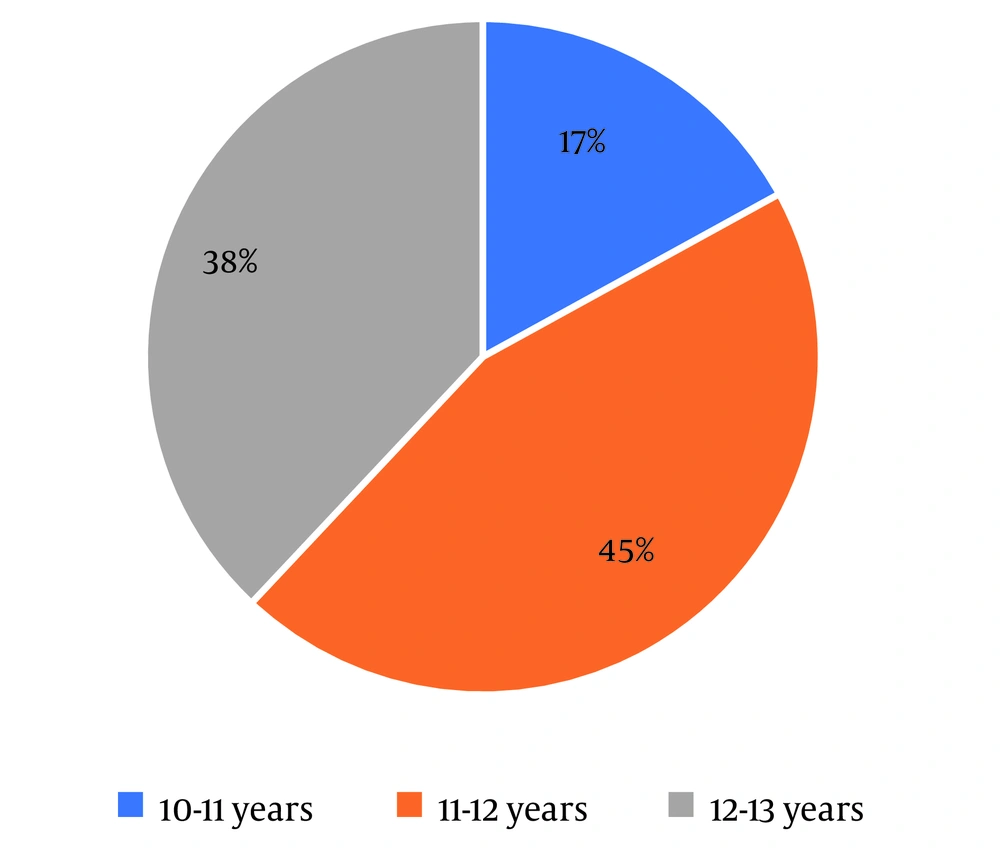
Figure 1.
Age distribution of students
The means and standard deviations of the components of students’ sports participation motivation are presented in Table 3.
Table 3.
Means and Standard Deviations of the Study Variables
| Components of Sports Participation Motivation at Post-Test | Experimental Group (Mean) | Experimental Group (Standard Deviation) | Control Group (Mean) | Control Group (Standard Deviation) |
|---|---|---|---|---|
| Achievement/Success | 19.025 | 4.946 | 18.113 | 5.704 |
| Team Affiliation | 11.465 | 2.537 | 9.641 | 3.212 |
| Fitness | 10.251 | 1.810 | 10.088 | 2.494 |
| Energy Release | 18.144 | 3.629 | 17.748 | 4.124 |
| External Factors | 9.628 | 2.591 | 9.289 | 2.858 |
| Skill Development | 9.314 | 2.213 | 8.943 | 2.849 |
| Friendship | 15.251 | 2.693 | 13.704 | 3.201 |
| Fun/Enjoyment | 11.138 | 2.174 | 9.924 | 2.299 |
An independent-samples t-test was conducted to compare student motivation dimensions between the experimental and control groups. The results are summarized in Table 4.
Table 4.
Comparison of Sports Participation Motivation Between Groups: Independent Samples t-test Results
| Components and Groups | Mean | Standard Deviation | t-Value | Sig. (2-Tailed) | Effect Size Cohen's d |
|---|---|---|---|---|---|
| Achievement/success | 1.523 | 0.129 | 0.171 | ||
| Experimental | 19.025 | 4.946 | |||
| Control | 18.113 | 5.704 | |||
| Team Affiliation | 5.618 | 0.001 | 0.630 | ||
| Experimental | 11.465 | 2.537 | |||
| Control | 9.641 | 3.212 | |||
| Fitness | 0.669 | 0.504 | 0.075 | ||
| Experimental | 10.251 | 1.810 | |||
| Control | 10.088 | 2.494 | |||
| Energy release | 0.909 | 0.364 | 0.102 | ||
| Experimental | 18.144 | 3.629 | |||
| Control | 17.748 | 4.124 | |||
| External factors | 1.110 | 0.268 | 0.124 | ||
| Experimental | 9.628 | 2.591 | |||
| Control | 9.289 | 2.858 | |||
| Skill development | 1.297 | 0.196 | 0.145 | ||
| Experimental | 9.314 | 2.213 | |||
| Control | 8.943 | 2.849 | |||
| Friendship | 4.664 | 0.001 | 0.523 | ||
| Experimental | 15.251 | 2.693 | |||
| Control | 13.704 | 3.201 | |||
| Fun/enjoyment | 4.837 | 0.001 | 0.542 | ||
| Experimental | 11.138 | 2.174 | |||
| Control | 9.924 | 2.299 |
As shown in Table 4, the program led to significant improvements in several key motivational factors in the experimental group. Specifically, the experimental group showed significantly higher levels of team affiliation (t = 5.62, P < 0.001), friendship (t = 4.66, P < 0.001), and fun/enjoyment (t = 4.84, P < 0.001) than the control group.
However, the program did not lead to significant differences between the two groups in achievement/success (t = 1.52, P = 0.129), fitness (t = 0.67, P = 0.504), energy release (t = 0.91, P = 0.364), external factors (t = 1.11, P = 0.268), or skill development (t = 1.30, P = 0.196).
In summary, the PD program effectively enhanced students’ social and recreational motivations for sports participation but did not significantly affect achievement- or skill development-related factors. Several motivational dimensions remained unchanged, suggesting that the program’s effects may be domain-specific and may primarily influence social and recreational factors rather than exerting a global impact across all motivational facets.
5. Discussion
The primary aim of this study was to examine the potential role of a selected PD program in motivation for sports participation among elementary school students. The findings indicated that students taught by teachers who participated in the PD program scored higher in certain dimensions of sports participation motivation, specifically team affiliation, friendship, and fun/enjoyment, than did students in the control group. However, no significant differences were observed in other components, including achievement/success, fitness, energy release, external factors, and skill development.
These results are consistent with previous studies showing that teachers’ PD programs can enhance students’ motivation toward physical activity (15, 32, 33). The role of PE teachers in fostering students’ motivation and self-confidence to adopt an active lifestyle and increase physical activity is critically important (7, 34). Professional development enhances teachers’ capacity to positively influence students’ participation and motivation by improving content knowledge, specialized skills, and access to adequate resources (35).
Self-Determination Theory (19) provides a strong framework for interpreting these findings. The dimensions of team affiliation and friendship, which showed significant differences in the present study, are directly linked to the fundamental psychological need for relatedness within this theory. The PD program likely helped teachers create a classroom environment in which students experienced a stronger sense of belonging and social connection. In addition, the significant effect on fun/enjoyment is related to the psychological need for autonomy, as enjoyment of an activity is a primary indicator of intrinsic motivation. These findings suggest that the training program strengthened students’ intrinsic motivation, which is a critical factor for sustained long-term engagement in sports participation (22).
However, the non-significant differences in achievement, fitness, and skill development suggest domain-specific intervention effects, consistent with meta-analytic findings in PE settings (16). These results, which diverge from studies suggesting a broader teacher influence across all motivational facets (7), indicate that dimensions linked to the need for competence typically require more prolonged or specialized training than the current 4-week program provided. Furthermore, according to Expectancy-Value Theory (24), factors beyond teachers’ immediate pedagogical control, such as parental expectations, innate student talent, and facility quality, likely exerted a stronger influence on these specific motivational facets. Therefore, while the program effectively fostered social and autonomous drivers, namely relatedness and autonomy, enhancing competence-related motivation may require longer-term, multilevel interventions.
Several limitations warrant acknowledgment. Although teacher randomization was used to support baseline comparability between groups, the absence of a student-level pre-test remains a limitation; therefore, the observed differences should be interpreted as associative rather than strictly causal. Accordingly, these results provide preliminary evidence and should be interpreted with caution. Furthermore, the nested structure of students within classes may compromise the independence of observations; future research should consider multilevel modeling to address this hierarchical structure more rigorously. In addition, variables such as students’ academic backgrounds, teachers’ professional experience, and local socio-environmental factors were not controlled. Finally, the focus on a single province may limit the generalizability of these findings to broader contexts.
5.1. Conclusions
The findings suggest that PD programs for PE teachers are associated with higher levels of students’ intrinsic and social motivation for sports. By fostering environments that satisfy students’ basic psychological needs, particularly relatedness and autonomy, these programs may help sustain participation in physical activities. However, in light of methodological constraints, specifically the post-test-only design and the nested structure of the data, these results provide preliminary evidence, and the observed differences should be interpreted as associative rather than strictly causal. Therefore, the findings should not be generalized universally without further longitudinal validation. Influencing motivational dimensions related to competence and environmental factors may require longer-term and more diverse interventions. Overall, these findings contribute to both the theoretical understanding of sports motivation and the design of more effective PD programs for teachers.