


1. Background
In recent years, findings from various studies have provided evidence regarding the influence of performers’ mindsets and perceptions on motor skill learning. Golf has been widely used as a research paradigm because it involves complex motor skills that require precise performance (1). Notably, interventions that enhance learners’ expectations of performance success or reduce perceived task difficulty have been shown to facilitate learning. Some of these findings were obtained by examining the effects of feedback on performers. Studies have indicated that providing feedback to learners after relatively successful trials, rather than after less successful trials, can enhance learning effectiveness (2-4). Setting performance criteria is another method that facilitates learning (5). Increasing learners’ perceptions of competence (6, 7) or self-efficacy (2, 4, 8) may be a common factor underlying such manipulations.
The findings also indicate that high levels of self-efficacy may facilitate the adoption of implicit strategies that promote the development of procedural knowledge, suggesting that self-efficacy mediates motor learning (9, 10). In addition, the positive relationship between self-efficacy and motor performance has been well established in many studies (11, 12). Importantly, recent research has directly linked visual illusions to self-efficacy in motor-learning contexts. For example, studies using the Ebbinghaus illusion in golf putting have shown that performers who perceived the target as larger reported higher self-efficacy and demonstrated superior retention performance, even when the illusion was removed during testing (13). Moreover, a visual illusion and self-controlled practice in children at risk for developmental coordination disorder resulted in enhanced retention, suggesting that motivational factors such as self-efficacy may interact with perceptual manipulations to strengthen learning consolidation (14). Collectively, these findings indicate that the effects of visual illusions may extend beyond perceptual biases and operate partly through enhanced expectancies and self-efficacy.
Motor performance may also be influenced by factors such as individual beliefs derived from the perception of visual illusions, which have the potential to enhance performance (15). The Ebbinghaus illusion , also known as the Titchener illusion, is among the most extensively studied optical illusions in motor skill research. This illusion shows that when 2 identical circles are presented, the circle surrounded by smaller circles is perceived as larger, whereas the circle surrounded by larger circles is perceived as smaller. Observers typically judge the former as larger than the latter. The apparent size difference can be substantial, with a circle perceived as up to 10% - 20% larger or smaller than its actual dimensions (16).
Witt et al. (15) first examined the effect of this illusion on perceived golf-hole size and putting accuracy. They found that golf holes surrounded by small circles were perceived as larger and that more successful putts were made than with golf holes surrounded by large circles. Similar results were reported when the potential mediating roles of attention and action planning were explored, although these studies assessed immediate performance rather than learning (17). Subsequently, Chauvel et al. (13) investigated how the Ebbinghaus illusion influenced golf motor-skill learning and performers’ self-efficacy. Their findings showed that putting accuracy in the last 2 blocks and self-efficacy increased during practice compared with the group that practiced with the golf hole surrounded by large circles. Bahmani et al. (18) later compared the effect of the Ebbinghaus illusion on golf putting from a distance of 2 m in 2 groups of 10-year-old children. Their results corroborated the findings of Chauvel et al. (13), showing that the group that perceived the hole as larger exhibited higher self-efficacy. Moreover, the group that perceived the hole as larger not only showed more accurate performance during practice but also demonstrated improved learning outcomes without the illusion, as assessed by delayed retention performance without the illusion (18). These findings were consistent with those in adult learners, suggesting that increased performance expectations are important for optimal motor learning (19).
However, the effects of the Ebbinghaus illusion on motor skill performance and learning remain controversial, and some findings have challenged its benefits. Another study examined the effect of the Ebbinghaus illusion on motor learning during marble shooting. The results differed from those of previous studies, as the group practicing with a perceived smaller target, which was surrounded by larger circles, performed better. The authors concluded that performers are more accurate when aiming at a perceived smaller hole, consistent with motor learning and control perspectives. Although these findings differ markedly from those of previous studies (13, 15), the motor tasks used across studies are quite different, and each task may influence different key factors in motor performance and learning.
Approximately a decade after the study by Witt et al. (15), Maquestiaux et al. (27) failed to replicate the performance benefits in students with no previous golf experience. However, they influenced participants’ perception by presenting both versions of the visual illusion side by side during putting performance. Previous work found benefits of the visual illusion on perception during the practice phase, including pre-practice and post-practice assessments (13), but no such effect was found 1 day later before the retention test, when perception was assessed without illusory circles. Furthermore, the large-perception group (LPG) showed better performance accuracy and higher self-efficacy during practice and the retention test. However, some participants had limited golf experience. Similar perceptual results were reported among highly skilled shooters performing a non-ballistic sports activity (20), with no differences in performance or self-efficacy between the 2 groups during the retention test.
Several methodological differences exist between Maquestiaux et al. (27) and previous studies. They assessed performance using the number of successful putts across the entire experiment. Although this measure is appropriate when emphasizing performance consistency across distances (21), more detailed aspects of movement accuracy may be captured by radial error. Radial error provides a more precise index of stroke accuracy by quantifying the deviation of the ball’s final position from the center of the hole while accounting for both distance and angular displacement (22). In addition, the total number of trials in Maquestiaux et al. (27) was limited to 10 trials per illusion condition, or 20 trials in total, which was considerably fewer than in earlier investigations (13). Furthermore, participants’ self-efficacy was not directly measured using a validated scale, despite evidence that self-efficacy can mediate motor learning processes (23).
These methodological variations may partly explain the inconsistent findings reported across studies. Indeed, Maquestiaux et al. (27) proposed that practice under favorable illusion conditions might enhance self-efficacy to a greater extent than practice under unfavorable conditions, potentially reducing the disruptive influence of explicit control processes (9). Given the divergent methodologies, samples, and outcome measures used in prior research, further systematic investigation of the Ebbinghaus visual illusion in ballistic sport tasks appears warranted. Moreover, although direct replications are relatively rare, conceptual replications are valuable for testing the robustness and validity of a phenomenon (24).
2. Objectives
The present study was designed to address these gaps by examining the simultaneous presentation of both versions of the Ebbinghaus illusion and their effects on skill accuracy, perception, and self-efficacy.
3. Methods
3.1. Participants
Ethics approval for the study was obtained from the Ethics Committee of the Sport Sciences Research Institute, and all participants provided written informed consent before the experiment. Forty-five healthy undergraduate students (28 females and 17 males; mean age = 21.7 years; SD = 1.25) with no prior golf experience were recruited from the Department of Sport Sciences at Urmia University. They participated voluntarily and were naive to the purpose of the study. The sample size was determined with consideration of previous studies that used a similar practice protocol, particularly Chauvel et al. (13), from which the present procedure was adapted. Accordingly, the number of participants was selected to be comparable with previous studies (13).
3.2. Apparatus and Task
A putter and standard white golf balls with a diameter of 4.27 cm were used to perform the golf putt. The golf course consisted of artificial turf measuring 600 × 200 cm, with a grass height of 10 mm. To display both versions of the visual illusion, a projector was mounted on the room ceiling and projected downward onto the floor. Two standard-sized golf holes, each 10.8 cm in diameter, were created in the artificial turf, with a distance of 75 cm between them. Creating a physical hole increases the ecological validity of the task (25), whereas a previous study used a video projector not only to display visual illusions but also to create a golf hole (13). In Microsoft PowerPoint, the large-perception illusion was created using 11 small circles, each 3.8 cm in diameter, and the small-perception illusion was created using 5 large circles, each 28 cm in diameter, arranged around the holes (Figure 1). Participants were then instructed by the examiner on how to putt correctly and were told to put the ball into the hole or stop it as close to the hole as possible. Participants performed 5 trials from a distance of 2 m without visual illusions to become familiar with the task. Performance accuracy was measured using radial error, defined as the deviation between the center of the hole and the edge of the ball. The maximum measurable deviation of 100 cm was recorded for each trial, consistent with previous research on golf-putting tasks using visual illusions (13).
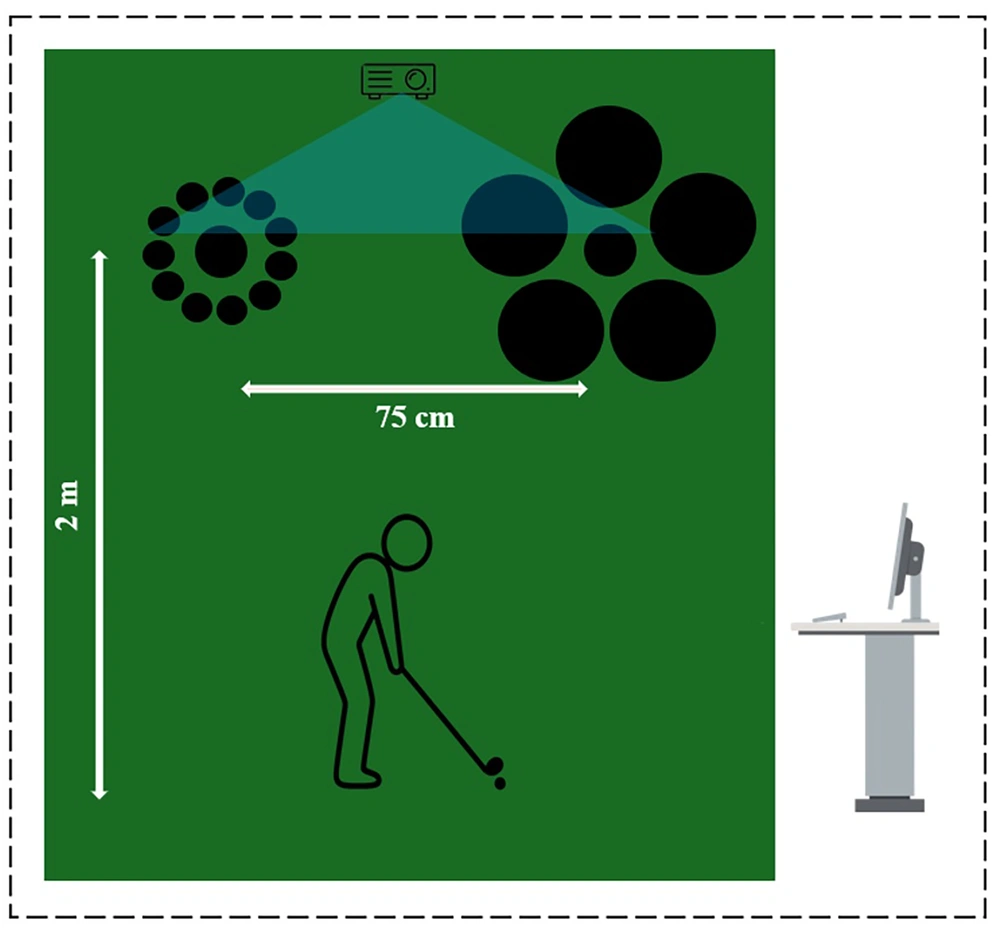
Figure 1.
Targets (“holes”) and surrounding circles used to create the Ebbinghaus illusion, including the distance between the targets.
3.3. Procedure
After the preparation phase, participants were randomly assigned to 1 of 3 groups: the LPG, small-perception group (SPG), or control group (CG; without illusion). Each participant first completed a pretest consisting of 5 trials without the illusory circles around the hole, following the methodology of prior studies (13, 18). During the practice phase, which immediately followed the pretest, the circles from both versions of the visual illusion were projected simultaneously around both holes. Participants were asked to draw a circle corresponding in size to the target circle on a 15.6-inch laptop screen using Microsoft PowerPoint. The diameter of the drawn circles was used as a measure of perceived target size (13, 18, 26). The diameters of the drawn circles were later measured to confirm that perceptions of hole diameter differed between groups.
Next, participants completed a self-efficacy questionnaire consisting of 4 items. On a scale from 1 (“not confident at all”) to 10 (“extremely confident”), participants rated their confidence that they would be able to achieve an average deviation of 20, 15, 10, or 5 cm or less, respectively, on the last 10 practice trials (trials 41 - 50). Participants then performed 50 practice trials. During the first, third, and fifth 10-trial blocks, they were given augmented feedback consisting of the average deviation in centimeters after each trial, primarily to facilitate subsequent self-efficacy ratings. After completing the practice phase, participants were again asked to draw the target circle and complete another self-efficacy questionnaire in which they rated their confidence in their ability to achieve certain average deviations of 20, 15, 10, or 5 cm or less on the retention day 24 hours later. On the second day of the experiment, during the retention test, all participants were first asked to draw the target circle and complete a self-efficacy questionnaire regarding their upcoming performance. They then performed a retention test similar to the pretest, but as a block of 10 trials, to examine potential learning differences between groups as a function of practice (Figure 2).
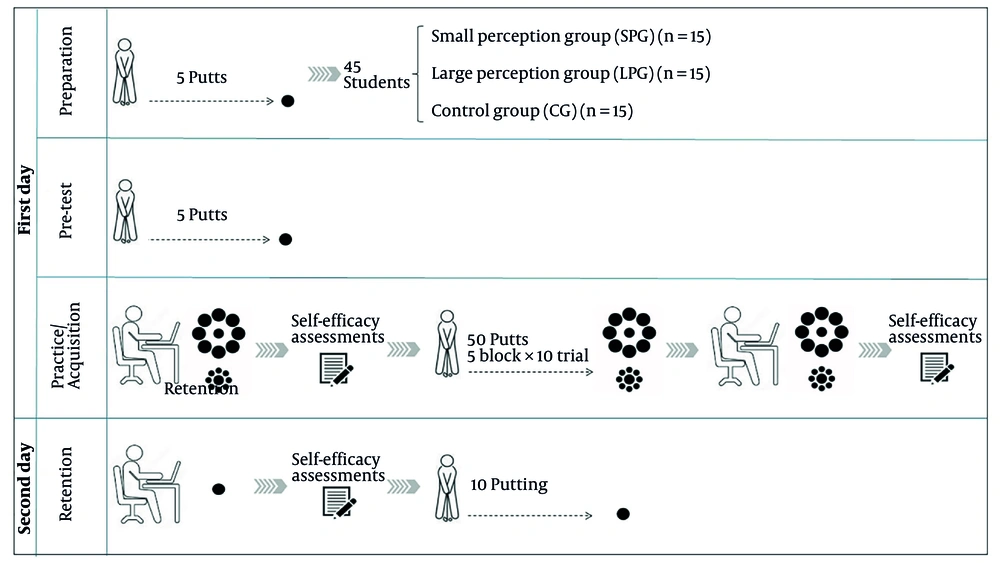
Figure 2.
Schematic diagram of the experimental procedure.
3.4. Data Analysis
To evaluate putting performance, deviations from the hole were averaged across 5 trials for the pretest and across 10 trials for the practice phase and retention test. Before conducting parametric analyses, the assumptions underlying repeated-measures analysis of variance (ANOVA) were systematically examined. Normality of residuals was assessed using Shapiro-Wilk tests (P > 0.05 for all dependent variables) and visual inspection of Q-Q plots, which confirmed approximate normal distributions. Homogeneity of variance was evaluated using Levene’s test, indicating no significant violations across groups (P > 0.05).
Univariate ANOVAs were used to compare groups on the pretest and retention test. For the practice phase, a 3 (group: SPG, LPG, and CG) × 5 (block) mixed-design ANOVA with repeated measures on the last factor was conducted. Mauchly’s test of sphericity was applied to all within-subject effects. When the assumption of sphericity was satisfied, uncorrected degrees of freedom are reported. In cases of violation (Mauchly’s P < 0.05), the Greenhouse-Geisser correction was applied, and adjusted degrees of freedom with corrected P values are presented.
Both perceived hole size, measured in centimeters, and self-efficacy scores, averaged across the items, were analyzed using a 3 (group) × 2 (time: Before practice and after practice) repeated-measures ANOVA for the practice phase and a 1-way ANOVA for the retention test. The same assumption-checking procedure, including normality, homogeneity of variance, and sphericity, was applied to these analyses, with Greenhouse-Geisser adjustments implemented where necessary. The alpha level for all statistical tests was set at 0.05. All analyses were performed using IBM SPSS Statistics version 26.0.
4. Results
4.1. Perceived Hole Size
The ANOVA for the perception variable showed a statistically significant difference among groups during the practice phase, F(2, 42) = 21.26, P = 0.001 (Figure 3). Further analysis using the Tukey test revealed significant differences between the LPG and CG (P = 0.001), between the LPG and SPG (P = 0.003), and between the SPG and CG (P = 0.014). During the practice phase, a significant difference was also indicated among the groups, F(2, 42) = 61.67, P = 0.001. The Tukey test showed significant differences between the LPG and CG (P = 0.001), between the LPG and SPG (P = 0.001), and between the SPG and CG (P = 0.003). In the retention test, a significant difference was observed among the groups, F(2, 42) = 130.15, P = 0.001. The Tukey test indicated significant differences between the LPG and CG (P = 0.001), between the LPG and SPG (P = 0.001), and between the SPG and CG (P = 0.001).
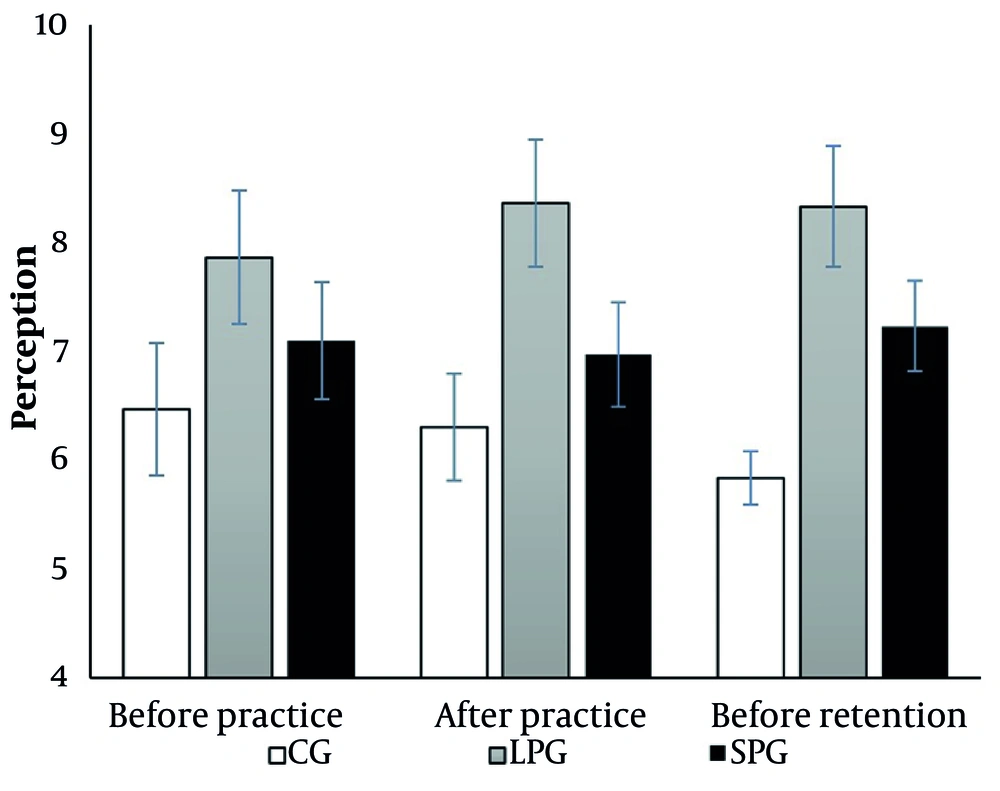
Figure 3.
Perceived size of the hole before practice, after practice, and before the retention test as a function of the visual illusion.
4.2. Putting Accuracy
The putting performance of the 3 groups on the pretest did not differ significantly, F(2, 42) = 0.223, P > 0.05 (Figure 4). During the practice phase, all groups reduced their deviations from the hole, as indicated by a significant main effect of block, F(6, 42) = 13.53, P < 0.001. However, the group × block interaction was not significant, F(12, 42) = 1.38, P > 0.05, indicating that the rate of improvement did not differ across groups. Instead, a significant main effect of group emerged, F(2, 42) = 7.16, P < 0.05, indicating that the LPG consistently outperformed the SPG and CG throughout practice. Post hoc comparisons confirmed that the LPG was significantly more accurate than both the CG (P = 0.001) and the SPG (P = 0.047), whereas the SPG and CG did not differ significantly (P = 0.237). These findings suggest a stable performance advantage for the LPG rather than differential learning trajectories. At retention, no significant group differences were observed, F(2, 42) = 1.56, P = 0.22, indicating that the practice-phase advantage was not maintained after the delay.
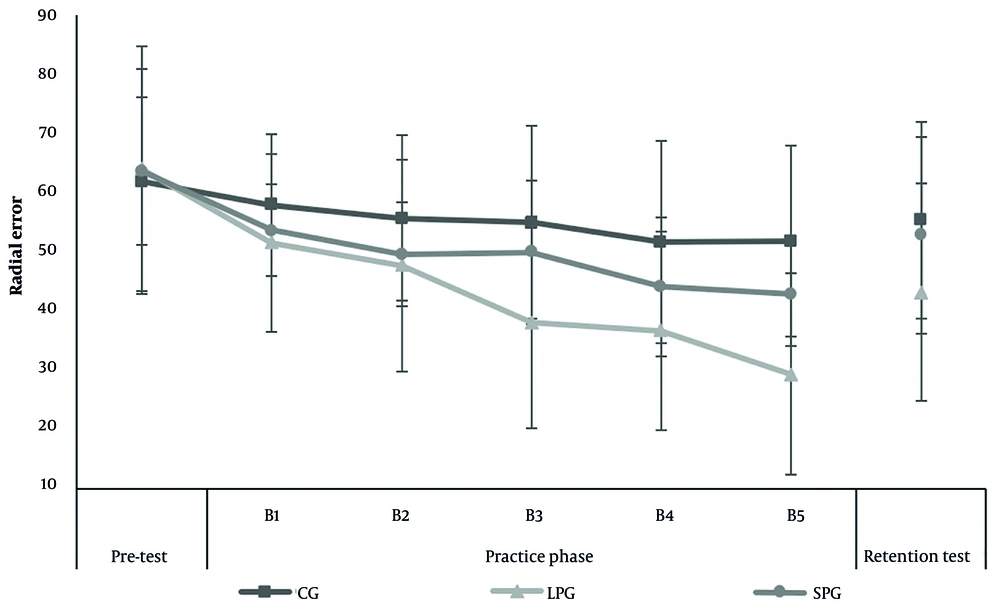
Figure 4.
Putting accuracy, measured as distance from the hole, in the LPG, SPG, and CG during the practice phase and retention phase.
4.3. Self-efficacy
The ANOVA results for self-efficacy indicated no statistically significant difference among groups before practice, F(2, 42) = 2.91, P = 0.07, although the mean value for the LPG was higher than those of the other 2 groups (Figure 5). However, statistically significant differences emerged between groups after practice, F(2, 42) = 9.76, P = 0.001, and during the retention test, F(2, 42) = 11.98, P = 0.001. Tukey post hoc analysis revealed statistically significant differences after practice between the LPG and CG (P = 0.007) and between the LPG and SPG (P = 0.001). Similar differences were observed in the retention test between the LPG and CG (P = 0.002) and between the LPG and SPG (P = 0.001). Notably, although differences in putting accuracy among groups were not maintained at retention, differences in self-efficacy persisted. This dissociation is considered further in the Discussion.
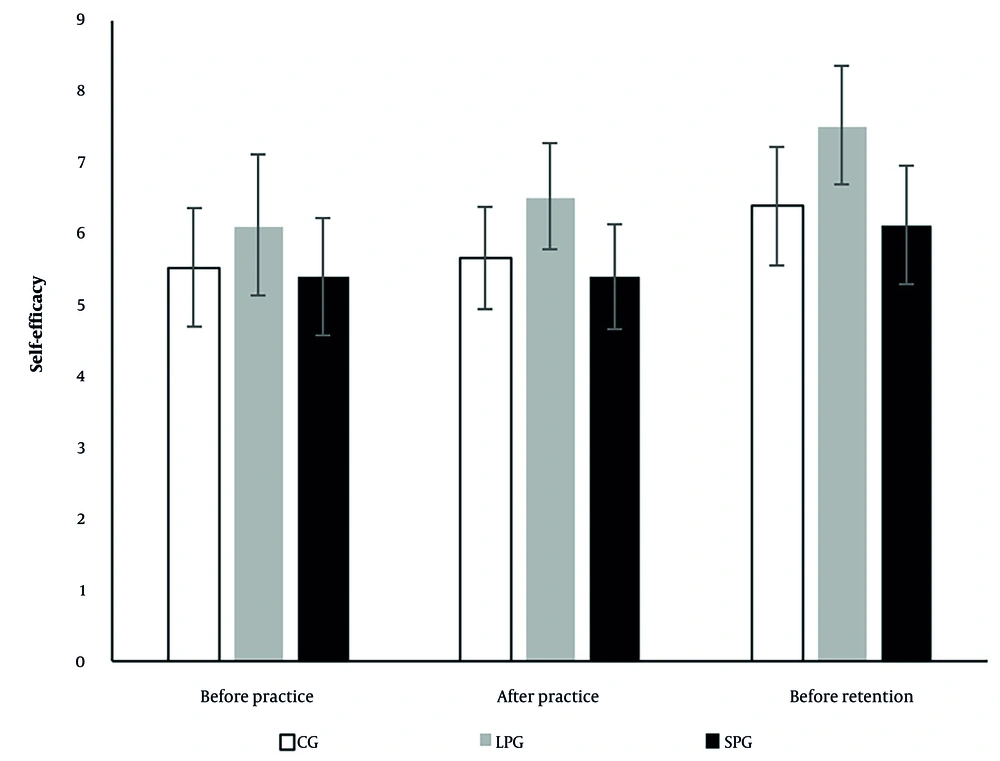
Figure 5.
Self-efficacy levels of the 3 groups before practice, after practice, and before the retention test, based on the group’s perception of hole size.
5. Discussion
The present study aimed to examine the effects of observing both versions of the Ebbinghaus visual illusion side by side on golf-putting accuracy, target-size perception, and self-efficacy. The findings showed that perceived hole size differed significantly when the hole was surrounded by smaller circles, larger circles, or no circles, and that this difference influenced performance. The LPG demonstrated higher putting accuracy than both the SPG and CG, with the CG showing the least improvement. However, this performance advantage in the LPG was temporary and limited to the practice phase, when the illusions were present. After 24 hours, when the illusions were removed, the groups no longer differed, and the retention test revealed no between-group differences in accuracy. Thus, the different practice conditions did not affect learning. This study is the first to show that the Ebbinghaus illusion does not influence learning in individuals without prior experience with a motor task.
The study by Witt et al. (15) prompted further investigations of the Ebbinghaus visual illusion; however, these studies yielded varying and sometimes contradictory results regarding target perception and performance in ballistic and non-ballistic sports, such as shooting. In within-group designs, visual illusions have been reported to produce adaptive effects in golf putting (17); however, such effects were not observed in 3 experiments examining putting from 3.5 m and 2 m using standard and reduced hole sizes (27). In a series of experiments conducted by Maquestiaux et al. (27), no effect of visual illusion on participants’ performance or perception was observed in experiments 1a and 1b. In experiment 2, although the putting distance remained 2 m, both versions of the illusion were presented simultaneously side by side during performance. The results indicated successful performance despite differences in perceived hole size. In experiment 3, these findings were replicated even when the task was simplified by reducing the distance to 1 m. Notably, even when data from all 3 experiments were pooled (combined N = 125), the confidence interval did not support even a small beneficial effect of visual illusions on putting performance (27). Previous studies of golf-putting accuracy, similar to the present study, have reported the effects of visual-illusion conditions in participants with minimal formal golf experience (17), low-experience players (13), and children, who are less sensitive to visual illusions than adults (18). This effect has also been observed in other motor skills, such as shooting, among highly skilled participants (20). Furthermore, in assessments of learning using a retention test, previous studies observed better putting accuracy in the LPG (13, 18). Although no differences in learning were found between 2 groups of highly skilled shooters after visual illusions were removed, despite differences in participant skill level (20), the findings of the present study regarding motor performance and learning are consistent with those results. In contrast, one study observed an improvement in marble-throwing performance from pretest to posttest in the group that perceived the target as smaller, but not in the group that perceived the target as larger. Aside from differences in task, number of trials, and practice sessions, the smaller errors of the LPG in the pretest provided more room for improvement in the SPG and CG from pretest to posttest.
Given the different findings on motor performance across studies, several points should be noted. First, participants’ level of experience with the motor task may be important. Maquestiaux et al. (27) suggested that novice performers may not retain images of the visual scene in their minds as well as expert golfers while executing the putt. This may be because novices rely more heavily on attentional processes to perform the golf-putting task (9, 28-30), which could reduce activation of relevant visual representations, such as the hole and surrounding circles, in working memory, leading these representations to decay or disappear. This interpretation remains speculative, but it may explain why the Ebbinghaus illusion did not affect the performance of novices in some studies (27), whereas it influenced experienced and highly skilled individuals (13, 15, 17, 20). From the perspective of attentional focus, this explanation also remains speculative, suggesting that beginners tend to adopt an internal focus of attention by directing attention to body movements, whereas skilled individuals benefit more from an external focus directed to movement effects (31). However, the present study does not fully support this interpretation, as participants without prior task experience benefited from visual illusions during practice under the large-perception condition. Second, measures of stroke consistency and shot variability were absent in a previous study (27), although similar scoring systems have been used to assess golf-putting accuracy in previous studies (13, 17, 18). Third, methodological differences, such as differences in motor tasks, the amount of practice, and study-group design, make comparisons between previous studies and the present study difficult.
The failure to achieve skill learning, despite the persistence of perceptual effects 1 day after practice, may be related to the characteristics of the early stages of skill acquisition and limitations in processing resources. In the initial stages of learning, successful execution relies more heavily on attentional resources and working memory (31). Strong visual cues, such as the perception of a larger hole, can enhance performance during practice by increasing motivation and directing attention to the movement effect. However, when these cues are presented simultaneously with conflicting visual stimuli, the likelihood of competition in working memory and reduced efficiency of motor planning increases (32, 33). Under such conditions, the perceptual representation may be stored in long-term memory or as associative memory and may remain stable until the retention test. However, in the absence of the original visual cues, this representation may not be effectively activated to produce accurate motor responses. This may explain why, in the present study, the observed effects were related to practice-phase performance, whereas putting accuracy did not transfer to learning. Importantly, the measurement of perceived hole size through drawing tasks may reflect not only perceptual experience but also memory-based reconstruction or response strategies. In general, not only skill level and prior familiarity with the tasks and practice protocols but also the manner in which visual illusions are used, such as side-by-side observation, may play a decisive role in action planning or subsequent control when performers are exposed to visual illusions in ballistic sports activities.
The perception of hole size, as determined by the size of the circles drawn by participants, was affected by observing both versions of the visual illusion side by side immediately before the start of practice, and this perception remained essentially unchanged at the end of the practice phase. Relative to the actual target size of 10.8 cm, the average circle drawn was larger in the LPG (8.2 cm) and smaller in the SPG (7.1 cm). The CG also showed the smallest perceived hole size (6.2 cm). The visual illusions present during practice were related to the perception of hole size 1 day later before the retention test, or at least to participants’ memory of the circles they had drawn previously. In contrast, previous studies reported no differences between groups after the removal of the surrounding circles before the retention test (13, 20). The only exception was reported in a previous study (18), which found a difference in target-size perception among children aged 10 - 11 years before the retention test. According to a theoretical framework (34), changes in subjective perception resulting from the manipulation of visual illusions and subsequent increases in self-efficacy may persist in participants’ memory and expectations until the retention test, whereas performance, as indicated by putting accuracy, improves only in the presence of temporary perceptual illusions and returns to baseline once the illusion is removed. It has been argued that simple perceptual manipulations can temporarily influence perception and action, but these effects do not necessarily reflect stable changes in perception-action coupling that are central to long-term skill consolidation (35). Thus, the simultaneous presentation of both versions of the Ebbinghaus illusion during motor-task practice can maintain differences in perceived hole size between novice participants until the retention test.
At the beginning of the practice phase, there was no difference in self-efficacy between groups. However, the LPG reported higher self-efficacy immediately after practice (13, 18), and this increase was maintained until just before the retention test. The SPG showed the lowest self-efficacy compared with the LPG and CG after practice and before the retention test. This finding suggests that perceiving a larger hole temporarily increased self-efficacy and enhanced short-term performance, but this effect did not influence learning. Expectancies refer to a range of anticipatory or predictive cognitions and beliefs about future events (19), including self-efficacy expectations. Studies have demonstrated that self-efficacy can be modified using various manipulations (13, 36, 37), and increased self-efficacy is associated with improved motor performance and learning (12, 37). Specifically, increased self-efficacy through success in practice can predict current (38) and future motor performance (23, 37, 39). The present findings support the perspective that increased confidence generated by perceiving a larger hole can enhance short-term performance (15), but is not sufficient to consolidate learning. However, the direction of this relationship remains unclear, as self-efficacy may act not only as a mediator of performance but also as an outcome of successful task execution.
Moreover, practice conditions that enhance expectations for successful outcomes can increase motivation and, consequently, increase dopamine release during training (40). This occurs because successful outcomes are intrinsically rewarding, activating the dopaminergic reward system (41) and motivating individuals to pursue rewards during motor-skill practice (42). Importantly, merely expecting dopamine release can modulate the dopaminergic reward system (43), which is crucial for motivation (40). However, this effect in the present study remained at the motivational level and did not transfer to learning, which may represent a challenging consequence for OPTIMAL theory. Recent meta-analyses have questioned the benefits of motivational factors in OPTIMAL theory, including enhanced expectations and their combination with autonomy support, highlighting the need for stronger evidence to confirm these effects and provide more precise estimates of their impact on motor learning (44, 45).
5.1. Conclusions
Overall, the results showed that observing both versions of the Ebbinghaus illusion side by side altered the perception of target size and improved performance accuracy and self-efficacy during practice. However, these effects did not persist in the retention test, indicating no corresponding improvement in learning. This pattern highlights the importance of distinguishing between temporary performance gains and relatively permanent changes in skill acquisition. The present study has several limitations. First, the sample size was relatively small, and future studies should include more participants to ensure sufficient statistical power. Second, given the differences in skill levels among participants across studies, future research should examine motor-skill precision, for example, among highly skilled golfers, while using similar illusion manipulations. Third, supplementary measures of self-efficacy during the training phase, such as intermediate trial blocks, would help clarify its role in performance changes across acquisition. The simultaneous presentation of both illusion conditions in the present design may offer a useful approach for examining how perceptual manipulations interact with motor performance. Finally, despite the observed facilitative effects of enhanced expectancies induced by visual illusions on performance, future studies should also investigate other components of OPTIMAL theory, such as an external focus of attention and autonomy support, in combination with enhanced expectancies, to better understand their effects on both performance and learning in ballistic and non-ballistic tasks.
