1. Background
Nowadays, the application of online technologies in education has provided many opportunities for the administration of new and effective learning techniques (1). With the advent of Internet technology in the 1990s, a new and powerful tool was available to higher education institutions, particularly universities, to achieve both their primary goals and to create new learning environments (2). Meanwhile, it requires a transformation in the policies and strategies of the educational systems and the concepts of electronic learning (3). Today, traditional learning is moving towards E-learning, which eventually will transform into an important tool in universities (4, 5).
Internet is the world of realizing dreams and solving long-standing educational problems and the application of new learning opportunities. Using traditional methods is time-consuming and costly, while e-learning is available at 24 hours a day seven days a week (6), and with the introduction of the Internet into the world of education, which led into the creation of virtual education, it was possible for learners to achieve educational contents they need in the shortest time while sitting behind their personal computer (7).
E-learning is one of the most commonly used terms in the field of education (8), which is defined as “planned learning and learning process in which learning and training are usually in separate environments.” E-learning is an educational innovation that facilitates learning and education using computer-based technologies (9).
E-learning is widely welcomed in recent years in Iran, as it inherits many of its advantages from traditional education, and several educational centers administer this technique, along with traditional education and as a complementary method. Meanwhile, many educational institutions use E-learning as an alternative to traditional education (10). Many of the benefits of E-learning, such as saving time, reducing the number of trips to the educational institutions, the need to leave the workplace to get the training, the flexibility of time in providing lessons, reducing the need for educational spaces, and many other issues. It is particularly useful for employees of organizations and, therefore, it has attracted the attention of many institutions and organizations as an effective way to educate/train employees. Nowadays, substituting traditional teaching methods with e-learning or simultaneous application of these two methods is constantly increasing in Iran (6). It should be noted that in the Millennium, E-learning is not only an alternative but a necessity (11).
Deputy for Public Health has 3581 staff and annually holds various workshops and training courses for various offices/departments according to the notification programs of the Ministry of Health and Medical Education so that in 1395, it held a total of 297 courses. If each workshop takes four hours, at least 1188 hours of training held each year. If at least 40 employees participate in each workshop, 47520 hours of training per employee provide annually. This time can be spent on providing services to society. Meanwhile, it should be noted that many workshops are longer than the above-mentioned time.
2. Objectives
Regarding the high number of programs and training courses that the Deputy for Public Health of Shahid Beheshti University of Medical Sciences held each year, and the plurality of the covered population as well as the time spent on providing services, due to the great benefits that e-learning has over traditional education, the current study aimed to provide an e-learning framework for public health departments.
3. Methods
The current study was implemented in three stages. Firstly, the level of preparedness of the staff (educators and learners) of the Deputy for Public Health was measured using a descriptive-survey study. All teaching staff of the deputy participated in the survey, and students were selected using the Morgan table. Data were collected using two researcher-developed questionnaires (one for instructors and one for learners). To evaluate the validity of the questionnaire, several meetings were held with counselors to review and revise the questionnaire. Eventually, the questionnaire was finalized. To assess reliability, the questionnaire was delivered to 20 experts. Then, after 2 weeks, the questionnaire was sent to the same participants again, and the results were analyzed. Using the test-retest, Cronbach’s alpha was calculated in Stata software version 11, which was calculated as 0.9. First, the questionnaires were divided into two sections. The first part included demographic information, including age, sex, place of employment, and work experience. The second part of the Learner’s questionnaire consisted of 22 questions. While the Educator’s questionnaire had 29 items. Each question consisted of a 5-point Likert scale. The collected data were analyzed by SPSS software version 21.
In the second stage, all deputy educational programs, which were implemented during the last year (1395), were analyzed. To analyze the programs, after removing similar items, the educational programs were identified and classified according to their goals and methods. Therefore, a comprehensive list of goals was developed. A special form was developed to collect information regarding the educational programs, it was based on the summary information form program of instruction. To finalize the form, several meetings were held with counselors and guidance professors during which the initial form of program analysis was reviewed and revised and eventually streamlined.
In the third stage, which was applied and functional, based on the results of the two previous sections, an e-learning process management based on a selective educational design model, a structure that involves the quality and supervision of classroom design, and also based on the potential and human resources of the health deputy, was designed. Initially, four models of ADDIE, ASSURE, 5E, and Gagne model, which are advanced teaching methods and successful instructional design, were proposed to facilitate the learning (12). After examining the weaknesses and strengths of these models and comparing them, and examining the results of the educational programs’ analysis, the Ganges model of instructional design was selected. Then, the E-learning structure was designed in the areas of planning, material production, course implementation, evaluation, and electronic loading. Then, tasks related to each area were tailored to the design of the Gagne model, in a manner that facilitates the implementation of educational programs of the deputy.
4. Results
Part One “assessing the preparedness of the staff of the Deputy for Public Health”:
In this section, all of the trainers of the deputy (90 people) as well as employees (350) in the affiliated centers and healthcare networks were evaluated. The demographic characteristics of the participants are described in Table 1.
Table 1.
Characteristics of Educators and Learners
| Personal Information | Educators (N = 90) | Learners (N = 350) | ||
|---|---|---|---|---|
| Number | Percentages | Number | Percentages | |
| Age | ||||
| Less than 30 | - | - | 59 | 16.9 |
| 34 - 30 | 10 | 11.1 | 72 | 20.6 |
| 39 - 35 | 19 | 21.1 | 82 | 23.4 |
| 44 - 40 | 21 | 23.3 | 64 | 18.3 |
| 49 - 45 | 23 | 25.6 | 48 | 13.6 |
| More than 50 | 17 | 18.9 | 25 | 7.2 |
| Gender | ||||
| M | 23.3 | 21 | 83 | 23.7 |
| F | 76.7 | 69 | 267 | 76.3 |
| Educational qualifications | ||||
| Expert | 31 | 34.4 | 221 | 75 |
| Masters | 44 | 48.9 | 66 | 18.7 |
| Doctorate | 1 | 1.1 | - | - |
| GP | 13 | 14.4 | 21 | 6.0 |
| Specialist | 1 | 1.1 | 1 | 0.3 |
| Work experience | ||||
| Less than 10 | 9 | 10.0 | 140 | 40.0 |
| 10 to 14 | 22 | 24.4 | 82 | 23.4 |
| 15 to 19 | 19 | 21.1 | 58 | 16.6 |
| 20 to 24 | 31 | 34.4 | 39 | 11.4 |
| 25 to 29 | 8 | 8.9 | 28 | 8.0 |
| More than 30 | 1 | 1.2 | 2 | 0.6 |
According to the findings, 88% of educators were using the Internet from moderate to very high levels. Also, 74% of learners reported that they use the internet moderately or to a high extent at home. 84.4% of the educators and 87.4% of the learners were in agree with implementing the E-learning. Meanwhile, 84.4% of educators and 67.4% of learners had passed the basic computer skills course (Table 2).
Table 2.
Basic Features of E-Learning Separated by the Participating Group
| Agree to Conduct E-Learning | Pass the ICDL Course | The Need for E-Learning | Internet Access | Use of the Internet at Home | |
|---|---|---|---|---|---|
| Educators | 84.4% | 84.4% | 84.4% | 82.2% | 88% |
| Learners | 87.4% | 67.4% | 64.4% | 52.2% | 74% |
74.5% of educators believed that the efficacy of e-learning is higher than traditional education. 72.2% of educators noted that their information about electronic forms is moderate to high. And while a large number of trainers (78.9%) had already prepared their e-learning content.
In the second part, the educational programs of the Deputy for Public Health, which were held during the past year (1395) were analyzed. In this section, after eliminating similar items, 50 educational programs were identified and classified according to their objectives and educational methods (Table 3).
Table 3.
Educational Programs of the Deputy for Public Health Separated by the Technical Unit in 1395
| Technical Unit Department of Health | Number of Predicted Courses | Number of Non-Repetitive Courses |
|---|---|---|
| Management of diseases | 41 | 9 |
| Family management, nutrition | 59 | 9 |
| Health network | 28 | 8 |
| Teens, youth and schools health | 32 | 5 |
| Occupational health | 32 | 5 |
| Environmental health | 20 | 5 |
| Mental health | 7 | 3 |
| Health education | 60 | 6 |
| Total | 279 | 50 |
Analysis of the educational programs indicated that 82.6% of the curriculum goals were cognitive, and only 17.4% were related to the skills (Table 4).
Table 4.
Educational Objectives of the Programs Held by the Deputy for Public Health
| Frequency | Percent | |
|---|---|---|
| Cognitive goals | 243 | 82.6 |
| Skill goals | 51 | 17.4 |
| Total | 294 | 100 |
Also, analyzing 50 programs revealed that 92.4% of them were based on theoretical teaching, and only 7.5% of the programs were practical. The final evaluation of all programs was based on written or oral tests, and only 10% of them were using practical evaluation methods.
In the third section, noting that there was no similar e-learning structure within the Deputy of the Health Department, a new structure was proposed with a focus on educational performance. This structure was designed to manage the e-learning process based on the Gagne model, which assures the quality of curriculum design. Furthermore, the aforementioned structure was proposed based on the deputy’s current facilities and staff.
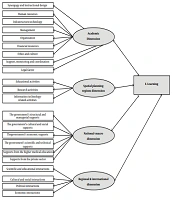
In the designed structure, considering the establishment and development of an e-learning system in each educational area based on the four basic components of the hardware and the network (Internet), Interested human(both educators and learners), as well as the technical support group, the content of e-learning and the existence of an online e-learning software for e-learning management (13) designed the design of an e-learning structure in the fields of planning, material production, course implementation, evaluation, and electronic loading. And the tasks of each area are proportional to its position and the nine-step activities of Gagne’s model Project (14), based on the needs of the health department (Figure 1).
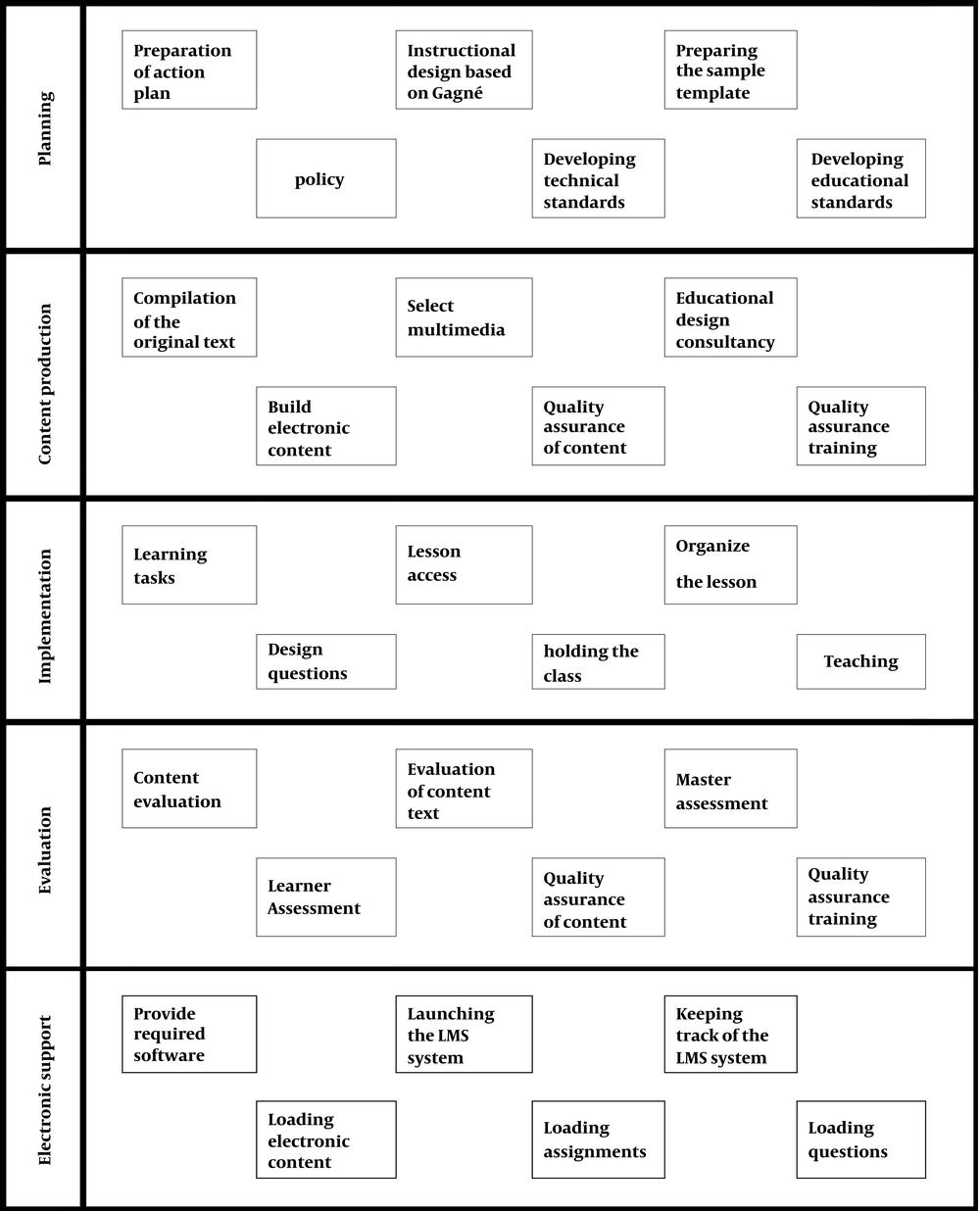
Figure 1.
The areas of e-learning structure by task
Tasks for planning based on event 2 and 1 of the Gagne’s model (gaining attention, informing learner of objectives) and the Tasks for content production based on event 4 and 5 (present content material, providing learning guidance) and implementation tasks of the course based on event 3, 4, 5, 6 (stimulate recall of prior learning, present content material, providing learning guidance, eliciting performance) and scope of evaluation, event 7 and 8 (provide informative feedback, assessing performance) has been.
In the proposed structure, we only devised and formulated the tasks. The necessary organizational and human resources implementation can be provided in various forms based on the policy of the deputy, both internally (using the current staff of the deputy) and through purchasing services.
5. Discussion
The current study aimed to provide a framework for distance education based on the Electronic Learning Management System in the Deputy for Public Health-Shahid Beheshti University of Medical Sciences. According to the results, although the deputy holds several courses annually, but still most of them are traditionally based. Fortunately, the evaluation of the staff’s attitudes toward e-learning was very well. The results of the study showed that 84.4% of the trainers of the Deputy for Public Health and 87.4% of the students were agreed with the implementation of electronic training programs, which can be attributed to the great benefits of this approach, such as the flexibility of time and place, cost savings, ease of access (that is available wherever and whenever available to trainees and apprentices), and avoiding to traveling to a specific place away from the workplace. These benefits are encouraging teachers and learners to use this method. Also, access to high-speed intercoms, one of the most important e-learning infrastructures, is also available at Shahid Beheshti University. According to the results, 48.9% of educators reported that they have fast internet speed. And 38.9% of them reported moderate Internet access.
While 50.6% reported that the university’s internet speeds is moderate, 24% reported that it is good.
Ranjbarzadeh and colleagues evaluated the staff, students, managers, and IT experts of the Tabriz University of medical sciences concerning the e-readiness and network speed (15), which their results are consistent with the current study. According to the results of the current study, e-readiness and availability of high-speed interconnect, which are the most important e-learning infrastructures, are acceptable. Besides, 72.2% of educators stated that their training programs could be provided electronically, and 78.9% noted that they had ready-made electronic content for these training, and 42.2% had questions for their educational content. Self-assessment has also been designed.
The findings also indicate that the deputy has required infrastructures to hold electronic training programs. And for very few cases, a series of practical works are needed, which can be done either in combination (as a part of the electronic environment and partly in the field). Taheri and colleagues concluded that the administration of virtual learning enhances learning in the cognitive domain (16). Considering that 82.6% of the goals of the Department of Health’s educational programs are cognitive and therefore, their content can be sent through email, which will improve the learning.
In this study, we also sought to educate learners about meaningful subjects. In this regard, the educational design patterns derived from the cognitive learning theories (Gagne’s instructional design model) and according to the previous experiences of the trainers of the deputy, we selected this methodology, because it provides the required conditions for the materials to be learned in a practical and profound way (17).
Neo and colleagues found that applying Gagne’s instructional design model to the traditional teaching method has a greater effect on learning and memorization (18).
According to the 2025 vision of the Shahid Beheshti University “moving towards the realization of learning network” is the main policy that should be implemented, and since 2003, the university is using its internal network for teaching physiology lessons. Currently, planning for continuous e-learning is making, and e-learning is active in continuous medical education (CME) for physicians and paramedics, and is also available to educators to provide electronic content (19).
Baesd to the structure of the deputy, all departments have experience in the implementation of virtual tests, but holding workshops using electronic means was first proposed in the current study.
Khazaee and Moradi reported that one of the main issues in electronic learning is attention to the structure and quality of producing educational content according to the principles of instructional design. Regarding the enhanced motivation and academic achievements of using electronic content, based on Gagne’s instructional design model, it is recommended that organizations and universities that are holding e-learning courses develop special educational frameworks (20).
Therefore, in the proposed structure, we have tried to ensure that the quality of the training programs is consistent with the activities required for the Gagne’s instructional design model. We also tried to structure the proposal according to the structure of the deputy, and by making the least change and the lowest cost, we can move toward e-learning.
5.1. Conclusion
Retraining programs of the staff can be implemented electronically. Human resources (trainers and learners) are interested and ready there. Besides, the aims of most educational programs at the health deputy were in the cognitive domain. Based on the results, the administration of e-learning increases learning in the cognitive domain (16).
E-learning is a new approach to provide a well-equipped, well-designed, interactive, and learner-centered learning environment for anyone, wherever and whenever, using the resources and specifications of various digital technologies and in line with other forms of educational environments for the creation of a free military, flexible and distributed in education (20).
The design and planning of the educational environment is a complex activity. To create an educational environment, an appropriate network with the required infrastructure for this environment should be provided, in addition to the educational content. Such infrastructure includes trainers, educational materials, and communication media. Gagne’s nine events of instruction provides a step-by-step checklist that helps to ensure a successful and comprehensive experience. Each step is designed to effectively train learners. Therefore, in this research, we tried to focus on the design of the e-learning structure in Gagne’s nine events of instruction as well as on the components of e-learning. Accordingly, a structure that implies the quality and proper management of this department, based on the potential and human resources of the Deputy for Public health, should be designed.