1. Background
E-learning is one of the new educational methods, integrating information and communication technology. It is defined as the education delivered through internet technologies without the necessity of teacher and student being present at the same place at the same time (1).
E-learning environments facilitate many practices in the field of education. To allow for better learning and learning opportunities; e-learning materials should comprise of components such as text, sound, simple graphical presentations, video presentations, animations, simulations, games, testing systems, interactions supported with feedback (2-4).
Over the last number of decades there has been a shift in medical education practice from traditional forms of teaching to other media which employ online, distance or electronic learning (5). As described by Howlett et al. (6) “Electronic or online learning can be defined as the use of electronic technology and media to deliver, support and enhance both learning and teaching and involves communication between learners and teachers utilize online content”. Online learning can provide students with “easier and more effective access to a wider variety and greater quantity of information” (7). However, the transition from traditional to online learning is not without challenges. Increasing time constraints and demands are continually placed on students and educators alike, driving departments to find new ways of providing a more personalized, self-directed learning experience.
The Spatial Planning Project (SPP) was a pivotal project in recent large-scale educational policy-makings in Iran. Based on the Iran’s 2025 Perspective Plan, the Iranian higher education must possess an Iranian-Islamic identity and be eminent, competitive, and pioneering in Southwest Asia. Upon the approval of the Supreme Council of the Cultural Revolution, medical higher education institutes were divided into 10 macro regions in Spatial Planning Project. Meanwhile, the Educational Transformation and Innovation Project proposed 12 education transformation packages based on the large-scale policies and orientations of the Ministry of Health and Medical Education (MoHME). A major process-oriented package in this project is the development of e-learning in universities. One of the main operational topics proposed in health care domain in the package is the presentation of an e-learning pattern (8).
To date, many studies have been conducted on e-learning. Nevertheless, there are a few studies conducted on presenting e-learning pattern and its related solutions for medical universities.
Regarding the theoretical foundations of research in recent years, different patterns and frameworks for e- learning are presented. The most important of which are discussed in Table 1.
Table 1.
E-Learning Patterns
| Pattern | Researcher & Year | Categories | Reference |
|---|---|---|---|
| Global e-learning framework | Khan and Badii (2012) | Educational, technology, user interface, design, evaluation, management, ethical, organizational resource, support, educational planning, human resources, organizational structure, teaching method, educational content | (9) |
| Chapnick and Meloy | Chapnick and Meloy (2005) | Technological infrastructure, content, culture, human resources, financial resources, awareness and organization | (10) |
| University of Illinois, e-learning pattern | University of Illinois (2007) | Educational designing, communication, interaction and collaboration, assessment and evaluation, resources and comprehensive support services, web design, course evaluation | (11) |
| Akaslan and Law | Akaslan and Law (2011) | Technological infrastructure, content, culture, human resources, support, pedagogy, learner and teacher | (12) |
| Darab and Montazer | Darab and Montazer (2011) | Technological infrastructure, content, politics, culture,human resources, financial resources, standard, security, rules and regulations, standard, management, support, supervision and coordination | (13) |
| Alshaher | Alshaher (2013) | Technological infrastructure, content, culture, human resources, management, organization, support and learners | (14) |
| Sugant | Sugant (2014) | Information quality (content, navigation power) and system quality (technical and accountability) | (15) |
| Ibrahim | Ibrahim (2015) | Management, support, learning objectives | (16) |
2. Objectives
The present study aimed to design a conceptual pattern of e- learning for Iran’s universities of Medical Sciences.
3. Methods
The study was carried out as a qualitative grounded theory study. In grounded theory, a set of ideas (the “theory”) is generated from the concepts and constructs retrieved from the coding stages. However, the theory remains grounded in the data, and is obtained from analysis of the codes and “memos” noted during the coding process, which come together to create an overall theory explaining the phenomenon under investigation (17).
The study population included university experts and faculty members in the field of educational technology, distance learning and medical education.
30 participants were selected on the basis of theoretical saturation. In other words, selection of participants continued until no new information was added to the previous information (Table 2).
Table 2.
Demographics of the Participants
| Variable | Frequency (%) |
|---|---|
| Gender | |
| Male | 23 (76) |
| Female | 7 (24) |
| Academic rank | |
| Professor | 8 (26) |
| Associate prof. | 13 (43) |
| Assistant prof. | 9 (30) |
| Specialized field | |
| Educational technology | 8 (26) |
| Distance learning | 6 (20) |
| Educational administration | 5 (16) |
| Medical education | 4 (13) |
| E-learning planning in medical sciences | 7 (23) |
| Work experience | |
| 1 to 10 years | 6 (20) |
| 11 to 20 years | 13 (43) |
| More than 20 years | 11 (36) |
Ethical concerns observed in the study were making the require arrangements before entering the research environment, briefing the participants about the objectives and method of interviews, ensuring the participants about confidentiality of their personal information like their identity, securing their informed consent for participation and voice recording the interviews, and reminding their right to leave the study at whatever stage.
Totally, 30 participants took part in the study. The interviews took between 35 and 60 minutes and the time and place of interviews were selected to the convenience of the participants mostly in the universities.
The researchers used semi-structured interviews because questions can be prepared ahead of time. This allows the interviewer to be prepared and appear competent during the interview. Semi-structured interviews also allow participants the freedom to express their views in their own terms, and also they can provide reliable, comparable qualitative data (18).
Data gathering process consisted of deep, semi-structured, private, and face-to-face interviews at the faculties and research and educational centers at different occasions.
The systematic approach of Strauss and Corbin (1998) was conducted in three stages of open, axial and selective coding (18).
So that after completion of the first interview, it was transcribed verbatim as soon as possible and the analyzing process was continued along with the interviews. The findings of data analyses would constitute the basis for the following interviews and this process was continued until the last interview. Three coding stages including open coding, axial coding, and selective coding were performed. The open coding stage was in fact a microscopic data analysis process where all possible meanings were extracted. The interview’s texts were reviewed several times at this stage and the research team concentrated on developing concepts based on the data. The axial coding stage used the codes and categories obtained throughout the open coding and similar categories were combined based on common axes. The codes were continuously compared at this stage and then each category was compared with other categories to make sure that the categories are distinguishable. Afterwards and based on selective coding the dimensions, categories and indicators of e - learning for universities of medical sciences were identified.
The validity and reliability of the data were achieved through Lincoln and Guba criteria (19). As to credibility of the data, the author had a prolonged engagement with the participants to win their trust and have a better perception of their experiences. In addition, the coding and analyses results were forwarded to some of the participants to check if the results reflect their opinions and viewpoints (member check). Moreover, a widest diversity in the participants added to the authenticity of the data. Confirmability was ensured through observing neutrality; asking experts in e-learning and qualitative research to check the codes and themes; and reviewing the interviews texts, codes, and categories through peer check. To ensure stability of the findings, the interviews were transcribed as soon as possible and experts were asked to check the data (external check). Transferability was ensured by selecting diverse participants and using direct quotes (19).
4. Results
The research data were conducted in three sections: analysis of interviews by coding method, Delphi method and brain storming, then research questions were answered.
Initially, the theoretical literature and the studies conducted in Iran and elsewhere were examined as extensively as possible. These studies were categorized based on the study population and the year in which the study was conducted, and relevant notes were taken. Phrases, concepts, and items extracted from the studies were examined by performing more precise analyses. Open coding was performed, i.e. the preliminary concepts were homogenized (selecting more accurate words, eliminating common concepts). In this step, 250 indicators were obtained. Then, through three Delphi rounds with 30 academicians and e-learning experts, the 250 indicators were analyzed. After the Delphi rounds and the brainstorming session, the common items and unnecessary or inappropriate concepts were removed, and finally 222 indicators (key concepts) remained.
As noted before, analysis in the grounded theory method is based on coding categories. After the indicators of the e-learning pattern were obtained in the open coding step, the categories constituting the pattern had to be identified through axial coding. In axial coding, relationships are based on the development of a category. Thus, the main category (e.g. core idea) is defined as a phenomenon, and other categories are related to this main category. In other words, in this step, one index was selected and the relevant indicators were related to it. This process continued until all the indicators were classified under more general categories. Finally, the indicators of the open coding step were classified under 22 more general categories. The categories resulting from the axial coding step were: synergogy and instructional design, human resources, infrastructure-technology, management, organization, financial resources, ethics and culture, support, monitoring and coordination, the legal factor, educational activities, research activities, information technology-related activities, the government’s structural and managerial supports, the government’s cultural and social supports, the government’s economic supports, the government’s scientific and technical supports, supports from the higher medical education system, supports from the private sector, scientific and educational interactions, cultural and social interactions, political interactions, and economic interactions.
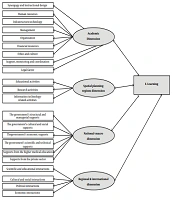
To identify the dimensions of the pattern, the final step of coding, i.e. primary categorization, was performed. In this step, one category is systematically related to other categories, and these relationships are validated while categories are modified or further elaborated. This step (selective coding) is based on the results of open and axial coding and is the main step for generating the theory. In this step, the main category is systematically related to other categories, and these relationships are presented in the form of a narrative. Moreover, categories which require refining or further elaboration are modified. Thus, selective coding was performed similarly to the axial coding step and by selecting a more general title for related categories. The categories which were semantically similar to one another were classified and labeled under a single category. At the end of the selective coding step, the 22 categories of the axial coding step were classified under four general categories titled “dimensions”. The dimensions identified for the e-learning pattern of universities of medical sciences were: academic, spatial planning regions, national-macro, and regional-international dimensions.
In the next steps of the qualitative data analysis, all the dimensions, categories, and indicators of the e-learning pattern for universities of medical sciences were validated and approved by experts in Delphi rounds and brainstorming sessions, and the final pattern was shown in Figure 1.
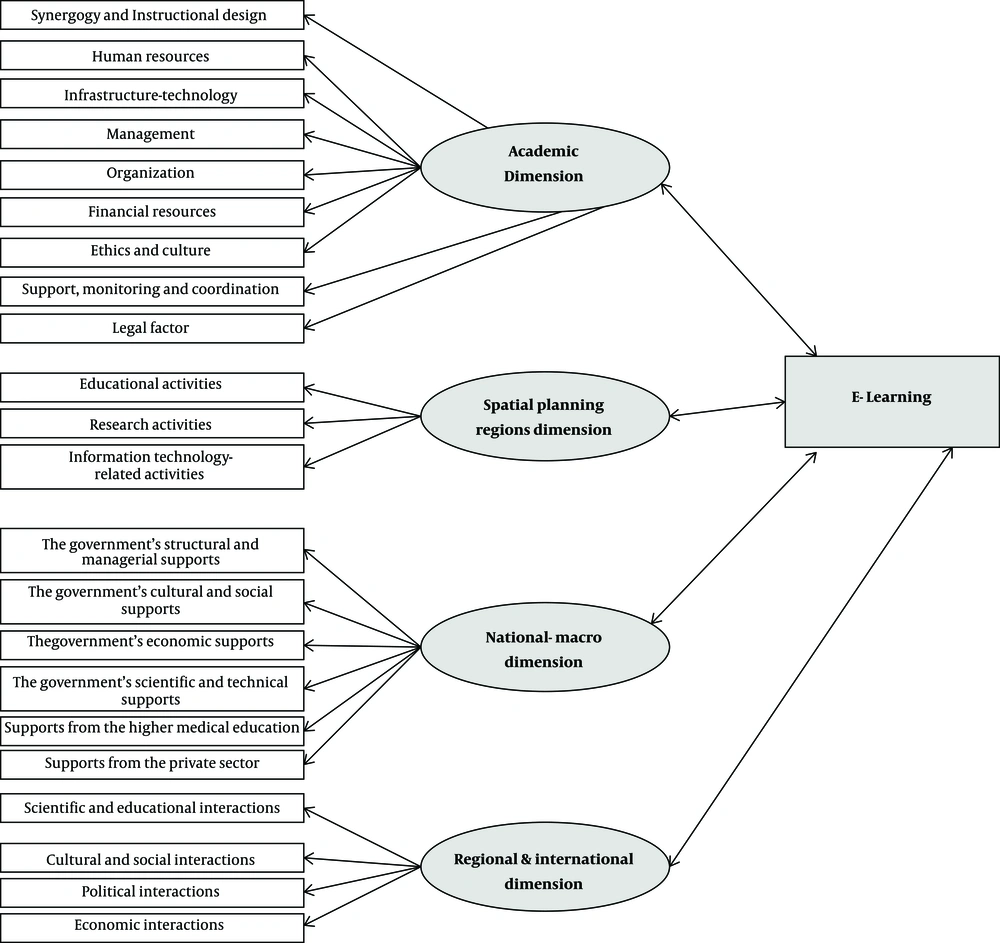
Figure 1.
E-learning pattern for university of medical sciences
5. Discussion
The present study aimed to design a conceptual pattern of e- learning for Iran’s universities of Medical Sciences. The findings of this study pertaining to the academic dimension and in the categories of synergogy and instructional design, human resources, infrastructure, support, monitoring and coordination are consistent with those reported by (20-23).
Also in the categories of management, organization, financial resources, ethics and culture, the legal factor are consistent with studies done by Khan (9, 13, 24). According to (21), and (23) successful implementation of e- learning at university requiresproper and appropriate process of synergogy and instructional design, human resources, infrastructure, support, monitoring and coordination, management, organization, financial resources, ethics, culture, and the legal factor. The present study is in line with the above studies, and what distinguish it from other research in academic dimension is support, monitoring and coordination.
The findings of this study pertaining to the spatial planning regions dimension and in the categories of educational, research and information technology- related activities are consistent with those reported by (14, 25-27). The results showed that academic managers and policy-makers must pay attention to cooperation in the 10 spatial planning regions because these interactions promote the relationships between academic experts, give rise to interdisciplinary scientific innovations, and facilitate the development of e-learning in the academia. The spatial planning of the higher medical education system provides long-term opportunities for developing higher education with a comprehensive cultural, political, geographical, and human approach.
Meanwhile, among the key factors in developmental projects, especially in higher education are the provision and fortification of e-learning infrastructures. The Educational Transformation and Innovation Project in universities of medical sciences had a higher medical education spatial planning approach and paid attention to regional capabilities, and aimed to provide an opportunity for universities of medical sciences to believe in the regional capabilities in relation to their needs, and thus attempt to plan and manage higher education in the healthcare system. One of the values discussed in these policy-makings was to address educational justice.
Several studies, including those by Khatib Zanjani et al. (28-30) emphasize the role of e-learning in developing educational justice; this factor is especially effective in eliminating the inequalities between deprived and privileged regions. In the conceptual pattern of e-learning, in the educational category, activities such as empowerment of faculty members in the 10 national regions, creating an e-learning center in universities of medical sciences in spatial planning macro regions, developing and holding annual regional summer schools, publishing e-journals on novel educational technologies for medical education, and standardizing and promoting the quality of e-learning programs in spatial planning macro regions affect the development of the virtualization package.
The findings of this study pertaining to the national-macro dimension demonstrate that the application of e-learning for medical education is a key topic for the development of information technology at present, and a challenge for the future. Universities of medical sciences have to adapt themselves to the trend of evolutions in this new environment; therefore, to plan and develop high-quality e-learning, these universities should identify the intra-university effective factors (at micro level) and also require support at macro level (structural and managerial, cultural and social, financial, scientific and technical support) from the government, as well as support from the higher medical education system and the private sector. The indicators of the category of structural and managerial supports noted by the experts during interviews include: A transparent and optimal bureaucracy in the country’s administrative and structural system, stability of specialized administrative managers, equality in the distribution of hardware facilities in different regions, removing limitations on the Internet and network access, and paving the way for entrepreneurship in e-learning.
The indicators of cultural and social supports include: paving the way for the cooperation of NGOs and scientific associations in higher medical education, addressing the digital gap and supporting the equitable distribution of learning and teaching, addressing training global citizens while maintaining national and regional values, adherence to the copyright law by the national software community, and institutionalizing organizational culture with an e-learning approach.
The indicators of the government’s economic supports noted by the experts in interviews include: Addressing the economic growth and increasing the competitiveness of e-learning, designing and deploying a stable and equitable financial provision and allocation system in the higher medical education system, and encouraging students to write applied dissertations, and commercializing these dissertations with the help of information technology and growth centers. The results are consistent with those reported by Zarea Bidaki et al (27, 29-33).
Moreover, the indicators of the government’s scientific and technical supports include: Learning from universities pioneering in e-learning, improving student admission methods, cooperation with knowledge enterprises for knowledge localization, and supporting the expansion of inter-university, regional, and international interactions. These findings are in line with those of Daneshgar et al. (27, 31, 34-37).
The indicators of the supports from the higher medical education system mentioned by the experts in interviews include: Standardization of the curriculum based on e-learning in the Ministry of Health and Medical Education, development of a supervision system for the developed contents, addressing the role of non-academic institutions in the development of e-learning, developing national regulations for validation of e-learning courses, binding regulations and incentives for virtual activities, facilitating the recruitment and employment of faculty members specializing in e-learning, and supporting the independence and freedom of universities. These results are consistent with those reported by Roshani et al (8, 20, 23, 38-41).
Finally, the indicators of supports from the private (non-governmental) sector include: competitiveness in production and implementation of e-learning software and hardware systems, cooperation in the development of knowledge enterprises and start-ups for the stakeholders of the higher medical education system, cooperation with universities in research projects, inventions, and development of educational content, and identification of resources universities need. These results are in line with those of Zolfaghari et al. (32, 37, 42-44).
The results of the present study in the regional and international dimension and in the categories of scientific, educational, cultural, social, political, and economic interactions highlighted indicators such as addressing the globalization approach to e-learning, using the experiences of countries in the region for promoting knowledge and technology, developing an e-learning international spatial planning project, enriching academic virtual environments based on credible international standards, implementing research projects with the cooperation of universities in the region, awareness-raising on the globalization of e-learning, designing an attractive e-learning space in the universities for attracting international students, adherence to international professional ethics, supporting the international academic elites, political stability in the country, addressing the level of trust and security of information, the level of commercialization of education, the level of international investment for e-learning start-ups, and expanding sister partnership programs.
5.1. Conclusion
One of the merits of this pattern is its comprehensiveness. The developed pattern comprises four dimensions of academic, spatial planning regions, national-macro, and regional-international. These four dimensions and their categories affect the development of e-learning in universities of medical sciences. This pattern has a number of differences with a similar foreign pattern. For example, the present pattern is a combination of four dominant dimensions of e-learning, while similar Iranian and foreign patterns pay less attention to these dimensions simultaneously. This pattern has addressed futuristic approach of e-learning in the global industry while it is a local pattern based on the requirements and conditions of the Iranian universities of medical sciences.
We hope that policy-makers, top managers of higher medical education, and those in charge of e-learning exploit the pattern proposed in this study for developing policies and programs for creating/developing e-learning centers, and sufficiently address the four dimensions, categories, and indicators mentioned here, so that the long-term effects of operationalizing each category of the pattern can be demonstrated more optimally and quickly. In this way, costs can be reduced, repeat work can be avoided (especially in the face of environmental crises), and Iranian universities can progress in line with world universities and thereby take a big step towards the successful implementation of e-learning in Iran. The application of this pattern can also realize the goals and programs of the Educational Transformation and Innovation Project in medical education. It is necessary that the government make investments at macro level on the infrastructure, legal aspects, and supports for e-learning, in line with the global evolutions in the near future. However, the study was not free of limitations as some of the participants had concerns about voice recording the interviews. To solve their concerns, they were informed about the objectives and necessity of the study and that the recorded content will be used only for research purposes and remain confidential. In addition, the authors ensured the participants that their identity will not be divulged to any institute or organization.