Fulltext
The body of the article can be found in the PDF file.
Journal of Medical Education for Future Demands
Former Title: Journal of Medical Education | The Official Journal of School of Medical Education and Learning Technologies

Image Credit:J Med Edu
Authors
Background and purpose: As in many countries, Medical Education (ME) is offered in three levels including Undergraduate ME, Graduate ME, and Continuing ME. Informtion tehnology development has provided a suitable chance for ME. E-learning in ME is growing more and more. The present study seeks to determine the key success factors (KSF) in E-learning in medical fields.Methods: KSF has been scrutinized in the literature following of which, and due to similarity, a classification with seven groupings was established including institutional factor, technology, interested parties, information knowledge, methods and approaches educational resources, and environmental factors. Through a questionnaire, the data were gatered from the information technology (IT) directors in all medical universities throughout the country. The data collected were subjected to factorial analysis. Data from heads of educational groups were obtained through focus group discussion. Cronbach reliability coefficient was calculated for questionnaire used. Factorial analysis was used to identify meaningful KSF. T-Test, and one-way variance analysis as well as Pearson’s correlation were used. The analysis was conducted with SPSS softwareResults: The results showed no significant differences between age, sex, career, and level of education, and KSF. The preparedness factors were analyzed through group discussions with the heads of the academic departments under the study. By factorial analyses, five factors were found including the departmental interest and potential (27.3%), task performance potential (25.1%), E-teaching development in basic and clinical sciences , and continuing education (20.1%), suitable cultural environment (16.8%), and infrastructures (10.8%). Fisher Exeact Test was used to compare the obtained ratios in 5% curve whose results showed that among the three factors including legal and technocal environment, specialized hardwareand software, and high speed internet, performance interest and potentials showed a significant difference (p=0.002). A p=0.011 was found for the authorities’ interest and financial and non-financial rewards. No other significant differences were found anywhere else.Conclusion: Our results showed that sex, age, career, work has no relation with KSF which means that if other factors such as technology, organizational and financial preparedness, curriculum content, human resources, teaching methods, standards, literacy, communications systems, trainers and learners, environment and culturewere ready motivated person can experience success in e learning in medicine.
© 2008, Author(s). This open-access article is available under the Creative Commons Attribution 4.0 (CC BY 4.0) International License (https://creativecommons.org/licenses/by/4.0/), which allows for unrestricted use, distribution, and reproduction in any medium, provided that the original work is properly cited.
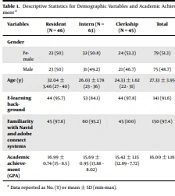
Daryazadeh S, Yavari M, Madani S, Taghavi-Ardakani A, Azadchahr MJ, et al. Correlation Between the E-learning Attitude and Academic Achievement of Medical Students in Clinical Levels. Educ Res Med Sci. 2021;10(2):e120391. doi: https://doi.org/10.5812/erms.120391

Khazaei MR, Norouzi A, Moradi E, Shahabi M, Haji S, et al. Investigating Factors Affecting the Acceptance of E-Learning among Faculty Members and Students of Macro Medical Universities in Region Three Based on the Davis Model: A Cross-Sectional Study. Shiraz E-Med J. 2024;25(7):e142395. doi: https://doi.org/10.5812/semj-142395

Abbasi S, Bagheri S, Mirmoghtadaie Z, Khoshgoftar Z. Identifying and Prioritizing the Educational Needs Professors of Medical Sciences in the Field of E-Learning with the Analytic Hierarchy Process Approach. J Med Edu. 2024;23(1):e147196. doi: https://doi.org/10.5812/jme-147196
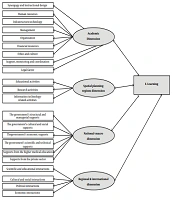
Sajedi R, Khorshidi A, Hamidifar F, Moghaddasi H, Mahmoodi AH. Designing a Conceptual Pattern of E-Learning for Iran’s Universities of Medical Sciences. J Clin Res Paramed Sci. 2021;10(1):e107521. doi: https://doi.org/10.5812/jcrps.107521
Sajedi R, Khorshidi A, Hamidifar F, Moghaddasi H, Mahmoodi AH. Presenting electronic learning pattern for universities of medical sciences: A grounded theory approach. koomesh. 2021;23(1):e153237. doi:
Last Update: 3 weeks ago
Last Update: 3 weeks ago
Last Update: 3 weeks ago
Last Update: 6 days ago
Last Update: 8 hours ago
Last Update: 4 days ago