Fulltext
The body of the article can be found in the PDF file.
Journal of Medical Education for Future Demands
Former Title: Journal of Medical Education | The Official Journal of School of Medical Education and Learning Technologies
Image Credit:J Med Edu
Authors
Background: Non-attendance is an undesirable student behavior. Although some studies about the factors for non-attendance behavior have been carried out at medical schools, the learning approach of a student has not been studied and it can also be a factor for non-attendance. We aimed to assess the relationship between learning approaches and non-attendance attitude and tendency.Methods: This is a correlational study. 644 students registered in three medical schools were enrolled. Data were collected during May 2015. “The Revised Two Factor Learning Approach Scale”, “Non-attendanceAttitude Scale” and “Non-attendance Tendency Scale” were used as data collection tools.Results: Out of 478 studied students, 10.3% mentioned that they never missed theoretical classes and 71.3% mentioned that they never missed practical classes. Sleeplessness was the most common reason fornon-attendance. 45.6% of all students thought that non-attendance affected student success. The students’ mean score for deep learning was 29.5±6.1 and for superficial learning was 30.5±5.6. The mean scorefor non-attendance attitude scale was 54.4±12.8 and from non-attendance tendency scale was 90.5±19.6. Conclusion: Learning approach is an effective factor for attendance. As deep learning approach is adopted, tendency for non-attendance decreases and the attitude becomes positive.
© 2017, Author(s). This open-access article is available under the Creative Commons Attribution 4.0 (CC BY 4.0) International License (https://creativecommons.org/licenses/by/4.0/), which allows for unrestricted use, distribution, and reproduction in any medium, provided that the original work is properly cited.
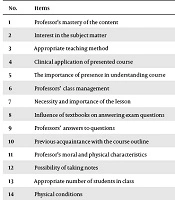
Rahiminia E, Yazdani S, Rahiminia H. Factors Affecting Concentration and Attendance in the Classroom from Students' Point of View in Qom University of Medical Sciences (2018). Educ Res Med Sci. 2019;8(2):e93075. doi: https://doi.org/10.5812/erms.93075
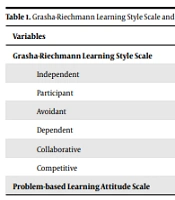
Aker S, Şahin MK. Relationship of Learning Styles and Attitudes Toward Problem-Based Learning with Academic Achievement in Preclinical Medical Students. J Med Edu. 2021;20(2):e115154. doi: https://doi.org/10.5812/jme.115154

Ebrahimi A, Ghodsi R, Jamali K, Meshkibaf M, Beigizade S. A Comparison Between Students' Attitudes And Their Performance Regarding The Factors Influencing Learning And Exam Results. J Med Edu. 2005;7(1):e105212. doi: https://doi.org/10.22037/jme.v7i1.848
Shakurnia A. Nursing and medical students' studying and learning approaches. Jentashapir J Cell Mol Biol. 2012;2(4):. doi:
Almousawi AM. Tutors Evaluation of Integrated Medical Learning in Karbala Medical College. J Med Edu. 2018;17(2):e105616. doi: https://doi.org/10.22037/jme.v17i2.20095
Last Update: 2 days ago
Last Update: 2 days ago
Last Update: 2 days ago
Last Update: 43 minutes ago
Last Update: 11 hours ago
Last Update: 4 days ago