
1. Background
Learning can be defined as permanent behavioral changes induced by life. Understanding the learning behavior of students is a part of this process. Therefore, the concept of learning styles has become a popular topic in recent literature, with many theories about learning styles put forward to better understand the dynamic process of learning (1).
The concept of learning style was first suggested by Dunn, and different models have been established on learning styles by numerous researchers (2, 3). Grasha has defined the learning styles as “the personal characteristics of the individuals which affect obtaining information, interacting with peers and teachers, and participating in learning experience” (3).
The approach based on learning styles is that each individual is different, and therefore, everybody has a different learning style. There is no learning style to be defined as good or bad. The significant point is to teach each student by the style they can learn (1, 4). In educational applications, it should be considered that each learning style has a different way of learning, students take advantage of different materials at different levels, and there are students with different learning styles in crowded classes (5). In medical education, most teaching is offered in crowded lecture halls; however, it would be very useful to know students’ learning styles and make some appropriate arrangements in the educational program to attract students’ attention more and increase learning and the quality of education. The problem-based learning method, in which students try to solve problems given to them based on their learning styles, may provide an opportunity for students in this sense.
Medical education is a difficult and lifelong process. Very intense changes have been experienced in medical education in our country in recent years. Ondokuz Mayıs Medical Faculty (Samsun-Turkey) has been also affected by these changes and started to apply a medical education model in which a student-centered approach has been applied, and problem-based learning (PBL) sessions have been offered actively since 2003.
Problem-based learning is an educational method in which individuals face issues similar to the ones they will face in their lives. They are guided to solve these issues and provided the opportunity to research and learn. In this approach, it is aimed to improve students’ meta-cognition and self-organized learning skills (6). There is not a common educational system in Turkey similar to PBL at the secondary education level. Students receiving education with the traditional system face a new educational method at university.
In recent years, learning styles have attracted the attention of researchers in the healthcare field. However, there is not sufficient research on the learning styles of medical students. Determining the effect of learning styles on attitudes towards PBL will be useful in preparing educational strategies.
2. Objectives
In this study, it was aimed to assess the relationship of learning styles and attitudes towards PBL with academic success among preclinical medical students.
3. Methods
This cross-sectional study was conducted among Ondokuz Mayıs University (OMU) Medical Faculty (Samsun-Turkey) students between May 1st and 31st, 2019. Overall, 846 first, second, and third-year students were included in the study.
Medical faculties teaching medicine at undergraduate level in Turkey provide six-year education. Medical students spend their first three years on primarily theoretical and laboratory training. In years IV and V, they perform internships, and in the sixth year, they serve as intern physicians, actively working in the hospital for 12 months.
The survey was used in the research as the data collection method. The survey form was composed of two parts. The first part was composed of items on sociodemographic information, and it was prepared by the researchers by literature review. In the second part, Grasha-Riechmann Learning Style Scale (GRLSS) and PBL Attitude Scale were included.
Grasha-Riechmann Learning Style Scale was developed by Grasha and Riechmann in 1996 (1). It is 32-item scale rated based on a 5-point Likert scale. The construct validity of the scale was tested by Vural in 2013 (7). In the scale, it is aimed to determine the social learning preferences of students in the six learning style categories of independent, avoidant, collaborative, dependent, competitive, and participant (1, 8). The total score obtained by the students from each sub-scale is divided into the sub-scale item number, and score standardization was performed in all the sub-dimensions.
Problem-based Learning Attitude Scale is a 20-item scale rated on 6-point scale. The scale was developed by Turan in 2009, and its reliability and validity were established (9). A higher score obtained from the scale indicates a better attitude towards PBL.
Poir to the study, the aim was explained to the students, and their verbal consent was obtained. All the first, second, and third-year students were invited to participate. At the beginning of the questionnaire, there was a section that confirmed that the student had received information about the study and that they participated in the study voluntarily. In this section, it was also stated that the study data would not be shared with anyone and would only be used for scientific purposes.
Data analysis was performed using SPSS. The data are presented as mean ± standard error and number (percentage). The suitability of the data obtained by the measurement of the normal distribution was tested with the Kolmogorov-Smirnov test. Analysis of variance (ANOVA) and student’s t-test were used to compare the data. Pearson correlation test was used in the assessment of the relation of the two groups of data obtained with measurement. The effect of learning styles and attitudes towards PBL on academic achievement was investigated by multiple regression analysis (enter method). A P-value of less than 0.05 was considered statistically significant.
Ethical approval was received from Ondokuz Mayıs University Clinical Research Ethical Committee (Samsun-Turkey) (IRB No: OMUKAEK 2019/306).
4. Results
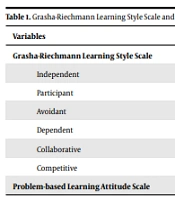
Overall, 612 (72.3%) students participated in the study. The lowest participation was related to first-year students (68.1%), and the highest participation pertained to third-year students (78.3%). The highest learning style mean value among the medical students was related to the independent learning style, and the lowest mean value belonged to the competitive learning style (Table 1).
Table 1.
Grasha-Riechmann Learning Style Scale and Distribution of Problem-Based Learning Attitude Scale Scores
| Variables | Mean | SE |
|---|---|---|
| Grasha-Riechmann Learning Style Scale | ||
| Independent | 3.9 | 0.1 |
| Participant | 3.2 | 0.1 |
| Avoidant | 3.1 | 0.1 |
| Dependent | 3.1 | 0.1 |
| Collaborative | 2.9 | 0.1 |
| Competitive | 2.6 | 0.1 |
| Problem-Based Learning Attitude Scale | 63.4 | 0.7 |
The scores obtained from the scales were compared based on some variables. The independent and dependent learning styles were compared according to gender (independent t = 10.35; P = 0.001; dependent t = 6.51, P = 0.011), the type of high school graduated from (independent F = 3.19, P = 0.042; dependent F = 5.98; P = 0.003), and the presence of the habit of going to the library (independent t = 10.56, P = 0.001; dependent t = 6.14, P = 0.013). The cooperative learning style was significantly associated with class repetition (t = 12.35, P < 0.001) and the presence of the habit of going to the library (t = 20.45, P < 0.001). The contestant learning style was significantly related to the educational status of the father (F = 8.78, P < 0.001), and the avoidant learning style was significantly linked to the type of high school graduated from (F = 5.50, P = 0.004), the level of education of the mother (F = 8.49, P < 0.001) and the status of choosing the medical school voluntarily (t = 5.30, P < 0.022).
The PBL scale scores were significantly higher in the following groups: those who graduated from a science high school compared to the ones who did not (F = 7.49, P = 0.001), the ones who did not repeat a grade level compared to the ones who repeated a grade level (t = 8.15, P = 0.004), and the ones with the habit of going to the library compared to the ones who did not have the habit of going to the library (t = 10.16, P = 0.002).
There was a significant positive correlation between the collaborative and participant learning styles scores and the PBL attitude scale scores and a significant negative correlation between the avoidant learning style score and the PBL attitude scale score. There was a positive correlation between the independent and participatory learning styles scores and academic achievement score and a negative correlation between the avoidant learning style and academic achievement score. There was a positive correlation between PBL attitude scale score and academic achievement (Table 2).
Table 2.
Correlation of Grasha-Riechmann Learning Style Scale and Problem-Based Learning Attitude Scale Scores with Academic Success
| Variables | Problem-Based Learning Attitude Scale | Academic Success |
|---|---|---|
| GRLSS | ||
| Independent | 0.04 | 0.17 a |
| Dependent | -0.07 | 0.03 |
| Collaborative | 0.33 a | -0.05 |
| Competitive | 0.05 | 0.04 |
| Participant | 0.19 a | 0.09 b |
| Avoidant | -0.22 a | -0.13 a |
| Problem-Based Learning Attitude Scale | 0.11 b |
a P < 0.01.
b P < 0.05
According to multiple regression analysis, independent and avoidant learning styles and attitude towards PBL were found significant variables in predicting academic performance. As students' independent learning style and positive attitude towards PBL increased, academic achievement improved, and as their avoidant learning style score increased, academic success declined (Table 3).
Table 3.
Multiple Regression Analysis a
| Academic Success | B Coefficients | β Coefficients | t | P | %95 CI |
|---|---|---|---|---|---|
| Grasha-Riechmann Learning Style Scale | |||||
| Independent | 0.64 | 0.17 | 4.09 | 0.000 | 0.33/0.94 |
| Dependent | -0.03 | -0.01 | -0.27 | 0.785 | -0.27/0.20 |
| Collaborative | -0.11 | -0.03 | -0.66 | 0.505 | -0.44/0.21 |
| Competitive | 0.08 | 0.04 | 0.96 | 0.334 | -0.09/0.26 |
| Participant | 0.13 | 0.03 | 0.69 | 0.487 | -0.23/0.50 |
| Avoidant | -0.38 | -0.15 | -3.31 | 0.001 | -0.60/-0.15 |
| Problem-Based Learning Attitude Scale | 0.07 | 0.12 | 2.67 | 0.008 | 0.02/0.13 |
a Constant = 69.18; Multiple R = 0.06; Multiple R2 = 0.05; Durbin-Watson = 1.46 (P < 0.001).
5. Discussion
In this study, the highest learning style mean values were related to the independent and participant learning styles, and the lowest mean value pertained to the competitive learning style. Students with an independent learning style like to study alone rather than studying with other students, and they are sure of their learning skills. As they prefer studying independently, they also like to do their homework independently, and they determine the pace of their study by themselves. These types of students are curious and self-confident. They are self-controlled students who make attempts to develop their own skills. They listen to others and learn what is required. They like to take on responsibility and freethinking. While learning, they want to have choice and flexibility, and structure and form should be decreased to a minimum (4, 10).
In a study conducted among medical students, it was determined that students mostly had independent and collaborative learning styles (4), which is line with another study where the competitive and collaborative learning styles were found to be predominant in medical students (10). In studies of medical students in different countries, there are studies where the independent and collaborative (11, 12), collaborative and competitive (13), avoidant, collaborative, and competitive (14) learning styles were more prominent. These studies had similarities with our study, but they did not comply completely. The discrepancy in findings may be due to the cultural differences of the students or the differences between generations of students.
In this study, it was determined that learning style scores varied based on some socio-demographic variables. It has been stated that culture affects learning styles (15), and factors such as gender and age also influence learning styles (16). The most researched variable in the study of learning styles has been gender. However, there is not a dominant view on this issue. Studies suggest that gender affects learning styles (17-19), but there are also studies stating the opposite (20). In a study conducted among medical students, it was determined that the avoidant learning style scores of male students were higher compared to female students (4). There are also studies stating that gender and demographic characteristics such as mother/father’s educational levels do not impact learning styles (21). Studies have shown that the type of high school has an influence on learning styles (19), but there are also studies stating the opposite (21). When we comapred these study findings with our results, we noted that some variables may be effective in learning styles, but there may be differences based on group and study design.
In this study, it was determined that high school type, repeating a grade level, and the habit of going to the library affected the attitudes towards PBL. In a study conducted among medical students, the attitude scores of first-year students and those who stated that learner-based applications were included in their secondary education were found higher. In the same study, no significant difference was noted in the attitudes of students based on gender (22). In another study, it was stated that being female, choosing medical school willingly, and being a sophomore student affected the attitudes towards PBL, but high school type did not influence the attitudes towards PBL (23).
We believe that high school type may be a central variable in attitudes towards PBL, and students who have not experienced such education before may face difficulties when they first encounter this kind of education. Problem-based learning is an educational method requiring students to research and study solutions before sessions. For this reason, the habit of going to the library in high school years will contribute to turning the attitudes towards PBL more positive.
There was a significant positive correlation between the collaborative and participant learning styles and attitude towards PBL and a significant negative correlation between the avoidant learning style and attitude towards PBL. Students learning collaboratively like to learn with their friends and teachers, and they learn through sharing their ideas and skills. Participant students are willing to learn and participate in all the activities as far as possible. Students with the avoidant learning style prefer acting passively in educational processes, and they are not concerned about learning content and attending lessons and activities in the classroom (4, 10). Problem-based learning is a student-centered process. Each student has the responsibility to participate in the studies completely not only for his/her learning but also for helping other group members to learn. Students have to spend large amounts of time in the library or on their computers. Considering the process of PBL, it is an expected situation that collaborative and participant students develop more positive attitudes towards PBL, while avoidant students may develop more negative attitudes.
In this study, a positive correlation was found between the independent learning style scores and academic success and a negative correlation was found between the avoidant learning style scores and academic success. According to the multiple regression analysis, independent and avoidant learning styles are essential variables in predicting academic performance. A study reported that active learning and independent learning style are critical variables in predicting academic success in an e-learning environment (24). In another study conducted among medical students, a negative relationship was reported between medical students' addictive learning style scores and achievement scores (4).
It has been reported that learning style is one of the main individual differences affecting success in the learning process (25). It has been stated that if students know about their learning styles, they will learn easier and faster, find solutions to their problems faster, their self-confidence will increase, their anxiety level will decrease, and they will develop positive attitudes towards lessons and school (25). Medical students are successful students in secondary education who attend university by obtaining high scores. However, acting passively in educational processes affects their success level in medical school. Although it has been stated that learning style is an effective variable for academic success, we believe that various factors affect academic success in medical education, and these factors should be researched continuously (26-28).
There was a positive correlation between the PBL attitude scale scores and academic success. According to the multiple regression analysis, attitude towards PBL is a significant variable in predicting academic performance. As positive attitudes towards PBL increase, academic success improves. Problem-based learning is an integral part of medical education in the medical faculty where this study was conducted. Here, it is not clear whether the positive attitudes of medical students towards PBL increase their academic achievement or whether their high academic achievement positively affects their attitudes towards PBL. Future studies evaluating the factors effective in the formation of positive and negative attitudes toward PBL can shed light on this issue.
5.1. Conclusion
It is vital to raise awareness in both educators and students on learning styles. Learning style is not a subject that has to be known only by students. Educators also have to consider the learning styles of students while providing education. Educators may apply the education techniques appropriate for students if they have a comprehensive knowledge of their learning styles. Raising awareness of students on this subject may help them to understand their own strengths and weaknesses in learning and prepare a study plan appropriate for themselves.
5.2. Limitations
Although medical education has similar characteristics in the world, there are different educational systems in various countries. While comparing the results of the study with studies in other countries, the effects of educational systems and cultural differences on discrepancies could not be determined.