
1. Background
The flipped classroom has been the focus of many educational practices in recent years. The interaction and collaboration within flipped classrooms enhance short-term and long-term retention (1). This instructional strategy provides opportunities for students to improve their thinking skills while actively producing and evaluating their knowledge (2). On the other hand, many universities have made significant efforts to adopt e-learning practices. Several higher education institutions have used e-learning environments combined with face-to-face sessions (3, 4), often referred to as blended learning. Specifically, an emphasis has been put on collaboration and interaction tools of e-learning platforms to engage students further (5, 6). The effect of interactions in flipped classrooms in face-to-face instructions also has long been observed by researchers (7-9). However, the flipped classroom has not been well studied in a blended learning or e-learning platform. Therefore, the authors' concern was to combine the flipped classroom with e-learning facilities to investigate how it influences students' learning satisfaction.
The flipped classroom is an educational method that helps focus on what students do by engaging them with learning materials like case studies and problem-solving activities in the classroom while leaving activities like reading learning materials and listening to lectures outside the classroom. Researchers believe that the flipped classroom is a tool for individual learning and an opportunity to use multiple educational strategies to encourage students to be more responsible for learning (10-12) and enhance the interaction between lecturers and students (13-15).
Students demonstrate an interest in flipped teaching, where they watch videos of lectures before the class and then interact and solve problems in the classroom (2, 16). Students in introductory microeconomics courses found inverted classrooms favorable (17). The flipped structure was also encouraging for students in a software engineering course in research, although some students were not satisfied (18). Further, 80% of the first-year physics students preferred flipped classrooms to a traditional lecture format (19). Most introductory business students responded positively to a flipped course, while 32% of the respondents supported a traditional approach (20). Conversely, in the introductory statistics lesson, students were less satisfied with the flipped classroom, however, the researcher reported that they had more cooperation and interaction to learn (21).
The instructional efficiency of flipped classrooms has been studied in some research. In a study by Fautch (12) on preparatory chemistry students, the final scores and the percentages of students who gained grade C or higher in the exam were higher in flipped classrooms than in the traditional lecture. Chu et al. (22) also found the same result when they followed a flipped approach for an evidence-based nursing course. The experimental (flipped) group scores significantly increased compared to the control (traditional lecture) group. Similarly, in Turan and Goktas's (23) research, the scores of students in the flipped class were higher than those in the control group.
However, the flipped classroom has challenges, as well. Students often prefer to follow traditional routines, expecting the teacher to explain all details. Further, students may not always accomplish the required tasks before attending the class (24, 25). Myers reported that some students found the new teaching set up as an opportunity to not participate in the class that entirely the purpose of improving learning outcomes. Therefore, thoughtful strategies are required to encourage students to follow flipped classroom requirements (26). While the efficiency of the flipped classroom with face-to-face instruction has been widely studied (7, 8), the literature is poor concerning integrating flipped strategy and virtual learning environments. For instance, Fisher et al. studied the relationship between flipped and blended learning, revealing that blended and flipped learning could enhance students' performance, engagement, and satisfaction (24). They surveyed students who participated in a course including seven online tutorials, followed by seven face-to-face workshops where discussions took place based on online tutorial modules. While they employed an e-learning platform to deliver tutorials, discussions occurred in a face-to-face sphere. However, no practical investigation was done in this research. This is the same for Liu, who proposed an e-platform to conduct a flipped classroom in an e-learning environment, but a little investigation was conducted on how the system could impact students (27).
In flipped classroom research so far, discussions between students and lecturers have occurred in a face-to-face environment. However, literature is limited in cases where discussions happen in a virtual space while establishing a flipped classroom structure.
2. Objectives
The present empirical study combined flipped classrooms and discussion rooms as elements of an e-learning system.
3. Methods
The present study was designed based on the four phases of the Levin model demonstrated in Figure 1.
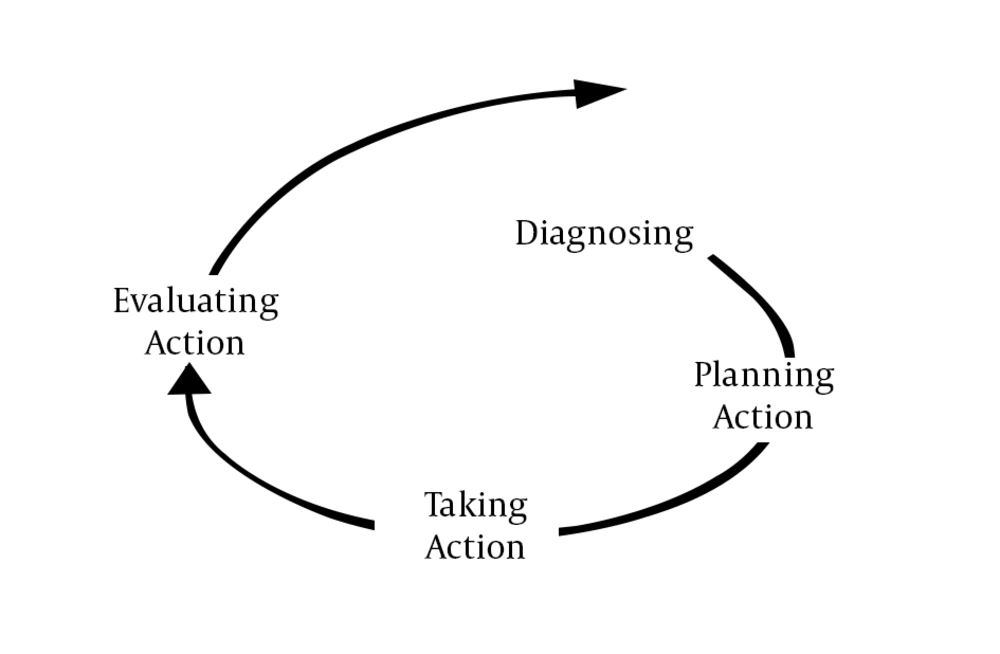
Figure 1.
Action research diagram in continuous phases (Elden and Levin 1991).
This process was monitored step by step and continued through different stages with different mechanisms (28).
3.1. Diagnosing
In the first stage, the researcher was concerned about the students' learning satisfaction with the e-learning paradigm due to the weakness of collaboration and interaction in this sphere. According to the 5E model, learning through inquiry follows five phases: Engagement, exploration, explanation, elaboration, and evaluation. Following the 5E model, an inquiry started with engaging and motivating students. Depending on the teachers’ choice, questions to be investigated can be propounded or developed together with the learners (29). This concern led the researcher to employ an LMS to develop a flipped classroom to examine how it can encourage further interaction and collaboration in the virtual space. In summary, the researchers aimed to investigate the following objectives: (1) leading factors of interactive learning in an e-flipped classroom; (2) restrictive factors of interactive learning in an e-flipped classroom; (3) the impact of the e-flipped classroom on students; (4) students' learning satisfaction with an e-flipped classroom.
Researchers selected forums for this purpose since they are effective offline tools to encourage collaboration (30, 31). Mohammad et al. showed that learners preferred discussion rooms to text chats and online interaction (32). It requires less time and cost for learning compared to online instruction. Those attending discussion rooms can choose the time and location of learning and have more freedom and independence to learn (33).
3.2. Planning Action
E-content, including the course's main subjects, was prepared and delivered to students via customized LMS in program planning. NAVID is a national and commercial learning management system under the license of the authors' university launched in 2010 (http://sbmunavid.vums.ac.ir/). Students were encouraged to study the content and then attend the virtual forum to discuss challenging and attractive pre-designed projects based on course critical points. Finally, the instructor concluded discussions and presented the main practical points of the subject. We employed a purposive sampling approach to select participants, including 12 Master students of e-learning in medical science who contributed to this research in two subsequent semesters. It was one of the main courses with two credits. Since this course is a prerequisite for many other courses, it was necessary for the students to fully understand the concepts of e-learning and apply them in solving problems in this area. What bothered the researcher was the skepticism about the effectiveness of combined learning. The success of blended learning is strongly influenced by how it is implemented and what can be done to increase the effectiveness of this approach. Although the NAVID LMS has features such as uploading electronic content and teaching resources and discussion and message rooms, during these years, its discussion room has not been used widely, and only student interactions with the teacher have occurred through messages, and the discussion room or forum has been used only in specific topics of the course rarely. Since the discussion of interactions is critical in e-learning, it was decided to use this course thoroughly.
3.3. Taking Action
Following the third phase of the Levin Model, the research was approved by the university research committee under the ethical code of IR.TUMS.VCR.REC.1397.989. Students were informed of the study procedure and freely participated in interviews or filled out the questionnaire. They gave written consent to participate. Learning materials, including papers, books, podcasts, lesson plans, and e-learning timetables, were uploaded to the LMS at the beginning of the semester. Each subject was assigned to a student who would ask a scenario-based question relevant to the professional field and select a suitable solution after collaborating with other students within LMS. The teacher approved scenarios before the flipped classroom. At the beginning of the session, the lecturer explained the subject's objectives in the forum. Then, the assigned student answered the others' questions under the lecturer's supervision. Next, several questions were asked from the students based on the relevant projects to motivate participation. Following each session, lasting two to 12 hours in one working day, the lecturer summarized and presented the abstract of essential discussions. Overall, 12 forums were handled in one semester. The lecturer was the observer of the forum and investigated students' participation quantitatively and qualitatively. In the middle of the semester, some peers observed the panel and investigated forums randomly from different perspectives, including the number and the concept of communications.
3.4. Evaluating Action
Relevant data were collected and analyzed with qualitative and quantitative methods to evaluate the intervention.
3.5. Data Collection
This research implemented a mixed research approach to achieve a detailed description of the participants' experiences, attitudes, and perceptions towards interactive e-learning. Semi-structured interviews were held to extract individuals' perceptions of what they experience (34). Interviewing is generally an effective way of understanding the experiences and meanings people attach to them. Interviews allow participants to express more detail and depth. A learning satisfaction questionnaire and a visual chart were employed for the quantitive phase. Researchers interviewed students at the middle and end of the semester. Nine students participated in interviews. Individual semi-structured interviews were held for data collection. In this research, some interviews were repeated because the researcher was looking for opportunities to understand different dimensions or seek clarification or additional information about issues raised in earlier interviews. Total interviews lasted 42 hours and 20 minutes. Interviews were recorded and transcribed by the researcher. There was an interview guide that included four questions on the desired concept. The questions were as follows: (1) explain your experience of the e-flipped program conducted in your course; (2) What did you like about the program? What are the positive points of the program from your perspective? (3) What problems did you have with accessing and studying e-content and participating in discussions in the virtual forum? (4) Can you please explain how satisfied you were with your e-flipped course compared to your other courses?
A standard satisfaction questionnaire with a five-point Likert scale was applied to evaluate the research quantitatively. This questionnaire included demographic data, satisfaction assessment, and some open questions. The satisfaction assessment included 37 questions evaluating technical and structural issues, learner concerns, content and lesson plan matters, and support and general satisfaction. Cronbach's alpha coefficient of this questionnaire was 0.83. Moreover, a visual scale was developed to evaluate students' learning satisfaction with the program. It was a vertical line, divided into four parts, numbered 1 (lowest satisfaction) to 5 (highest satisfaction).
3.6. Data Analysis
Interviews were analyzed using the thematic analysis approach. All interviews were recorded and then transcribed verbatim for further analysis. The analysis was performed by summarizing the meaning units and converting them into codes, subcategories, and categories via Graneheim and Landman's content analysis approach. Data analysis was performed with Atlas ti7 software.
3.7. Trustworthiness
In this study, the credibility of qualitative findings was ensured by using member check and immersion techniques and the ongoing engagement of the researchers with the data. To examine the transferability of the findings, in addition to individual interviews, two focus groups of five and six students who were not interviewed individually were asked about the consistency of the findings with their experiences. The quantitative data were analyzed using the one-sample t test. The p value of 0.05 was considered significant in SPSS 22.
4. Results
This research employed a mixed-method design using questionnaires and interviews. The results of each part are reported separately.
4.1. Statistical Analyses
Questionnaires were distributed among 12 students, 10 with responses (response rate 83%). The participants included 37.5% males and 63.5% females, and all were married and employed. They were mostly under 40 years old (80%), lived in owned houses (75%), and had easy access to a computer (75%). They were all skillful to a moderate extent in using Microsoft office word (55.56%), the internet (66.7%), and Windows (55.6%). Besides, 37.5% of the students were familiar with the PowerPoint skill to a great extent. Table 2 displays detailed demographic information of participants. The questionnaire was designed with five subscales: Technical and structural issues, learner, content and lesson plan, support, and general satisfaction. Students reported significant satisfaction in all five subscales. Table 1 shows the results of the subscales. The only parameters that students were relatively dissatisfied with were access to a computer when they needed it (P = 0.111) and the easy use of the e-learning system (P = 0.244).
Table 1.
Significance and Mean Value of Questionnaire Subscales
| Subscales | Test Value = 3 | |
|---|---|---|
| Sig. | Mean | |
| Technical and structural | 0.000 | 4.1750 |
| Learner | 0.000 | 3.9636 |
| Content and lesson plan | 0.000 | 4.0931 |
| Support | 0.000 | 4.1857 |
| General satisfaction | 0.000 | 4.4000 |
Most students were highly (37.5%) or very highly (37.5%) satisfied with the flipped classroom, and none of them was dissatisfied. There was a significant correlation between students' satisfaction with the flipped classroom and their familiarity with PowerPoint (one-sample t test P < 0.05). No significant correlation was revealed between students' satisfaction with the flipped classroom and their age, living conditions, computer access, and software skills, except for PowerPoint skills. Tables 2 and 3 provide further information about students' satisfaction. Students explained easy access to resources and the lecture, enhanced learner' self-regularity, group discussion, interactions, and further supervision of the lecturer as the positive aspects of this system. However, they were dissatisfied with some features of the e-learning platform, such as the lack of an online voice chat option, the need to refresh the page to see new threads, and low-speed internet. They also mentioned the difficulties confronting the students who lacked enough skill to work in the new sphere.
Table 2.
The Percentage of Participants' Satisfaction in the Flipped Classroom and Virtual Learning
| Variables | Flipped Classroom | Virtual Learning (Without Interaction) |
|---|---|---|
| Satisfaction | ||
| Not at all | 0 (0) | 0 (0) |
| Low | 0 (0) | 0 (0) |
| Moderate | 2 (25) | 1 (16.7) |
| High | 3 (37.5) | 3 (50) |
| Very high | 3 (37.5) | 2 (33.3) |
| Mean (SD) | 0.835 | 0.753 |
Table 3.
Correlation Between Participants' Satisfaction with Flipped Classroom and Demographic Parameters
| Variable | Age | Living Condition | Computer Access | Familiarity with MS Word | Familiarity with the Internet | Familiarity with Windows | Familiarity with PowerPoint | |
|---|---|---|---|---|---|---|---|---|
| Satisfaction with the flipped classroom | Pearson Correlation | 0.316 | -0.540 | -0.167 | 0.033 | -0.033 | -0.234 | -0.853* |
| Sig. | 0.445 | 0.211 | 0.721 | 0.937 | 0.937 | 0.577 | 0.015 | |
4.2. Qualitative Analyses
The pedagogical and motivational factors and LMS features enhance learning through an interactive e-learning system.
4.3. Pedagogy
Students believed that interaction, collaboration, independent learning opportunities, feedback facilitation, and learner-centered activities through the e-flipped teaching and learning method constituted the pedagogical requirements of an effective training system. One student said:
“Using this system, we could interact and collaborate with the lecturer and other students easily.”
4.4. Motivation
This method also motivated learners by changing the learning procedure and affecting students' learning styles and perspectives. One student explained:
"This method changed our perspective on learning. We perceived that we should explore deeper."
4.5. LMS Features
Similarly, the LMS features provided further opportunities for students to interact with learning materials and enhance learning. Ease of access to learning materials and lesson plans any time, anywhere, and being aware of objectives and evaluation methods were found by students positive about the system. One student mentioned:
"It is amazing to access learning materials any time you want. You are not restricted to time or place to access resources."
However, some individual factors, infrastructure defects, and ethical limitations may restrict the effectiveness of the e-learning system. Individual factors such as students' time limitations and inadequate mastery of class management diminished the effectiveness of the e-learning approach. One student complained:
"We are not old enough to manage our time and way of study! Sometimes we lose time, and this lack of control is annoying."
Moreover, the LMS deficiencies negatively impacted the effectiveness of the interactive method conducted in this research. Students were dissatisfied with the lack of technical support, network disconnections, the lack of audio communication through the LMS, the lack of verification of student attendance, and the lack of direct reply features in the discussion room. One student said:
"In the virtual sphere, you need technical support. When you can't access resources, or the LMS fails, you need somebody to help."
Further, students were unaware of cyber ethical rules, and there was no obligation to follow the rules. One student quoted:
"As a student, I don't know what the rules of cyberspace are and how we should prevent plagiarism in this space."
The interactive e-learning method in this research resulted in students' individual and educational achievements. From the individual point of view, students experienced exploratory learning, self-efficiency, satisfaction, communication skills development, motivation, involvement in the learning process, taking the responsibility of learning, pleasant feeling, further interaction, feeling of being in class, and studying during the semester not just before the exam. Educational achievements included academic progress, educational and cognitive skills improvement, and deep learning due to reviewing the content. Table 4 demonstrates some student quotes about each of these factors.
Table 4.
Examples of Meaning Units, Codes, Subcategories, and Categories
| Category, Subcategories and Codes | Meaning Unit |
|---|---|
| Learning satisfaction | |
| Individual achievements | |
| Exploratory learning | As the teaching method was based on predetermined projects, I think it revived the scientific argument and exploratory learning. |
| Self-efficiency | I am happy to help myself to learn. |
| Satisfaction | I enjoyed interactions through this method. It is pleasant to connect with your friends from far away and share your knowledge. |
| Communication skills development | Both real and virtual learning environments require communication skills, each in its own way. |
| Motivation | Higher education students generally are motivated to learn; otherwise, they don't start education. Since this method is student-centered, it enchases motivation. |
| Involvement in the learning process | Projects involve you practically in discussions and encourage you to answer. |
| Taking the responsibility of learning | The lecturers evaluate discussion, and students are responsible for what they say, so they should not say something irrelevant. They should provide reason and reference for what they say. |
| Pleasant feeling | Curiosity and motivation in this method make me happy. While you are happy, you enjoy. |
| Further interaction | Participating in forums provides further interaction with the lecturer and friends in cyberspace. |
| The feeling of being in class | Although you are far from your friends and class environment, weekly interaction through the system makes you feel close to your friends. |
| Studying during the semester, not just before the exam | Participating in the forum makes you study before; otherwise, you cannot answer questions. |
| Educational achievements | |
| Academic progress (good final grades) | When students have to study each week to participate in the forum, they feel less pressure during exams. Consequently, they get better results. |
| Cognitive and metacognitive skills improvement | I think studying in cyberspace enhances cognitive and metacognitive skills. Discussing empirical subjects improves students' ability to analyze. |
| Deep learning | When students have to study learning materials several times and be involved further with resources, they learn deeper. |
5. Discussion
This research showed a high level of satisfaction with the e-flipped approach among students. Many studies reported student satisfaction with flipped classrooms (35, 36). However, the present study is different since it developed the flipped classroom in the virtual space.
The e-flipped strategy followed in this study impacted students individually and educationally. From the individual point of view, this method encouraged discovery learning due to its problem-based nature. It enhanced students' self-efficiency, communication skills, motivation, engagement with the learning process, and responsibility for learning. All of these cases were self-reported by the students via completing a questionnaire. The researcher also verified the interaction between the lecturer and the students or between the students by looking at the course panel, forum, and message section. Receiving feedback from the lecturer and peers in the e-flipped classroom may develop self-efficacy (35). Chen et al. (36) and Mohammadimehr and Mirmoghtadaie (37) reported that the discussion environment through the forum was pleasant and less stressful for them. However, it puts further responsibility on students for their learning.
From the educational point of view, weekly discussions about critical points of the course helped students become more comfortable for their final exam. Additionally, discussing empirical problems fostered deep learning and cognitive and metacognitive skills development, such as analyzing practical problems and finding solutions (12).
The success of an e-flipped classroom depends on many factors, while there are limitations that negatively impact the effectiveness of this method. This study indicated that three leading factors could enhance interactive learning via flipped classrooms. These include pedagogical, motivational, and LMS parameters. However, individual and infrastructures limitation and ethical factors may harm the success of an inverted class program.
Pedagogic factors, such as effective interactions, collaboration, feedback, learner-centered, and independent learning, were found positive by students about the e-flipped method conducted in this study. These results are in line with many other studies (2, 16-20) showing the effectiveness of flipped classrooms due to the opportunity provided to develop and enhance collaboration and interaction between lecturers and students.
We further demonstrated that the strategies we implemented in the flipped classroom, such as discussing empirical problems, could change the students' learning procedure, learning style, and perspectives and consequently affect their motivation. Active learning practices, like discussions, practical case studies, teamwork, and self-reflection, can enhance students’ engagement while motivating them to improve their skills and knowledge (38).
The last leading factor we found was the opportunities that the LMS provided, such as easy access to learning materials and resources, lesson plan, objectives, and evaluation methods. The LMS supports lecturers and educational institutes to run course administration and delivery using e-learning tools. Flexible access to learning materials through LMS is the key to web-based instruction (39). However, individual limitations may confine the benefits of a flipped method. Time limitations and inadequate mastery of class management are parameters restricting the effectiveness of the flipped class strategy. These are challenges reported in many other studies (40).
Another vital factor that negatively influences the e-flipped program efficiency is infrastructure deficiencies. These include both the LMS characteristics and network limitations. The lack of technical support, system failure, lack of voice communication through the forum, non-verification of the student's attendance in the forum, and lack of direct answer to any student question through the forum might have reduced students' satisfaction with the e-flipped method. Finally, ethical factors such as the lack of awareness of cyber ethical rules and obligations to follow the rules threaten the legal use of the e-learning sphere.
Congruent to other studies in the field of collaborative e-learning, the results highlight the importance of pedagogy, technology learners, and lecturers' attitude and support (26, 41, 42) in improving the effectiveness of an e-learning program. Further, the level of students' skill and knowledge to use the e-learning system and how self-efficient they are can significantly impact their satisfaction with an e-learning system and, consequently the program effectiveness (43).
This research aimed to measure students’ satisfaction in terms of interactions in an e-learning platform. We aimed to change the attitude of students and teachers who think that e-learning is not efficient and effective. We showed that the teacher's approach determines satisfaction rather than the type of training or platform used.
5.1. Conclusions
This study explains how an LMS tool, forum, can be used to develop an e-flipped classroom. The interaction within this platform, self-efficiency, communication skills development, involvement in the learning process, being responsible for learning, pleasant feeling, positive energy, less stress, the feeling of classroom presence, educational and cognitive skills improvement, and deep learning were what students liked about this program. However, they reported a couple of problems related to the LMS and students' limitations. This study is an example of how LMS tools can be used to simulate actual face-to-face educational approaches, such as flipped classrooms, in an e-learning environment. A limitation of this study is the few numbers of participants. It is proposed to investigate the e-flipped teaching approach with more students.