
1. Background
Remarkable innovations and advances have been made in the field of information technology over the past decade, as such technology, as a valuable part, is intertwined with the education process. In this new millennium, students are more dependent on information technology and less tolerant of conventional educational patterns. In other words, students’ needs and expectations from educational systems have changed (1).
The flipped classroom is an alternative educational approach focusing on student-centered teaching methods that keeps the traditional classroom environment in reserve. It has recently gained much more attention and is widely approved in higher education (2). The flipped classroom is a learning environment providing a variety of tools for students to offer basic knowledge as part of their homework to be prepared for classroom meetings. With the learned content as the class prerequisite, teachers then spend the class time more effectively to present tasks and encourage students to do lesson practices. In the flipped classroom, students learn basic content before the class in the form of instructional videos, recorded lectures, readings, podcasts, and so on. Teachers then spend the class time applying the curriculum by using complex issues and addressing deeper concepts and interaction between students (3). This model allows learners to be engaged in instructional materials independently based on their own time and speed, and the focus of this transition is converted from the instructor to the learner to promote active learning and problem-solving (4).
The flipped classroom teaching model can be an ideal ground to turn traditional teaching into a problem-solving learning environment. Problem-solving learning is a teaching method, in which students are engaged in meaningful activities, and the teacher, instead of exhibiting facts or simple, obvious solutions to a problem, engages students in the process of discovering concepts and their applications by presenting well-constructed problems. Students are also assigned some tasks to solve problems, make guesses, do experiments, and exhibit creativity, efficiency, and their relationship (5, 6). The flipped classroom model provides an opportunity to make educational changes in classroom content because of the following reasons: (1) This model offers a way of rethinking the learning and educational processes, (2) The teacher can act as a learning designer, and (3) Flipped classroom activities can be determined by ideas such as student-oriented learning and active learning, as well as theories such as self-determination (7).
The self-determination theory raises three dimensions of competency, autonomy, and relatedness, depending on students’ needs (8). Narendran et al. (9) argue that these three psychological needs promote learners’ participation. In contrast, when the teacher, as part of the learners’ external environment, imposes much more control over the learning process, learners’ sense of autonomy and competency decreases. On the other hand, teachers encourage and support their learners in active learning environments and promote their autonomy when these learners do well what they have learned independently. The feeling of competency is also aroused by positive feedback regarding the improvement of learners’ thoughts and skills in a meaningful and specific form during teamwork. Communication also exhibits a sense of belonging to a social group, and students may experience communication at higher levels and provide greater opportunities to meet their needs during participatory learning activities in small groups (7).
2. Objectives
Given the significance of variables such as problem-solving learning and self-determination, the present study aimed to compare the effectiveness of flipped teaching and traditional teaching in problem-solving learning and self-determination among female university students.
3. Methods
The research method was experimental with a pretest-posttest design and a control group. The statistical population included all female students of Farhangian University in Ahvaz city in the academic year 2019. Using a purposive sampling method, 36 students were selected and randomly divided into experimental and control groups (n = 18 per group). The pretest and posttest were performed in both experimental and control groups before and after the intervention, respectively. The inclusion criteria were being a fresh woman, taking the statistics course, familiarity with virtual networks and the Internet, and willingness to participate in the study. The exclusion criteria were being absent from more than one session during the semester and incomplete questionnaires. In the present study, the researcher adopted the traditional and flipped statistics classroom approaches.
3.1. Procedure
The flipped classroom was organized, as follows:
1- Pre-classroom phase: In this phase, group teaching in the classroom was converted into individual teaching at home. The students watched the class electronic content from the statistics book in each session, as specified by the instructor, and answered the four-choice questions selected from the same content. To answer the questions, students were allowed to watch and read the electronic content whenever they wished and learn taught content tailored to their own learning pace.
2- Attendance in the classroom: In the classroom, the instructor offered a brief review of the electronic content and provided students with additional explanations. Then, the instructor discussed the given four-choice questions and removed ambiguities. In the classroom, the instructor also formed groups of three or four (students could select their groupmates) and presented the questions extracted from the statistics book to the groups to be discussed in groups. When the students were doing exercises, the instructor was walking around the classroom to answer the students’ questions with the help of their groupmates. The experimental group received eight sessions (120-min sessions per week) of the flipped teaching method.
The traditional classroom was organized, as follows:
In the traditional classroom, the lesson was lectured, and the course instructor presented the materials and exercises in PowerPoint slides. The students in the classroom often listened and took notes. In the classroom, there were some exercises and discussions about the book content, for which there was often no enough time to do them; hence, the students were supposed to do them at home. The traditional training programs were also conducted in eight 120-min sessions once a week.
3.2. Research Instruments
Problem-Solving Inventory (10): This 35-item questionnaire was scored based on a six-point Likert scale ranging from 1 (strongly agree) to 6 (strongly disagree) and encompassed three subscales: Problem-Solving Confidence (11 items), Approach-Avoidance Style (16 items), and Personal Control (eight items). In this questionnaire, 15 negatively-worded items (scored reversely) were included to avoid bias in responses. The total score of the questionnaire was obtained from the sum of the scores for all the responses, ranging from 35 to 210. The higher scores in this scale indicated a lack of familiarity with problem-solving skills and inability in this skill, while the lower scores indicated further familiarity with problem-solving skills. Rastgo et al. (11) reported Cronbach’s alpha coefficient of 0.84 for the whole questionnaire. In a study, Azarbarzin and Maleki Lootaki (12) reported Cronbach’s alpha coefficient of 0.88 for the reliability of this questionnaire. In the current study, the Cronbach’s alpha coefficient for the whole questionnaire was obtained as 0.84.
Basic Psychological Need Satisfaction: This questionnaire was developed by La Guardia et al. (13) and consists of 21 items, scored on a seven-point Likert scale ranging from "completely false" to "completely true". This scale measures three subscales of autonomy (seven items), competency (six items), and relatedness (eight items). The scores of each subscale ranged from 7 to 49, and the total score was obtained by adding the scores of all the items. A higher score on each scale indicated a higher level of satisfaction. Arfaa Baluchi et al. (14) reported Cronbach’s alpha coefficient of 0.88 for the questionnaire. Deci et al. (15) reported Cronbach’s alpha coefficient of 0.83 for the reliability of this questionnaire. In the present study, Cronbach’s alpha coefficient was 0.80 for the questionnaire.
3.3. Statistical Analyses
Data were analyzed by descriptive and inferential statistics such as mean, standard deviation, multivariate analysis of covariance (MANCOVA), univariate analysis of covariance (ANCOVA), and Bonferroni post hoc test. Cronbach’s alpha was calculated to determine the reliability of the questionnaires. SPSS version 22.0 was used for analyzing the data.
4. Results
The posttest scores (mean ± SD) of problem-solving learning and self-determination were 83.77 ± 14.17 and 119.33 ± 13.79, respectively, in the experimental group, which were significantly different from those of the control group. Table 1 presents the mean and Standard Deviation (SD) of studied variables in the experimental and control groups in the pretest and posttest.
Table 1.
Mean and Standard Deviation of Dependent Variables in Experimental and Control Groups in Pretest and Posttest
| Variable | Experimental Group (Mean ± SD) | Control Group (Mean ± SD) |
|---|---|---|
| Problem-solving | ||
| Pre-test | 82.00 ± 19.25 | 83.77 ± 15.31 |
| Post-test | 83.77 ± 14.17 | 87.77 ± 15.57 |
| Problem-solving confidence | ||
| Pre-test | 28.22 ± 7.05 | 29.16 ± 7.94 |
| Post-test | 26.88 ± 6.44 | 29.72 ± 8.10 |
| Approach-avoidance style | ||
| Pre-test | 44.22 ± 7.16 | 43.44 ± 6.47 |
| Post-test | 37.27 ± 7.60 | 43.33 ± 7.60 |
| Personal control | ||
| Pre-test | 14.50 ± 4.99 | 15.88 ± 3.44 |
| Post-test | 13.16 ± 4.43 | 15.22 ± 4.25 |
| Self-determination | ||
| Pre-test | 101.11 ± 15.46 | 108.33 ± 14.26 |
| Post-test | 119.33 ± 13.79 | 108.22 ± 14.24 |
| Autonomy | ||
| Pre-test | 32.22 ± 6.05 | 33.89 ± 6.16 |
| Post-test | 37.22 ± 7.38 | 34.88 ± 7.60 |
| Competency | ||
| Pre-test | 30.16 ± 6.02 | 31.83 ± 6.16 |
| Post-test | 34.22 ± 6.42 | 32.44 ± 5.58 |
| Relatedness | ||
| Pre-test | 38.66 ± 6.00 | 42.77 ± 6.69 |
| Post-test | 47.66 ± 4.33 | 41.38 ± 5.22 |
Before analyzing the data, the assumptions of the present study were examined by the analysis of covariance. In this regard, data normality, resulting from the insignificant Kolmogorov-Smirnov Z statistic, showed that problem-solving and self-determination scores followed a normal distribution. The results of Levine’s test for the homogeneity of variances in the dependent variable components revealed that the variance of components did not differ significantly between the two groups. The results of the box test, which was used to examine the equality of the covariance matrix for the dependent variables in the groups, also showed that the covariance matrix of the dependent variables was similar in the two groups (P < 0.745, F = 0.282, BoX M = 0.845). The results of the Chi-square test and Bartlett’s test to evaluate the sphericity or significance of the relationship between the problem-solving components revealed the significant relationships between these variables (P < 0.020, df = 2 and χ2 = 6.89).
After meeting the assumptions of multivariate analysis of covariance, the test results indicated a significant difference between the two groups in problem-solving (P = 0.00, wilk’s lambda = 0.123) and self-determination (P = 0.00, wilk’s lambda = 0.228) components, as shown in Table 2.
Table 2.
Wilks’ Lambda and Partial Eta-Square of Studied Variables
| Variables | Wilk’s Λ | df1 | df2 | F | P | Partial η2 | Power |
|---|---|---|---|---|---|---|---|
| Problem-solving | 0.123 | 28 | 48 | 3.17 | 0.000 | 0.523 | 1.00 |
| Self-determination | 0.228 | 28 | 48 | 3.17 | 0.000 | 0.523 | 1.00 |
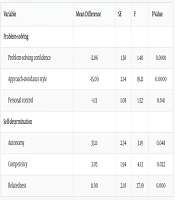
According to Table 3, the F-values were significant for problem-solving confidence (F = 1.48) at P= 0.0001, approach-avoidance of problem-solving activities (F = 19.21) at P = 0.0001, and personal control during solving problems (F = 1.52) at P= 0.041. The mean scores in problem-solving confidence (-2.06), approach-avoidance of problem-solving activities (-15.00), and personal control during solving problems (-1.13) were smaller in the experimental group than in the control group. The F-values were significant for autonomy (F = 3.19) at P = 0.048, competency (F = 1.94) at P = 0.022, and relatedness (F = 2.18) at P = 0.000. The results also indicated that the mean scores of the experimental group were larger than those of the control group concerning competency (3.05), autonomy (33.11), and relatedness (11.90).
Table 3.
Mean Difference of Posttest Scores of Variables in Experimental and Control Groups
| Variable | Mean Difference | SE | F | P-Value |
|---|---|---|---|---|
| Problem-solving | ||||
| Problem-solving confidence | -2.06 | 1.38 | 1.48 | 0.0001 |
| Approach-avoidance style | -15.00 | 2.14 | 19.21 | 0.0000 |
| Personal control | -1.13 | 1.08 | 1.52 | 0.041 |
| Self-determination | ||||
| Autonomy | 33.11 | 2.34 | 3.19 | 0.048 |
| Competency | 3.05 | 1.94 | 4.13 | 0.022 |
| Relatedness | 11.90 | 2.18 | 27.19 | 0.000 |
5. Discussion
The present study aimed to investigate the effectiveness of flipped and traditional teaching methods in problem-solving learning and self-determination among female students. The research findings indicated a significant difference between the mean scores of problem-solving learning in the two flipped and traditional teaching groups, suggesting that problem-solving learning was better in the flipped group than in the traditional teaching group. This finding is consistent with the research results by Kavianii et al. (4), Hmelo-Silver, (6), Narendran et al. (9), Love et al. (16), and Syakdiyah et al. (17). A large number of studies have examined the positive effects of the flipped classroom on problem-solving learning, promoting students’ learning motivation (18), enhancing their participation (16), developing critical skills (19), promoting self-learning skills (17), and developing participatory skills (6). Previous research has also examined the effectiveness of the flipped classroom model on students’ self-determination. Muir (20) and Zainuddin and Perera, (21) documented that the flipped classroom had some effects on students’ self-determination and promoted their motivation and participation.
The Kheirabadi findings (22) revealed that the flipped classroom promoted students’ satisfaction and motivation and optimized the teaching process in terms of time management and avoidance of repetitive and exhausting processes. Joshaghan Nejhad and Bagheri, (23) reported that the flipped classroom is more efficient than traditional education if the grounds for its implementation are provided. Piri et al. (24) suggested that flipped teaching could have a significant effect on self-directed learning, as the posttest mean scores of self-directed learning were higher among students taught by the flipped classroom technique. According to Bahmani et al. (25), students in the flipped classroom participated in activities that were related to English practice and homework.
In this regard, it can be argued that the learners in the flipped teaching group adopted active learning strategies and had group interactions under the supervision of the instructor to do the exercises, and the instructor devoted all the class time to the practices and advanced discussions. In this case, if the students had any difficulty in doing their homework, in addition to receiving help and support from their instructor, they relied on their peers to consult and find out logical solutions. The flipped teaching group had learned the topics to be taught out of the class time, and the instructor devoted the class time to face-to-face teaching, implementation of concepts, facilitation of students’ engagement, and more advanced exercises.
In the flipped classroom, problem-solving learning is an educational technique applying learning in a complex problem-solving structure. This provides students with opportunities to detect the connection between their acquired knowledge and the specific problem at hand. This made them ask what they needed to know. In the flipped classroom, problem-solving learning provided students with the potential to become reflective and flexible thinkers using their knowledge to act. Problem-solving learning activities in the classroom promotes the students’ understanding of the content and simultaneously encourages them to be more engaged in their activities. Furthermore, this technique challenges the students to explore solutions to real-world problems and prepares them for critical thinking and the appropriate use of learning resources. According to Oliveira Fassbinder et al. (7), the main idea behind problem-solving learning is that the learning process should be started with a problem or a puzzle in which the student is interested and willing to solve.
The findings also suggested a significant difference in the mean scores of the components of self-determination between the two flipped and traditional teaching groups. This finding is consistent with the research results by Oliveira Fassbinder et al. (7), Sergis et al. (8), Narendran et al. (9), and Zainuddin and Perera (21). The flipped classroom provides a flexible and student-oriented learning environment, thereby improving learners’ autonomy and teaching them to learn independently at their own pace. Accordingly, this technique makes the students search their knowledge independently, do not always rely on their instructor, and have a higher motivation to interact with peers, and engage in their learning process. Three psychological needs (namely autonomy, competency, and relatedness) in a learning-oriented environment such as the flipped classroom encourages students’ learning activities and determines the levels of their effort, activity, attention, and concentration. In the flipped classroom group, the students also had higher confidence and competency when participating in class activities since, before coming to the classroom, they had studied the lesson content, were prepared, did the learning activities meaningfully, reflected on them, and had opportunities for self-learning. McLean and Attardi (26) believe that this model provides a learning environment focusing on interaction between students, between students and instructors, and between teaching and learning. This technique, as a student-centered approach, further monitors students’ learning activities such that both students and instructors are in charge of learning.
5.1. Conclusion
According to the study findings, flipped teaching had a significantly positive effect on students’ problem-solving learning and self-determination. The flipped classroom is a model that exposes students to challenging situations and problem-solving processes and strengthens active and student-oriented strategies to make students improve their performance during learning interactively and independently by relying on the ones’ abilities and understanding of their competencies. Accordingly, it is proposed to hold training courses for professors and students in terms of the flipped classroom, its significance, and its impacts on learning and teaching, and how to implement this technique. Given that the majority of the students in humanities are accustomed to the traditional lecturing and teaching methods and are not familiar with the flipped teaching method, they may not be prepared to accept this technique; therefore, it requires teachers in this field to be patient and flexible and pose more control over students’ performance in the first weeks of the flipped classroom. Furthermore, the flipped classroom requires devices such as computers, flash memories, high-speed internet, and other digital devices and the teachers should be ensured of the availability of these devices before the class. A flipped classroom can also be accompanied by some problems since this technique is underpinned by the teacher’s ability, incentives, and attitudes. Accordingly, more than one teacher is required for the flipped classroom, who must be aware of all the learning needs of the students and meet them.