
1. Background
Researchers have recommended interprofessional education (IPE) as a solution to poor communication and inadequate collaboration in patient care (1, 2). Collaborative practice refers to health workers from different professional backgrounds working together to provide comprehensive care to patients, families, and communities.
The WHO report on IPE and collaborative practice indicates that IPE enables effective collaborative practice, better prepares the healthcare workforce, and improves patient outcomes. One way educators can incorporate IPE into the classroom is through forum-style interprofessional simulation-based education (ISBE), an interactive improvisational technique that helps participants engage in both reflection-in-action and reflection-on-action (3).
Forum-style ISBE is based on forum theatre and involves a facilitator/joker, the actor(s), and learner/spect-actors (3). The actors present a familiar but unacceptable scenario, known as an antiplay (4). The facilitator invites learners, through questioning and guided exploration, to suggest how the scenario can be improved (3, 5). Actors or learners then enact these suggestions (3). Participants continue this process as an ongoing dialogue until the scenario is concluded. Engaging in critical thinking through realistic scenarios develops participants' communication skills (3). The interactive and collaborative nature of this approach encourages active listening, empathy, ethical reasoning, conflict resolution, navigation of differing perspectives, and management of challenging situations. Therefore, forum-style ISBE is a strong candidate for improving collaboration (3).
2. Objectives
The purpose of this project was to assess whether forum-style ISBE could improve health professions students' (HPS) attitudes toward collaboration.
3. Methods
3.1. Study Design and Participants
A quasi-experimental study was conducted among students in nursing, dietetics, and speech-language pathology (SLP) programs. Inclusion criteria were enrollment at Indiana University of Pennsylvania, age 18 years or older, and enrollment in classes participating in the required 75-minute forum-style ISBE experience. This study used a nonrandomized, single-group pretest-posttest quasi-experimental design to evaluate the impact of a required forum-style ISBE experience on health profession students, without a concurrent or historical control group.
Students (n = 41) were approached to participate in the study at the beginning of their required ISBE experience. All students consented to have their data included. No students who initially provided consent withdrew from the study; however, 3 students failed to submit the posttest form because of an administrative error unrelated to their performance or study outcomes. These data were considered missing completely at random, and the corresponding pretests were excluded from the analysis because matched pretest-posttest pairs were unavailable, resulting in a final analytic sample of n = 38.
3.2. Instrument and Intervention
Using a single-arm pretest-posttest sequence, students completed the Jefferson Scale of Attitudes Toward Interprofessional Collaboration (JeffSATIC) at the beginning of the required simulation session. The JeffSATIC is a 20-item, 7-point Likert-type scale with a score range of 20 - 140 that measures attitudes toward collaboration among HPS and practitioners; higher scores indicate a greater orientation toward teamwork and collaboration (6). The JeffSATIC was used with permission from Thomas Jefferson University.
Immediately after completing the pretest, students participated in a forum-style ISBE intervention delivered during a single 75-minute class session. The intervention began with a warm-up facilitated by a faculty member with a background in forum theatre, intended to help students become comfortable interacting with one another and to enhance communication. Next, a faculty-developed antiplay was performed by 3 theatre students who had been briefed on the scenario in advance. The scene portrayed a team-based conflict in which an SLP identifies prohibited thin liquids in a patient's room and confronts the dietitian and nurse; both deny responsibility, leaving the issue unresolved.
The faculty facilitator asked students to reflect on whether the situation was realistic and to identify the conflicts. Students were then separated into groups of 3 and given a copy of the script to role-play alternative interaction strategies. After 10 minutes, students returned for a large-group enactment of their revised scenarios, one at a time, with facilitator-guided discussion prompting further suggestions for improving the situation. These suggestions were implemented immediately and then reanalyzed. A structured debrief followed, focusing on key takeaways, unsuccessful versus successful communication strategies, and team roles. Immediately after the debriefing, students completed the JeffSATIC again as a posttest measure. Pretest and posttest responses were linked at the individual level for analysis. No follow-up assessments were conducted beyond the immediate postintervention time point.
3.3. Ethical Considerations
The Indiana University of Pennsylvania Institutional Review Board approved this study. Although participation in the simulation and completion of the JeffSATIC were required as part of a class activity, only data from consenting students were included in the study. Students were provided with a digital consent form that was read aloud and signed before they completed the JeffSATIC survey. If students answered "no" to providing consent, the JeffSATIC questions were bypassed, and they were taken to the end of the digital survey. No grades were assigned for JeffSATIC completion, and faculty members teaching the participating classes were unaware of which students provided consent. Accepting or declining consent did not affect students' course standing. The primary investigator, Olivia Jean Gambill, and faculty member Dr. Pao Ying Hsiao were the only individuals with access to consent status; neither was responsible for assigning student grades.
3.4. Statistical Analysis
Descriptive statistics were used to characterize demographic variables. Wilcoxon signed-rank tests were used to assess differences in linked pretest-posttest JeffSATIC ordinal scores. Rank biserial correlation was used to quantify the effect size between scores. Statistical tests were performed using jamovi version 2.6.26, with statistical significance set at P < 0.05 (7).
4. Results
Of all participants (n = 38), 76.3% were female (n = 29) and 23.7% were male (n = 9), with most participants aged 20 - 22 years. Participants were primarily enrolled in nursing (50.0%, n = 19), followed by dietetics (39.5%, n = 15) and speech-language pathology (SLP; 10.5%, n = 4).
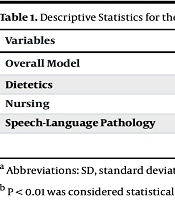
Median total JeffSATIC scores increased significantly from 112/140 at pretest to 120/140 at posttest (P = 0.008) (Table 1). The corresponding effect size was moderate (rrb = 0.498). Improvements in JeffSATIC scores were observed across all disciplines, with dietetics demonstrating the largest median increase (+8 points), followed by nursing (+7 points) (Table 1). SLP students had the highest median scores at both pretest (median, 132) and posttest (median, 135), relative to the other groups (Table 1).
Table 1.
Descriptive Statistics for the Overall Model and Academic Majors a
| Variables | Pretest | Posttest | W | rrb | P-Value |
|---|---|---|---|---|---|
| Overall Model | 111 ± 16.1 (112) | 117 ± 16.3 (120) | 177 b | 0.498 | 0.008 |
| Dietetics | 110 ± 14.7 (110) | 117 ± 14.3 (118) | 14.5 | 0.758 | 0.010 |
| Nursing | 111 ± 16.4 (111) | 113 ± 17.4 (118) | 68.5 | 0.199 | 0.497 |
| Speech-Language Pathology | 130 ± 5.60 (132) | 135 ± 3.86 (135) | 1.000 | 0.125 |
a Abbreviations: SD, standard deviation; W, Wilcoxon signed-rank test; rrb, rank biserial correlation; r(df), Pearson correlation coefficient with degrees of freedom.
b P < 0.01 was considered statistically significant.
5. Discussion
This study examined whether forum-style ISBE improves collaborative attitudes among HPS. The results indicated that forum-style ISBE can improve collaborative attitudes among HPS. This study demonstrates that a single session of forum-style ISBE improves collaborative attitudes and strengthens skills in active listening, communication, empathy, ethical reasoning, conflict resolution, problem-solving, and management of differing perspectives (3). Although this study was limited to the immediate impact of a single session, the findings provide a foundation for future classroom use and research. Simulation offers HPS risk-free, low-cost, in-house opportunities to build communication skills, strengthen interdisciplinary understanding, and practice engaging with colleagues and patients, particularly when field experiences are limited.
5.1. Study Limitations
Limitations include the lack of a control group and the small convenience sample. Nursing students had more simulation and clinical experiences than dietetics and SLP students, reflecting differences in their curricula. This disparity may have contributed to the minimal pretest-posttest increase in nursing students' scores.
Because all participants received the intervention and outcomes were assessed immediately before and after a single session, the design is most susceptible to testing and maturation effects; however, the short pretest-posttest interval reduces the influence of external historical factors. Fidelity checks were not conducted because the intervention occurred in a single session with one cohort of students, and generalizability to other ISBE experiences cannot be assumed without fidelity monitoring in subsequent studies.
5.2. Conclusions
Forum-style ISBE can be an effective classroom tool for enhancing collaboration and communication among HPS and improving future working relationships among them. Future studies should investigate how simulation compares with other modes of IPE, such as case studies, and the magnitude of improvement in attitudes toward collaboration following a simulation experience.