
1. Background
Similar to other emergencies and disasters, during the coronavirus disease 2019 (COVID-19) pandemic, the emergency department (ED) is the first point of contact for hospital patients. The ED admission increased from 22% to 149% during this period (1). The patients with serious and severe symptoms and life-threatening conditions, including acute respiratory failure, were admitted to the intensive care unit (ICU) (1, 2). According to the definition by the World Health Organization (WHO), acute care units include the ED and other special departments, such as ICU and coronary care unit (CCU) (3, 4).
Acute care nurses are prepared to deal with life-threatening problems, harsh environments, and difficult situations and have specific knowledge, skills, and attributes to assess care for critically ill patients and their families and the most time-sensitive and adopt individual-oriented diagnostic and therapeutic procedures whose main goal is to improve health (5, 6). The acute care nurses provide 24-hour care, which includes triage, assessment, planning, implementing and evaluating nursing care, and managing and monitoring treatments. They play a significant role in advocating for patients and their families, educating and communicating with them, coordinating care, and improving the system and nursing documentation (7, 8).
Due to the constant and direct contact of intensive care nurses with COVID-19 patients, they face numerous risks (9, 10). The lack of resources, such as staff nurses, ventilators, and personal protective equipment, high workload, increased tasks and duties, witnessing more patients dying every day, and fear of transmitting the disease to family and relatives affect various aspects of their socio-psychological characteristics, including their professional quality of life (11, 12).
The professional quality of life is the quality that an individual feels concerning his/her work as a helper (13). The professional quality of life is affected by two aspects, which are compassion satisfaction (CS) and compassion fatigue (CF). The CF consists of two parts (i.e., burnout and secondary traumatic stress). A study conducted by Kim et al. on nurses showed that the level of professional quality of life plays an important role in the quality of patient care (14). In a study conducted by Sanso et al. in Spain during the COVID-19 pandemic in 2020, it was stated that mental health also affects the professional quality of life, which can indirectly affect patient care quality (13).
Emergencies and disasters, including the COVID-19 pandemic, have a direct impact on the mental health of nurses. Anxiety is a common mental health disorder that might arise in this condition (5). A study conducted by Que et al. in China during the COVID-19 pandemic demonstrated that the nurses’ anxiety level was high during the COVID-19 pandemic, and this situation was linked to some factors, such as work overload and burnout (6).
In 2020, Labrague et al. conducted a study in the Sultanate of Oman on COVID-19 anxiety among nurses working on the first frontlines of the COVID-19 pandemic, and the results showed a direct impact of COVID-19 anxiety on frontline nurses (15). Another study was conducted by Alipour et al. on the COVID-19 anxiety of a community in Iran in 2020 (16). The findings of the aforementioned study indicated that a significant percentage of the participants suffered from COVID-19 anxiety. The aforementioned study also confirmed that psychological and physical symptoms appeared in the participants after the outbreak of COVID-19 (16).
Iraq belongs to the WHO health zone in the Eastern Mediterranean and has had a damaged infrastructure since 1991. During the Gulf War, the health situation in Iraq seemed to deteriorate (17, 18). Iraq is one of the famous countries in the field of Islamic religious tourism. Despite the restrictions imposed by the COVID-19 pandemic, pilgrims continue to visit various religious cities, including Najaf (18).
In Iraq, due to poor health beliefs, individuals pay less attention to health instructions, which has led to the spread of different types of COVID-19 (17, 18). Iraq reported its first confirmed cases of severe acute respiratory syndrome coronavirus-2 infection in Najaf on February 22, 2020 (18, 19). Najaf is located in the southeast of the capital of Iraq, Baghdad. It is characterized as a religious city where millions of visitors from around the world flock on various occasions, such as Arbaeen, Ashura, and Eid al-Ghadir (18, 20).
Many nurses were infected with the virus, and some died; therefore, there was an acute shortage of nursing and medical staff in the hospitals of Najaf. This issue has generated great work pressure that has not only affected the professional quality of life but also increased the COVID-19 anxiety of nurses who work in ICUs. Therefore, this study was conducted to determine the relationship between the professional quality of life and COVID-19 anxiety in acute care nurses in Najaf hospitals in Iraq in 2021.
2. Objectives
The present study aimed to investigate the professional quality of life and COVID-19 anxiety among nurses working in the ICU and ED and the relationship between them.
3. Methods
3.1. Research Design and Setting
This descriptive correlational cross-sectional study was conducted in five hospitals in Najaf in February - May 2021. The investigated hospitals in this study included Al-Sader Medical City, Al-Amal Hospital, Al-Hakeem Hospital, Al-Zahra Maternity, and Children Specialized Hospital, and Al-Furat Al-Awsat Hospital. The inclusion criteria were a bachelor’s degree, work experience in the ICU, CCU, dialysis department, and ED more than 6 months before the COVID-19 pandemic, and work experience with COVID-19 patients in the aforementioned units for at least 3 months. The nurses absent from the illustration session held by the researcher in each hospital, and those working on the administrative side were excluded from the study.
3.2. Sample Size and Sampling Procedure
The sample size was calculated at 120 subjects using the correlation analysis method in G*Power software (version 3.1), taking into account the type one error of 5% and the power of the test at 80%. The minimum correlation level was considered 0.3, which is a medium level according to Cohen’s effect size guidelines (21). Census sampling was used to collect data and obtain a large number of respondents. A total of 144 nurses who worked in the ICU and ED in Najaf hospitals participated in this study.
3.3. Data Collection Tools and Procedure
The data collection tools included three questionnaires, namely the demographic questionnaire, the Professional Quality of Life-5 (ProQOL-5), and the Coronavirus Anxiety Scale (CAS). The original questionnaire of the ProQOL is in English and has been translated into multiple languages, such as Arabic. The ProQOL has 30 items on a Likert scale ranging from 1 (never) to 5 (very often). Total scores range from 30 to 150. Items 3, 6, 12, 16, 18, 20, 22, 24, 27, and 30 are related to CS, and the sum of the scores shows the CS level. If the total score of CS is 22 or less, it means low satisfaction. Items 1, 4, 8, 10, 15, 17, 19, 21, 26, and 29 are related to burnout. Higher scores mean that respondents are at higher risk for burnout. Items 2, 5, 7, 9, 11, 13, 14, 23, 25, and 28 are related to secondary traumatic stress. Higher scores mean that participants are at higher risk for experiencing secondary traumatic stress (22).
Another tool used in this study was the CAS. The CAS is a 7-item mental health screening tool developed to help healthcare professionals find potential cases of anxiety effectively related to COVID-19. Each item of the CAS is rated on a 4-point scale (0 = not applicable to me, 1 = hardly ever applicable to me, 2 = sometimes applicable to me, and 3 = highly applicable to me) over the preceding 2 weeks. This scaling format is consistent with the Diagnostic and Statistical Manual of Mental Disorders-Fifth Edition’s cross-cutting symptom measure (5). The validity of the questionnaires was checked using the content validity method. For this purpose, the opinions of 10 expert nursing professors were used, and all these professors confirmed the validity of the questionnaires. The ProQOL-5 questionnaire has been translated into Arabic, and its reliability was confirmed by Cronbach’s alpha (α = 0.87).
The COVID-19 anxiety questionnaire was translated into Arabic using the translate-retranslate method. For this purpose, first, it was translated from English into Arabic and then retranslated from Arabic to English by two expert translators. There was a great match in the meanings. Finally, the reliability was determined using the test-retest method and correlation coefficient (r = 0.81). In both instruments, the ProQOL-5 and CAS, higher scores indicate a better professional quality of life and higher COVID-19 anxiety. For data collection, first, the researcher went to the hospitals in Najaf, which have ICU and ED with admitted COVID-19 patients. After determining eligible nurses and explaining the aim of the study to them, informed consent was obtained from the nurses. Then, the questionnaires were delivered to the participants, and the data collection process took place.
3.4. Data Analysis
After completing the data collection process, the data were analyzed using SPSS software (version 20) with descriptive statistics and statistical tests, such as the Kruskal-Wallis test, chi-square test, and Spearman’s correlation coefficient.
3.5. Ethical Considerations
Ethical considerations in the present study included obtaining the ethical approval letter from Tehran University of Medical Sciences, Tehran, Iran (IR.TUMS.FNM.REC.1400.090), obtaining written consent from the participants in the study, and compliance with the information confidentiality principle.
4. Results
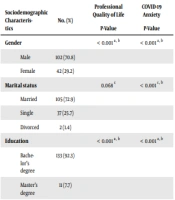
Data analysis showed that the average age of the study participants was 28 ± 5.00 years. The average work experience of the participants was 12.8 ± 6.31 years (Table 1). The mean level of professional quality of life obtained by the respondents in this study was 101 ± 11.09 out of 150, which indicated that participants’ professional quality of life was moderate to high. The level of CS indicated a moderate to high level (39.8 ± 6.2 out of 50). The burnout level was also moderate to high (34.7 ± 4.3 out of 50). The level of secondary traumatic stress was slightly lower but remained moderate (28.6 ± 3.1 out of 50) (Table 2). When examining the level of COVID-19 anxiety among acute care nurses in Najaf hospitals, it was observed that the mean level of COVID-19 anxiety was 13.3 ± 5.7 out of 28, less than moderate (Table 2).
Table 1.
Relationship of Nurses’ Sociodemographic Characteristics with Professional Quality of Life and Coronavirus Disease 2019 Anxiety
| Sociodemographic Characteristics | No. (%) | Professional Quality of Life | COVID-19 Anxiety |
|---|---|---|---|
| P-Value | P-Value | ||
| Gender | < 0.001 a, b | < 0.001 a, b | |
| Male | 102 (70.8) | ||
| Female | 42 (29.2) | ||
| Marital status | 0.068 c | < 0.001 c, b | |
| Married | 105 (72.9) | ||
| Single | 37 (25.7) | ||
| Divorced | 2 (1.4) | ||
| Education | < 0.001 a, b | < 0.001 a, b | |
| Bachelor’s degree | 133 (92.3) | ||
| Master’s degree | 11 (7.7) | ||
| Hospital name | 0.085 c | < 0.001 c, b | |
| Al-Sader Medical City | 59 (40.9) | ||
| Al-Amal Hospital | 35 (24.3) | ||
| Al-Hakeem Hospital | 21 (14.5) | ||
| Al-Zahra Maternity and Children Specialized Hospital | 9 (6.2) | ||
| Al-Furat Al-Awsat Hospital | 20 (14.1) | ||
| Working ward | < 0.001 c, b | < 0.001 c, b | |
| ICU | 64 (44.4) | ||
| Emergency | 60 (41.6) | ||
| Dialysis | 5 (3.4) | ||
| CCU | 15 (10.4) |
Abbreviations: COVID-19, coronavirus disease 2019; ICU, intensive care unit; CCU, coronary care unit.
a Mann-Whitney U test
b Statistically significant
c Kruskal-Wallis test
Table 2.
Mean Values of Professional Quality of Life-5 and Its Subscales and Coronavirus Disease 2019 Anxiety in Emergency and Intensive Care Unit Nurses
| Variables | Mean ± Standard Deviation |
|---|---|
| Professional Quality of Life-5 | 101 ± 11.09 |
| Compassion satisfaction | 39.8 ± 6.2 |
| Compassion fatigue-burnout | 34.7 ± 4.3 |
| Compassion fatigue-secondary traumatic stress | 28.6 ± 3.1 |
| COVID-19 anxiety | 13.3 ± 5.7 |
Abbreviation: COVID-19, coronavirus disease 2019.
The results of the data analysis examined the correlation between the level of professional quality of life and COVID-19 anxiety among acute care nurses in Najaf hospitals. There was a direct and significant correlation between the professional quality of life and COVID-19 anxiety of the participating nurses (r = 0.19, P < 0.05). Looking at the subscales showed a statistically significant positive relationship between all of the subscales of professional quality of life (i.e., CS, burnout, and secondary traumatic stress) and COVID-19 anxiety (Table 3).
Table 3.
Correlation of Professional Quality of Life-5 and Its Subscales with Coronavirus Anxiety Scale in Emergency and Intensive Care Unit Nurses
| Variables | CAS | |
|---|---|---|
| Spearman’s Correlation Coefficient | P-Value | |
| Professional Quality of Life-5 | 0.19 | 0.018 a |
| Compassion satisfaction | -0.21 | 0.010 a |
| Compassion fatigue-burnout | 0.29 | < 0.001 a |
| Compassion satisfaction-secondary traumatic stress | 0.37 | < 0.001 a |
Abbreviation: CAS, Coronavirus Anxiety Scale.
a Statistically significant
5. Discussion
The results of the current study showed that the level of ProQOL for emergency and intensive care nurses in Najaf was 101 ± 11.09 out of 150, indicating a moderate to a high level. Moreover, the level of COVID-19 anxiety was 13.3 ± 5.7 out of 28, indicating a moderate level, and the relationship between professional quality of life and COVID-19 anxiety was direct and statistically significant. The results of a study similar to the present study regarding the method and setting, conducted in Saudi Arabia in 2021 on clinical nurses by Inocian et al., indicated that clinical nurses’ ProQOL was moderate (23). Furthermore, the average levels of CS, burnout, and secondary traumatic stress were moderate (57.9%), moderate (54.4%), and moderate to high (66.9%), respectively (23). The findings of a similar study conducted in Italy by Buselli et al. during the outbreak of COVID-19 in 2020 also indicated that although there are some negative results related to healthcare providers’ mental health, the quality of professional life of the participants working on the frontline was moderate to high (12). The ProQOL-5 subscales’ scores were at a moderate level. Additionally, the mean scores of CS, burnout, and secondary traumatic stress were 38.2 ± 7.0, 19.8 ± 5.0, and 18.0 ± 5.6, respectively (12). The aforementioned studies’ results are consistent with the present study’s results regarding the level of ProQOL.
The level of the first subscale of the ProQOL (i.e., CS) in the current study was at a moderate level which is consistent with the results of a study conducted in 2015 by Portero de la Cruz and Vaquero Abellan in Spain that indicated a moderate level of burnout and CS (24). In a study conducted in Turkey in 2016 by Dikmen et al., the proportion of nurses suffering from CF, including burnout and secondary traumatic stress, was moderate to high (25), which is slightly different from the results of the present study. This inconsistency might be due to differences in setting and the time of these two studies.
Another study was conducted in Thailand in 2014 by Jehloh that dealt with the issue of CF. The results of the aforementioned study indicated a moderate level of CF among nurses, especially nurses working in palliative units (26). In the current study, secondary traumatic stress, the second subscale of CF, was at a moderate level. In a study conducted in Latvia in 2011 by Circenis and Millere, the level of secondary traumatic stress was moderate among the participants, compared to burnout and CS, which were slightly higher (27). The aforementioned studies support the results of the present study.
The results of the current study showed that the nurses had a moderate level of COVID-19 anxiety. Karim et al.’s (28) study conducted in Iraq during the COVID-19 period in 2020 on COVID-19 anxiety among Iraqi respondents showed that the level of COVID-19 anxiety among the participants was moderate. In 2020, Labrague and De Los Santos conducted a study in the Sultanate of Oman on COVID-19 anxiety among nurses working on the first frontlines of the COVID-19 pandemic (15). The results of the aforementioned study indicated that 123 (37%) out of 325 nurses suffered from COVID-19 anxiety, and there was a direct impact of COVID-19 anxiety on the frontline nurses (15). The results of the aforementioned studies are consistent with the current study’s results.
The present study demonstrated a direct statistically significant relationship between ProQOL and COVID-19 anxiety. In other words, nurses with a higher professional quality of life also had higher COVID-19 anxiety. A study conducted in Saudi Arabia in 2021 by Inocian et al. showed that despite the outbreak of the COVID-19 pandemic and its effects on nurses, such as anxiety, nurses’ ProQOL was at a moderate level (23). In another study conducted by Ruiz-Fernandez et al. in 2021 in Spain, individual factors, such as resilience, empathy, and anxiety, affected the ProQOL (29). The aforementioned studies are consistent with the present study regarding the effect of anxiety on ProQOL.
One of the limitations of this study was the lack of cooperation of the nursing staff in filling out the questionnaires or the inaccuracy in filling them out due to the momentum in their workplaces. Therefore, the researcher provided moral gifts (i.e., small gifts such as a pen) to encourage them to actively participate in and focus on filling out the questionnaires. It is suggested to carry out similar studies in other cities in Iraq and other countries to exactly determine the direct and statistically significant relationship between COVID-19 anxiety and ProQOL.
5.1. Conclusions
Although COVID-19 anxiety has increased the professional quality of life of nurses (this could be due to nurses’ work commitment), it can still have destructive effects on nurses. According to the results, nursing managers should pay further attention to the physical and mental health status of nurses working in EDs and ICUs, especially in Najaf hospitals. Health policymakers should also implement supportive policies to improve the ProQOL and reduce the level of COVID-19 anxiety in nurses. Nurses should also make the necessary efforts to protect themselves against work-related risks.