
1. Background
Pregnancy is a significant period characterized by physiological, psychological, and social changes in women's lives (1). A key aspect of this stage is the formation of a unique emotional bond between a woman and her fetus, termed prenatal attachment (2). Prenatal attachment starts as early as 18 weeks into pregnancy and intensifies progressively, reaching its peak in the third trimester (3). Between weeks 18 and 25 of pregnancy, the mother’s ability to perceive fetal movements allows her to distinguish herself from the fetus and recognize it as a being with needs as well as motivations. Along this period, prenatal attachment begins to develop (4). This attachment initially arises from the mother’s imagined perception of the unborn child, rooted in her emotions rather than awareness of the infant’s specific characteristics (5). Cranley identifies six subgroups of prenatal attachment behaviors: Differentiation between self and fetus, interaction with the fetus, attributing characteristics and intentions to the fetus, selflessness, role tasking, and nesting (6). Studies suggest that maternal psychological variables can influence prenatal attachment (7, 8). Muller (2) believes that the mother's attachment experience to her own mother in childhood influences her future attachments to her partner, family, and friends, which in turn impacts her relationship with her fetus (5). The early secure relationships with caregivers play a critical role in the development of mother-fetus attachment (9). Research has indicated that mothers with a secure attachment style demonstrate a greater ability to cope with distress and adapt to the demands of parenthood (10). The parent's own insecure attachment style contributes to elevated anxiety and emotional challenges along their own transition to parenthood in pregnancy. This, in turn, can negatively influence the crucial mother-child bond (11). Another factor involved in prenatal attachment is body image (12). Pregnancy often elicits ambivalence about bodily changes, weight gain, and skin alterations (13). Some studies note that since pregnancy marks the commencement of a new role for women — culturally underscoring the importance of fertility over beauty — women are likely to experience an unchanged or even improved body image throughout this time (14, 15). Conversely, others argue that weight gain and body shape changes owing to pregnancy can lead to diminished body satisfaction among some women (16, 17). Malus et al. noted a positive relationship between body perception and prenatal attachment (18). This connection has been theorized by Rubin, positing that maternal self-acceptance — including acceptance of one's body — is a foundational prerequisite for establishing a bond with the fetus (19). Empirical evidence supports this, indicating that mothers satisfied with their appearance manifest higher levels of prenatal attachment (20), while a negative body image can impair maternal mental health and hinder fetal attachment development (21). The formation of a positive body image is itself rooted in interpersonal experiences. It often hinges on the acceptance received from "significant others", an experience fostered within secure attachment relationships. Those with a secure attachment style internalize a positive self-model, resulting in a more positive and resilient body image (22). Conversely, women with an anxious attachment style are vulnerable to self-doubt and critical body appraisal, as unpredictable intimate relationships can trigger fears of rejection and intensify focus on perceived physical flaws (23).Gender roles also play a key role on prenatal attachment. Motherhood is a fundamental aspect of feminine gender role which plays a key role in bonding between mother and fetus (prenatal attachment) (24, 25). Another research suggests that both feminine and masculine gender traits can predict the strength of this prenatal attachment (24). Studies reveal that pregnant women with an androgynous personality — integrating both feminine and masculine traits — report greater maternal satisfaction and stronger prenatal attachment (24, 26). This is because androgynous individuals can draw upon a wider repertoire of behaviors, allowing for better functioning in interpersonal relationships and psychological adjustment (27). The process of bonding with the fetus and embracing motherhood requires both emotional sensitivity (often associated with femininity) and adaptive resilience (often linked to masculinity). This dual requirement aligns perfectly with the integrative nature of androgyny, which itself is more likely to develop in individuals with a secure attachment style (28, 29). Indeed, secure attachment is a strong predictor of higher levels of both masculinity and femininity, with androgynous individuals presenting a particularly strong correlation with this attachment style. Conversely, an anxious attachment style forecasts higher femininity, while an avoidant attachment style predicts higher masculinity (30). In spite of growing evidence on the psychological factors influencing prenatal attachment, the literature notes persistent contradictions and underexplored dimensions. Previous study have predominantly emphasized motherhood and adherence to feminine gender roles as central drivers of maternal-fetal bonding (25). Nevertheless, emerging research challenges this singular focus, suggesting that traits traditionally associated with masculinity, androgyny (integration of both masculine and feminine traits) may equally shape prenatal attachment (24, 26). This contradiction also applies to body image along pregnancy. Whereas some studies suggest that body image becomes more positive owing to the cultural value of motherhood outweighing bodily concerns, others argue that body image deteriorates (14, 17). Both factors, in turn, influence the quality of the mother-fetus relationship.
2. Objectives
The general objective of this research is to explore the relationship between attachment styles and prenatal attachment in Iranian pregnant women mediated by body image and gender roles in the third trimester of pregnancy. By examining these relationships, the research aims to resolve existing contradictions in the literature and provide a comprehensive framework for understanding the psychological mechanisms underlying maternal-fetal bonding. Eventually, this work intends to inform interventions that enhance maternal mental health and promote healthier prenatal attachment, benefiting both mothers and their developing children.
3. Methods
3.1. Study Design and Setting
This study is a cross-sectional study which was structural equation modeling (SEM) research among 132 pregnant mothers who went to Mahdiye Hospital to be visited by an obstetrician based in Tehran, Iran. This study started in summer 2023 and ended in winter 2023.
3.2. Study Participants and Sampling
The study targeted pregnant women aged 15 - 45 years, residing in Tehran, and at ≥ 28 weeks of pregnancy. The participants first visited an obstetrician and if they were in the third trimester of pregnancy they were referred to the researcher to fill the questionnaires. Exclusion criteria included incomplete response to questionnaires or response bias (non-differentiation in responses) and withdrawal from participation.
3.3. Data Collection Tool
The data collection process included administration of several questionnaires.
Demographic Information Questionnaire: The items of this questionnaire were specifically designed for this research and collect data on factors such as age, baby gender, level of education, marital status, number of children, history of abortion, occupation, marital satisfaction, pregnancy week, fetus gender preference, unintended pregnancy, illness, and drug consumption. Pregnant mothers would complete these questionnaires through self‑reporting. Additional validated scales were used to measure core constructs (attachment styles, gender roles, etc.), which are mentioned below.
Revised Collins and Read Adult Attachment Scale (RAAS): This questionnaire was developed by Collins and Reed in 1990 to ascertain attachment styles in adults (33). It evaluates relationship skills and how attachments are formed with close others. The RAAS consists of 18 questions, with each response rated on a five-point Likert scale ranging from 0 "does not match my characteristics at all" to 4 "completely matches my characteristics". The RAAS assigns six items to each subscale. Scores are based on the respondent's selections, with options 1 through 5 receiving scores of 0 to 4, respectively. Questions 1, 6, 8, 12, 13, and 17 measure closeness; questions 2, 5, 7, 14, 16, and 18 deal with dependence; and questions 3, 4, 9, 10, 11, and 15 address anxiety. Since there are 6 items per subscale and each item is scored from 0 to 4, the theoretical range for each subscale is 0 - 24. Attachment styles were classified by comparing participants' subscale scores to the sample means: Secure (above mean on closeness and dependence, below mean on anxiety), anxious-preoccupied (above mean on anxiety), and dismissing-avoidant (below mean on closeness and dependence). The Cronbach's alpha for the main questionnaire is 0.80, where the correlation of this tool with self-esteem and social behavior constructs confirmed the tool's high validity (33). Pakdaman translated this questionnaire to Persian. The reliability for the Iranian sample was reported as 0.80 by Pakdaman with a test-retest coefficient of 0.95 (34).
Prenatal Body Image Questionnaire (PBIQ): This questionnaire was first designed by Sohrabi et al. in 2019 to measure body image during pregnancy. The current questionnaire consists of 30 items, each scored on a 5-point Likert scale (1): Strongly disagree to 5: Strongly agree. The scores range within 30 - 150. A higher score on this questionnaire reflects dissatisfaction with one’s body image. It includes 7 subscales: (1) Fitness and beauty, (2) lower body fat, (3) attention to changes during pregnancy, (4) shame, (5) negative feelings towards skin changes, (6) maternal symbolism. The Cronbach's alpha for this test was calculated to be 0.92. Construct validity was considered via exploratory factor analysis. Exploratory factor analysis revealed that the calculated extraction subscription values for all items were between 0.425 and 0.812 (35). Cronbach's alpha was calculated as 0.91 in this study.
Maternal-Fetal Attachment Questionnaire: This questionnaire was developed by Cranley in 1981 to measure the attachment between mother and fetus. The 24-item tool employs a 5-point Likert scale (1 = strongly disagree, 5 = strongly agree), yielding a total score from 24 to 120, with a higher score indicating stronger attachment. Its five subscales include: (1) Interaction with the fetus: Items 1 to 5; (2) attributing specific characteristics to the fetus: Items 6 to 11; (3) selflessness: Items 12 to 16; (4) differentiation between self and fetus: Items 17 to 20; (5) acceptance of the maternal role: Items 21 to 24. This questionnaire was initially utilized by Cranley, and its content validity has been confirmed. The Cronbach's alpha was 0.85 (6). In Iran, Khoramrody established the content validity and test-retest reliability (r = 0.85) of the Persian version of this questionnaire (36). Cronbach's alpha was calculated as 0.81 in this study.
Bem Sex Role Inventory (BSIR): This questionnaire was designed by Bem in 1974 to measure masculinity and femininity (gender role) (37). It consists of 60 traits — 20 masculine, 20 feminine, and 20 neutral — rated on a 7-point scale from 1 (never true) to 7 (always true). Participants receive separate femininity and masculinity scores, calculated through summing the respective traits and dividing by 20, leading to scores between 1 and 7. Scores above 4.9 are considered high, and below are low. Based on these scores, individuals are classified into four types: Masculine (high masculinity, low femininity), feminine (low masculinity, high femininity), androgynous (both high), and undifferentiated (both low). The Cronbach's alpha for the original version is 0.86 for the masculinity scale and 0.82 for the femininity scale, with a test-retest reliability of 0.90 for both masculinity and femininity (27). In Iran, Mehrabizadeh Honarmand et al. translated this scale into Persian and reported Cronbach’s alpha of 0.75 for the masculinity scale and 0.99 for the femininity scale. Total Cronbach’s alpha was 0.80. To ascertain the validity of this test, the correlation between the short form and the long form was tested, whereby the correlation coefficient was 0.99 (38). Cronbach's alpha was calculated as 0.83 for masculinity, 0.71 for femininity, and 0.73 for neutral in this study.
3.4. Data Collection
A clinical psychologist briefed eligible individuals on the study’s purpose and, upon obtaining informed verbal consent, administered self-report measures evaluating gender roles, attachment styles (Revised Adult Attachment Scale, RAAS), prenatal body image, and prenatal attachment. The questionnaires were distributed either physically or electronically (Google Form). Following data collection, incomplete or inaccurately completed responses were excluded from analysis.
3.5. Ethical Considerations
This study was ethically approved by the Ethics Committee of Shahid Beheshti University of Medical Sciences, Iran (IR.SBMU.MSP.REC.1401.491). Informed consent was obtained from all participants, and their anonymity was guaranteed. The collected data remained confidential and were used only for scientific analysis.
3.6. Data Analysis
Analyses were performed using SPSS Statistics 26. Descriptive statistics (frequency, percentage, mean, standard deviation) summarized demographic and key variables. Data normality was confirmed via kurtosis and skewness indices (range: ± 3) (39). Bivariate relationships between attachment styles, gender roles, body image, and prenatal attachment were inspected using Pearson’s correlation. To test hypothesized pathways, (SEM) was undertaken via partial least squares (PLS) regression (version 3), enabling simultaneous analysis of direct and indirect effects. The significance level was considered less than 0.05 (40, 41).
4. Results
As reported in Table 1, a total of 132 pregnant women participated in this study, with a mean age of 31.47 ± 6.49. Most participants had a diploma, were unemployed, satisfied with their marriage, had one child, had not experienced a miscarriage, had a boy fetus, were satisfied with the gender of their fetus, had a planned pregnancy, and were healthy and did not use medication.
Table 1.
Demographic Data of Pregnant Women in Third Trimester
| Variables | No (%) |
|---|---|
| Education status | |
| Below high school | 28 (21.2) |
| High school diploma | 56 (42.4) |
| Bachelor's degree | 41 (31.1) |
| Master's degree | 5 (3.8) |
| Doctorate | 2 (1.5) |
| Employment status | |
| Employed | 18 (13.6) |
| Unemployed | 114 (86.4) |
| Marital satisfaction | |
| Yes | 127 (96.2) |
| No | 5 (3.8) |
| Number of children | |
| No children | 49 (37.1) |
| One child | 54 (40.9) |
| Two children | 28 (21.2) |
| Three children | 1 (0.8) |
| History of miscarriage | |
| Have | 38 (28.8) |
| Does not have | 94 (71.2) |
| Satisfaction with fetal gender | |
| Satisfied | 125 (94.7) |
| Non-satisfied | 7 (5.3) |
| Planned pregnancy | |
| Yes | 107 (81.8) |
| No | 25 (18.9) |
| Fetal gender | |
| Girl | 62 (47) |
| Boy | 70 (53) |
| Health conditions | |
| Healthy | 102 (77.3) |
| Diabetes | 12 (9.1) |
| Thyroid problems | 17 (12.9) |
| Hypertension | 1 (0.8) |
| Medication use | |
| Present | 31 (23.5) |
| Absent | 101 (76.5) |
| Age | |
| 15 - 25 | 30 (22.7) |
| 25 - 35 | 62 (46.9) |
| 35 - 45 | 40 (30.3) |
Table 2.
The Scores of Maternal Attachment Styles, Gender Roles, Body Image, and Prenatal Attachment
| Variables | Mean ± Standard Deviation |
|---|---|
| Maternal attachment styles | |
| Secure | 15.67 ± 3.76 |
| Avoidant | 12.85 ± 3.59 |
| Anxious | 12.86 ± 2.98 |
| Gender roles | |
| Masculine | 92.33 ± 14.75 |
| Feminine | 97.73 ± 11.25 |
| Neutral | 93.00 ± 9.97 |
| Prenatal body image | |
| Beauty and fitness | 10.41 ± 4.07 |
| Body fat | 11.93 ± 4.19 |
| Attention to changes | 10.55 ± 3.63 |
| Shame | 7.65 ± 3.33 |
| Sexual attractiveness | 9.92 ± 3.07 |
| Negative emotions | 9.57 ± 4.02 |
| Symbol of motherhood | 8.55 ± 2.71 |
| Total score | 68.27 ± 18.25 |
| prenatal attachment | |
| Interaction with fetus | 19.25 ± 3.69 |
| Attributing characteristics to fetus | 22.70 ± 4.23 |
| Selflessness | 21.14 ± 2.69 |
| Differentiation between self and fetus | 17.37 ± 2.58 |
| Acceptance of maternal role | 15.76 ± 2.40 |
| Total score | 96.23 ± 11.26 |
As observed in Table 2, the highest mean in "Attachment Styles" belongs to the secure attachment. The highest mean in "Gender Roles" belongs to the Feminine gender role. The highest mean in "Prenatal Body Image" has been associated with the Body Fat. The highest mean in "Prenatal Attachment" belongs to the attributing characteristics to fetus.
The results of the correlation matrix between the study variables revealed that there was a significant negative correlation (r = -0.29, P < 0.01) between prenatal body image and prenatal attachment. There was a significant positive correlation (r = 0.19, P < 0.05) between the feminine gender role and prenatal attachment. On the other hand, there was a significant negative correlation (r = -0.31, P < 0.01) between the secure attachment style and prenatal body image (Table 3).
Table 3.
Correlation Matrix of Prenatal Attachment, Gender Roles, Prenatal Body Image, and Attachment Styles
| Variables | Prenatal Attachment | Prenatal Body Image | Gender Role | Attachment Styles | |||
|---|---|---|---|---|---|---|---|
| Masculine | Feminine | Neutral | Secure | Avoidant | |||
| Prenatal attachment | 1 | ||||||
| Prenatal body image | -0.29, P < 0.001 | 1 | |||||
| Gender roles | |||||||
| Masculine | -0.14, P = 0.27 | -0.16, P = 0.06 | 1 | ||||
| Feminine | 0.19, P = 0.03 | -0.26, P = 0.002 | 0.43, P < 0.001 | 1 | |||
| Neutral | 0.17, P = 0.05 | -0.08, P = 0.34 | 0.45, P < 0.001 | 0.75, P < 0.001 | 1 | ||
| Attachment styles | |||||||
| Secure | 0.041, P = 0.64 | -0.31, P < 0.001 | 0.41, P < 0.001 | 0.04, P = 0.68 | 0.01, P = 0.087 | 1 | |
| Avoidant | 0.08, P = 0.33 | 0.20, P = 0.02 | -0.14, P = 0.09 | -0.01, P = 0.94 | 0.03, P = 0.73 | -0.21, P = 0.01 | 1 |
| Anxious | 0.05, P = 0.60 | 0.02, P = 0.81 | -0.006, P = 0.94 | -0.04, P = 0.64 | 0.03, P = 0.75 | 0.01, P = 0.99 | -0.09, P = 0.31 |
As outlined in Table 4, the direct path from attachment styles (secure, anxious, avoidant) to prenatal attachment was not statistically significant. Nevertheless, the direct path from prenatal body image to prenatal attachment was statistically significant. Considering gender roles, none of the direct paths from masculine, feminine, or neutral gender roles to prenatal attachment reached statistical significance. In contrast, the direct path from secure attachment to prenatal body image was significant, whereas the paths from avoidant and anxious attachment to this variable were not significant. For masculine gender role, only the direct path from secure attachment was significant, whereas avoidant and anxious attachment revealed no statistically meaningful effects. Conversely, none of the paths associated with feminine gender role (secure; avoidant; anxious) or neutral gender role (secure; avoidant; anxious) were statistically significant.
Table 4.
Path Coefficients of Direct Effects of Prenatal Attachment, Prenatal Body Image, Attachment Style, and Gender Role
| Dependent and Independent Variables | Β | Cohen’s f² | Standard Error | t | P-Value |
|---|---|---|---|---|---|
| Prenatal attachment | |||||
| Secure attachment | -0.112 | 0.019 | 0.107 | 1.043 | 0.297 |
| Avoidant attachment | -0.045 | 0.002 | 0.099 | 0.453 | 0.650 |
| Anxious attachment | 0.028 | 0.001 | 0.090 | 0.313 | 0.754 |
| Prenatal body image | -0.409 | 0.244 | 0.105 | 3.896 | 0.001 |
| Masculine gender role | 0.056 | 0.003 | 0.128 | 0.439 | 0.661 |
| Feminine gender role | 0.086 | 0.002 | 0.167 | 0.513 | 0.608 |
| Neutral gender role | 0.066 | 0.004 | 0.148 | 0.444 | 0.657 |
| Prenatal body image | |||||
| Secure attachment | -0.286 | 0.104 | 0.085 | 3.360 | 0.001 |
| Avoidant attachment | 0.151 | 0.029 | 0.088 | 1.714 | 0.087 |
| Anxious attachment | 0.024 | 0.001 | 0.087 | 0.269 | 0.788 |
| Masculine gender role | |||||
| Secure attachment | 0.405 | 0.191 | 0.076 | 5.320 | 0.001 |
| Avoidant attachment | -0.062 | 0.004 | 0.085 | 0.729 | 0.466 |
| Anxious attachment | -0.012 | 0.001 | 0.078 | 0.147 | 0.883 |
| Feminine gender role | |||||
| Secure attachment | 0.036 | 0.001 | 0.089 | 0.399 | 0.690 |
| Avoidant attachment | -0.002 | 0.001 | 0.098 | 0.022 | 0.983 |
| Anxious attachment | -0.040 | 0.002 | 0.125 | 0.321 | 0.748 |
| Neutral gender role | |||||
| Secure attachment | 0.021 | 0.001 | 0.107 | 0.196 | 0.844 |
| Avoidant attachment | 0.037 | 0.001 | 0.089 | 0.417 | 0.676 |
| Anxious attachment | 0.031 | 0.001 | 0.114 | 0.273 | 0.785 |
Based on Table 5, the mediating effect of prenatal body image on the relationship between secure attachment and prenatal attachment was statistically significant. However, the mediating effects of prenatal body image in the relationships between avoidant attachment and anxious attachment with prenatal attachment were not significant. Likewise, the mediating effects of masculine gender role were not significant for all attachment styles: secure, avoidant, and anxious. The same pattern was observed for feminine gender role and neutral gender role, with none of the paths reaching statistical significance.
Table 5.
Mediating Effects of Gender Roles and Prenatal Body Image on the Relationship Between Maternal Attachment Styles and Prenatal Attachment During Pregnancy a
| Independent Variable and Mediator | B | Standard Deviation | t | P-Value |
|---|---|---|---|---|
| Prenatal body image | ||||
| Secure attachment | 0.117 | 0.044 | 2.681 | 0.007 |
| Avoidant attachment | -0.062 | 0.041 | -1.503 | 0.133 |
| Anxious attachment | -0.010 | 0.036 | -0.267 | 0.790 |
| Masculine gender role | ||||
| Secure attachment | 0.023 | 0.053 | 0.432 | 0.666 |
| Avoidant attachment | -0.003 | 0.013 | -0.267 | 0.789 |
| Anxious attachment | -0.001 | 0.010 | -0.064 | 0.949 |
| Feminine gender role | ||||
| Secure attachment | 0.003 | 0.018 | 0.169 | 0.866 |
| Avoidant attachment | 0.000 | 0.019 | 0.010 | 0.992 |
| Anxious attachment | -0.003 | 0.025 | -0.138 | 0.890 |
| Neutral gender role | ||||
| Secure attachment | 0.001 | 0.019 | 0.074 | 0.941 |
| Avoidant attachment | 0.002 | 0.016 | 0.149 | 0.882 |
| Anxious attachment | 0.002 | 0.020 | 0.100 | 0.920 |
a The dependent variables is prenatal attachment.
The conceptual model of the research and the standardized path coefficients are presented in Figure 1.
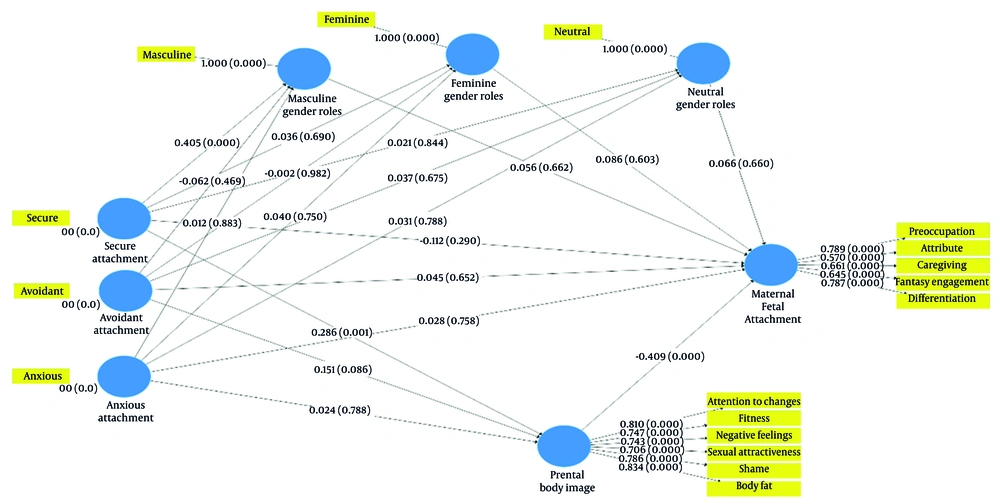
Figure 1.
Conceptual model illustrating the mediating roles of prenatal body image and gender role in the relationship between pregnant mothers' attachment styles and prenatal attachment.
5. Discussion
The purpose of this study was to examine the relationship between attachment styles and prenatal attachment, mediated by body image and gender role in pregnant women in the third trimester. The results demonstrated a significant indirect impact of secure attachment style on prenatal attachment, emphasizing prenatal body image as a critical mediator in this relationship. In contrast, gender role was found to have no mediating influence in the proposed model. Collectively, the predictors — attachment styles, prenatal body image, and gender roles — accounted for 21% of the variance in prenatal attachment, underscoring the key role of body image in the attachment process along late pregnancy.
There was no significant direct relationship between attachment styles and prenatal attachment. Research consistently highlights the critical role of attachment styles in shaping the transition to parenthood (42). A mother's own attachment pattern is a strong predictor of her future parenting style. This attachment pattern reflects her early experiences in managing and coping with distress. Studies have shown that mothers with a secure attachment style demonstrate a greater ability to cope with distress and adapt to the demands of parenthood (10, 43). Although previous research has highlighted the critical role of early secure relationships with caregivers in the development of mother-fetus attachment (42), recent studies have indicated that this emotional bond – which involves attentiveness to needs and the provision of security – reflects the caregiving system rather than the attachment system (44, 45). The attachment system involves seeking care from someone who can provide comfort and security (46), whereas the caregiving system involves attending to needs and offering protection (44). Hence, the mother's relationship with her child along the prenatal period is not attachment, since parents typically do not seek care from their unborn child, and rather it more closely resembles the initial formation of caregiving representations (47). Thus, as our research revealed, attachment styles are not necessarily related to mother-fetus attachment, since in this relationship, it is the caregiving system that is activated, not the attachment system.
The analysis found no statistically significant overall relationship between attachment styles and gender roles, contrary to the established literature. The sole exception was a positive correlation between secure attachment and masculine gender roles. This finding diverges from previous research showing that secure attachment strongly forecasts higher levels of both masculinity and femininity, often resulting in an androgynous gender role (30). Furthermore, existing evidence suggests that anxious attachment is linked to femininity and avoidant attachment to masculinity (30). Our study just supported the connection between secure attachment and masculine gender role. It seems that in the challenging and inflexible context of pregnancy, the adaptive and functional components of masculinity (such as adaptation and management) become prioritized for the mother (29, 48). These components are an additional advantage demonstrated only by women with a strong psychological resource, namely, those with a secure attachment (28). These characteristics help a pregnant woman adapt better to the changes along this period as well as feel more competent in managing this phase (29). Although the findings highlight the important role of early relationships with caregivers on development of gender roles, our study did not support this finding. This discrepancy may be attributed to two primary methodological factors. Firstly, the study's recruitment of a low-socioeconomic status (SES) population may have introduced response bias. Participants from this demographic may have confronted educational or linguistic barriers in comprehending the questionnaires, potentially resulting in responses influenced by social desirability rather than accurate self-assessment. Secondly, the limited sample size likely led to insufficient statistical power, thereby reducing the ability to detect significant effects that may indeed be present. Finally, low Cronbach's alphas of questionnaires may result in non-significant findings related to the femininity and masculinity roles.
There was a negative relationship between secure attachment and prenatal body image. Supporting our finding, research suggests that internalizing secure attachment enables individuals to develop an internal sense of safety. In contrast, insecure attachment styles contribute to the development of a "false bodily self" (49). Krueger emphasizes this fundamental connection, stating that "attachment needs are primarily needs linked to the body", indicating early internal working models directly shape bodily awareness through unmet infant needs (50). While existing literature has established attachment's influence on body image in general populations, its specific relationship in pregnant women remains underexplored. Our study found a negative correlation specifically between secure attachment (not avoidant or anxious styles) and prenatal body image. This indicates pregnant women with secure attachment report more positive body image, while those with anxious or avoidant styles show no significant attachment-body image correlation. In accordance with this finding, a study noted that individuals with secure adult attachment styles presented a more positive perception of their body image when compared to those with insecure attachment patterns (22). Existing research on avoidant attachment and body image reveals mixed results, with most studies indicating minimal to no significant correlation (22, 51). Our findings align with the literature with regards to secure and avoidant attachment patterns.
Nevertheless, a notably divergent pattern emerges for anxious attachment. In women with anxious attachment, any close relationship that communicates uncertainty triggers fears of rejection and self-critical perceptions; as such, intimate relationships marked by unpredictability foster self-doubt and heightened critical assessments of one’s physical appearance and body image (23). Some research confirms that women receiving greater acceptance and emotional support from social networks exhibit more positive body attitudes (52, 53). Importantly, the perceived acceptance of one’s body by close others — including friends, family, and romantic partners — has been established as a key determinant of body appreciation, reinforcing the association between social validation and positive self-perception (54). Pregnancy initiates a new social role where cultural emphasis shifts from beauty to fertility, boosting perceived social acceptance of bodily changes (15). Overall, the enhanced social support, particularly from significant others, lowers rejection sensitivity, thereby diminishing activation of anxious attachment mechanisms.
The findings indicate that prenatal body image serves as a critical mediating factor between secure attachment style (specifically, not anxious or avoidant styles) and prenatal attachment. In line with our finding, research confirms that body image significantly correlates with maternal-fetal attachment (18). A positive maternal body image may facilitate emotional bonding with the fetus. As Rubin theorized, maternal self-acceptance — including body acceptance — forms the foundation for fetal attachment, implying that positive self-perception precedes positive fetal attachment (19). Secure attachment, characterized by positive self-modeling, enables this self-acceptance, as individuals develop self-worth through validation from significant others in secure relational contexts (22). Notably, attachment styles exert only indirect effects on prenatal attachment through body image mediation. This suggests mothers can form fetal bonds irrespective of attachment style, with attachment variables gaining significance primarily through their influence on body perception. The mother-fetus bond, fundamentally physical in nature, suggests the fetus may be perceived as a bodily extension. Hence, maternal body self-perception appears to fundamentally shape how the baby is nourished, nurtured, and loved (55).
The analysis further examined gender role as a potential mediator between attachment styles and prenatal attachment. According to the results, gender role does not serve as a mediating factor in this relationship. Meanwhile, motherhood is a fundamental aspect of the feminine gender role, which plays a key role in bonding between mother and fetus (prenatal attachment) (24, 25), and some studies suggest that pregnant androgynous women have greater maternal satisfaction and prenatal attachment (24, 26). Nevertheless, the current study did not confirm this mediating pathway. This is particularly noteworthy since androgyny — characterized by integration of both feminine and masculine traits — typically predicts better interpersonal functioning (27). It also seems theoretically aligned with the dual demands of emotional bonding and adaptive flexibility required in pregnancy (28, 29). The possible explanations for this finding may lie in the predominant role of neuroendocrine mechanisms in shaping prenatal attachment along pregnancy (56). Pregnancy induces significant hormonal changes, including elevated estrogen and progesterone, which prime maternal responsiveness while also facilitating prenatal attachment through oxytocin as well as prolactin pathways (57, 58). These biological mechanisms may override psychological constructs such as gender role, enabling prenatal bonding through neuro-hormonal channels rather than psychosocial ones.
This research had some limitations that should be considered when interpreting the findings. Notably, the reliance on cross-sectional data restricts the ability to infer cause-and-effect dynamics between variables, leaving causality unresolved. Further, the small sample size may limit generalizability to all pregnant women, potentially restricting the applicability of the findings. Also, participants were selected from one public hospital in a low socioeconomic context in the city, a demographic that may face challenges in accurately comprehending questionnaire items owing to educational or linguistic barriers. Thus, participants’ responses might reflect social desirability bias (i.e., a tendency to provide socially acceptable answers rather than truthful self-assessments), limiting the generalizability of the findings to other cultural and socio-economic contexts.
Given these limitations, several directions for future research are recommended. Longitudinal studies are required to elucidate the causal pathways linking attachment styles to prenatal attachment. Examination of these relationships across more racially and socioeconomically diverse samples would help clarify the role of cultural and contextual factors. Ultimately, given the inconsistent literature on body image and prenatal attachment, further research should identify potential mediating variables that might explain the complex interplay between these constructs.
5.1. Conclusions
In conclusion, the results indicated that the relationship between attachment and prenatal attachment in pregnant women in the third trimester is mediated by prenatal body image and not by gender roles. This research shows that pregnant women who have secure attachment often have positive prenatal body image, which can improve prenatal attachment.
The findings of this study highlight some critical considerations for clinical implication. Given the significant mediating role of body image in the association between attachment styles and prenatal attachment, healthcare providers should prioritize interventions that promote positive body image during pregnancy. Cognitive-behavioral therapy (CBT) or psychoeducation programs could help pregnant individuals reframe negative self-perceptions and boost their emotional connection to the fetus. Obstetricians, therapists, and social workers should work together to support mothers during pregnancy, as this teamwork can ameliorate health outcomes for both mothers and neonates by tackling these interlinked issues.