
1. Context
Cardiac arrest is one of the leading causes of death worldwide. In North America and Europe, the incidence of sudden cardiac arrest is approximately 50 to 100 per 10,000 people in the general population (1). In developing countries such as Iran, cardiovascular diseases (CVDs) are the cause of 80% of deaths (2), and it is expected that in low and middle-income countries, CVDs account for the highest number of deaths and cause about 4.6 million deaths in individuals aged 39 - 60 years (3, 4). The evidence shows that despite the support for recovery and treatment of cardiac arrest in recent years, the overall post-cardiac arrest survival rate is still low (5). Immediate initiation of cardiopulmonary-cerebral resuscitation (CPCR) is essential to preserve and revive the heart and brain. Despite many advances in the protocols, medications used, and the skill of medical staff in performing CPCR, the mortality rate of cardiac arrest is still high. Unskilled staff and the delay in performing massage therapy are the two most important factors affecting CPCR outcomes (6). For this purpose, many hospitals have a cardiopulmonary resuscitation (CPR) team that intervenes using advanced technology when cardiac arrest occurs (7).
Although CPR teams have been operating for many years, these teams often have poor and worrying performances. Accordingly, a study conducted in three teaching hospitals in Tehran found that 64.4% of CPR operations failed, and only 2.7% of patients were discharged from the hospital with moderate to optimal brain function (8).
The inefficiency of the CPR team in CPR operations and an increase in the post-CPR death rate in recent years have caused negative consequences in hospitals and society, including physical and irreversible injuries to patients, increased hospital costs, increased time and energy consumption, reduced motivation and self-confidence, weakening the morale and performance of medical staff, and public dissatisfaction (9, 10). Different members of the CPR team perform the CPR procedure with different specializations. However, nurses play a vital role in the CPR team by identifying patients with critical conditions, preventing cardiac arrest, and performing timely and principled CPR operations and post-CPR care to improve CPR outcomes in hospitalized patients. The incompetence of nurses undoubtedly leads to the risk of losing the opportunity to save the patient's life because nurses are among the first members of the CPR team who encounter patients in need of CPR in the early stages and play a very sensitive role in the lives of patients (11). Thus, an awareness of the latest CPR techniques is one of the most important requirements for medical staff, especially members of the CPR team. Studies on many clinical cases have shown that many medical personnel and nurses do not have basic CPR skills and knowledge to help patients in emergencies (12).
Nagashima et al. concluded that several factors effectively perform CPR, but CPR training is the most important and vital factor (13). CPR training assures nurses of acquiring CPR knowledge and skills and helps them maintain their knowledge and skills for successful CPR (14). Since promoting knowledge and skills is one of the basic requirements for professional development in nursing education (15), CPR training can enhance the main skills required for the nursing profession (16). Every educational program leads to learning, but the learning rate, depth, and retention are different for different educational methods. Thus, a huge number of studies in recent years have addressed the effectiveness of various educational programs in promoting lifelong learning (17), as education aims to develop lifelong learning and promote knowledge and performance (18). Therefore, failure to pay attention to the training of the CPR team and their poor performance in the CPCR procedure can lead to an increase in mortality and complications, a decrease in the survival rate, and an increase in the average length of stay. To this end, the present study aimed to review CPCR training methods and apply an integrated method for sustainable learning and improving nurses' CPCR skills and knowledge.
2. Evidence Acquisition
In this review study, the English keywords; education, training, cardiopulmonary-cerebral resuscitation, nurses, knowledge, skill, and performance, and their equivalent Persian terms were searched in articles published from 2010 to 2020 in Iranian and international databases, including Google Scholar, SID, IranMedex, Magiran, PubMed, Ensani.ir, and CINAHL. A total of 21 articles were identified. After removing duplicate articles and the studies conducted in Iran, ten articles were selected for the final review. The researcher reviewed all articles regarding CPCR training techniques and various learning issues related to nurses. Finally, nine articles and one thesis were selected for analysis. An overview of the selected articles showed that one article used clinical trial methodology, eight studies used quasi-experimental designs, and one was conducted in action research.
3. Results
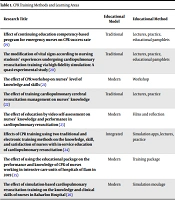
Several studies have addressed CPR training in clinical settings for nurses in Iran. These studies have measured the effects of training methods on learning outcomes using researcher-made tools. Conventional, modern, and integrated teaching methods were used in these studies, as displayed in Table 1.
Table 1.
CPR Training Methods and Learning Areas
| Research Title | Educational Model | Educational Method | Learning Areas | ||
|---|---|---|---|---|---|
| Knowledge | Attitudes | Performance | |||
| Effect of continuing education competency-based program for emergency nurses on CPR success rate (19) | Traditional | Lectures, practice, educational pamphlets | √ | ||
| The modification of vital signs according to nursing students’ experiences undergoing cardiopulmonary resuscitation training via high-fidelity simulation: A quasi-experimental study (20) | Traditional | Lectures, practice, educational pamphlets | √ | √ | |
| The effect of CPR workshop on nurses’ level of knowledge and skills (21) | Modern | Workshop | √ | √ | |
| The effect of training cardiopulmonary cerebral resuscitation management on nurses’ knowledge (22) | Traditional | Lectures, practice | √ | √ | |
| The effect of education by video self-assessment on nurses’ knowledge and performance in cardiopulmonary resuscitation (23) | Modern | Films and reflection | √ | √ | √ |
| Effects of CPR training using two traditional and electronic training methods on the knowledge, skill, and satisfaction of nurses with in-service education of cardiopulmonary resuscitation (24) | Integrated | Simulation apps, lectures, practice | √ | √ | |
| The effect of using the educational package on the performance and knowledge of CPR of nurses working in intensive care units of hospitals of Ilam in 2019 (25) | Modern | Training package | √ | √ | |
| The effect of simulation-based cardiopulmonary resuscitation training on the knowledge and clinical skills of nurses in Baharloo Hospital (26) | Modern | Simulation moulage | √ | √ | √ |
3.1. Conventional CPR Training Methods
Conventionally, CPR training is performed by reading books, CPR instructions, lectures, watching training videos, and practicing on a medical moulage to promote CPR skills and knowledge. The contents of the instructions and books are provided for nurses to study, and then their knowledge is tested. Since books and educational materials are available to nurses, they can recall the contents by referring to the materials. Besides, watching educational videos several times can help to increase nurses' knowledge of CPR steps (27).
3.2. Modern CPR Training Methods
Modern CPR training methods include scenarios and simulator environments, workshops, filming and reflection, training packages, flipped classrooms, and e-learning techniques. Simulation is a technique that places nurses in a similar situation to improve their knowledge and practical skills.
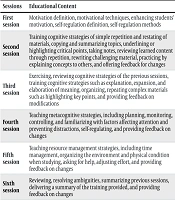
3.3. Integrated CPR Training Methods
4. Discussion
Training plays a key role in improving nursing skills. Since CPR training is one of the main training requirements for nurses, how to provide this type of training is also important. Choosing a training method to improve nurses’ knowledge and competence in CPR is of special importance (29). There are different care education models (30). In face-to-face CPR training courses, models and lectures are also used to train nurses (31). However, studies show that the knowledge gained by nurses through these educational methods is short-lived (32, 33). Hashemi et al. and Memarian et al. showed that CPR training through lectures and educational pamphlets is effective only on the knowledge of nurses and does not affect other areas and team performance of the group (22, 34). In the video-based training method, learners can learn from recorded videos in their free time and in places other than the educational environment without the presence of a teacher and watch them many times if needed. Thus, video-based instruction can be proposed as an effective method for CPCR training (35), but it cannot necessarily lead to lifelong learning alone. An important issue is the efficiency of these methods in teaching nursing skills. In their study on nursing students in Mashhad, Nourozi et al. showed that training with film screening effectively in all three areas of knowledge, attitude, and performance (36). Therefore, video-based instruction can be used as a supplement to other training methods. In practical training, CPR is performed on a medical moulage in the presence of the learners (34), which leads to the control and accuracy of using equipment such as manual resuscitators and electroshock devices and the correct implementation of cardiac massage, and helps to increase knowledge in this vital care (35). However, in this type of instruction, since the nurse does not actively participate in implementing the procedures, he/she does not gain much skill. Active and team participation in practicing step-by-step CPR procedures leads to high functional proficiency and helps learners learn the pitfalls and proper execution of the CPR operation.
Furthermore, scenario-based CPR training enhances nurses’ diagnostic skills in real situations. Scenario-based learning improves nurses’ clinical judgment and decision-making skills for making the correct choice at each CPR stage. Moreover, performing CPR on a medical moulage promotes nurses’ skills in performing CPR on real patients (36). Sometimes, learners’ interventions are filmed so they can review their performance again and decide to choose the right action (37). Zahedmeher et al. showed that scenario-based training only affects nurses’ performance and functions and does not improve team knowledge and skills (23). Another CPR training technique is training through applications that can be installed on mobile phones and tablets. These applications are currently used extensively and can be utilized to promote nurses’ cognitive and practical skills (38). Sadeghzadeh et al. showed that the use of CPR simulation applications along with other training methods could be effective (39), but these applications are not able to create lifelong learning and team skills. A literature review indicated that integrated learning is the most comprehensive teaching and learning technique and a community-oriented method for continuous and spontaneous education that relies on the learner’s interests and characteristics. It also motivates learners and develops their sense of responsibility, independence, self-confidence, critical thinking, and creativity in clinical matters. Compared to face-to-face learning, integrated learning also facilitates learning outcomes, enhances the effectiveness of knowledge, promotes lifelong learning, encourages self-learning based on discovery and interactive and collaborative learning activities, and makes learning less expensive and more effective (40). Khoshnoodifar et al. showed that integrating traditional and modern CPCR training methods could enhance nurses’ awareness, performance, and attitudes (24). Furthermore, Hojat et al. showed that using a range of educational methods contributes to improving the quality of the CPCR process (41).
4.1. Limitations of the Study
Any training technique has limitations, and paying attention to these limitations helps to choose the best training method tailored to nurses’ specific conditions. For CPR training methods to be more effective for nurses, a combination of training and teaching techniques and models should be used. Moreover, integrating different information sources and educational methods can lead to more effective education.
5. Conclusions
CPR education has evolved from traditional modes of education, such as reading books and showing videos, to simultaneous and practical training on simulators and simulated situations. Integrating a wide range of traditional and modern educational methods is more effective in CPR training. Hence, educational officials and managers should use integrated training methods to improve nurses’ CPCR skills.