
1. Background
Aging leads to changes in the freshness and beauty of the skin and the shape of the face (1). Many external and internal factors, including genetics, ethnicity, exposure to sunlight, smoking, and air pollution, affect the speed of facial aging (2). Aging of the skin clinically in the form of dry wrinkles and roughness, loosening, and pigmentation changes appear (3).
Facial rejuvenation(FR) and rejuvenating the skin have long been the concern of humans. Throughout history, various methods have been used to rejuvenate and reduce Skin aging or the damaging effects of the sun (4). Dermatologists and researchers always look for highly efficient methods and fewer side effects to remove wrinkles and rejuvenation. These methods are invasive and non-invasive (5). In the last decade, the demand for non-invasive rejuvenation methods has increased significantly (6). Part of the increase in non-invasive methods can be attributed to the increase in new injections. Technologies offered to many patients include soft tissue fillers, laser treatments, and radiofrequency- or ultrasound-based skin tightening methods used today were introduced in the last decade (7).
The use of botulinum toxin as a non-invasive method of rejuvenation and beauty has attracted many people, and its use has increased among patients (8, 9). However, this method may have short-term and long-term side effects such as headache, eye disorder, eyelid ptosis, and eyelid and face heaviness (8).
One of the methods of facial rejuvenation is the use of laser, which has become popular as one of the beauty methods since the 1980s. In America, there was a 19% increase in skin regeneration treatments, including laser, light, and energy-based methods, in 2017 compared to 2016 (10). Using laser and light sources for skin rejuvenation involves the removal of old skin tissue, which can cause tissue damage due to the thermal heat generated by high-power lasers. It then stimulates the surrounding tissues to heal through natural wound healing (11). Today, skin lasers are used in various therapeutic directions (10). Therefore, in general, the application of skin lasers can be categorized as wrinkle removal, rejuvenation, superficial and deep exfoliation, skin lifting and rejuvenation, facial and body hair removal, removal of skin spots, removal of freckles, removal of some moles and scars (10, 12, 13). However, this method may have side effects such as dry skin, pimples, sun sensitivity, blisters, and skin infections (14).
Facelift is one of the beauty methods that causes facial skin to stretch upwards. In this case, sagging skin in the cheeks and jawline disappears and brings rejuvenation and freshness to the skin (15). In the past, a facelift was possible only through surgery. However, today, using different non-surgical methods, lifting can be done with the least pain and without a recovery period. Of course, non-surgical methods are temporary and need to be renewed once in a while. This method generally helps the collagen production of the skin and stimulates the skin cells (16).
The Internet and its data are now recognized as an alternative tool for collecting data on disease patterns and population estimates in epidemiology (17, 18). Patients considering an elective skin rejuvenation procedure are more likely to do research before the procedure, which often starts with social media platforms such as Instagram, Twitter, Facebook, and YouTube, as well as Google search engines (19). Google is the largest search engine used in the world. The phrases searched on Google and their trends can help understand the public's interests and views on a specific issue and the progress and spread of diseases (20). The usefulness of this source of information in epidemiological research has been shown in many studies (20-22). FR services are diverse, and the desire to use them is increasing. Therefore, it is necessary to know the tendencies of society toward these methods and study these trends during different years to plan for the future.
2. Objectives
This study aims to analyze Google Trends data to investigate the desire to perform methods related to FR in Iran and the world and the impact of the COVID-19 pandemic as a historical effect on these desires.
3. Methods
This study is an ecological one that was conducted using the Google Trends (GT) database. We first searched for users' specified search terms related to" Botox," "Gel injection"," "Laser," "Facelift," Fillers," and "Bridge,” and "COVID-19," "Corona (Iranian COVID-19) among all searches performed using GTs in the World and Iran from January 2017 to July 2023. The volume ranges from 1 to 100, where 100 represents the peak of popularity, and a score of 0 indicates that the phrase is below 1% of its peak (23).
3.1. Data Analysis
Statistical analyses were conducted using SPSS and Microsoft Excel, and the Spearman correlation coefficient using SPSS. We have reviewed the interest over time using the data and visuals from the GT.
4. Results
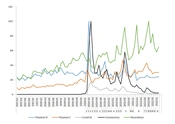
The trend of Google Trends shows that the search volume of laser and filler is more than other services worldwide. In Iran, until 2022, laser and gel injection had the highest volume of searches, and from 2022 onwards, fillers are among the top searches. In 2020, with the onset of the COVID-19 pandemic, the global and Iranian FR procedures have been significantly impacted. There has been a noticeable decrease in searches for FR procedures, while the number of searches for COVID-19 has increased (Figures 1 and 2).
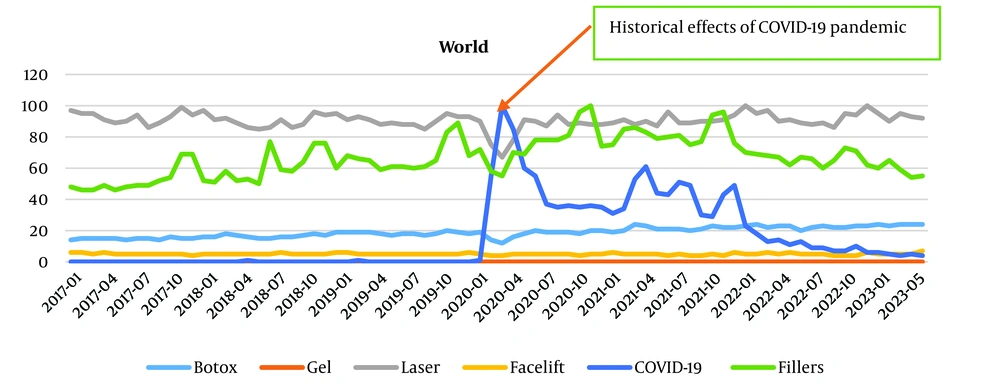
Figure 1.
Frequency (RSV Google Trends) of search terms in Iran from January 2017 to July 2023
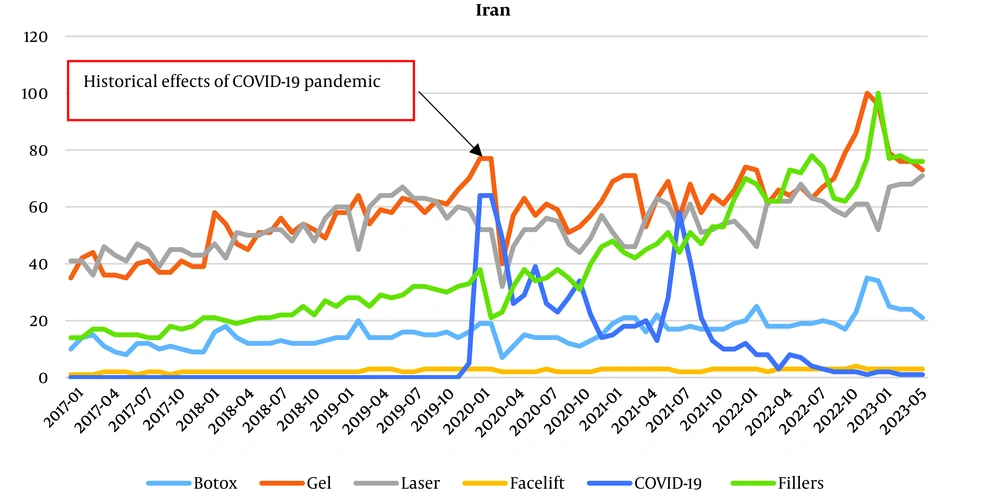
Figure 2.
Frequency (RSV Google Trends) of search terms in Iran from January 2017 to July 2023
4.1. Correlation Between FR Procedures and COVID-19
There is a negative and significant correlation between the volume of searches for COVID-19 and FR procedures worldwide (R2 = -0.52, P = 0.0001) and in Iran (R2 = -0.84, P = 0.0001). Most of the negative correlation in the world is related to Botox (R2 = -0.49, P = 0.001) and laser (R2 = -0.47, P = 0.001). In Iran, it is related to Botox (R2 = -0.71, P = 0.0001) and filler (R2 = -0.83, P = 0.001) (Table 1).
Table 1.
Correlation Coefficients for 4 Years Displaying Relationships Between Search Terms Botox, Gel, Laser, Crown, Facelift, Fillers, and COVID-19.
| Variables | Total | Botox | Gel | Laser | Facelift | Fillers |
|---|---|---|---|---|---|---|
| COVID-19 a | ||||||
| R2 | -0.52 | -0.49 | - | -0.47 | -0.31 | 0.51 |
| P | 0.0001 | 0.001 | 0.001 | 0.03 | 0.001 | |
| 2020 | ||||||
| R2 | -0.56 | -0.42 | - | -0.63 | -0.41 | -0.40 |
| P | 0.05 | 0.17 | 0.02 | 0.17 | 0.19 | |
| World | ||||||
| 2021 | ||||||
| R2 | 0.06 | 0.35 | - | -0.29 | -0.02 | 0.11 |
| P | 0.84 | 0.25 | 0.36 | 0.94 | 0.72 | |
| 2022 | ||||||
| R2 | 0.61 | 0.26 | - | 0.51 | 0.60 | 0.42 |
| P | 0.03 | 0.40 | 0.09 | 0.03 | 0.17 | |
| 2023 | ||||||
| R2 | 0.92 | 0.13 | 0.92 | 0.06 | 0.47 | |
| P | 0.009 | 0.77 | 0.003 | 0.89 | 0.33 | |
| COVID-19 a | ||||||
| R2 | -0.84 | -0.71 | -0.67 | -0.64 | -0.65 | -0.83 |
| P | 0.0001 | 0.0001 | 0.0001 | 0.001 | 0.001 | 0.001 |
| Iran | ||||||
| 2020 | ||||||
| R2 | -0.41 | -0.30 | -0.38 | -0.58 | -0.34 | -0.43 |
| P | 0.18 | 0.33 | 0.21 | 0.04 | 0.26 | 0.16 |
| 2021 | ||||||
| R2 | -0.26 | -0.20 | -0.20 | 0.10 | -0.64 | -0.46 |
| P | 0.40 | 0.52 | 0.52 | 0.73 | 0.02 | 0.13 |
| 2022 | ||||||
| R2 | -.24 | 0.34 | -0.13 | -0.29 | -0.22 | 0.13 |
| P | 0.45 | 0.26 | 0.67 | 0.34 | 0.49 | 0.67 |
| 2023 | ||||||
| R2 | 0.29 | 0.29 | 0.43 | -0.66 | 0.47 | 0.30 |
| P | 0.57 | 0.52 | 0.32 | 0.10 | 0.28 | 0.56 |
a All the years.
The time trend of the correlation coefficient shows that most of the negative impact of COVID-19, both globally and in Iran, occurred in 2020. However, starting from 2021 in the world and 2022 in Iran, the negative effects of COVID-19 on FR procedures have decreased (Figure 3).
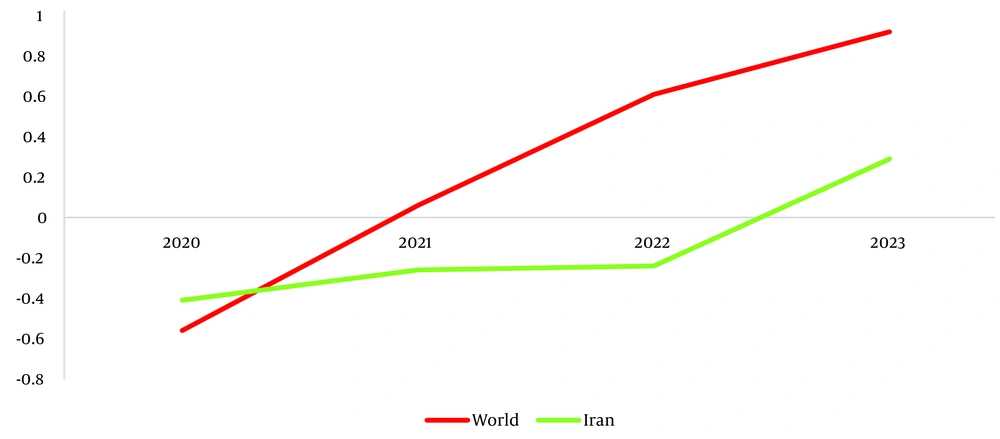
Figure 3.
Time series correlation coefficients for four years displaying relationships between search terms Botox, Gel, Laser, Crown, Facelift, Fillers, and COVID-19.
5. Discussion
The main purpose of this study is to analyze Google Trends data to investigate the desire to perform methods related to FR in Iran and the world and the impact of the COVID-19 pandemic as a historical effect on these desires.
The results showed that the COVID-19 pandemic has caused a decrease in the desire to perform beauty services in the world and Iran as a historical work. Its impact in 2020, the beginning of the COVID-19 pandemic, is greater than in other years. FR is one of the businesses that the COVID-19 pandemic has had a huge negative impact on, as the demand for beauty services has decreased significantly during the COVID-19 pandemic (24, 25). People searching for the terms on Google Trends indicate they want to learn more about FR procedures to help them choose the best course of action. Due to restrictions, quarantine, and fear of infection during the pandemic, the search volume decreased drastically at the beginning of the COVID-19 pandemic (26).
Laser and filler are among the most common FR services in the world. However, in Iran, until 2022, laser and gel injection were the most commonly offered services. Furthermore, since 2022, the filler has replaced the laser, and the search volume has increased. Dermal fillers are an increasingly popular rejuvenation procedure, ranking as the second most common non-surgical cosmetic procedure. There has been an estimated 58% increase in injection prevalence over the past five years (27, 28). Lasers are used to treat wrinkles and other deeper skin defects. They promote collagen regeneration, making them popular options for treating fine lines, wrinkles, sagging skin, and age spots (29). The high volume of laser searches can be attributed to the fact that lasers are not only used for facial rejuvenation but also for removing unwanted hair (30-32).
GT has shown that the global Botox market has experienced weak growth over the years. However, in Iran, there has been a significant increase in recent years. The result of Jonathan's study in 2023 showed that the volume of Google Trend Botox searches increased from 2004 to 2019 in the world (19). These varying results can be attributed to the disparity in the years being analyzed.
5.1. Limitations
- People searching for the desired keywords may not have received those services.
- Although we tried to use general and commonly used keywords, people may have used a search term that does not align with our chosen words.
- Beauty enhancement services are more common among young people with lower levels of education. Therefore, people who wish to use these services may need more knowledge about this information source and may need to effectively utilize it.
- Internet access still exists in some places, not widely, but limited, so rural areas have more limited access than urban areas. However, Google is the dominant search engine. However, some people may use other tools like Yahoo (33).
- Certain subpopulations and cultural differences may not be addressed by Google Train. Additionally, Google Trends data only shows searches made on Google (34-36). It is important to consider that although Google Trends is a simple and low-cost alternative to a national database, it is still insufficient for accurately describing global behavioral characteristics. It should be used in conjunction with other sources of information, such as the volume of referrals for this service, in order to draw more reliable conclusions (37, 38).
5.2. Conclusions
Many people worldwide, including those in Iran, are seeking facial rejuvenation. Clinicians can enter this business with a positive outlook. Young people and women comprise the largest demographic of Internet users. Conversely, most people who undergo FR procedures are also women and young people. GT data is a powerful tool for predicting the demand for FR procedures, considering the increasing demand for FR services and recognizing that each of these methods may have complications. It is suggested to conduct studies to investigate the short-term and long-term complications of these services in people who have utilized them.