1. Background
Mycosis fungoides (MF) is the most common cutaneous T-cell lymphomas (CTCL), which are categorized as non-Hodgkin lymphomas; it affects males twice as often as females and its incidence is reported to be five in a million population (1). The parapsoriasis en plaque (PEP), and more precisely, large plaque parapsoriasis (LPP), is another lymphoproliferative disorder that may evolve into MF and is considered by some authors as a point in the spectrum of MF (2, 3). Although the precise etiology of the disease has not been known yet, there are two generally accepted hypotheses: antigen stimulating hypothesis and viral induction hypothesis.
The antigen stimulating hypothesis states that the antigen persistence stimulates T cells continuously and leads to development of a clone of malignant T cells (4). On the other hand, the viral induction hypothesis is based on the similarity of clinical skin symptoms between CTCLs and adult T-cell leukemia/lymphoma; however, while the human T-cell leukemia virus 1 (HTLV-1) is associated with the adult T-cell leukemia/lymphoma, the studies concerning association between HTLV-1 and MF had contradictory results (5, 6). Other viruses were also investigated including Epstein-Barr virus (7), cytomegalovirus (8), and Human herpes viruses type 6 and 7 (7, 9, 10); however, the data were inconclusive.
Human herpes virus 8 (HHV-8) is present in almost all cases of kaposi sarcoma (KS), which is a common vascular malignancy in patients with AIDS. Although numerous studies have investigated the presence of HHV-8 in either MF or LPP, the results are contradictory (7, 9, 11-19); moreover, the prevalence of the disease varies with respect to the ethnic group and geographic area (20). Hence, the prevalence in population may affect the detection of HHV-8 in MF/LPP.
2. Objectives
We conducted a molecular case-control study to evaluate the presence of HHV-8 in MF and LPP in Iranian population.
3. Patients and Methods
We designed a molecular epidemiology case-control study to assess the association between HHV-8 and MF/LPP in the histopathologic skin samples obtained from patients admitted to Shohada-e-Tajrish Hospital from September 2004 through March 2011. The protocol of the study was designed in accordance with Helsinki declaration and implemented after receiving approval from our University Ethics Review Board.
The primary outcome of the study was finding HHV-8 DNA sequence by Real-time polymerase chain reaction (RT-PCR) in the specimens. The paraffin-embedded blocks of biopsy specimen from lesions previously diagnosed as MF or LPP were used to find DNA sequence of HHV-8. Biopsy specimens from patients with chronic dermatitis (CD) were used as controls; we also used biopsy specimens from patients with KS as positive controls in RT-PCR. The diagnosis of MF, LPP, CD, and KS was made histopathologically; for the study purpose, the samples were re-examined by a pathologist who was unaware of the previous diagnosis.
The samples were labelled by numbers randomly and introduced to the reference lab that was blinded to the histopathological diagnosis of the specimens. These samples were tested by means of RT-PCR; samples were thawed at room temperature, spun, and processed according to kit instruction. Total DNA was extracted using the Primerdesign Genesig kit for HHV-8 genomes according to the manufacturer’s instruction. The manufacture claims that the kits primers have 100% homology with a broad range of clinically relevant reference sequences.
Finally, the data were analyzed using SPSS (v.16 for windows, SPSS Inc. Chicago, IL, USA); the PCR results was introduced to the software as either positive or negative with the values of zero and one, respectively, and the missing data were introduced to the software by a code. If the samples results returned positive, Chi square or Fischer’s exact test would be used to compare the frequency of HHV-8 DNA in biopsy specimens of the study and control groups. A P value > 0.05 was considered as statistically significant.
4. Results
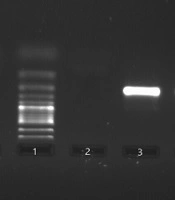
A total of 23 paraffin-embedded blocks were examined. The studied samples were as follows: ten samples from patients with MF (4 males [40%], 6 female [60%]; mean age, 49.90 ± 15.35 years); and 13 samples from patients with LPP (9 males [69.23%]; and 4 female [30.77%]; mean age, 49.38 ± 14.57 years). The samples were histopathologically diagnosed during the years 2004 through 2011. According to the results of RT-PCR, none of the samples had positive results for HHV-8 genome. The controls were 23 biopsy specimens from patients diagnosed with CD (13 males [56.52%], 10 females [43.48%]; mean age, 46.13 ± 16.99 years) and five specimens from patients with KS, as positive control. The PCR results were positive in none of the specimens from patients with CD while all the five specimens from patients with KS had positive results.
5. Discussion
The association of HHV-8 with lymphoproliferative disorders (LPD) has been investigated previously with contradictory and inconclusive results. In our study, we could not link HHV-8 to the studied LPD, namely MF and LPP, as the results of RT-PCR were negative in all cases.
The reported prevalence rates of HHV-8 are not the same with regard to the population and geographic area; the highest rate of seropositive results were reported from African countries while the prevalence rate is about 2% to 5% in the United States and Northern Europe (20). The prevalence of disease is not determined in Iranian population; however, in a study by Gharehbaghian et al. (21), only five out of 256 healthy blood donors (2%) were seropositive for HHV-8 antibodies while the seropositive results were reported in 16.9%, 25%, and 45.7% of hemodialysis, kidney transplantation, and HIV-positive patients, respectively. The mode of transmission of virus is horizontal or via sexual contact (22-24).
The role of viruses in pathogenesis of LPD was studied previously; however, the results were inconclusive (5-10). The association of the latest member of herpes viruses, namely, HHV-8, with MF/LPP is assessed in different countries and populations. Sander et al. (11) investigated patients with lymphoproliferative disorder and found HHV-8 in 10% and 33% of specimens from patients with MF and PEP, respectively; they proposed a possible role for HHV-8 in pathogenesis of LPD. At the same year, Pawson et al. (12) provided some evidence against this hypothesis by failing to detect HHV-8 DNA sequence T-cell LPD including MF.
Henghold et al. (13) studied patients from different ethnic populations and could not link the HHV-8 to MF or other associated diseases. In France, Dupin et al. (14) investigated different cutaneous lymphoproliferative malignancies including MF with PCR and reported only one positive result in specimens from patients with LPP. The same result from France was reported by Quereux et al. (9) who reported negative PCR results in patients with LPP. In Spain, Nagore et al. (7) investigated the prevalence of HHV-8 in primary cutaneous lymphoma and found HHV-8 in 14% of the specimens from patients with MF; however, they did not report any association between HHV-8 and MF. In turkey, Erkek et al. (15) did not find any positive result for HHV-8 in patients with MF. In a study in Saudi Arabia, Fahad et al. (18) found two positive results for HHV-8 in patients with early-stage MF and reported no association between HHV-8 and MF. In Israel, Amitay-Laish et al. (19) studied the existence of HHV-8 in patients with early-stage MF in Jewish population including eight patients with familial MF, ten adults and 17 children with sporadic MF, and 11 patients with MF. They found the positive PCR results only in two adult patients with sporadic MF and concluded that no association between MF/LPP and HHV-8 existed; moreover, their report was the first study that investigated the association of familial MF with HHV-8.
On the other hand, the opposite results are reported from Italy and Germany. Trento et al. (16) studied the association of HHV-8 and cutaneous LPD by using serologic markers; they found antibodies against HHV-8 in all of the patients with LPP and in 25% of patients with MF. In patients with LPP, the HHV-8 sequence was found in 80% and 100% of peripheral mononuclear cells and lesional samples, respectively; the sequence was found in 17% of peripheral mononuclear cells and lesional samples of patients with MF. Based on their findings, they suggested possible role for HHV-8 in pathogenesis of LPP. In Germany, Kreuter et al. (17) reported HHV-8 sequence in 87% and 70% of LPP and MF lesional specimens, respectively.
The present study could not find any evidence for the possible role of HHV-8 in MF and LPP; it was in accordance with most of the previous studies that had rejected the association of HHV-8 with MF/LPP (more detailed information about these studies is illustrated in Table 1). The oncogenic effect of HHV-8 on infected cells is demonstrated in animal models (25). This herpes virus is found in almost all patients with kaposi sarcoma, a common malignancy in patients with AIDS (26); HHV-8 has a long latency period and may be activated as the immunity status of the host deteriorates. There are evidences that associate HHV-8 with some skin diseases including angiosarcoma and pemphigus vulgaris; however, the results are inconclusive (27-31). In cutaneous LPD including MF and LPP, as most previous studies have demonstrated, weak association with HHV-8 exists and the etiological role of this virus in these disorders seems unsubstantial.
In conclusion, we could not find any association between HHV-8 and LPP in Iranian population. Most of the previous studies could not find such an association and it seems that this hypothesis is getting weaker and other casual factor must be sought for etiopathogenesis of MF/LPP. Our study had some limitations, which might lead to bias in the study. We could not completely reject the role of HHV-8 in pathogenesis of MF/LPP because the samples were taken from lesions and we did not examine the serum of patients for viral DNA or antibodies against HHV-8; therefore, we could not declare whether the underlying cause of MF/LPP was the HHV-8 genome itself or the immunologic reactions due to the antibodies or other mediators induced by the virus particles. Further studies by examining serum antibodies and using other methods of diagnosis, e.g. immunohistochemical staining, might reveal the association of HHV-8 and LPD, albeit, according to our study, this association seems weak.
Table 1.
Studies Concerning the Association of Human Herpes virus 8 With Mycosis Fungoides/Large Plaque Parapsoriasisa
| Year | Authors | Country | Method | Samples (Number of Positive/All) |
|---|---|---|---|---|
| 1996 | Sander et al. (11) | Germany | PCR | 2/20 MF; 2/6 PEP. 2/20 peripheral T-cell lymphoma. 0/6 other lymphomas. 1/2 Lymphomatoid papulosis. 3/9 Atypical lymphoid infiltrate |
| 1996 | Pawson et al. (12) | UK | Nested PCR | 0/20 MF; 0/5 Sézary syndrome. 0/4 Lymphomatoid papulosis |
| 1997 | Henghold et al. (13) | multiple nations | PCR | 0/16 MF; 1/1 KS. 0/12 large T-cell, Hodgkin’s lymphoma. 0/7 lymphomatoid papulosis |
| 1997 | Dupin et al. (14) | France | PCR | 0/23 MF; 1/6 LPP. 0/5 Sézary syndrome. 0/12 lymphoma (PTCL, LTCL, BCL) |
| 2000 | Nagore et al. (7) | Spain | PCR | 4/29 MF; 2/4 TCL; 2/12 BCL |
| 2002 | Erkek et al. (15) | Turkey | PCR | 0/50 MF; 0/20 healthy controls |
| 2005 | Trento et al. (16) | Italy | Nested PCR; IHC and AB for serum and lesion samples | 3/12 MF; 10/10 LPP. 6/6 KS. 6/45 autoimmune. 8/50 healthy controls |
| 2009 | Quereux et al. (9) | |||
| IHC Analysis | 0/31 different stage MF; 0/14 LPP. 0/8 lymphomatoid papulosis. 23/23 KS; 0/10 AD | |||
| France | Real-time PCR | 0/28 LPP; 0/21 SPP | ||
| 2010 | Fahad et al. (18) | KSA | Real-time PCR | 2/27MF; 0/21 psoriasis; 2/2 KS |
| 2011 | Amitay-Laish et al. (19) | Israel | TaqMan-based PCR | 2/35 MF (2/17 sporadic; 0/10 juvenile; 0/8 familial). 0/11 LPP; 1/1 KS |
a Abbreviations: PCR, polymerase chain reaction; IHC, immunohistochemical assay; MF, mycosis fungoides; LPP, large plaque parapsoriasis; SPP, small plaque psoriasis; KS, kaposi sarcoma; PEP, parapsoriasis en plaque; PTCL, pleomorphic T-cell lymphoma; LTCL, large T-cell lymphoma; BCL, B-cell lymphoma; TCL, T-cell lymphoma; CD, chronic dermatitis; and AD, atopic dermatitis.