
1. Introduction
Lipomas are the most common mesenchymal neoplasms in adults, accounting for almost 50% of all cases, but they represent less than 10% of tumors in children. These tumors are slightly more common in females, tend to be associated with obesity, and usually present in the fifth to seventh decades of life (1, 2). Lipomas are well-circumscribed and encapsulated tumors of mature adipose tissue without features of invasion (3). Various lipoma subtypes exist, classified based on the type of mesenchymal components and histopathological characteristics (4). Myxolipoma is a rare lipoma variant characterized by significant myxoid changes due to its abundant mucoid content. This variant has been identified in different parts of the body, including the retroperitoneal region, heart, tongue, oral cavity, and epiglottis (5). The definitive diagnosis and subtyping are based on a histopathological examination. The foot is one of the rare locations, and no such report has been made recently, so we report here a case of myxolipoma involving the foot in a 5-year-old child who presented with a left foot swelling to our hospital.
2. Case Presentation
A 5-year-old male child presented to our hospital’s surgical outpatient department by his father with a chief complaint of left foot swelling for 3 years’ duration. It was a progressively increasing, painless swelling causing only discomfort on walking and difficulty in wearing shoes. There was no history of trauma. On physical examination, the mass measured approximately 3 × 2 cm in dimension on the dorsolateral aspect of the big toe, widening the first web-space. It was firm, nontender, nodular, and mobile, with an intact overlying skin.
2.1. Investigations
A plain X-ray of the left foot was done to determine if there was bony involvement, and it revealed a soft tissue swelling of the left big toe, as shown in Figure 1 below, causing widening of the first web-space. The adjacent bones appeared normal. Fine needle aspiration was also done from the mass, showing bland spindle cells in a myxoid matrix admixed with adipocytes, which was suggestive of myxolipoma, and excisional biopsy was recommended for confirmation.
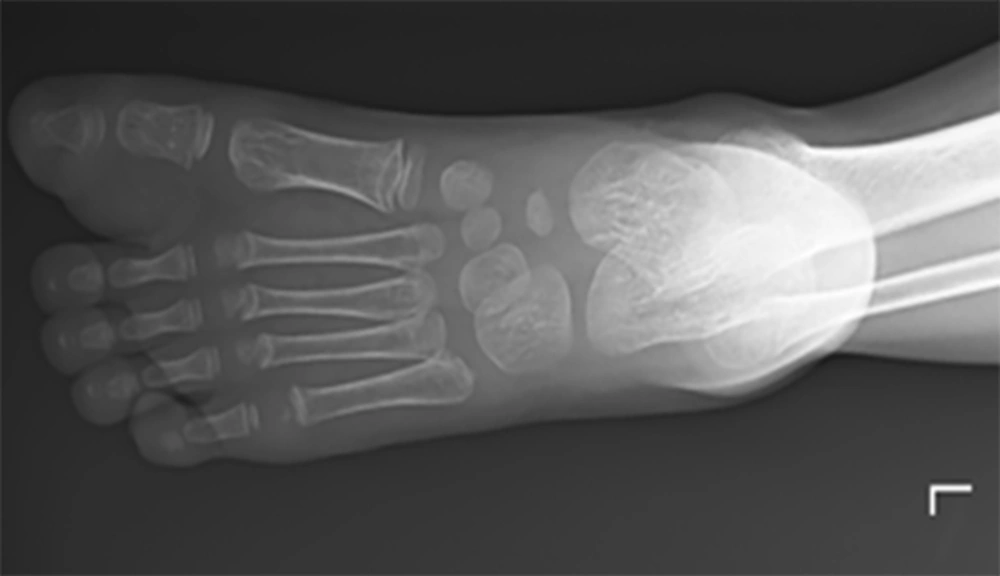
Figure 1.
Plain x-ray of the Left foot showing soft tissue mass of the big toe with widening of the first web space
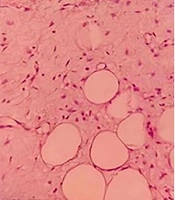
After the investigations, the parents agreed to an excisional biopsy, and complete surgical excision of the mass was done. The intraoperative finding was a yellowish to pink fleshy mass measuring 2.5 × 3 cm. Excision with a clear margin was done, and the sample was subjected to histopathology. Gross examination of the specimen revealed a nodular, gray-white, well-circumscribed 3 × 2.5 × 1.5 cm firm tissue having a glistening yellow surface on cut section (Figure 2). Microscopic examination of the tumor revealed a well-encapsulated mass composed of lobules of mature adipose tissue. These lobules were separated by fibrous septa and exhibited extensive areas of myxoid change. No lipoblasts, nuclear atypia, necrosis, or mitotic activity was seen (Figure 3). These findings were consistent with a myxolipoma. After the surgery, the patient had a smooth post-operative course. There is no evidence of recurrence at 4 months of follow-up.
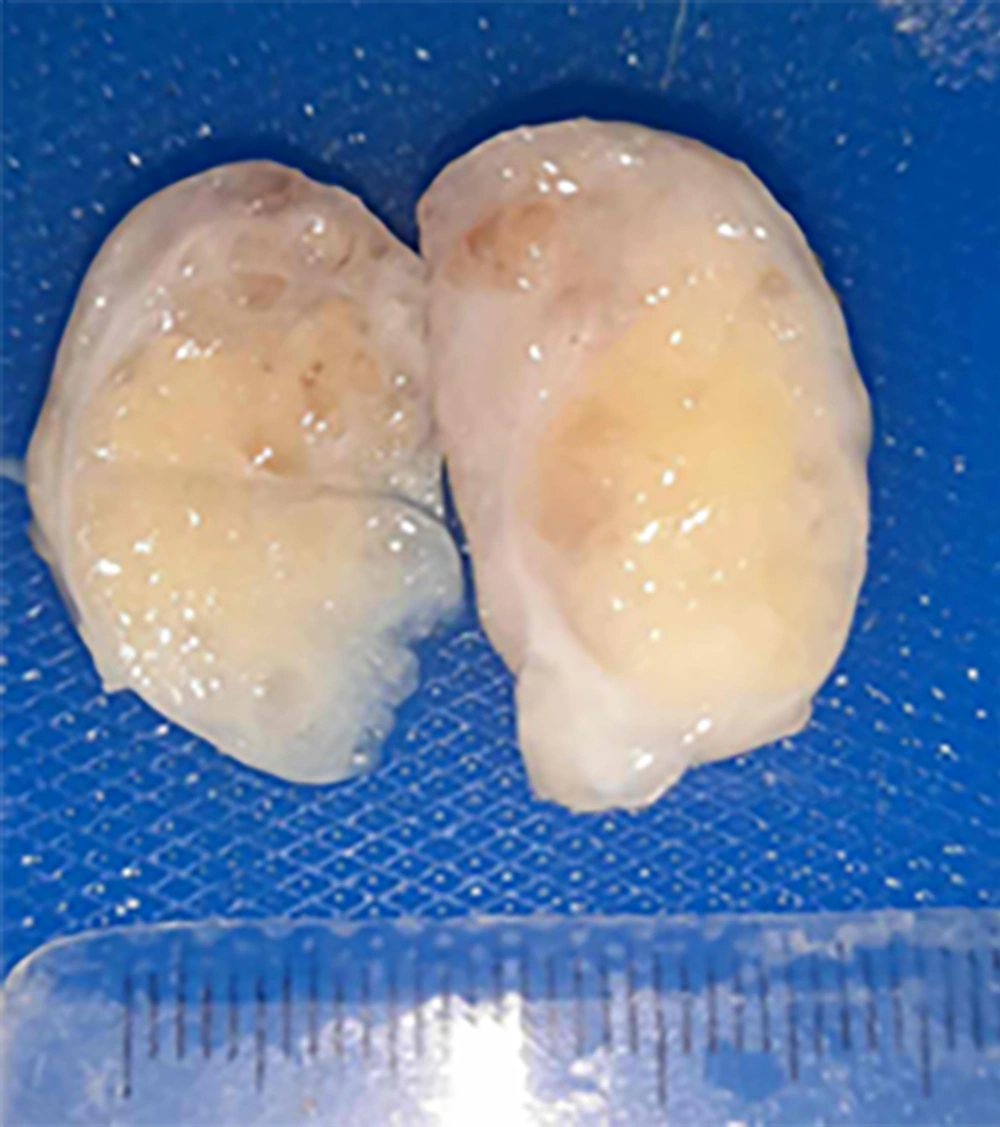
Figure 2.
Gross appearance of the specimen
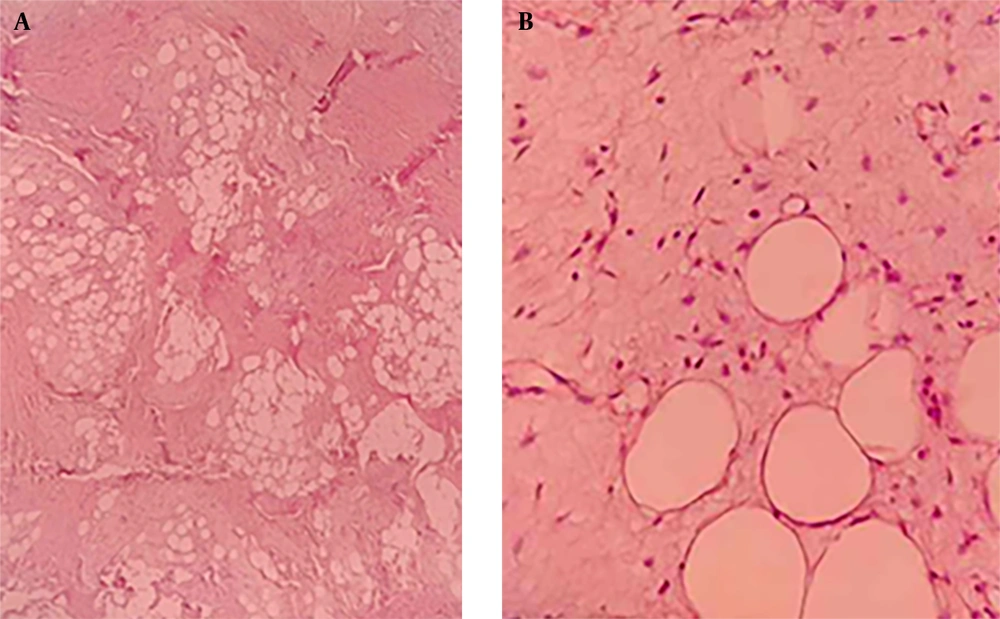
Figure 3.
Microscopic examination of the tumor showing lobules of mature adipose tissue with extensive areas of myxoid change
3. Discussion
Lipomas are benign neoplasms composed of mature adipose tissue. These tumors can be found in various parts of the body. They are slowly growing tumors and are usually asymptomatic (4). Commonly affected areas include the neck, trunk, shoulders, and arms, while occurrences in the hands or feet are rare. Foot lipomas, in particular, are uncommon, with only a few cases reported at different sites within the foot (6, 7). Both benign and malignant soft tissue lesions may affect the foot. These include ganglions, lipomas, villonodular synovitis, foreign body reactions, fibrolipomas, and soft tissue sarcomas (8). Myxolipoma is a rare benign tumor characterized by the presence of a mucoid substance and distinct histopathological features, accounting for less than 1% of all lipomas (4, 9). It consists of a lipoma interspersed with abundant mucoid material. Some cells within the developing lipoma will undergo differentiation into adipocytes while others, in addition to forming fatty tissue, secrete mucoid material, which leads to the formation of a myxoid appearance (10). The myxoid change is due to a gelatinous matrix which is composed of water mixed with sulfated and nonsulfated glycosaminoglycans (5). Most cases of myxolipoma are reported in individuals in their fifth or sixth decade of life (4). A few cases have been documented in various parts of the body, including the oral cavity, cervico-mediastinal region, retroperitoneum, heart, tongue, epiglottis, and kidney, occurring in both adults and children over the age of five (9). To the best of our knowledge, this is the first case of myxolipoma of a foot in a 5-year-old child. Ultrasonography is the preferred imaging modality for superficial soft tissue masses. The MRI has 94% accuracy with the added advantage of delineating the anatomical extension of the lesion and displaying the lesion in relation to the surrounding (9, 11). Surgical excision is usually curative with minimal risk of recurrence.
3.1. Conclusions
The foot is a rare location for soft tissue tumors, including lipoma. Myxolipoma, a variant of lipoma, is even rarer. This case highlights the importance of documenting such presentations to contribute to future studies. Clinically, myxolipoma may mimic other benign soft tissue masses; therefore, it is recommended to consider lipoma as a differential diagnosis across all age groups. Definitive diagnosis requires biopsy and histopathological evaluation.