
1. Background
The skin is the largest organ of the body, accounting for around 15% of the total body weight in adults, and it is constantly growing and renewing throughout life. It has numerous functions, including thermoregulation, conduction of physical sensations, and acting as a mechanical barrier to protect the body against the invasion of microorganisms and harmful environmental factors such as radiation, mechanical damage, and thermal and chemical burns (1, 2). Maintaining the natural structure of the skin, especially facial skin, is highly valuable in social relationships, as it plays an important role in determining an individual’s appearance. This is evident in the growing global industry of cosmetic treatments and plastic surgeries aimed at rejuvenating the skin or removing skin lesions (3).
Psoriasis is a chronic papulosquamous skin disease. It is a non-contagious, chronic, and inflammatory condition that can cause disfigurement and disability in affected individuals (4). The disease is characterized by small, red, scaly plaques on various parts of the body and is associated with arthritis in 5 - 20% of cases. The most common form of the disease is psoriasis vulgaris, which appears as ring-shaped plaques on the extensor areas of the body, such as the elbows, lower back, and around the navel (5, 6). Psoriasis leads to patches of thick, red skin with shiny scales. These patches are most commonly found on the elbows, knees, scalp, back, face, palms, and soles of the feet, but other areas may also be affected, including the fingernails, toenails, and mouth (7, 8). Treatment options include topical ointments, oral medications, injectable drugs, light therapy, or a combination of these approaches. Some treatments can relieve psoriasis. Creams or ointments may be sufficient to improve small areas of rash, but if the rash affects larger areas or if there is joint pain, other medications may be needed. Joint pain may be a sign of arthritis. The healthcare provider will determine a treatment plan based on the severity of the rash, the area of the body affected, and the patient's age.
Seborrheic dermatitis is a multifactorial medical condition with an etiology that is not yet fully understood. Stress, fatigue, androgens, microangiopathic vascular changes, seasonal weather changes, dietary patterns, food sensitivities, autoimmunity, Malassezia infections, and deficiencies in riboflavin, pyridoxine, and biotin have all been implicated in its pathogenesis and severity (2).
In adolescents and adults, seborrheic dermatitis typically does not resolve on its own without treatment. The type of treatment depends on the area of the body affected and the severity of the condition. The goal of treatment is to reduce the visible symptoms of seborrheic dermatitis, as well as itching and redness. Treatment includes the use of over-the-counter products and prescription medications. Prescription treatments include topical antifungals, calcineurin inhibitors, and corticosteroids.
Given the important role of personality traits and body image in the occurrence of psychosomatic diseases — and considering the conditions mentioned above — it appears that no specific research has been conducted in Iran comparing personality traits and body image in patients with psoriasis and seborrheic dermatitis. Therefore, this study aims to compare personality traits and body image in patients with these two skin conditions.
According to our searches, no studies have been conducted in Iran that compare personality traits and body image in patients with both psoriasis and seborrheic dermatitis, making this study a novel investigation. Most previous studies examine each skin condition individually. Among the strengths of the present study is the consideration of how skin diseases affect patients’ self-image and influence their personality traits, anxiety, and depression.
2. Objectives
This study was designed to examine personality traits and body image in two skin diseases, so that the results can be used to implement targeted interventions to manage patients’ anxiety and depression.
3. Methods
The present study is an analysis that was conducted during the years 2021 - 2022. To begin the study, after the proposal was approved, a letter of introduction was obtained by referring to the research vice-president, and the necessary coordination was made to conduct the study. The study population consisted of patients with psoriasis and seborrheic dermatitis who referred to the skin clinics of hospitals in Ilam. From these patients, 80 individuals with psoriasis and seborrheic dermatitis were selected using the available sampling method. After explaining the purpose of the study, ensuring the confidentiality of their personal information, and obtaining informed consent, the patients entered the study.
The data collection tool in this study was a survey, which consisted of three parts.
The first part included demographic data such as age, sex, marital status, and level of education.
The second part was the standard Big Five Personality Factor Questionnaire (NEO-FFI), used to examine personality traits in patients.
The third part was the Body Image Questionnaire (MBSRQ).
3.1. Big Five Personality Factor Questionnaire (NEO-FFI)
This questionnaire was developed by Costa and McCrae (1992) to measure the five-factor model of personality (neuroticism, extraversion, openness to experience, agreeableness, and conscientiousness). Each domain has six subscales, representing specific personality traits that reflect different aspects of each domain. This test contains 60 questions. Respondents are asked to express their opinion on each item using a 4-point Likert scale (0 = strongly disagree to 4 = strongly agree). Scale scores are calculated by summing the 12 items for each dimension, with some items reverse-scored according to the provided instructions.
3.2. Body Image Questionnaire (MBSRQ)
This questionnaire consists of 68 items completed by the participant and is designed to assess the individual’s attitude toward different dimensions of body image. It comprises three scales:
1- Body-Self Relations Questionnaire (BSRQ): All items except for those specified in the next two subscales are scored as follows: 1 for "strongly disagree," 2 for "somewhat disagree," 3 for "no opinion," 4 for "somewhat agree," and 5 for "strongly agree."
2- Body Areas Satisfaction Scale (BASS Body): This includes items 60 to 68. Scoring is as follows: 1 for "Very dissatisfied," 2 for "Somewhat dissatisfied," 3 for "No opinion," 4 for "Somewhat satisfied," and 5 for "Very satisfied."
3- The scale related to the individual’s attitude towards weight: This includes items 56, 57, 58, 59, and 66. It covers two components: Psychological preoccupation and the individual’s self-assessment of their weight.
The validity of the main parts of the MBSRQ was evaluated and confirmed by Brown et al. in 1990, with a reported reliability of 0.81. In Iran, the reliability of this tool was also reported by Zarshenas and his colleagues, with the following subscale reliability coefficients: Appearance orientation 0.87, appearance evaluation 0.85, weight gain concern 0.82, satisfaction with different body parts 0.79, and weight evaluation from the individual's perspective 0.75.
The subscales of this questionnaire are:
- Appearance assessment (5-11-21-30-39-42-48)
- Appearance orientation (1- 50-49-41-40-32-31-23-22-13-12-2)
- Fitness assessment (24-33-51)
- Fitness orientation (53-44-43-35-34-26-25-16-15-14-6-4-3)
- Health assessment (54-45-30-27-17-7)
- Health orientation (52-38-29-28-19-18-9-8)
- Disease orientation (56-55-47-46-37)
- Body satisfaction (61-68)
- Subjective weight (60-59)
- Preoccupation with (excess) weight (10-28-57-58)
- The following two subscales:
- Mental weight) is obtained by summing the items 59-60 divided by 2)
- Preoccupation with excess weight) is obtained by summing the items 57-11 divided by 4).
- A higher score indicates greater satisfaction.
The questionnaire was provided to the patients by the interviewer visiting the skin clinics of Ilam city and the dermatologist's office. After completing the questionnaire and collecting the data, SPSS 22 software was used to analyze the data.
4. Results
In this study, 80 individuals (26 men and 54 women) were examined. The average age of the study subjects was 31.31 ± 8.8 years. Fifty-five percent of the participants were single, and the remainder were married. Most of the participants (41.3%) held a bachelor's degree. Among the participants, 50% had seborrheic dermatitis, 43.8% had psoriasis vulgaris, and 6.2% had scalp psoriasis (Table 1).
Table 1.
Demographic Information of Participants by Disease Type
| Disease Type | Female | Male | Age (Mean ± SD) |
|---|---|---|---|
| Scalp psoriasis | 2 | 3 | 40.13 ± 4.35 |
| Seborrheic | 22 | 18 | 53.8 ± 25.5 |
| Psoriasis vulgaris | 30 | 5 | 63.3 ± 36.6 |
In this study, the NEO questionnaire was used to measure the dependent variable of personality, and the score obtained by each participant in this questionnaire was used for this purpose.
The analysis of the results from the personality traits questionnaire for all three groups — patients with scalp psoriasis, seborrheic dermatitis, and psoriasis vulgaris — is presented in Table 2.
Table 2.
Status of Personality Traits in the Patients Studied
| Variables | SD ± Mean | Mode | ||||
|---|---|---|---|---|---|---|
| Scalp Psoriasis | Seborrheic | Psoriasis Vulgaris | Scalp Psoriasis | Seborrheic | Psoriasis Vulgaris | |
| Extroversion-introversion | 28.2 ± 3.49 | 28.73 ± 3.08 | 28.63 ± 3.46 | 28 | 28 | 29 |
| Openness to experience | 25.2 ± 4.38 | 25.2 ± 3.84 | 24.74 ± 3.59 | 24 | 29 | 25 |
| Agreeing | 26.6 ± 0.894 | 26.3 ± 3.86 | 26.31 ± 2.74 | 27 | 22 | 28 |
| Being conscientious | 25.2 ± 4.15 | 28.33 ± 3.09 | 27.37 ± 3.69 | 25 | 27 | 26 |
| Neuroticism | 24.2 ± 5.02 | 23.88 ± 3.42 | 26.34 ± 3.56 | 20 | 24 | 24 |
One-way ANOVA analysis of personality trait data among patients in the three groups — scalp psoriasis, seborrheic dermatitis, and psoriasis vulgaris — showed a significant difference only in neuroticism traits at a 5% significance level (P = 0.014, df = 2, F = 4.55). However, no significant differences were observed in the other personality characteristics (extraversion-introversion, openness to experience, agreeableness, and conscientiousness) based on the NEO survey among patients in all three groups (Table 3).
Table 3.
Analysis of Variance of Personality Traits Among Patients in the Three Groups of Scalp Psoriasis, Seborrheic Dermatitis, and Psoriasis Vulgaris
| Variable | F | df | P-Value |
|---|---|---|---|
| Neuroticism | 4.55 | 2 | 0.014 |
| Extroversion-introversion | 0.059 | 2 | 0.943 |
| Openness to experience | 0.145 | 2 | 0.865 |
| Agreeing | 0.019 | 2 | 0.981 |
| Being conscientious | 2.153 | 2 | 0.123 |
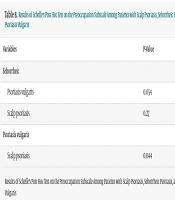
Using the Sheffe post hoc test, it was determined that there was a significant difference in the neuroticism trait only between the scores of seborrheic dermatitis patients and those of psoriasis vulgaris patients (P = 0.015), while no significant differences were found between the scores of seborrheic dermatitis patients and those of scalp psoriasis patients, nor between the scores of psoriasis vulgaris patients and those of scalp psoriasis patients (Table 4).
Table 4.
Results of Scheffe's Post Hoc Test on Neurotic Personality Trait Among Patients with Scalp Psoriasis, Seborrheic Psoriasis, and Psoriasis Vulgaris
| Variables | P-Value |
|---|---|
| Seborrheic | |
| Psoriasis vulgaris | 0.015 |
| Scalp psoriasis | 0.982 |
| Psoriasis vulgaris | |
| Scalp psoriasis | 0.461 |
ANOVA analysis showed significant differences at the 5% significance level among the three patient groups — seborrheic dermatitis, scalp psoriasis, and psoriasis vulgaris — only for the three subscales of fitness tendency (P = 0.045), health evaluation (P = 0.048), and preoccupation (P = 0.047) (Table 5).
Table 5.
Analysis of Variance of Body Image Subscales Among Patients in Three Groups of Scalp Psoriasis, Seborrheic Psoriasis, and Psoriasis Vulgaris
| Variables | F | df | P-Value |
|---|---|---|---|
| Appearance assessment | 2.255 | 2 | 0.112 |
| Appearance trend | 2.851 | 2 | 0.094 |
| Suitability assessment | 0.241 | 2 | 0.786 |
| Proportion tendency | 3.22 | 2 | 0.045 |
| Health assessment | 3.159 | 2 | 0.048 |
| Health trend | 1.839 | 2 | 0.166 |
| Disease tendency | 1.084 | 2 | 0.343 |
| Physical satisfaction | 1.849 | 2 | 0.164 |
| Mental weight | 2.081 | 2 | 0.132 |
| Preoccupation | 2 | 3.186 | 0.047 |
Using Scheffe's follow-up test for the three subscales of fitness tendency, health assessment, and preoccupation, it was shown that in the fitness tendency subscale, there was a significant difference (P = 0.015) only between the scores of patients with seborrheic dermatitis and those with psoriasis vulgaris (Table 6).
Table 6.
Comes About of Scheffe's Post Hoc Test on the Wellbeing Propensity Subscale Among Patients with Scalp Psoriasis, Seborrheic Psoriasis, and Psoriasis Vulgaris
| Variables | P-Value |
|---|---|
| Seborrheic | |
| Psoriasis vulgaris | 0.015 |
| Scalp psoriasis | 0.284 |
| Psoriasis vulgaris | |
| Scalp psoriasis | 0.895 |
Also, in the health assessment subscale, a significant difference was observed between the scores of patients with seborrheic dermatitis and those with scalp psoriasis (Table 7).
Table 7.
Comes About of Scheffe's Post Hoc Test on the Wellbeing Appraisal Subscale Among Patients with Scalp Psoriasis, Seborrheic Psoriasis, and Psoriasis Vulgaris
| Variables | P-Value |
|---|---|
| Seborrheic | |
| Psoriasis vulgaris | 0.173 |
| Scalp psoriasis | 0.021 |
| Psoriasis vulgaris | |
| Scalp psoriasis | 0.097 |
In the preoccupation subscale, a significant difference was observed between the scores of patients with psoriasis vulgaris and those with scalp psoriasis (Table 8).
Table 8.
Results of Scheffe's Post Hoc Test on the Preoccupation Subscale Among Patients with Scalp Psoriasis, Seborrheic Psoriasis, and Psoriasis Vulgaris
| Variables | P-Value |
|---|---|
| Seborrheic | |
| Psoriasis vulgaris | 0.054 |
| Scalp psoriasis | 0.27 |
| Psoriasis vulgaris | |
| Scalp psoriasis | 0.044 |
5. Discussion
Maintaining the natural structure of the skin, especially the facial skin, is of great value in social relationships, as its appearance is an important determinant of an individual’s formal communication (9). The skin is a major material organ that plays a role in social intuition throughout life. The skin responds to emotional jolts, and its appearance impacts body image and self-esteem (2, 10). Disorders in the organs cause disturbances in the individual’s self-concept and body image.
The results indicate that more than 50% of the patients in this study were women, which aligns with the studies of Soulati Dehkordi et al. (11), Taheri et al. (4), and Khaledian et al. (5), showing that the prevalence of this disease is higher in women. This may be because women usually pay more attention to their health and seek medical help sooner if the disease occurs.
According to the findings of the study, there is a significant difference in the personality trait of neuroticism among patients in the three groups of scalp psoriasis, seborrheic psoriasis, and psoriasis vulgaris. According to the results, people with psoriasis vulgaris have a different level of neuroticism than those with seborrheic psoriasis, which is consistent with studies by Darvishi et al. (12) and Wheeler et al. (8). Neuroticism is a personality trait that makes a person unable to resolve anxieties and conflicts and causes them to suffer from pathological symptoms. Neurotic individuals are characterized as anxious, depressed, and irrational, with low self-esteem. Due to psoriasis and its psychological, mental, and physical effects on individuals, these individuals score high on the neuroticism factor or are more prone to experiencing negative emotions such as worry, anger, frustration, guilt, sadness, hopelessness, and shyness due to loss of socio-economic support. A person who scores high on neuroticism (anxiety, depression, anger, tension) has less impulse control and a lower degree of adaptability (12). In another study, the scores on the EPQ-RSF neuroticism subscale of patients with seborrheic dermatitis were statistically significantly higher than those of the control group. Neuroticism is the strongest and most unique indicator of common psychiatric disorders, playing a critical role in chronic mental health and physical health issues related to mental stress. In a study by Khaledian et al., patients with irritable bowel syndrome scored higher on the neuroticism scale and lower on extraversion and conscientiousness components compared to healthy individuals, but the differences in openness to experience and agreeableness were not significant between the two groups (5). Kumar et al. also showed that these patients report high levels of neuroticism due to the presence of skin lesions, which include negative emotions such as anxiety, depression, reduced activity threshold, lack of inhibition and control of emotions, and heightened reactivity to stressors, becoming sad and nervous with the slightest incompatible stimulus. These individuals also experience avoidance of intimacy and emotional closeness in attachment relationships, and limitations in their ability to identify and verbally express emotions (13).
The results showed no significant difference in the personality trait of extraversion-introversion between the two groups with psoriasis and seborrheic dermatitis. Although the extraversion score in psoriasis patients is lower than in seborrheic patients, this difference is not significant; in other words, the extraversion personality trait is similar in psoriasis and seborrheic patients, which aligns with the findings of Hashemi et al. (14). To explain these findings, it may be said that extraversion is related to lower personality traits, and the results suggest that extraversion goes beyond major variables to lower levels within the personality hierarchy. On the other hand, the lack of association of extraversion with psoriasis and seborrheic disease in this study may be related to cultural and gender factors (high percentage of female patients and expression of emotion and interpersonal communication), which should be considered in future research.
The results showed no significant difference in the raw scores of the personality traits of openness and agreeableness between psoriasis and seborrheic patients, which is consistent with the study of Hashemi et al. (14) but not with that of Darvishi et al. (12). The study by Agah Heris et al. (15) showed that the personality trait subscale of openness to experience was lower in individuals with psoriasis than in those without psoriasis, and there was no significant difference in other personality subscales such as conscientiousness, agreeableness, and extraversion between people with and without psoriasis. The results showed no significant difference in the level of agreeableness between the two groups of patients with psoriasis and seborrheic dermatitis. This finding is consistent with the studies of Darvishi et al. (12) and Mahmoud Alilou et al. (16), but not with Cohen et al. (17, 18). An agreeable person is altruistic, empathetic, eager to help others, and believes that others are helpful in return.
Body image, a fundamental element of a person's personality and self-concept, can be a source of both positive and negative emotions, thus affecting psychological life and attitudes. In fact, if this image is positive, it creates a sense of self-worth, but dissatisfaction with this image leads to humiliation, which affects daily functions, interpersonal relationships, sexual relationships, and consequently marital relationships. In other words, physical appearance, an important portion of body image, is the primary source of information that others use for interpersonal intuition with that individual (19).
Given that body image is a complex construct related to an individual's perceptions and attitudes about themselves — especially their physical appearance — factors such as body satisfaction, self-appearance schemas, the importance of internalized appearance ideals, and emotions related to body image are also relevant to body image therapy (20, 21). The results showed a significant difference between the three groups of seborrheic, scalp psoriasis, and psoriasis vulgaris patients only for three subscales: Fitness tendency, health evaluation, and preoccupation. In the study by Rayegan et al., the treatment method improved fitness tendency, which is consistent with our study. This subscale measures fitness status and indicates the level of investment in being physically fit or engaging in sports activities. In our study, average body satisfaction in seborrheic patients was higher than in psoriasis patients, but this difference was not statistically significant, which aligns with Rayegan et al.’s findings. In another study, no positive change was observed in the body satisfaction subscale with the application of the treatment method. This subscale measures the degree of dissatisfaction or satisfaction with specific body regions and features such as the face, weight, and muscle tone (22). In skin diseases, since the disease affects individuals' appearance, the patient’s psyche is affected, which leads to dissatisfaction with appearance.
5.1. Conclusions
Considering the important role of personality traits and body image in the occurrence of psychosomatic diseases, and the effect skin diseases have on the body and psyche of individuals, the impact of skin diseases on the psychological state ranges from mild anxiety to severe worry in the patient. These psychological characteristics can cause or exacerbate skin diseases; therefore, it is necessary to consider the psychological aspects of these diseases and implement interventions to control their psychological effects on patients.