J Skin Stem Cell

Image Credit:J Skin Stem Cell

Tear Trough Deformity Refinement by an Innovative Hyaluronic Acid Injectable Filler

Author(s):
Eleftheria TampouratziEleftheria TampouratziEleftheria Tampouratzi ORCID1, Eirini Nektaria GiagkouEirini Nektaria Giagkou1,*, Athanasios ChristopoulosAthanasios Christopoulos1, Kyriakos TalaiporouKyriakos Talaiporou2, Spyridon MatsagosSpyridon Matsagos1, Eslam Taha ElbadawayEslam Taha Elbadaway3, 4, 5, Ioannis KatsantonisIoannis Katsantonis6
1Tzaneio General Hospital of Piraeus, Pireas, Greece
2Department of Business Administration, School of Administrative, Economics and Social Sciences, University of West Attica, Athens, Greece
3M.B.B.Ch, Faculty of Medicine, Benha University, Benha, Egypt
4MSc in Dermatology, Andrology and STDs, Faculty of Medicine, Benha University, Benha, Egypt
5Dermatologist and Venereologist, Aesthetic Dermatologic Polyclinic, Kuwait
6Dermatologist and Venereologist, Tzaneio General Hospital, Piraeus, Greece

Journal of Skin and Stem Cell:Vol. 12, issue 2; e163854
Published online:Jun 30, 2025
Article type:Research Article
Received:Apr 23, 2025
Accepted:Jun 27, 2025
How to Cite:Tampouratzi E, Nektaria Giagkou E, Christopoulos A, Talaiporou K, Matsagos S, et al. Tear Trough Deformity Refinement by an Innovative Hyaluronic Acid Injectable Filler.J Skin Stem Cell.2025;12(2):e163854.https://doi.org/10.5812/jssc-163854.

Abstract

Background:

The tear trough refers to the anatomical depression extending from the medial canthus obliquely down and out across the cheek. With aging or significant weight loss, there is often a loss of subcutaneous volume and thinning of the overlying skin in this area, resulting in a sunken appearance and shadowing that contributes to a fatigued look. Tear trough deformity is often treated with hyaluronic acid (HA) fillers or surgical interventions (blepharoplasty, fat grafting), but minimally invasive treatments have gained popularity due to fewer side effects. The HA-based dermal fillers, specifically designed for the periorbital region, can be used to restore volume, reduce the depth of the tear trough deformity, and improve the overall contour and brightness of the under-eye area. However, challenges like edema and irregularities persist due to filler quality, which usually concerns professionals.

Objectives:

To evaluate the efficacy and safety of a novel HA filler (20 mg/mL) using specific cross-linked enhanced dermal integration system-mono-densified sphere creation (SCEDIS-MSCS) technology, which produces monophasic, mono-densified HA Neo-Spheres for enhanced stability, tissue integration, and resistance to degradation compared to traditional non-cross-linked or polydensified HA fillers for tear trough deformity correction in a prospective single-arm pilot trial.

Methods:

A prospective single-arm study enrolled sixteen Caucasian females (40.5 ± 5.45 years) with Fitzpatrick type III-IV skin and longstanding tear trough deformity. Participants received a single session of HA filler injections (1 mL total, 0.5 mL per side) using a 25 G cannula. Outcomes were assessed using the Global Aesthetic Improvement Scale (GAIS), high-resolution digital photography, and a modified Tear Trough Improvement Scale (TTIS) Questionnaire at baseline, immediately after, and one month post-treatment. Statistical analysis employed one-way Friedman ANOVA and Wilcoxon signed-rank tests with a significance level of α = 0.10.

Results:

The GAIS scores indicated significant improvement in tear trough appearance (P = 0.05, 18.2% reduction in wrinkle severity, mean ± SD 5.8). The TTIS scores increased from 29.2 ± 4.5 to 41.8 ± 3.9, P = 0.001) one month post-treatment, reflecting high patient satisfaction. Digital photography confirmed visible refinement in infraorbital hollows. No significant adverse events, including prolonged edema, were reported.

Conclusions:

The SCEDIS-MSCS HA filler significantly improved tear trough deformity with sustained effects at one month, suggesting its potential as an effective non-surgical treatment. A larger randomized controlled trial (RCT) is warranted to confirm efficacy.

1. Background

The tear trough, referring to the medial one-third of the periorbital hollow, is a common aesthetic concern contributing to a fatigued or aged appearance (1). While often associated with aging, tear trough deformity can also be present in younger individuals due to anatomical factors (2). Non-surgical correction using hyaluronic acid (HA) fillers has gained popularity due to its minimally invasive nature as opposed to surgical options like fat grafting or blepharoplasty (3). However, challenges such as post-injection edema and skin irregularities have been reported, often linked to filler quality or injection technique (4).

To address these issues, a novel monophasic, mono-densified HA filler, developed using specific cross-linked enhanced dermal integration system-mono-densified sphere creation (SCEDIS-MSCS) technology, was introduced. This technology produces ultrafine HA Neo-Spheres with enhanced intermolecular bonds, improving material stability, tissue integration, and resistance to degradation compared to traditional non-cross-linked or polydensified HA fillers (5). These properties aim to minimize edema and ensure smooth, natural-looking results in the sensitive tear trough area.

2. Objectives

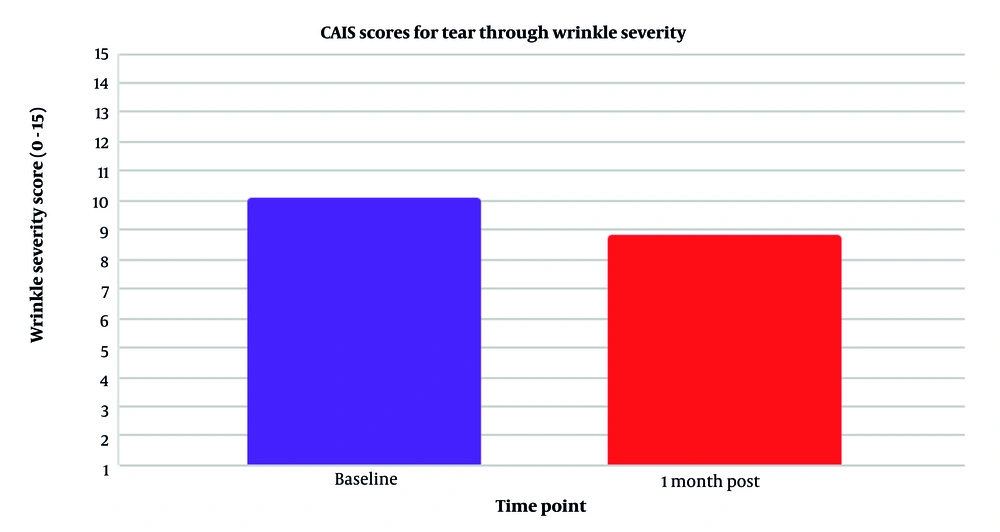
Based on this, the current pilot study explicitly aimed to evaluate the efficacy and safety of the novel HA filler in improving tear trough aesthetics, using both objective Global Aesthetic Improvement Scale (GAIS) and subjective Tear Trough Improvement Scale (TTIS) measures, with plans for a larger randomized controlled trial (RCT) to confirm findings (Figure 1).

Global Aesthetic Improvement Scale (GAIS) scores showed an 18.2% reduction in wrinkle severity (P = 0.05, mean ± SD 5.8) one-month post-treatment.
Figure 1.

Global Aesthetic Improvement Scale (GAIS) scores showed an 18.2% reduction in wrinkle severity (P = 0.05, mean ± SD 5.8) one-month post-treatment.

3. Methods

3.1. Patients

Sixteen females (age range 30 - 55, 40.5 ± 5.45 years) with obvious tear trough aesthetic deformity were enrolled in the study. All participants had been experiencing an obvious infraorbital hollow for more than 10 years. The exclusion criteria included connective tissue diseases (e.g., lupus erythematosus), blood disorders, and cancer. The use of salicylic acid, vitamin E, Ginkgo Biloba, anti-inflammatory, and anti-platelet drugs was prohibited for 20 days before the application of HA. Patients who had undergone chemical peelings, dermabrasion, fractional laser application, or any type of filler injection in the area under study should have been treated more than 2 years ago. All females provided written informed consent after receiving detailed information about the tear trough filler, and the study was conducted in compliance with Good Clinical Practice and the Declaration of Helsinki, in accordance with Greek law. The study protocol and patient involvement were formally approved by the Local Ethics Committee of Tzaneio General Hospital, Piraeus, Greece.

3.2. Tear Trough Treatment

Each subject was injected with 1 mL of the studied HA filler, approximately 0.5 mL per side. In all cases, a 25 G cannula was used to ensure safer penetration, aiming to avoid puncturing blood vessels and nerves, thereby reducing the risks of bleeding, bruising, and pain (4). Microinjections (0.02 - 0.05 mL/site) were spaced 1 - 2 cm apart, following a standardized protocol.

Outcomes were assessed using: (1) The GAIS, a validated 5-point scale for evaluating aesthetic treatment outcomes (5); (2) high-resolution digital photography (consistent focus, lighting, and file format; participants remained expressionless) taken before and one month post-treatment.

A modified TTIS Questionnaire, adapted from a validated scale (6), administered before, immediately after, and one month post-treatment. The TTIS was designed based on a retrospective analysis of tear trough filler outcomes (7) and was used to assess daily feel-good sense. For that purpose, it was completed at the same time points to capture subjective satisfaction and to monitor side effects like edema.

It should be mentioned that the GAIS score was conducted one month after the tear trough injections since immediate post-injection edema may mislead the objective observation. However, edema, even if short-lasting, is considered a bothersome side effect. Because of this, and since it was of main interest to estimate the daily feel-good sense of the participants, the TTIS Questionnaire was applied before, the first day after, and one month post the injectable aesthetic intervention.

3.2.1. Content of the Modified Tear Trough Improvement Scales and Checklists

3.2.1.1. Tear Trough and Upper Lip Wrinkles Improvement Scale

Please rate your satisfaction with the following aspects of your dermal filler treatment for tear troughs and upper lip wrinkles on a scale of 1 to 5, where: 1 = very dissatisfied, 2 = dissatisfied, 3 = neutral, 4 = satisfied, and 5 = very satisfied.

1. Reduction in the appearance of tear trough deformity.

2. Improvement in the appearance of dark circles or shadows under the eyes.

3. Smoothing of upper lip wrinkles (barcode lines).

4. Enhancement of lip definition and shape.

5. Natural-looking results in the treated areas.

6. Comfort and absence of lumps or irregularities in the treated areas.

7. Harmony of the treated areas with the rest of your facial features.

8. Improvement in the overall youthful appearance of your periorbital and perioral regions.

9. Likelihood of continuing with this dermal filler treatment for long-term maintenance of the results.

10. Likelihood of recommending this dermal filler treatment to others seeking to improve their tear troughs and upper lip wrinkles.

Scoring:

- Add up the scores for all 10 questions.

- Minimum score: 10.

- Maximum score: 50.

- Higher scores indicate greater satisfaction with the dermal filler treatment for tear troughs and upper lip wrinkles.

3.3. Hyaluronic Acid Injectable Fillers
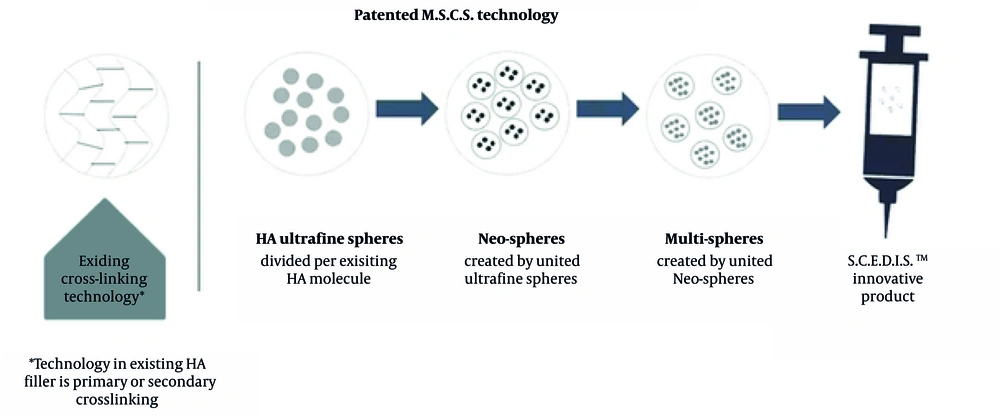
The HA filler, composed of monophasic, mono-densified cross-linked HA chains with enhanced intermolecular bonds, was developed using SCEDIS-MSCS technology to ensure material stability and delayed degradation. As depicted in Figure 2, this technology produces ultrafine HA Neo-Spheres that integrate smoothly into the tear trough, minimizing edema and irregularities compared to traditional polydensified or non-cross-linked HA fillers (5).

Innovative hyaluronic acid (HA) filler production process, designed to enhance both tissue integration and filler longevity, according to specific cross-linked enhanced dermal integration system-mono-densified sphere creation (SCEDIS-MSCS) technology
Figure 2.

Innovative hyaluronic acid (HA) filler production process, designed to enhance both tissue integration and filler longevity, according to specific cross-linked enhanced dermal integration system-mono-densified sphere creation (SCEDIS-MSCS) technology

3.4. Statistical Analysis

Statistical analysis employed one-way Friedman ANOVA to assess changes across multiple time points, followed by post-hoc Wilcoxon signed-rank tests with Bonferroni correction for pairwise comparisons. The Mann-Whitney U test was used to compare independent groups when applicable. Effect sizes were calculated as percentage changes in means. A significance level of α = 0.10 was chosen to align with the exploratory nature of this pilot study, though future RCTs will adopt α = 0.05. Statistical significance was set at P < 0.10 unless otherwise noted.

4. Results

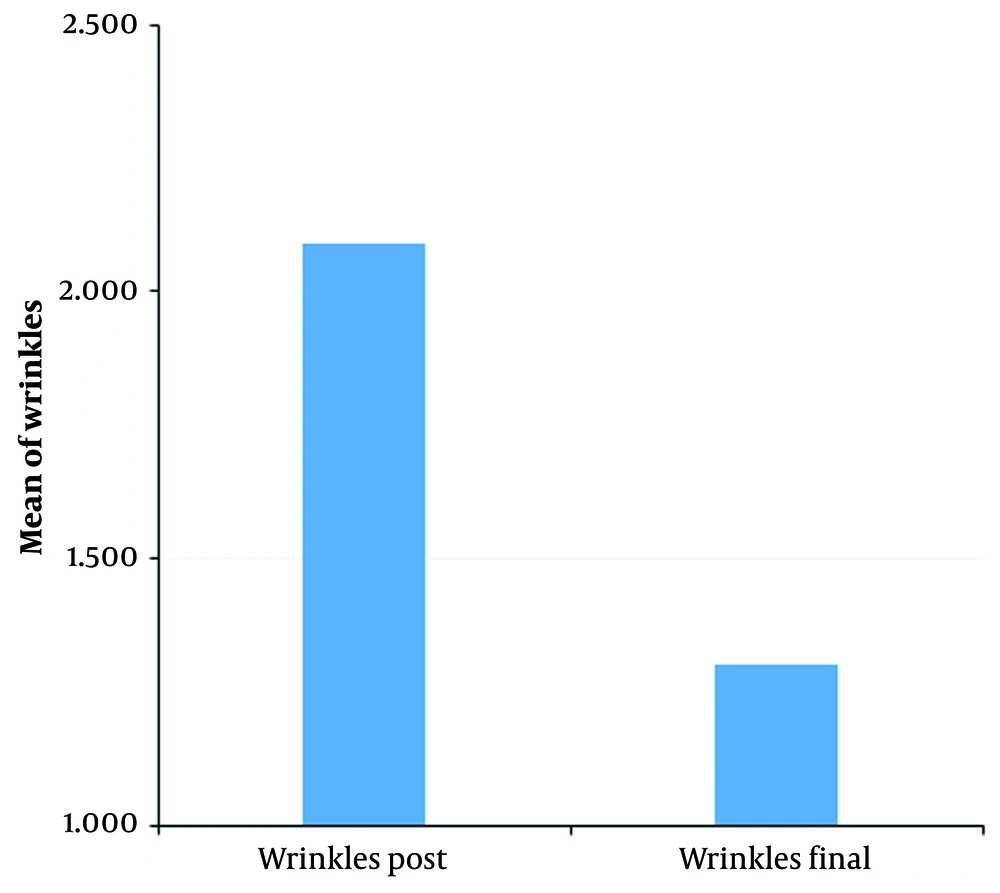
The overall aesthetic refinement of the tear trough area was found to be statistically remarkable. Figure 3, using the GAIS method of wrinkle estimation, depicts the summarized outcome, with the decrease in tear trough wrinkles shown as statistically significant at P = 0.05 (for α = 0.10). Additionally, Figure 1 illustrates an 18.2% reduction in wrinkle severity (P = 0.05, mean ± SD 5.8) according to the GAIS method. Moreover, as clearly shown in Figure 4, the TTIS Questionnaire demonstrated significant improvement in patient satisfaction (P = 0.018 immediately post-treatment, P = 0.001 one-month post-treatment, α = 0.10), with mean scores increasing from 29.2 ± 4.5 to 37.6 ± 4.2 immediately post-treatment (28.8% improvement), and to 41.8 ± 3.9 one-month post-treatment (43.2% improvement; Table 1).

Global Aesthetic Improvement Scale (GAIS) score; bar charts for means of infraorbital wrinkles variable, post and one month after treatment with hyaluronic acid (HA) injection. Statistical analysis confirms the advantageous aesthetic effect of the injected HA filler (P = 0.05).
Figure 3.

Global Aesthetic Improvement Scale (GAIS) score; bar charts for means of infraorbital wrinkles variable, post and one month after treatment with hyaluronic acid (HA) injection. Statistical analysis confirms the advantageous aesthetic effect of the injected HA filler (P = 0.05).

Results of subjective satisfaction feeling [Tear Trough Improvement Scale (TTIS) Questionnaire]; bar charts showing mean satisfaction scores (scale 8 - 40) at baseline, immediately post-treatment (P = 0.018), and one-month post-treatment (P = 0.001; error bars represent standard deviations).
Figure 4.

Results of subjective satisfaction feeling [Tear Trough Improvement Scale (TTIS) Questionnaire]; bar charts showing mean satisfaction scores (scale 8 - 40) at baseline, immediately post-treatment (P = 0.018), and one-month post-treatment (P = 0.001; error bars represent standard deviations).

Table 1.Statistical Summary of Global Aesthetic Improvement Scale and Tear Trough Improvement Scale Results
Variables; Time PointMean ± SD95% CIP-Value
GAIS (wrinkle severity)0.05
Baseline10.8 ± 3.19.2, 12.4
One month post8.8 ± 2.97.3, 10.3
TTIS score0.001
Baseline29.2 ± 4.527.0, 31.4
Immediately post37.6 ± 4.235.5, 39.7
One month post41.8 ± 3.939.8, 43.8

Abbreviations: GAIS, Global Aesthetic Improvement Scale; TTIS, Tear Trough Improvement Scale.
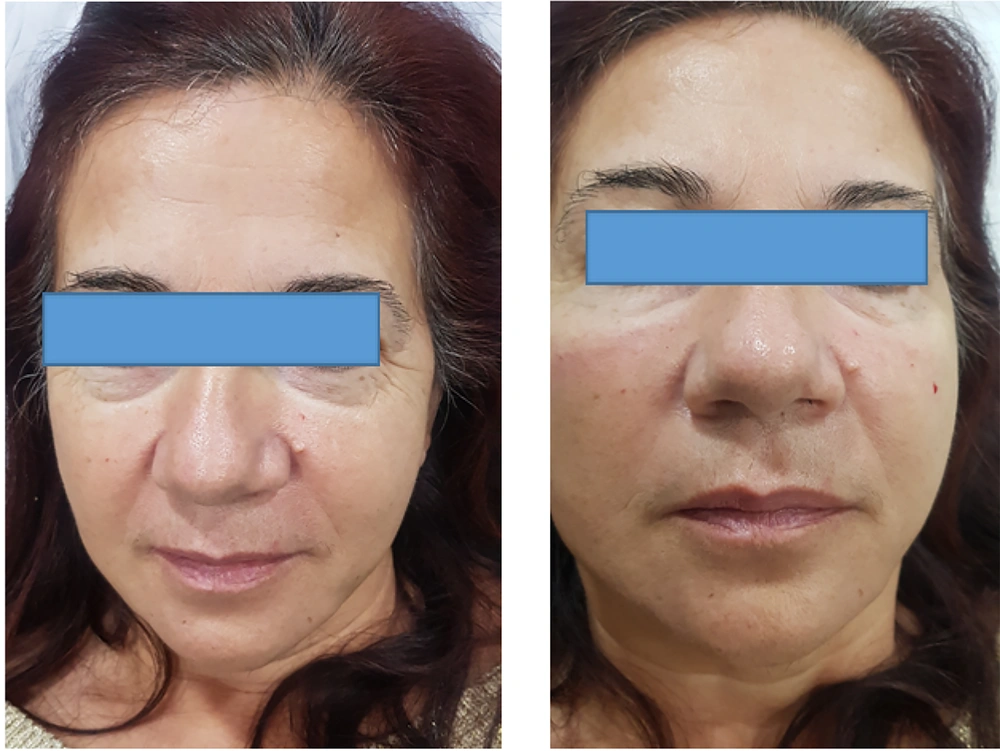
Participants' high-resolution photographs taken before and one month post-treatment demonstrated obvious refinement of the infraorbital area. Figure 5 depicts such a characteristic case. No significant adverse events, including prolonged edema, were reported, suggesting the SCEDIS-MSCS HA filler's suitability for the sensitive tear trough region.

Patient before and one month after tear trough filler application with a characteristic refinement of the infraorbital area

Figure 5.

Patient before and one month after tear trough filler application with a characteristic refinement of the infraorbital area

5. Discussion

The innovative SCEDIS-MSCS HA filler demonstrated statistically significant improvement in tear trough deformity, as evidenced by GAIS scores, high-resolution photography, and the TTIS Questionnaire (7, 8). These findings align with prior studies on HA fillers for tear trough correction, which highlight the importance of filler quality in minimizing complications like edema (9, 10). The sustained satisfaction at one month, as shown in Figure 4, likely reflects the filler’s smooth integration and stability, attributed to the SCEDIS-MSCS technology’s ultrafine HA Neo-Spheres (5). Unlike traditional HA fillers, which may cause short-term edema or irregularities due to polydensified structures, the monophasic, mono-densified design of this filler minimizes such side effects, as evidenced by the absence of significant adverse events in this study (4, 9). The gradual improvement in patient satisfaction (TTIS) suggests that the filler’s tissue integration enhances over time, potentially due to its ability to provide a stable scaffold for cellular adhesion and hydration (7). However, the lack of a control group introduces potential biases such as placebo effects or natural aging, which should be addressed in future studies.

5.1. Limitations

This pilot study has limitations, including a small sample size (n = 16), a focus on Caucasian females with Fitzpatrick type III-IV skin, and the absence of a control group, which limits conclusions about the SCEDIS-MSCS HA filler’s specific efficacy compared to other treatments. The one-month follow-up may not capture long-term outcomes, and while GAIS and photography provide robust objective measures, additional metrics (e.g., skin hydration, collagen density) could enhance evaluation. These limitations are typical of pilot studies assessing initial efficacy and feasibility.

5.2. Future Research

A multicenter RCT is planned, targeting 100 participants (50% male, diverse skin types) with a placebo control and active comparator (e.g., standard HA filler). Follow-up assessments at 6 and 12 months will evaluate durability, with additional endpoints like skin hydration and tissue integration via imaging. This will address current limitations and provide robust evidence for the SCEDIS-MSCS HA filler’s efficacy.

Footnotes

References


Crossmark
Crossmark
Checking
Share on
Cited by
Metrics

Purchasing Reprints

  • Copyright Clearance Center (CCC) handles bulk orders for article reprints for Brieflands. To place an order for reprints, please click here (   https://www.copyright.com/landing/reprintsinquiryform/ ). Clicking this link will bring you to a CCC request form where you can provide the details of your order. Once complete, please click the ‘Submit Request’ button and CCC’s Reprints Services team will generate a quote for your review.
Search Relations

Author(s):

Related Articles