1. Background
Acne is a common skin disease causing psychological and physical problems for patients. Acne often is associated with other symptoms of hyperandrogenism and this relationship and the therapeutic effect of anti-androgenic agents are important in order to manage the symptoms related to acne disease.
Diabetes and cardiovascular diseases are common in these patients; thus, treatment can help prevent these problems. Hyperandrogenism is important as a clinical sign of polycystic ovary syndrome (PCOS). Abnormalities in the metabolism of androgens and estrogen have been seen in PCO (1). All PCOS subjects should be considered at risk of atherosclerosis (2).
The pathogenesis of acne includes increased sebum production, abnormal follicular keratinization, the proliferation of Propionibacterium acne, and inflammation (3).
The role of Propionibacterium can be blocking follicles leading to inflammatory process (4).
Hyperandrogenism is a term describing the most common clinical signs in women with hyperandrogenemia. The most significant signs related to this symptom include oily skin, acne, hirsutism, android obesity, and androgenic alopecia.
2. Methods
This case-control study was conducted from 2015 to 2016 at the department of dermatology of Farshchian hospital in Hamadan, Iran. 220 female patients referring to our clinic were enrolled in the study (110 patients as the case group with mild to severe acne and 110 patients with other dermatologic complaints as the control group). Informed consent was obtained from all participants in the study.
The patients were asked about age, menstrual regularity, body weight, and height. In addition, data on the presence or absence of acne, hirsutism, androgenetic alopecia, and family members with acne history, dietary habits like consumption of fatty and sweaty foods or milk and fish were obtained from each subject.
Regular menstruation was defined as cycles of 22 to 41 days’ duration, amenorrhea referred to the absence of menstruation for 180 days or more, oligomenorrhea was an average menstrual cycle of 42 to 180 days, polymenorrhea was an average menstrual cycle of 21 days or less (5), and regular menstrual cycles were an average menstrual cycle of 22 to 41 days (6).
The patient studied in this method were suffering from acne and classified based on the global acne grading system (6-8).
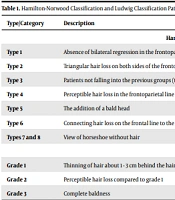
The patients were also checked for hirsutism using the modified Ferryman and Galway score assessing terminal hair density on different parts of the body. A total score less than 8 is considered normal, score 8 to 15 indicates mild hirsutism, and score greater than 15 indicates moderate to severe hirsutism (9). The patients were also checked for Alopecia using Sinclair scale. Sinclair scale is a useful tool for assessing the degree of hair loss (10).
Body mass index (BMI) categorization was based on the WHO Asia-Pacific classification for obesity, which was defined as BMI ≥ 25 kg/m2 (11).
All data were entered SPSS-20 Macintosh software and analyzed by statistical tests such as independent T-test, Chi-square, and U-test. P values less than 0.05 were considered statistically significant.
3. Results
The mean age in the case and control groups was 26.46 ± 3.63 and 27.66 ± 5.52 years, respectively, and all of the subjects were female. BMI was also measured for all the patients, and the difference in BMI between the two groups was significant. There was a significant association between acne and BMI (P value < 0.05) (Table 1).
Table 1.
Age and BMI in the Two Groups
| Mean | SD | P Value (t-Test) | |
|---|---|---|---|
| Age | |||
| Case | 26.46 | 3.63 | 0.085 |
| Control | 27.66 | 5.52 | |
| BMI | |||
| Case | 24.5 | 2.54 | 0.001 |
| Control | 22.57 | 2.64 |
Abbreviations: BMI, Body Mass Index; SD, Standard Deviation.
The highest frequency of acne was seen in the moderate group (46.3% of patients) (Table 2).
Table 2.
Acne Severity Frequency
| Acne Severity | Frequency | Percentage |
|---|---|---|
| Moderate | 51 | 46.3 |
| Mild | 38 | 34.5 |
| Severe | 14 | 12.7 |
| Very severe | 7 | 6.3 |
| Total | 110 | 100 |
The most common menstrual pattern in both groups was regular pattern; in the case group, other items in order of frequency were irregular, oligomenorrhea and polymenorrhea (Table 3). The difference between the two groups was significant.
Table 3.
Menstrual Pattern in the Two Groupsa
| Group | Regular | Oligomenorrhea | Polymenorrhea | Irregular | Amenorrhea | P Value (chi2) |
|---|---|---|---|---|---|---|
| Case | 46 (41.8) | 19 (17.2) | 6 (5.4) | 30 (27.2) | 9 (8.1) | 0.001 |
| Control | 78 (70.9) | 9 (8.1) | 5 (4.5) | 15 (13.6) | 3 (2.7) |
aValues are expressed as No. (%).
Most of the patients described worsening of their acne just before their menstruation. The peak incidence of alopecia in the case group was stage 2, which demonstrates the progression to an adult hairline and at the sign that could be seen in male baldness patterns (Table 4). The difference between the two groups was significant.
Table 4.
Alopecia and Acne Relationshipa
| Group | Stage 1 | Stage 2 | Stage 3 | Stage 4 | P Value (chi2) |
|---|---|---|---|---|---|
| Case | 34 (30.9) | 41 (37.2) | 22 (20) | 13 (11.8) | 0.001 |
| Control | 83 (775.4) | 13 (11.8) | 8 (7) | 6 (5.4) |
aValues are expressed as No. (%).
Table 5 indicates the difference between the case and control groups who were suffering from hirsutism. Based on the data, sever hirsutism could be seen in the case group more than in the control group (the scale ratio of 20% to 9%, respectively) (Table 5).
Table 5.
Hirsutism and Acne Relationshipa
| Group | Mild | Moderate | Severe | P Value (chi2) |
|---|---|---|---|---|
| Case | 53 (48.1) | 35 (31.8) | 22 (20) | 0.102 |
| Control | 81 (73.6) | 19 (17.2) | 10 (9) |
aValues are expressed as No. (%).
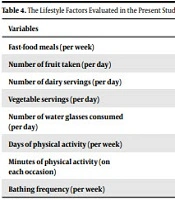
The results of this study on the comparison of the groups showed a direct relationship between dealing with acne problems and using higher amounts of high fatty and sugar diets. The patients described acne worsening by eating certain foods (Table 6).
Table 6.
Foods and Acne Relationship
| Group | Sweet and Fatty Foods | P Value (chi2) | |
|---|---|---|---|
| Yes | No | ||
| Case | 74 | 36 | 0.001 |
| Control | 22 | 88 | |
The case patients were classified into two groups with a family history of acne and without a family history of acne. Univariate logistic regression test (P value ≤ 0.01, OR 2.98, 95% CI 1.5 - 3.4) showed a positive relationship between acne and family history of acne. The family history was positive in 43 (39%) of their mothers, 21 (19%) of their fathers, and 23 (20%) of their sisters or brothers.
4. Discussion
Acne is a common disease with more prevalence in the face due to sebaceous gland 5α-reductase type 1 activity in comparison with other areas. Excessive sebum plays an important role. It is commonly observed during the onset of puberty because with the advance of puberty, circulating androgen levels increase (12).
The previous studies have not proven any relationship between androgenicity and acne; however, a relationship between acne severity and clinical parameters of androgenicity or androgen levels has been observed in many studies, with inconsistent results (13).
A routine approach to the management of patients with hyperandrogenism signs is an endocrine evaluation, comprising tests such as DHEAS, total and free testosterone, and LH/FSH ratio.
Although women with hyperandrogenism should receive hormonal therapy, women with normal serum androgen levels also respond well to the treatment (14). Endocrinologic abnormalities are rare in acne patients but they can be the only clinical sign of androgen excess in women (15). The end-organ sensitivity of the pilosebaceous unit to androgens can be the main reason for this issue.
Hormonal treatments can decrease circulating and local androgens levels and affect sebaceous gland and probably follicular keratinocytes (16).
In conclusion, no evidence of an association between serum androgen levels and acne problems was found in patients; therefore, their levels are not very reliable and clinical suspicion is more helpful in treatment selection. Metabolic syndrome and peripheral hyperandrogenism due to the increased sebum production usually are seen in obese people. Body mass index (BMI) is a good measurement for obesity (17).
The severe forms of hyperandrogenism with elevated free testosterone are caused by obesity (18). On the other hand, obese patients have insulin resistance, too. Acne vulgaris has been proposed to be a disease mediated by IGF-1. Its receptors are expressed in epidermal keratinocytes. Therefore, hyperinsulinemia may lead to the increased proliferation of basal keratinocytes within the pilosebaceous duct and abnormal desquamation of follicular corneocytes (19).
Previous studies showed a tight relationship between acne severity and hyperandrogenism signs; however, some studies showed different results; for example, Sheehan-Dare in 1988 reported no correlation between acne severity and clinical markers of androgenicity in women (20).
We found a positive relationship between BMI and acne that is consistent with the results of previous research conducted by Alan S et al. 2014 (21); however, in Pavicic Baldani DP 2013 research, there were no significant associations between acne and BMI (22). It seems research results can vary in different races and communities. For example, in a study in Taiwan, obese women had acne less than non-obese women (11).
We could not find any relationship between hirsutism and acne as Borgia F study 2004 observed no correlation between acne severity and hirsutism (23).
Hirsutism is a major clinical feature of PCOS. It has to be mentioned the distribution of excessive facial and/or body hairs in women is known as hirsutism.
In a Taiwanese research study, similar to our results, the prevalence of hirsutism did not differ between obese and non-obese people. It seems that acne and hirsutism do not always present concomitantly.
This differential expression of acne and hirsutism in obese women can be the difference of androgen sensitivity in the epithelial sebocytes of sebaceous glands and the mesenchymal cells of the hair follicle dermal papilla.
In the sebaceous gland, there is an enzyme called 5α-reductase, which converts testosterone to dihydrotestosterone (DHT). Increased 5α-reductase activity in their hair follicles is reported in hirsute women.
Factors that could boost the acne formation in patients are related to the increased levels of androstenedione, dehydroepiandrosterone (DHEA), and dehydroepiandrosterone-sulfate (DHEAS). Unlike hirsutism, the formation of acne has a less direct relationship with the level of DHT in patients.
Obesity and insulin resistance, with an increase of 17-hydroxyprogesterone, ovarian and adrenal androgens, 3α- androstanediol glucuronide, insulin, insulin-like growth Factor-I and low luteinizing hormone, sex hormone binding globulins and insulin-like growth factor binding protein- 1 levels, are associated with hirsutism. Acne was associated only with the lowest 3α-androstanediol glucuronide levels; thus, different pathogenetic mechanisms may be seen in acne and hirsutism (24).
Alopecia is a common problem in female patients of reproductive age. We found a relationship between acne and alopecia that is consistent with the findings of other studies (21, 25).
The most common presenting symptom in adolescents diagnosed with PCOS was menstrual irregularities (26).
In this study, we found a positive association between acne and menstrual function. The most common association was with oligomenorrhea. In another study also reported the same association (27).
Our female patients reported premenstrual flare of their acne. Hormonal therapies can be effective in women with acne flare-up premenstrually (16). In Williams study, 60% - 70% of females had a premenstrual flare (27). In the study of Stoll, 44% of 400 female participants reported flare-up of acne before menstruation in questionnaires (28).
Changes in surface lipid composition in the premenstrual phase, changes in hydration or in the molecular structure of keratins or prostaglandin effects via its vasoactive properties could be considered as causative agents (29, 30).
Family history plays a role in acne disease. A mother with acne history influences the severity of acne. Similar results have been seen in some research (31).
A history of acne in the mother resulted in a significantly higher prevalence of acne (32). Genetic modeling showed 81% of the disease was related to additive genetic effects (1).
In contrast to the belief that there is a relationship between diet and acne, there are only a few studies evaluating the role of diet in acne. We had more reports of sweet and fatty foods intake in the case group. Previous studies presented no effect on acne, but it needs more evaluation. Consumption of fish was associated with a protective effect (33).
4.1. Conclusion
Hyperandrogenism should be evaluated in girls with premature pubarche, unusual acne, hirsutism, androgenetic alopecia, and obesity.
Hormonal therapies can have excellent effects on female acne despite the presence of normal serum androgen levels.