


1. Introduction
To perform uncomplicated abdominal operations, it is necessary to have detailed knowledge of the normal anatomy of the major abdominal arteries and their potential variations. This is more important when it comes to unpaired arteries, such as the celiac trunk (1). Classically, below the aortic hiatus of the diaphragm, the celiac trunk arises from the abdominal aorta and divides into 3 branches, namely, the splenic artery, left gastric artery, and common hepatic artery (1-5). Trifurcation of the celiac trunk was first described by Haller (6). Embryological and developmental alterations in the splanchnic arteries can cause variations of the unpaired branches of the abdominal aorta (7).
Matusz et al. evaluated 10 750 cases from 19 studies and found the cumulative percentage of the complete celiac trunk (typical 3-branched) to be 90.7%, while the incomplete celiac trunk was found in 6.1% of cases and the absent celiac trunk only in 0.2% (3). Autopsies, angiography, and computed tomography (CT) have also shown isolated cases of the absent celiac trunk (1, 7-14). Here, we present a case with an absent celiac trunk with common hepatic and splenic arteries directly originating from the abdominal aorta.
Song et al. evaluated 5002 patients and found the common hepatic artery variations in the origin and/or anatomic course in 183 patients (3.71%) (15).
Pandey et al. evaluated 320 cases and noted a direct origin of the splenic artery from the abdominal aorta in 26 (8.1%) cases (16).
2. Case Presentation
A 53-year-old female with a known lymphoma case was referred to the radiology clinic for abdominopelvic computed tomography (CT) for staging. CT imaging revealed an absent celiac trunk with common hepatic and splenic arteries directly originating from the abdominal aorta. Narrowing and angulation of these branches were observed due to the compression of the median arcuate ligament (Figures 1 - 3). Corresponding to these variations, the patient had a history of off-and-on, especially postprandial, abdominal pain from her youth.
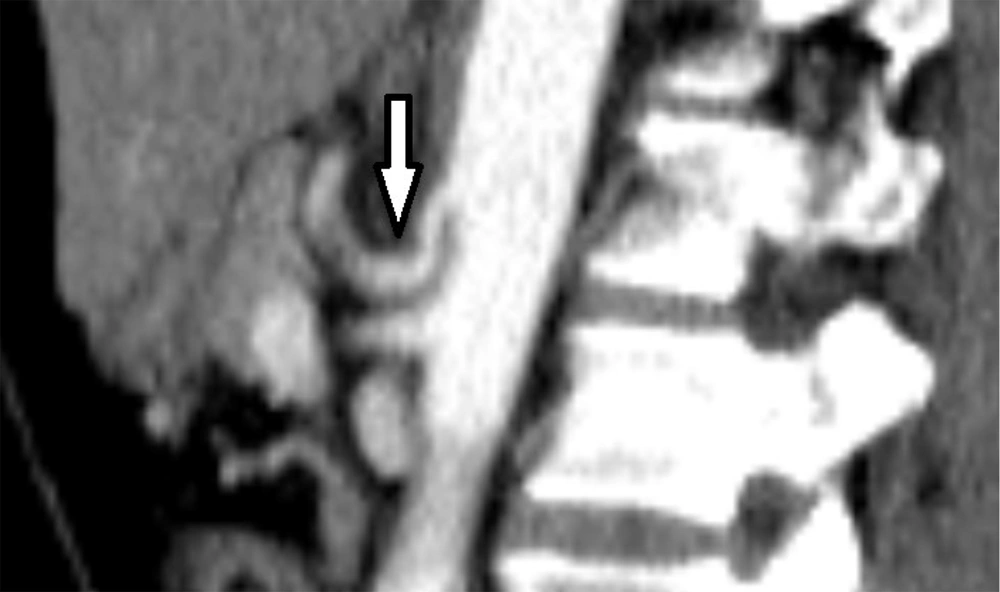
Figure 1.
Computed tomography sagittal cut; splenic artery directly originating from the abdominal aorta, narrowing and angulation of the splenic artery due to compression by the median arcuate ligament.
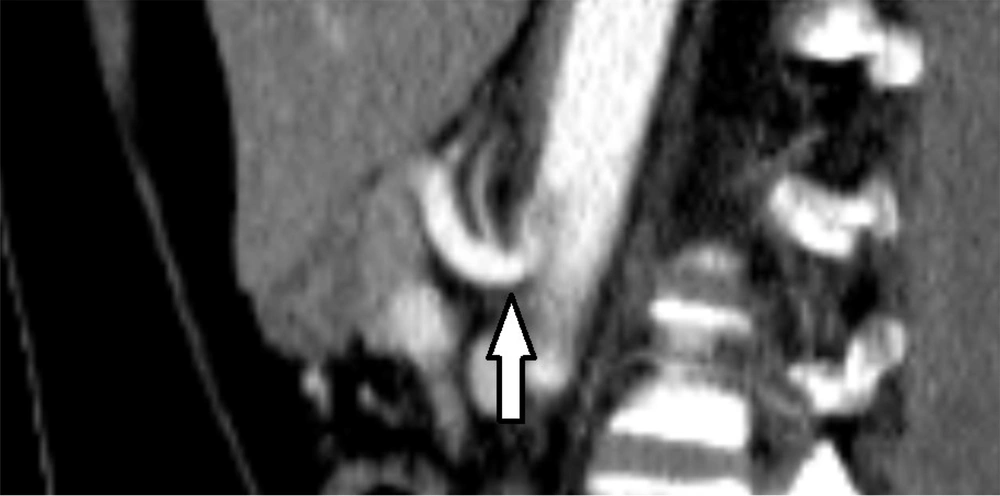
Figure 2.
Computed tomography sagittal cut; direct origination of the common hepatic artery from the abdominal aorta, narrowing and angulation of the common hepatic artery due to compression by the median arcuate ligament.
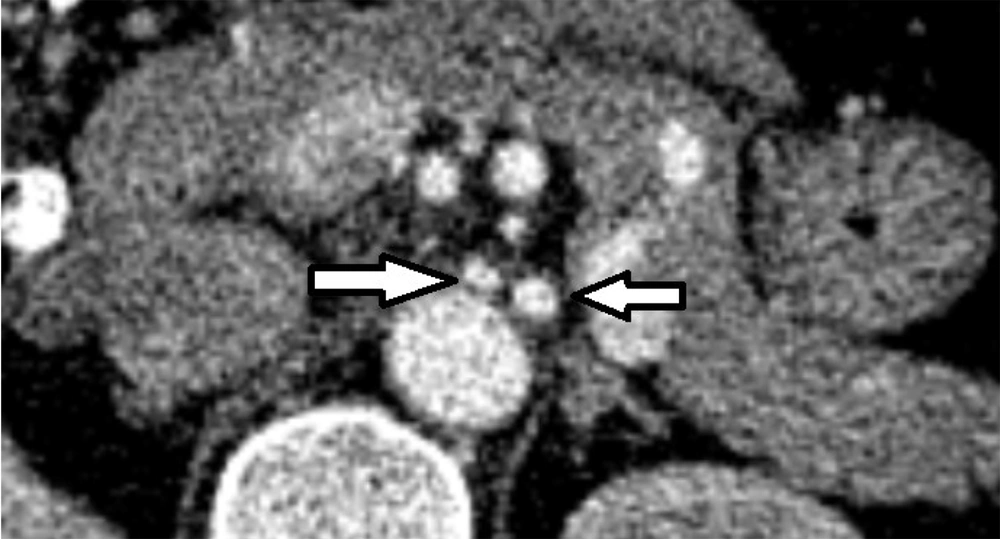
Figure 3.
Computed tomography axial cut; the splenic and common hepatic artery directly originating from the abdominal aorta.
3. Discussion
The most common and classical configuration of the celiac trunk is its trifurcation into the left gastric artery, splenic artery, and common hepatic artery (17). Developmental changes in the ventral segmental arteries account for anatomical variations of the celiac trunk and the superior and inferior mesenteric arteries (18). The roots of the ventral segmental arteries unite during fetal development through longitudinal anastomoses. Later, different parts of these anastomoses are either resorbed or retained, the extent of which causes several anatomical variations in unpaired arteries of the abdominal aorta (19). Although longitudinal anastomoses completely regress in the case of an absent celiac trunk, the primitive roots of ventral segmental arteries remain and form the left gastric artery, splenic artery, common hepatic artery, and superior and inferior mesenteric arteries, separately originating from the abdominal aorta (20). Consistently, in our case, the splenic and common hepatic arteries originated from the abdominal aorta instead of arising from the celiac trunk.
Our patient also had a history of occasional postprandial abdominal pain from her youth, which can be due to the angulation and narrowing of the splenic and common hepatic arteries resulting from the compressive effect of the median arcuate ligament. However, the lack of an earlier history of abdominal pain can be justified by the gradual enlargement of the diaphragm and its ligament by age.
3.1. Conclusion
In patients with a history of abdominal pain, especially postprandial pain, evaluation of vascular anomalies, including the abdominal aorta, celiac artery, common hepatic artery, and splenic artery, is recommended.

