The progression of DKD is influenced by several biological factors, of which IGF-I is significantly involved in the development of DN, which regulatory effects highly depend on its binding proteins that contribute to the pathology of a diabetic kidney disorder (
6,
17). The most abundant IGFBP species in the human peripheral circulation is IGFBP-3 (%80), which promotes apoptosis and insulin resistance. Hence, considering the importance of this biomarker in the prediction and development of DN, this study raises this question, “to what extent the intervention of an 8-week RT would alter the plasma levels of IGFBP-3 in DN patients”. With respect to the demonstrated effectiveness of exercise intervention in the improvement of DN and the results of previous studies indicating that the levels of IGFBP-3 are significantly higher in diabetic patients with kidney impairment compared to diabetic patients without kidney dysfunction (
7,
17), the plasma levels of IGFBP-3 were expected to decrease in response to eight weeks of RT. However, contrary to our hypothesis, we observed the absence of any significant changes in the plasma levels of IGFBP-3 in the RTG. In agreement with our findings, Nindl et al. reported that there were no significant changes in free IGFBP-3 levels after 12 weeks of RT in end-stage renal disease patients (
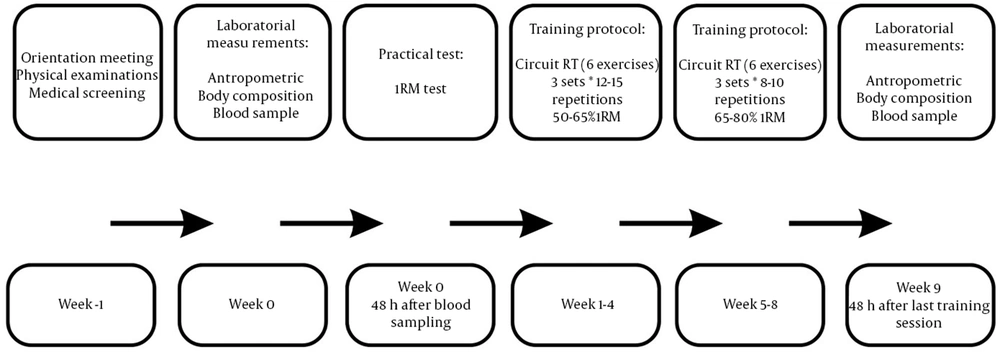
29). The same outcomes have also been reported by Borst et al. over the first phase (13 weeks) of RT in both the 1-SET and 3-SET groups, while in the second phase of RT (13 - 25 weeks), the plasma levels of IGFBP-3 significantly reduced by 20% in the 3-SET group (
30). Although the exact mechanisms, by which RT leads to IGFBP-3 response are not fully understood, according to the available data, IGFBP-3 response may depend on the duration and volume of exercise. Therefore, the duration and volume of RT in this study were probably inadequate to affect the IGF-I system and alter the plasma levels of IGFBP-3.
However, with respect to the significant increase in the levels of IGFBP-3 and also the significant decrease in the eGFR levels observed in the CG, it can be proposed that IGFBP-3 response is associated with kidney function, and therefore, the lack of any change in the rate of eGFR is probably responsible for the lack of any significant changes in the levels of IGFBP-3 in the RTG. In line with this, previous studies have shown that the levels of IGFBP-3 are negatively associated with the eGFR levels in patients with DN (
7). This means that the development of kidney dysfunction (a decrease in the eGFR levels) may be accompanied by an increase in the levels of IGFBP-3. Accordingly, by a simple analogy between the results of the CG and RTG, it can be logically concluded that RT, though it did not improve kidney function, at least stopped the development of kidney dysfunction and prevented eGFR from decreasing in the RTG, whereas the kidney function of the CG probably deteriorated due to the lack of RT, resulting in the increased levels of IGFBP-3. This justification can be supported by the report of Santos et al. who showed that RT could attenuate renal dysfunction in animal DN after an 8-week training period (
31). However, it seems that the improvement of kidney function relies on various sophisticated physiological adaptations, requiring the long-term intervention of proper exercise therapy; otherwise, significant improvement can be barely observed through short-term training programs. In agreement with the importance of training duration in the improvement of kidney function, Ishikawa et al. reported no significant differences in eGFR levels between the exercise and control groups after exercise intervention (eight weeks) on diabetic rats with nephropathy (
32). Another study also found no significant change in eGFR levels after 12 weeks of resistance and aerobic exercises (
33), while Greenwood et al. observed significant improvement in the eGFR levels of 20 patients with CKD stages 3 - 4 after 12 months of high-intensity resistance and aerobic training (
34). On the other hand, Hiraki et al. reported no significant differences between the eGFR levels of the control or training group after a one-year of resistance and aerobic training (
35). It is worthy of note that the intensity of training protocol in the study by Hiraki et al. was moderate, while in that of Greenwood et al., the subjects underwent a one-year combined resistance and aerobic training with 80% 1RM and maximum heart rate (HR) (
34). Accordingly, in addition to the duration, the intensity of RT seems to be a very important factor that affects the improvement in eGFR levels; however, Hiraki et al. (
35) had a different opinion. Because muscle strength and mass are increased in response to RT, and increased muscle mass affects creatinine plasma levels, they argue that the eGFR levels measured from the plasma level of creatinine after RT may not precisely show kidney function improvement induced by exercise. It is an undeniable fact that RT increases muscle mass and strength (
35). Perhaps, utilizing cystatin C or other factors that are not influenced by RT adaptations (increased muscle mass) could be more useful for future research.
Fasting blood glucose decreased after eight weeks of RT in this study. Egger et al. reported similar findings in T2D patients after eight weeks of various types of RT (
36). Since RT highly relies on the energy produced by the glycolytic pathway, it was not surprising that the present study observed reductions in blood glucose levels. However, it has been suggested that people with T2D usually have a defective insulin-dependent pathway, which is responsible for activating glucose transporters of the muscles to help move the glucose from the blood into the cells (
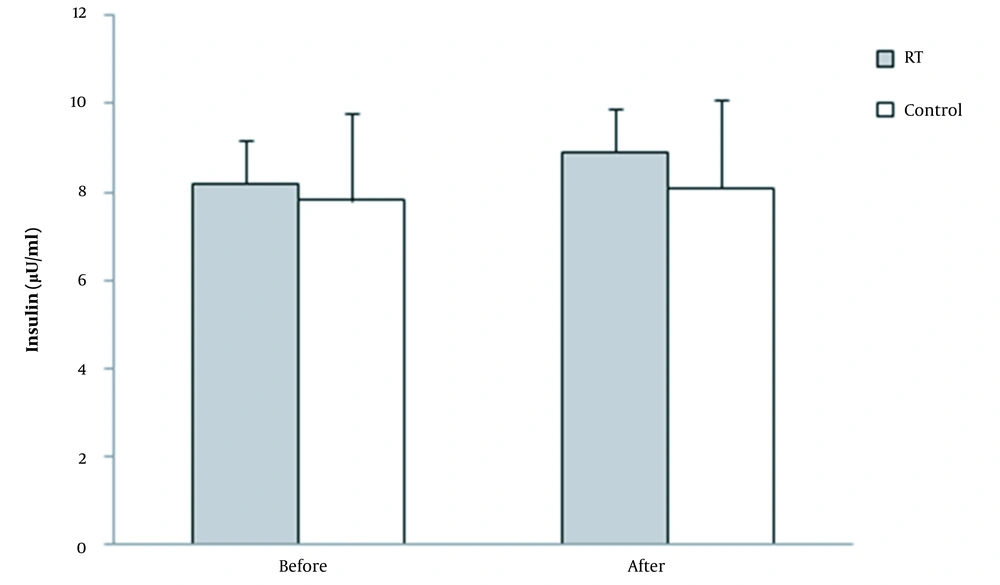
37). In this study, no significant changes were observed in fasting insulin, and therefore, the decreased levels of fasting glucose were probably the result of non-insulin-independent glucose uptake. This possibility agrees with the results of previous studies reporting an increase in glucose transport after regular muscle contraction via a contraction-stimulated pathway (
37). In addition, since insulin action is closely linked to lean body mass as the primary metabolic target tissue for glucose metabolism, the increased lean body mass due to RT intervention may be another reason for decreased levels of fasting glucose in this study (
38). An increase in muscle mass as the result of RT leads to increased glucose storage (
39). Accordingly, it is reasonable to speculate that the small increase in muscle mass as the result of RT may be responsible for the improved glucose homeostasis and metabolism observed in the RTG (
21). Nevertheless, increased capillary density, increased number of glucose-carrying proteins (GLUT4), increased glycolytic and oxidative enzyme activity, and increased glycogen activity synthesis are other related mechanisms that may affect the delivery of glucose from the blood to the muscle, decreasing the fasting glucose (
40).
RT also induced a significant decrease in insulin resistance. Although the exact mechanisms for HOMA-IR reduction observed after RT in this study are not fully understood, the association between physical inactivity and insulin resistance has been suggested over the last five decades. It has been previously stated that a reduction in visceral and abdominal fat is a key linkage between exercise and insulin resistance improvement (
41). In this study, although abdominal fat mass was not directly assessed, previous studies have supported the reduction of visceral and subcutaneous fat after RT (
21). Hence, it may be partly justified why we observed HOMA-IR reduction only in the RTG. However, the lack of strict diet control and blood pressure monitoring were the limitations of the present study.
5.1. Conclusions
In conclusion, eight weeks of RT did not improve the renal function of T2D patients with the risk of nephropathy and had no significant effect on plasma levels of eGFR and IGFBP-3. Nevertheless, its positive role in preventing the development of renal dysfunction into DN is undeniable because the kidney function of the CG deteriorated over the research period. In addition, after eight weeks of RT intervention, blood glycemia significantly decreased in the RTG. Due to the importance of glycemic control for the treatment of T2D and its related complications, in particular DN, RT seems to be a very useful, cost-effective, and safe therapeutic measure to assist patients suffering from this disease. Although the subjects of this study were middle-aged men, it seems that RT is beneficial not only for these people but also for people of different ages and genders. However, conducting further studies on a larger sample, both genders, with a longer training period and blood pressure monitoring can better clarify the probable effects of RT on renal function of patients with T2D.


![Plasma levels of IGFBP-3 before and after eight weeks of resistance training (RT) [* Significant differences within group (P < 0.05)].](https://brieflands.com/journals/mcj/articles/128713/figures/mcj-128713-i002-F2-preview.webp "Plasma levels of IGFBP-3 before and after eight weeks of resistance training (RT) [* Significant differences within group (P < 0.05)].")
![eGFR value before and after eight weeks of resistance training (RT) [* Significant differences within group (P < 0.05)].](https://brieflands.com/journals/mcj/articles/128713/figures/mcj-128713-i003-F3-preview.webp "eGFR value before and after eight weeks of resistance training (RT) [* Significant differences within group (P < 0.05)].")
![Fasting blood glucose levels before and after eight weeks of resistance training (RT) [* Significant differences within group (P < 0.05); † Significant differences between groups (P < 0.05].](https://brieflands.com/journals/mcj/articles/128713/figures/mcj-128713-i004-F4-preview.webp "Fasting blood glucose levels before and after eight weeks of resistance training (RT) [* Significant differences within group (P < 0.05); † Significant differences between groups (P < 0.05].")
![Insulin resistance index (HOMA-IR) levels before and after eight weeks of resistance training (RT) [* Significant differences within group (P < 0.05); † Significant differences between groups (P < 0.05)].](https://brieflands.com/journals/mcj/articles/128713/figures/mcj-128713-i006-F6-preview.webp "Insulin resistance index (HOMA-IR) levels before and after eight weeks of resistance training (RT) [* Significant differences within group (P < 0.05); † Significant differences between groups (P < 0.05)].")


