
1. Background
In industrial societies, about one-third of the workforce consists of people whose voice is essential to their job (1, 2). Professional voice users include those who rely on the quality of a particular or attractive voice as a primary job tool or generally give up their job and look for another job if their voice is damaged (3). With this description, university professors are professional voice users too. They are apt to be confronted with vocal complaints (4) or even voice problems (5).
Vocal complaints include symptoms a person reports about his/her voice (6). Voice disorders may lead to different symptoms, such as nine major complaints: hoarseness, vocal fatigue, breathy voice, reduced pitch range, aphonia, pitch breaks, strain/struggle voice, tremor, and pain or other abnormal physical sensations (7). Vocal symptoms or complaints can affect the quality of life of university professors, their daily life, social communication, and work performance (8-10). The frequent occurrence of vocal symptoms or complaints in professors impairs performance and contributes to the idea of the future profession changing due to vocal problems (11, 12). Studies show that the voice problems of university professors should be studied in a separate group (4, 13). A 2017 study by Ahmed et al. reported an abnormal voice in 38.8% of participants in a population of university professors (14). In 2012, Higgins and Smith examined voice problems in university professors, stating that 45% of professors had voice problems, and all of these problems affected their communication. They also reported that 93.3% of their voice problems lasted less than four weeks (acute), 6.7% of them lasted more than four weeks (chronic), and 82% of people with voice problems reported hoarseness (10). In a powerful study by Moghtader et al. in 2019, the scores of the total scale and subtests (physical, functional, and emotional) of VHI were much higher in professors with vocal complaints than in professors without vocal complaints (4).
People with almost the same symptoms of voice problems experience different effects of voice problems on their lives (15). Therefore, assessing voice problems from the clients' perspective and their impact on their quality of life is of great value. According to the World Health Organization, "Health is a state of complete physical, mental and social well-being and not merely the absence of disease or infirmity" (16). Hence, in recent years, specialists and voice therapists have attempted to develop methods and construct new tools such as self-report questionnaires to comprehensively study voice disorders and evaluate the patients' views of their problems. Therefore, the importance of self-assessment and self-report questionnaires can be identified.
One of the standard questionnaires in the study of the effects of a voice disorder on patients' lives is the Voice Handicap Index (VHI). The VHI questionnaire was developed by Jacobson et al. (15) to investigate the damage caused by voice disorder. The Persian version of the questionnaire was prepared by Moradi et al. (17). The cutoff point of the VHI Persian version was calculated at a score of 14.5 (18). There is one original Iranian study on university professors using the VHI, and we found no study on the professors of rehabilitation colleges using this scale.
Research on voice problems among professors from different universities has not reported the same results on the prevalence of voice problems and related risk factors. For example, the prevalence of voice disorders in several studies at different universities has been 24%, 38.8%, 68.2%, and 73.8% (4, 8, 14, 19). Therefore, investigating voice problems among professors of rehabilitation schools can explain the current situation to determine the need for further investigation to prevent and treat voice problems in this group of university professors. To identify vocal complaints and problems among rehabilitation faculty members, we conducted a study using VHI to assess vocal complaints among Iranian professors of rehabilitation colleges.
2. Objectives
The current study implemented the VHI in Iranian rehabilitation professors with and without vocal complaints.
3. Methods
A comprehensive cross-sectional study was conducted at all rehabilitation faculties of Iranian universities. The sample size for this research was calculated at 235 persons using the sample size formula. Then, a stratified random sampling method was used to select the subjects. First, each rehabilitation school was considered a class (stratum). Then, several quotas were allocated to each class (50% of the professors of each faculty), and the professors were selected using a table of random numbers. Finally, 235 professors (100 men and 135 women) with a mean age of 44.58 ± 8.63 years (between 28 and 67 years) from the rehabilitation colleges were selected. The survey included demographic information, a four-part questionnaire about vocal complaints, and the Voice Handicap Index questionnaire. The link to the Google Form was sent to professors via email and social media such as WhatsApp. The four-part questionnaire included a question about the presence or absence of vocal complaints, a questionnaire about nine-items vocal complaints, a question about the impact of vocal complaints on communication, and a question about the duration of vocal complaints. This study was approved under the ethical code of IR.IUMS.REC.1399.1230. All members gave their consent to participate in this survey.
3.1. Statistical Analysis
Data were entered into SPSS software and were statistically analyzed. Data normality was assessed using the Kolmogorov-Smirnov test. Because the data did not have a normal distribution, non-parametric Mann-Whitney U and chi-square tests were used to compare the questionnaire scores in the two groups with and without vocal complaints. A significance level of 0.05 was considered.
4. Results
According to the answers of 235 university professors from rehabilitation colleges, they were categorized into two groups with and without vocal complaints. In this study, 103 professors reported vocal complaints (69 women and 34 men). The mean age was 44.57 years (SD ± 8.37) among the professors with vocal complaints and 44.59 years (SD ± 8.87) among those without vocal complaints. The distribution of subjects according to age range and work experience in two groups with and without vocal complaints is presented in Table 1.
Table 1.
Distribution of Participants by Age, Work Experience, and Vocal Complaints a
| Variables | With Complaints | Without Complaints | Total |
|---|---|---|---|
| Age range | |||
| ≥ 30 | 3 (2.9) | 1 (0.8) | 4 (1.7) |
| 31 - 45 | 56 (54.4) | 79 (59.8) | 135 (57.5) |
| 46 - 60 | 44 (42.7) | 48 (36.4) | 92 (39.1) |
| +61 | 0 (0) | 4 (3) | 4 (1.7) |
| Work experience | |||
| 1 - 10 | 42 (40.8) | 62 (47) | 104 (44.2) |
| 11 - 20 | 35 (34) | 40 (30.3) | 75 (31.9) |
| 21 - 30 | 23 (22.3) | 23 (17.4) | 46 (19.6) |
| +31 | 3 (2.9) | 7 (5.3) | 10 (4.3) |
a Values are expressed as No. (%).
The mean teaching career length was 14.80 years (SD ± 9.61) for the professors with vocal complaints and 14.09 years (SD ± 8.59) for professors without vocal complaints.
Among university professors with vocal complaints (103 subjects), 27.2% (28 subjects) reported that the vocal complaints lasted for more than four weeks, and 72.8% (75 subjects) reported that they lasted for less than four weeks. Also, 21.35% (22 subjects) reported that the vocal complaints did not affect their communication and 78.64% (81 subjects) reported that they affected their communication.
Table 2 shows the results of the chi-square test. According to these results, 29.12% of professors with vocal complaints and 9.09% of professors without vocal complaints acquired scores of more than 14.5 on the VHI, showing a significant difference between the two groups (χ2 (2 d.f., N = 235) = 15.82, P < 0.001).
Table 2.
Distribution of Subjects According to Voice Handicap Index in Two Groups with and Without Vocal Complaints
| Groups | ≥ 14.5, No. (%) | < 14.5, No. (%) | χ2 | P-Value |
|---|---|---|---|---|
| Professors with complaints | 30 (29.12) | 73 (70.87) | 15.82 | 0.000* |
| Professors without complaints | 12 (9.09) | 120 (90.90) |
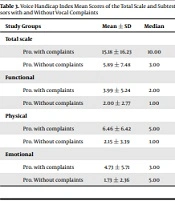
According to Table 3, the highest mean scores in both groups of professors were related to the physical subtest, and the lowest were related to the functional subtest. As can be seen, the mean score was much higher for professors with vocal complaints than professors without vocal complaints. The differences in the mean VHI scores between the two groups with and without vocal complaints were significant in the VHI total scale score (P < 0.000) and all three subtests' scores (P < 0.000, P < 0.002, and P < 0.000).
Table 3.
Voice Handicap Index Mean Scores of the Total Scale and Subtests in Professors with and Without Vocal Complaints
| Study Groups | Mean ± SD | Median | P-Value |
|---|---|---|---|
| Total scale | 0.000* | ||
| Pro. with complaints | 15.18 ± 16.23 | 10.00 | |
| Pro. without complaints | 5.89 ± 7.48 | 3.00 | |
| Functional | 0.002* | ||
| Pro. with complaints | 3.99 ± 5.24 | 2.00 | |
| Pro. without complaints | 2.00 ± 2.77 | 1.00 | |
| Physical | 0.000* | ||
| Pro. with complaints | 6.46 ± 6.42 | 5.00 | |
| Pro. without complaints | 2.15 ± 3.39 | 1.00 | |
| Emotional | 0.000* | ||
| Pro. with complaints | 4.73 ± 5.71 | 3.00 | |
| Pro. without complaints | 1.73 ± 2.36 | 5.00 |
Table 4 shows the frequency of vocal complaints in professors. The highest vocal complaints were vocal fatigue, hoarseness, pain, breathy voice, strain, monotone voice, pitch breaks, aphonia, and tremor, in sequence. Vocal fatigue (64.1%) and hoarseness (61.2%) had the highest frequencies, and tremors (4.9%) had the lowest frequency.
Table 4.
Frequency of Vocal Complaints (n = 103)
| Complaints | No. (%) |
|---|---|
| Vocal fatigue | 66 (64.1) |
| Hoarseness | 63 (61.2) |
| Pain or other abnormal physical sensations | 25 (24.3) |
| Breathy voice | 17 (16.5) |
| Strain/struggle voice | 16 (15.5) |
| Monotone voice | 14 (13.6) |
| Pitch breaks | 12 (11.7) |
| Aphonia | 6 (5.8) |
| Tremor | 5 (4.9) |
5. Discussion
This research implemented the VHI among two groups of Iranian professors of rehabilitation colleges with and without vocal complaints. The results showed that the prevalence of voice disorder (as defined by this study) was more in professors with vocal complaints (29.12%) than in the general population (6). In 2017, Ahmed et al. stated that 38.8% of university professors had abnormal voices (14). The difference between the frequencies of voice disorders reported by the present study and Ahmed et al. (38.8%) could be due to differences in location, sample size, a cutoff point of the VHI in two languages, and gender fit of participants.
There is a significant difference between the mean scores of the professors with and without vocal complaints on the total score and subtests of VHI (physical, emotional, and functional). The finding denotes that university professors with vocal complaints are more apt to experience voice problems three times more than those without vocal complaints. These results indicated a higher probability of voice problems and their adverse effects on the physical, emotional, and functional health of university professors with vocal complaints than those without vocal complaints. This finding is consistent with the results of Moghtader et al. in 2019 (4). They showed that the average VHI scores of professors with vocal complaints (38.95 ± 24.99) were higher than the average scores of professors without vocal complaints (29.00 ± 24) (4).
This study investigated the frequency of nine main voice complaints, their effect on communication, and the duration of voice complaints among professors. Vocal fatigue (64.1%) was the most frequent complaint, and tremor (4.9%) was the least. The high percentage of vocal fatigue in professors indicated that this group is prone to vocal problems. The frequency of vocal fatigue in the present study is higher than the frequency of speaking fatigue in the studies of Depolli et al. (49.2%) (19) and Gomes et al. (27.2%) (8), which can be different due to the sample size of the study, the different load of voice work in professors, and different physiological conditions of the larynx in different countries. In studies conducted on university professors and teachers with different methods and questionnaires (more vocal fatigue index) to measure vocal fatigue, the importance of this voice complaint in the vocal health of people has been emphasized (4, 20, 21). A large number of university professors (72.8%) had experienced vocal complaints of limited duration (< 4 weeks). This finding is consistent with the study of Higgins and Smith (10), who showed that only 6.7% of professors surveyed reported vocal complaints that lasted more than four weeks. It may be because professors may experience some degrees of tissue repair over weekends, holidays, and vacations, when occupation-related voice demands are lessened and vocal fold tissue injury is reduced. The biological response to tissue injury is highly organized and timely. In this study, many professors with vocal complaints (78.64%) reported that the vocal complaints affected their communication. This finding is consistent with the study of Higgins and Smith (10), who showed that only 6.7% of professors surveyed reported vocal complaints that lasted more than four weeks.
We did not find any studies on the voice status of rehabilitation faculty professors in Iran. The results of the present study indicated that the voice problems of rehabilitation faculty professors might be like the problems of teachers, but they may be much more vulnerable to voice damage than teachers. It can be stated that university professors may do more and more delicate work with their larynx because of teaching, research, supervisory and executive work, and participating in presentations at conferences and international forums. These results indicate the unfavorable state of vocal health in the professors of rehabilitation colleges and its impact on their quality of life. Therefore, it is proposed to hold workshops and classes by voice specialists to teach simple preventive techniques and corrective methods of using the voice for teaching and doing work related to voice tasks and to improve the educational environment by the officials. Voice problems should be prevented because of their adverse effects on various aspects of life, especially the physical health of this group of professional voice users. Consequently, it may increase students' trust, attention, interest in communicating with professors, and educational quality.
5.1. limitations of the Study
Due to the limited period at the time of the senior thesis, it was not possible to do a cohort study, and due to the study's cross-sectional nature, we cannot express the cause-and-effect relationship.
5.2. Conclusions
The prevalence of voice problems (defined by the study) was 29.12% in university professors with vocal complaints. Voice problems significantly impact university professors' quality of life, especially in three dimensions (physical, emotional, and functional). Vocal fatigue was reported as the most common voice complaint among professors, and voice complaints greatly affected the communication of professors. It is suggested that future studies develop programs to provide voice hygiene and prevent voice problems in this group of professional voice users.