
1. Background
Nowadays, medical imaging is an important tool in medicine, although in most cases uses ionizing radiation (1, 2). The adverse biological effects of radiation may vary depending on the duration of exposure (3) and in general, increase the risk of cancer (4). People often become worried whenever they are exposed (5), as recently radiation hazards have risen with the exposure of patients and personnel (6). Exposure of people in the operating rooms is an important problem to study the safety of personnel and patients (7, 8). Endoscopic retrograde cholangiopancreatography (ERCP) is one of the procedures used in the diagnosis and treatment of disease (9, 10) that causes the exposure of both patient and personnel (9). Extracorporeal shock-wave lithotripsy (ESWL) is one of the medical practices associated with patient radiation exposure (11). Suitable use of personal protective equipment and requirements for radiation protection can almost reduce unnecessary exposure (4). Therefore, the knowledge, attitude, and practice (KAP) of radiographers about observances and standards play an important role in the radiation protection (4). Some studies showed radiographers’ unsatisfactory level of awareness about radiation protection (4). However, personnel’s awareness and knowledge regarding the risks of radiation is crucial (12). To date, few studies are accomplished to evaluate KAP among personnel in hospitals (8, 13); therefore, it is necessary to evaluate radiographers’ KAP on ionizing radiation protection (4).
2. Methods
According to a review of the current scientific evidence containing radiation hazards and the literature linking issues on protection and health, the first draft of the questionnaire was developed based on the relevant items and, then, its content validity was demonstrated by the expert panels. All items were assessed carefully calculating content validity ratio (CVR) with the direct help and advice of 10 panelists including 7 academic specialists (4 medical physicists, 1 nuclear medicine specialist, 1 occupational health specialist, and 1 epidemiologist) and 3 staff of the affiliated centers. In this way, the panelists were requested to specify whether an item is necessary or not. They were requested to score each item from 1 to 3 using a 3-option Likert scale as not necessary (1), useful but not essential (2), and essential (3). The CVR is equal to (Ne -N/2)/(N/2), in which the Ne is the number of panelists indicating “essential” and N is the total number of panelists. In the current study, the number of panelists was 10; if CVR was bigger than 0.62, the item was accepted. After the finalization of the questionnaire, a pilot study was conducted on 15 employees in the relevant fields to check the reliability of the scale and ensure the face validity. The tendency of the scale towards consistency was confirmed by the repeated measurements. Two sets of responses (with a 2-week interval) were used to measure test-retest reliability via estimation of the Pearson correlation coefficient. The overall reliability of the final version was high (r = 0.81, P < 0.001).
After validating and before distribution of the questionnaires, the project and the validated questionnaires were approved by the ethical committee of research council of Semnan University of Medical Sciences, Semnan, Iran. It is noteworthy that the participants were assured about the confidentiality of the data provided by the questionnaires, and signed the written consent. A questionnaire-based, cross sectional study was established to examine the operating room personnel’s knowledge, attitude, and practice (KAP) on radiation protection in the selected Iranian hospitals in 11 provinces from 2014 to 2015. The study population was the personnel of the operating room who used ionizing radiation as a part of their job (secretaries, radiology technicians, nurses, and physicians). The study was conducted on 332 personnel of operating room. Participants responded to 63 questions. The questions were divided into 4 parts: 1) Demographic data including age, gender, job, etc., 2) Personnel’s knowledge, 3) Personnel’s attitude, and 4) Personnel’s practice. The number of questions about knowledge, attitude, and practice were 10, 26, and 27, respectively. Three types of hospitals (educational, non-educational, and private clinics) were selected in 5 regions of Iran (Tehran, Center, East, North, and West). Data were analyzed using SPSS version 16.0 and statistical analyses were accomplished by the one-way ANOVA; P < 0.05 demonstrated a significant difference.
3. Results
The response rate was 100%, with a gender distribution of female (n = 219) and male (n = 113). Age distribution (ranged 30 to 39 years) was 54% and 45% for female and male, respectively (Figure 1). Distribution of percentage of response was indicated according to job and gender (Figure 2).
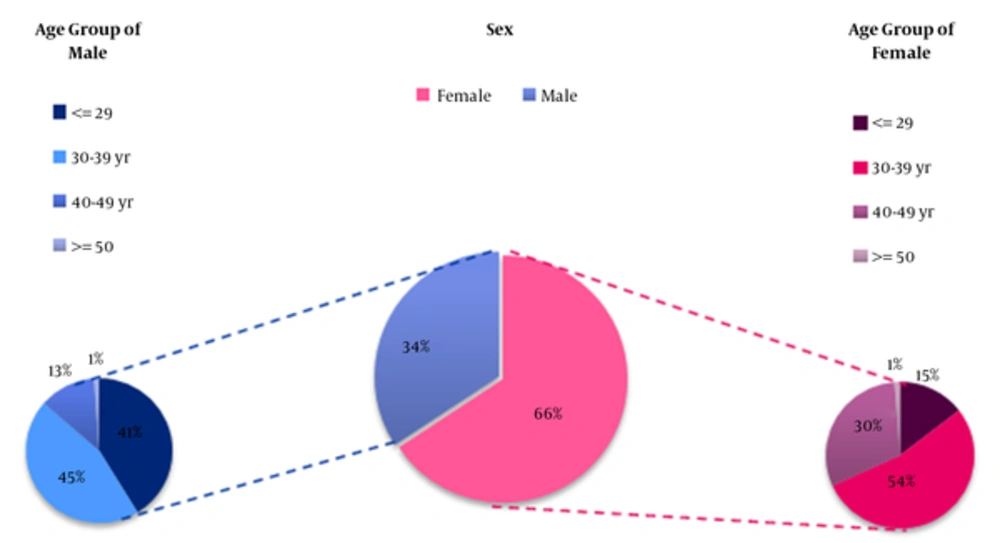
Figure 1.
Distribution of Gender and Age Groups of Responders
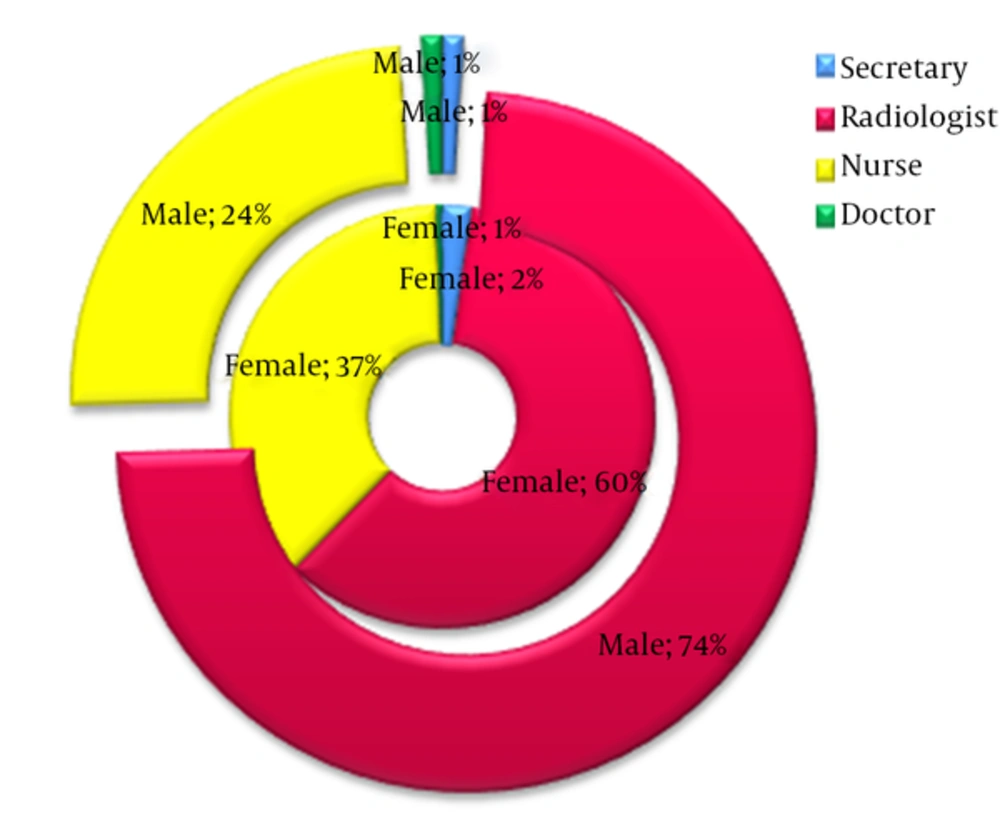
Figure 2.
Distribution of Percentage of Respondents According to Job and Gender
Table 1 shows the output of questionnaires classified based on gender, time since graduation, work experience, type of hospital, and region of the respondents to evaluate the knowledge of personnel; the similarly of attitude and practice are shown in Tables 2 and 3, respectively. According to Table 1, the mean score of knowledge about radiation protection was 50.56% in males and 43.84% in females, which showed no significant difference (P = 0.099). Besides, comparing the knowledge level with time since graduation (P = 0.242) and work experience (P = 0.116) no significant difference was observed. The highest knowledge level about radiation protection was in the personnel with time since the graduation of more than 15 years and work experience of lower than 15 years. The knowledge level of radiation protection was significantly higher in the personnel of private clinics (P = 0.004), while the lowest knowledge level was observed in the personnel of non-educational hospitals (mean score = 35.66). The highest knowledge level was observed in the personnel of Northern region hospitals, which was significantly higher than those of other regions (P < 0.0001), while the lowest knowledge score was observed in the personnel of hospitals in the Central region (mean score = 20.92).
Table 1.
Radiation Protection Knowledge Level Among Personnel in Operating Room
| Characteristic | Mean | SD | P Value |
|---|---|---|---|
| Gender | 0.099 | ||
| Male | 50.56 | 23.04 | |
| Female | 43.84 | 29.51 | |
| Time since graduation, yr | 0.242 | ||
| ≤ 15 | 40.97 | 29.80 | |
| > 15 | 54 | 33.13 | |
| Work experience, yr | 0.116 | ||
| ≤ 15 | 45.56 | 27.71 | |
| > 15 | 38.57 | 30.88 | |
| Type of hospital | 0.004 | ||
| Educational | 46.33 | 27.95 | |
| Non-educational | 35.66 | 31.47 | |
| Private clinic | 52.08 | 22.58 | |
| Region | 0.000 | ||
| Tehran | 33.46 | 34.25 | |
| Center | 20.92 | 26.36 | |
| East | 43.68 | 21.65 | |
| North | 57.73 | 18.64 | |
| West | 42.75 | 28.64 |
Table 2.
Radiation Protection Attitude Level Among Personnel in Operating Room
| Characteristic | Mean | SD | P Value |
|---|---|---|---|
| Gender | 0.964 | ||
| Male | 70.83 | 15.39 | |
| Female | 71.05 | 19.13 | |
| Time since graduation, yr | 0.924 | ||
| ≤ 15 | 70.07 | 21.00 | |
| > 15 | 69.77 | 14.68 | |
| Work experience, yr | 0.006 | ||
| ≤ 15 | 71.51 | 18.39 | |
| > 15 | 63.52 | 19.27 | |
| Type of hospital | 0.918 | ||
| Educational | 70.86 | 18.29 | |
| Non-educational | 71.77 | 20.02 | |
| Private clinic | 70.44 | 15.51 | |
| Region | 0.000 | ||
| Tehran | 59.29 | 26.47 | |
| Center | 64.94 | 22.21 | |
| East | 82.67 | 8.66 | |
| North | 74.28 | 11.68 | |
| West | 73.46 | 15.33 |
Table 3.
Radiation Protection Practice Level Among Personnel in Operating Room
| Characteristic | Mean | SD | P Value |
|---|---|---|---|
| Gender | 0.009 | ||
| Male | 36.82 | 12.80 | |
| Female | 32.32 | 16.54 | |
| Time since graduation, yr | 0.566 | ||
| ≤ 15 | 31.91 | 17.01 | |
| > 15 | 33.47 | 17.41 | |
| Work experience, yr | 0.356 | ||
| ≤ 15 | 32.87 | 16.12 | |
| > 15 | 35.22 | 16.63 | |
| Type of hospital | 0.006 | ||
| Educational | 33.51 | 15.65 | |
| Non-educational | 29.42 | 20.86 | |
| Private clinic | 38.27 | 11.07 | |
| Region | 0.000 | ||
| Tehran | 26.45 | 19.34 | |
| Center | 16.94 | 13.23 | |
| East | 33.91 | 8.92 | |
| North | 40.47 | 9.91 | |
| West | 37.93 | 16.13 |
Table 2 shows the attitude level of personnel. There was no significant difference in the attitude level of operating room personnel towards radiation protection with distinct gender (P = 0.964). A significantly higher level of attitude towards radiation protection was observed among the ones with a lower work experience (P = 0.006). There was no significant difference between the attitude level and time since graduation (P = 0.924). Analyses showed no significant correlation between personnel’s level of attitude toward radiation protection and types of hospital (P = 0.918), while significantly higher attitude level (P < 0.0001) was observed in the personnel of Western region hospitals (mean score = 82.67) and the lowest value was observed in the ones who worked in Tehran (mean score = 59.29).
Table 3 shows the mean score of practice in male (36.82) and female (32.32). According to the analyses, the male group had a significantly higher level of practice compared with female group (P = 0.009). There was no significant relationship between the level of practice towards radiation protection and time since graduation (P = 0.566). Moreover, no significant difference was observed between the level of practice regarding personnel’s work experience (P = 0.356). The highest level of practice regarding radiation protection was observed in the personnel who worked in private clinics (mean score = 38.27), while the lowest level of practice was observed in the personnel of non-educational hospitals (mean score = 29.42). Besides, the practice level was significantly higher in the personnel of the Northern region hospitals than the ones in other regions (P < 0.0001). It is noteworthy that the lowest level of practice regarding radiation protection was observed in the personnel of Central region (mean score = 16.94).
The last analyses were the total level of KAP shown in Table 4. There was no significant relationship between KAP level and gender (P = 0.106), the time since graduation (P = 0.406), and work experience (P = 0.106). A significantly higher level of KAP towards radiation protection was observed in the personnel of private clinics (P = 0.023). The lowest value of KAP was observed in the personnel of non-educational hospitals (mean score = 45.61). According to Table 4, the personnel of Northern region had a significantly higher level of KAP, compared with the others ( P < 0.0001 ). The lowest value of KAP was observed in the personnel who worked in the Central region hospitals (mean score = 34.27).
Table 4.
Radiation Protection Total KAP Level Among Personnel in Operating Room
| Characteristic | Mean | SD | P Value |
|---|---|---|---|
| Gender | 0.106 | ||
| Male | 52.74 | 12.62 | |
| Female | 49.07 | 17.38 | |
| Time since graduation, yr | 0.406 | ||
| ≤ 15 | 47.65 | 17.55 | |
| > 15 | 49.97 | 17.79 | |
| Work experience, yr | 0.106 | ||
| ≤ 15 | 49.98 | 15.98 | |
| > 15 | 45.77 | 19.33 | |
| Type of hospital | 0.023 | ||
| Educational | 50.24 | 16.04 | |
| Non-educational | 45.61 | 18.96 | |
| Private clinic | 53.60 | 13.16 | |
| Region | 0.000 | ||
| Tehran | 39.74 | 20.68 | |
| Center | 34.27 | 13.81 | |
| East | 53.42 | 10.23 | |
| North | 57.49 | 9.55 | |
| West | 51.38 | 15.95 |
4. Discussion
Radiation protection is both subjective and objective, which is ideally performed if the necessary equipment and accessories are available and the personnel have enough knowledge and attitude toward using them in daily practice. It is noteworthy that those working in radiation departments and exposed to X-ray should be protected against harmful exposure (5).
In exploring the knowledge of operating room personnel about radiation protection, it was found that the mean score of knowledge for males was higher than that of females. Although gender did not significantly affect knowledge level of personnel towards radiation protection, it could be concluded that the knowledge of male personnel was better than that of female in radiation protection. The study by Rassin et al., showed a lack of knowledge on the radiation hazards (14). Dehghani et al., did not report any significant differences between the genders in radiation awareness (8).
The current study findings on personnel’s knowledge showed a significant difference in the working regions and types of hospitals. Results of Mojiri et al., showed that personnel’s knowledge was inadequate, but their awareness about workplace was acceptable (2). However, it was observed that the personnel with more than 15 years of time since graduation had more knowledge than the other ones. According to the results of the current study, personnel with a lower work experience had better practice level regarding radiation protection.
Several studies are performed (15, 16) on the relationship between knowledge, performance, and educational level of radiologists. Furthermore, in another study, showed that radiologists physicians more than10 years ago had less knowledge about techniques (17), while no significant difference was found between the knowledge and practice level, and time since graduation and work experience.
A significantly higher level of practice towards radiation protection was observed in males compared with females. Results of Fatahi Asl et al., indicated no significant differences in the mean scores of protection performance between male and female participants (4).
The current study found a significantly higher level of attitude in the personnel with a lower work experience. Soylemez et al., compared personnel based on their knowledge and attitude toward radiation protection and found no significant difference between them based on working experience (18).
In the current study, there was no significant difference between the attitude level of personnel towards radiation protection and time since graduation. Askarian et al., showed no significant difference between the type and degree of specialty and the mean attitude score (19). In a study by Chan et al., on KAP level, no significant relationship was observed between the gender and work experience in the operating room (20). Moreover in their study, there was no significant difference in KAP, while in the current study the mean score of KAP showed no significant differences in gender. Although there was no significant relationship between the gender and KAP level in radiation protection, it was observed that the KAP level in males was more than females. As indicated in the current study, there was no significant difference between the KAP level of personnel about radiation protection and work experience. The level of KAP towards radiation protection among personnel with lower work experience was more than those of other personnel (less than 15 years = 49.98 and more than 15 years = 45.77). While Tok et al., showed the highest level of KAP in the teaching and research hospitals (with the distribution percentage of 12.6% for the participants in private hospitals, 15% for the ones in the state hospitals, 40.9% in the teaching and research hospitals, and 31.5% for the personnel in the university hospitals) (21); the current study observed the highest level of KAP in private clinics, which highlighted the necessity of holding continuous educational courses for the personnel of educational hospitals who work with radiation.
As a limitation, although the current study tried to cover a wide geographical distribution of the studied hospitals, it is better to cover a larger sample size and embed a detailed analysis regarding each city (not a geographical region) and the number of beds in assayed hospitals.
4.1. Conclusion
The current study findings showed that the level of KAP regarding radiation protection among operating room personnel was inadequate. They need to pay more attention to radiation protection and its principles in the operating room. In this regard, holding courses on radiation protection and an elaborate educational program might be useful.