
1. Background
Cerebral palsy (CP) is the most common chronic motor disability and neurological complication in children, resulting from a non-progressive impairment to the developing brain. This impairment may occur before, during, or after birth and is often accompanied by sensory, cognitive, communication, and behavioral disorders, as well as epilepsy and musculoskeletal problems. It causes limitations in activities and reduces social participation (1). Its incidence rate is 1.4 to 2.4 per 1000 live births (2). In the Iranian population, the prevalence of CP is estimated to be two to three per thousand live births (3). Neurological defects of children with CP include neuromuscular and musculoskeletal problems, spasticity, muscle contracture, incoordination, loss of selective movement control, and weakness in motor performance and daily activities of these children. Therefore, the primary goal of rehabilitation interventions, and especially occupational therapy in these children is to increase the child's abilities to perform activities of daily living (4, 5). The participation of children with CP in society is lower than normal children of the same age (6). According to the international classification model of functioning, disability, and health, participation is the involvement of a person in life situations and is mentioned as one of the important components of function and health (7). A child's disability affects the child’s life and the lives of family members and caregivers (8, 9). On the other hand, the client-centered perspective emphasizes shared cooperation between the patient and the therapist (10-12), and it increases the patient's satisfaction and improves the patient's performance (13). Therefore, client-centered occupational therapy on respect for the patient and the participation of the patient and family in decision-making as the most important factor of treatment and defends the needs of the patient (14), and to achieve the goals needed by children with CP and their families, it has been introduced in the course of the healthcare system. Considering that parents know their child better than anyone else, they can help to achieve and set therapeutic goals and priorities in terms of functional levels, which are more focused on the child's participation and activity levels, as well as facilitate therapeutic strategies to promote children's participation in society (15). Also, the family plays an essential role in ensuring the health and well-being of children, which is why today’s attention to health and development-related services has changed from the traditional child-centered model to the family-centered model. Therefore, it is very important to understand the priorities of parents and occupational therapists to participate in the daily activities of children's lives to provide client-centered services (16). Treatment for children with CP should be based on the needs, values, and abilities of the family environment. These needs are better known when all family members are involved (17).
The main goal of rehabilitation is to improve the child's participation in the activities of daily living. Therefore, it is necessary for therapists to be aware of the child's priorities and needs from the parent's perspective because parents have sufficient knowledge of their child's skills and needs (15, 18, 19). Knowledge of these priorities can help therapists to prepare rehabilitation strategies according to the needs of the child and the family's priorities, and family-centered treatment can be carried out (20). Therefore, occupational therapists must know the occupational performance priorities of children and parents so that they can advance the treatment goals of the rehabilitation program exactly to the priorities and needs of children with CP and increase the participation of the child and family in the treatment process to make the treatment more effective.
Children with CP often face challenges in their occupational performance, including self-care, productivity, and leisure. The main goal of the occupational therapy profession is the full and useful use of all capacities and abilities of people throughout their lives so that the person can perform activities and roles that are beneficial for life with satisfaction (21). The focus of the occupational therapy profession is on occupational performance (22), and the client's occupational performance should be evaluated to obtain information about the client's capacity to perform occupational duties (23). Therefore, it is necessary to have a suitable scale to evaluate the client’s occupational performance and design an effective treatment program (24). One of these well-known reference-oriented tools that determine occupational performance problems is the Canadian Occupational Performance Measure (COPM). This scale was established in 1988 by the National Health and Welfare Department of the Canadian Occupational Therapy Association and is under extensive research. The COPM is based on a specific occupational therapy model and includes occupational performance areas, including personal care, productivity, and leisure, as main outcomes. This scale includes the client's roles and role expectations from the moment the client enters occupational therapy and can be used in all developmental stages and all disabilities groups (25). This questionnaire can be completed by parents and occupational therapists or other people who are in contact with clients, which is implemented through a semi-structured interview by occupational therapists (26).
In previous research, the occupational performance priorities of children with CP have been investigated from the perspective of parents based on the COPM (16, 20-24) (Table 1), and the results showed that the occupational performance priorities of children with CP from the perspective of parents in different age groups are the same in children with CP and are mainly focused on self-care activities. According to the conducted studies, the greatest need and priority of CP children and their families are related to activities of daily living, especially activities related to self-care. In previous studies, the occupational performance priorities of children with CP were examined only from the perspective of parents, and the perspective of children with CP and occupational therapists was not considered. Occupational therapists must know the occupational performance priorities of children and parents so that they can advance the treatment goals of the rehabilitation program exactly to the priorities and needs of children with CP and increase the participation of the child and family in the treatment process for more effective client-centered treatment. It is necessary to complete the previous studies to determine and compare the priority of occupational performance from the perspective of all three groups of children, parents, and occupational therapists, so that rehabilitation programs are carried out in coordination with the needs of these three groups. Therefore, in the present study, the comparison of the priority of occupational performance from three groups has been made for this purpose.
Table 1.
A Summary of Previous Studies
| References | Purpose | Conclusion |
|---|---|---|
| Brando et al. (20) | Examining the priority of occupational performance using parents of 75 children with CP aged 3 - 16 years based on the Canadian Occupational Performance Measure (COPM). | The main functional need of caregivers was related to self-care activities (48.2%), followed by productive activities, including school activities (19.78%) and plays (14.39%). |
| Gimeno et al. (21) | Examining occupational performance priorities in activities of daily living of 57 children and adolescents aged 3 - 18 years with dystonic disorder from the perspective of parents with the Canadian Occupational Performance Measure (COPM). | The most important priority of caregivers and parents was the participation of children and adolescents in self-care activities. |
| Chiarello et al. (24) | Investigating occupational performance priorities based on COPM on 585 children and adolescents with cerebral palsy aged 2 - 21 years from the parent’s perspective. | The highest priority for all children from a parent's perspective was daily living activities, especially self-care (more than productivity or leisure) for children of all ages. |
| Ostensjo et al. (22) | Investigating occupational performance priorities of children with cerebral palsy aged 2 to 4 years from the perspective of parents based on the Canadian Occupational Performance Measure (COPM). | Parents of children with cerebral palsy expressed their children's priorities and needs, including individual care, mobility, playing, social relations, coordination, and balance. |
| Verkerk et al. (23) | Investigating occupational performance priorities of children with cerebral palsy under 8 years of age from the perspective of parents based on the Canadian Occupational Performance Measure (COPM). | The highest priority of the occupational performance of children with cerebral palsy from the parents' perspective included individual care, movement function, play, and social relations. |
| Jalili et al. (16) | Examining the occupational performance priorities of children and adolescents with cerebral palsy aged 3 to 18 years based on the parents' perspective based on the Canadian Occupational Performance Measure (COPM). | The most important priority of occupational performance of children with cerebral palsy from the parents' perspective was activities related to self-care. |
Because no study has been conducted in Iran and other countries to compare the priority of occupational performance of children with CP from the perspective of children, parents, and occupational therapists, and the studies have examined the priority of occupational performance only from the perspective of parents, there is little information in this field. Currently, treatment priorities are mostly determined by occupational therapists, and less attention is paid to the priorities of children with CP and their parents, in which case referral-based treatment is not carried out effectively, and the participation of children with CP and their parents in the treatment and rehabilitation process is reduced. Therefore, in this research, we determined and finally compared the occupational performance priorities from the perspective of children with CP, parents, and occupational therapists so that by identifying the possible differences in priorities from the perspective of these three groups, a suitable model for the rehabilitation team and especially occupational therapists should focus on client-centered approaches to consider the priorities of occupational performance, take into account the child's and parent’s perspective, and manage the child's rehabilitation process with greater participation between the therapist, the child, and the family.
The general purpose of this research was to compare the priority of occupational performance from the perspective of children with CP, parents, and occupational therapists in Isfahan city, and the specific goals were determining the priority of occupational performance from the perspective of children with CP, parents, and occupational therapists, comparing the priority of occupational performance from the perspective of children with CP and parents, from the perspective of children with CP and occupational therapists, and from the perspective of parents and occupational therapists.
We considered six questions: Q1: What is the priority order of occupational performance of children with CP from the perspective of these children? Q2: What is the priority order of occupational performance of children with CP from the perspective of the parents of these children? Q3: What is the priority order of occupational performance of children with CP from the perspective of occupational therapists? Q4: Is there a difference in the occupational performance priorities of children with CP from the perspective of children and parents? Q5: Is there a difference in the work performance priorities of children with CP from the perspective of children and occupational therapists? and Q6: Is there a difference in the occupational performance priorities of children with CP from the perspective of parents and occupational therapists?
2. Objectives
Priorities of occupational performance from the perspective of children with CP, parents, and occupational therapists were determined and finally compared so that by clarifying the possible differences in priorities from the perspective of these three groups, a suitable model for the rehabilitation team and especially occupational therapists focusing on client-centered approaches should take into account the child's and parent’s perspectives to consider occupational performance priorities, and manage the child's rehabilitation process with greater participation between the therapist, the child, and the family.
3. Methods
3.1. Study Design
The current descriptive-analytical study is of a comparative type and was conducted to investigate the occupational performance priorities of 115 children with CP, their parents, and occupational therapists, and compare these priorities with each other in Isfahan in 2021. Ethical approval was obtained from the Ethics Committee of the University of Rehabilitation Sciences and Social Health (Code: IR.USWR.REC.1399.239).
3.2. Inclusion Criteria
3.2.1. Inclusion Criteria for Children
- Diagnosis of CP by a pediatric neurologist (based on the child's medical record)
- A minimum IQ of 70 on the Sparkle IQ scale (measured by the researcher)
- Willingness to participate in the study
- Absence of psychiatric problems in children with CP, such as autism and hyperactivity (based on the child's medical record)
- The age range of 6 to 12 years
- No hospitalization for a long time in the last three months
- Speech and verbal understanding (with the speech therapist of the clinic or rehabilitation center and interview with the child and mother)
3.2.2. Inclusion Criteria for Parents of Children with CP
- The father or mother of the child with CP who are responsible for the main care
- Consent to participate in the research
- Parents' age (20 - 55 years)
3.2.3. Inclusion Criteria for Occupational Therapists
- Having at least a bachelor's degree in occupational therapy
- Having at least six months of work experience in the occupational therapy department of rehabilitation clinics, rehabilitation centers, or the occupational therapy department of Isfahan hospitals
- An occupational therapist who is currently working with a child with CP
3.3. Exclusion Criteria for Children with CP, Parents, and Occupational Therapists
- Unwillingness to continue participating in the research
3.4. Procedures
After the approval of the proposal, in the Department of Rehabilitation Management and Postgraduate Education of the University of Welfare and Rehabilitation Sciences and the approval of the Ethics Committee, the necessary permits to conduct the study were obtained and after referring to the occupational therapy department of ten rehabilitation clinics, five rehabilitation centers and the occupational therapy department of three hospitals in Isfahan, people who met the inclusion criteria were selected. After obtaining informed consent and explaining the objectives of the research to them, a semi-structured interview was done based on the Canadian occupational performance measurement (COPM) by the researcher individually and separately with the children with CP, and their parents and occupational therapists. After completing the questionnaires, the results of all three groups were compared and analyzed, and finally, the findings were reported.
3.5. Sample Size
The target population was children with CP, parents, and occupational therapists of children with CP in Isfahan city. The number of samples was obtained using the following equation:
3.6. Contributors
The researcher referred to the occupational therapy department of ten rehabilitation clinics, five rehabilitation centers, and the occupational therapy department of three hospitals in Isfahan city, and based on the diagnosis of neurologists and medical records, children who were diagnosed with CP and their parents and occupational therapists, who met the inclusion criteria were selected as available.
3.7. Research Tool
3.7.1. Canadian Occupational Performance Measurement
The Canadian occupational performance measurement (COPM) is a client-centered measurement scale that measures the client's self-perception in three domains: self-care, productivity, and leisure using a semi-structured interview. This scale helps clients identify goals. Then, the clients are asked to rate their performance and satisfaction based on a 10-point scale. The test takes about 20-60 minutes (depending on the client) (25).
This scale determines the problem areas in occupational performance, prioritizes the occupational performance of the clients, and evaluates the performance and satisfaction with the problem areas. The first step in administering the COPM is a semi-structured interview about daily living problems or priorities with children, parents, or therapists. The second step involves rating the importance, in which the child, parent, or therapist is asked to rate the activities according to their importance in daily living. Importance is rated on a 10-point scale. In the third step, using the information obtained in the previous steps, the test takers (children, parents, and occupational therapists) are asked to choose the five most important problems. In this step, the completer of the questionnaire prioritizes the problems in occupational performance according to the rank obtained in the previous step, and the most important problems and the least important problems are determined (26).
The COPM can be used for all clients and may require modifications in several items for some individuals. Also, this questionnaire can be completed by parents and occupational therapists. The COPM has been used extensively in clinical and research practice in over 40 countries since it was first published (27). It has established reliability, validity, and responsiveness to change and has been translated into over 35 languages and featured in more than 3000 articles with wide use in several health conditions (26).
In 2015, Dehghan et al. translated the COPM into Persian and evaluated the psychometric properties of the Persian version in Iranian mothers of children with CP. The Persian version demonstrated a high content validity (80.95 ± 0.222). The Spearman correlation coefficients of the test and retest scores ranged from r = 0.84 for performance to r = 0.87 for satisfaction, and this indicated a high correlation between scores and acceptable reliability of the Persian version of COPM (26).
3.7.2. Sparkle IQ Scale
It is a form to estimate the cognitive level of children with CP, which is derived from the Sparkle project. Cognitive levels are according to ICD 10, where 70 indicates mild learning disability, 50 to 70 indicates moderate learning disability, and below 50 severe learning difficulties. If, according to the child's mother or therapist, he learns different things like children of the same age and plays with his friends, the child's cognitive level is considered above 70. If the answer to the above questions is negative and from the point of view of the child's mother or therapist, he/she has severe problems in learning various things and is more like children who are half his/her age in reading and understanding, the cognitive level is below 50. If these issues are not accepted by the mother or the therapist, and in their opinion, the child needs more help in learning, like reading and understanding, compared to other children and is better and more comfortable with younger children, the cognitive level is considered 50 - 70 (28).
3.8. Data Analysis
Descriptive statistics, such as mean, standard deviation, and percentages, were used to describe the data. Stuart Maxwell test was used to compare occupational performance preferences in children, parents, and occupational therapists. In this research, data analysis was done through SPSS version 27 software. A probability value of less than 0.05 was considered significant.
4. Results
In this research, 115 children with CP, their parents, and occupational therapists participated. In terms of gender, most of the participants were boys (71.3%), in terms of the type of CP, most of the participants were spastic CP (80.9%), and in terms of age group, most of the participants aged six years old (50.4%).
4.1. Descriptive Results
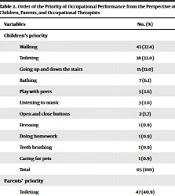
The order of the priority of the occupational performance of children with CP from the children's perspective includes walking (43 people (37.4%)), toileting (38 people with a frequency of 33%), going up and down the stairs (15 people (13%)), and bathing (7 people (6.1%)).
The order of the priority of occupational performance of children with CP from the parent's perspective includes toileting (47 people (40.9%)), walking (39 people (33.9%)), and going up and down the stairs (9 people (7.8%)).
The order of the priority of occupational performance of children with CP from the occupational therapist's perspective includes toileting (45 people (39.1%)), walking (41 people (35.7%)), and going up and down the stairs (17 people (14.8%)).
The priority of the occupational performance of children, parents, and occupational therapists is related to the field of self-care (Table 2).
Table 2.
Order of the Priority of Occupational Performance from the Perspective of Children, Parents, and Occupational Therapists
| Variables | No. (%) |
|---|---|
| Children's priority | |
| Walking | 43 (37.4) |
| Toileting | 38 (33.0) |
| Going up and down the stairs | 15 (13.0) |
| Bathing | 7 (6.1) |
| Play with peers | 3 (2.6) |
| Listening to music | 3 (2.6) |
| Open and close buttons | 2 (1.7) |
| Dressing | 1 (0.9) |
| Doing homework | 1 (0.9) |
| Teeth brushing | 1 (0.9) |
| Caring for pets | 1 (0.9) |
| Total | 115 (100) |
| Parents’ priority | |
| Toileting | 47 (40.9) |
| Walking | 39 (33.9) |
| Bathing | 12 (10.4) |
| Going up and down the stairs | 9 (7.8) |
| Dressing | 2 (1.7) |
| Teeth brushing | 1 (0.9) |
| Meal planning | 1 (0.9) |
| Cleaning the table | 1 (0.9) |
| Drawing/ writing | 1 (0.9) |
| Going to the park, going to the club | 1 (0.9) |
| Participating in group activities | 1 (0.9) |
| Total | 115 (100) |
| Occupational therapists’ priority | |
| Toileting | 45 (39.1) |
| Walking | 41 (35.7) |
| Going up and down the stairs | 17 (14.8) |
| Bathing | 7 (6.1) |
| Teeth brushing | 3 (2.6) |
| Climbing, running, jumping | 1 (0.9) |
| Play with peers | 1 (0.9) |
| Total | 115 (100) |
4.2. Analytical Results
Based on the data obtained according to the Stuart Maxwell test (statistic = 19.88, probability value = 0.177), the priority of occupational performance of children and parents had no statistically significant difference. The priority of 37 children with CP and their parents was walking, the priority of 35 children with CP and their parents was toileting, and the priority of six children with CP and their parents was going up and down the stairs, the priority of four children with CP and their parents was bathing (Table 3).
Table 3.
Comparison of the Priority of Occupational Performance of Children with Cerebral Palsy from the Perspective of Parents and Children
| Parent’s Priority (Statistic = 19.88) | Children's Priority (Probability Value = 0.177) | |||
|---|---|---|---|---|
| Walking | Going Up and Down the Stairs | Bathing | Toileting | |
| Toileting | 5 | 6 | 1 | 35 |
| Bathing | 0 | 2 | 4 | 0 |
| Going up and down the stairs | 0 | 6 | 0 | 2 |
| Walking | 37 | 1 | 1 | 0 |
Based on the data obtained according to the Stuart Maxwell test (statistic = 14.79, probability value = 0.192), the priority of occupational performance of children with CP and occupational therapists had no statistically significant difference. The priority of 39 occupational therapists and children with CP was walking, the priority of 33 people of occupational therapists and children with CP was toileting, the priority of nine occupational therapists and children with CP was going up and down the stairs, and the priority of three occupational therapists and children with CP was bathing (Table 4).
Table 4.
Comparison of the Priority of Occupational Performance of Children with Cerebral Palsy from the Perspective of Occupational Therapists and Children
| Occupational Therapist’s Priority (Statistic = 14.79) | Children's Priority (Probability Value = 0.192) | |||
|---|---|---|---|---|
| Walking | Going Up and Down the Stairs | Bathing | Toileting | |
| Toileting | 4 | 5 | 1 | 33 |
| Bathing | 0 | 0 | 3 | 0 |
| Going up and down the stairs | 0 | 9 | 3 | 4 |
| Walking | 39 | 1 | 0 | 1 |
Based on the data obtained according to the Stuart Maxwell test (statistic = 16.31, probability value = 0.177), the priority of occupational performance of parents and occupational therapists had no statistically significant difference. The priority of 38 parents and occupational therapists was toileting, the priority of 36 parents and occupational therapists was walking, the priority of eight parents and occupational therapists was going up and down the stairs, and the priority of six parents and occupational therapists was bathing (Table 5).
Table 5.
Comparison of the Priority of Occupational Performance of Children with Cerebral Palsy from the Perspective of Parents and Occupational Therapists
| Occupational Therapist’s Priority (Statistic = 16.31) | Parent’s Priority (Probability Value = 0.177) | |||
|---|---|---|---|---|
| Walking | Going Up and Down the Stairs | Bathing | Toileting | |
| Toileting | 2 | 1 | 2 | 38 |
| Bathing | 0 | 0 | 6 | 0 |
| Going up and down the stairs | 1 | 8 | 2 | 5 |
| Walking | 36 | 0 | 0 | 4 |
5. Discussion
Considering the decisive role of occupational therapy in the field of rehabilitation of children with CP, it is important to consider the family's priorities according to client-centered approaches. In this study, the occupational performance priorities of children with CP aged 6 - 12 years, from the perspective of children, parents, and occupational therapists in three areas of self-care, productivity, and leisure, were examined and compared to make it clearer for the rehabilitation team, especially the occupational therapists, by focusing on client-centered approaches to consider the priorities of occupational performance and the views of children and parents and to manage the child's rehabilitation process with greater participation between the therapist, the child, and the family.
In response to the first question of the research, the most important priority of the occupational performance of children with CP from the perspective of these children was related to the field of self-care. CP children have problems and limitations in performing activities of daily living, such as toileting, mobility, dressing, eating, and bathing. Restrictions in performing these activities cause long-term dependence of children on parents and caregivers and create special needs in the child that the caregiver must meet, and on the other hand, these children tend to be independent in doing their activities of daily living (29). Due to the significant role of personal care in childhood independence, it seems that personal care is one of the most important challenges of occupational performance in children with CP. Gharebaghy et al. investigated occupational performance in children with cancer. The results of the mentioned study were in line with this study, and self-care was the most important priority of occupational performance in doing daily affairs of children with cancer (30).
In response to the second question of the research, the most important priority of the occupational performance of children with CP from the parents' perspective was related to the field of self-care. Brando et al. investigated the priority of occupational performance by the parents of 75 children with CP aged 3 - 16 years, and the results indicated that the main functional need of caregivers was related to self-care activities (48.2%) (20). Gimeno et al. examined the occupational performance priorities in the daily life of 57 children and adolescents aged 3 - 18 years with dystonic disorder from the parents' perspective using the COPM, and the results showed that the most important priority of caregivers and parents was the participation of children and adolescents with a dystonic disorder in self-care activities (21). The most important priority for the occupational performance of children with CP from the parent’s perspective in all children with CP aged 6 - 12 years is self-care. The results of this study are consistent with those of Gimeno et al., Chiarello et al., and Brando et al. (20, 21, 24).
In response to the third question of the research, the most important priority of the occupational performance of children with CP from the perspective of occupational therapists was related to the field of self-care. Occupational therapists in the treatment and rehabilitation of children with CP should pay attention to the active participation of these children and their parents, possibly by identifying the needs and priorities of children and parents in activities of daily living (31). An occupational therapy program designed to improve occupational performance can lead to improved independence in daily living activities and occupational performance. Therefore, the attention of occupational therapists to the needs and priorities of occupational performance makes the rehabilitation program of CP children successful, and the satisfaction of CP children and their parents with occupational therapy programs increases (32, 33). For this reason, based on the results obtained in this research, the highest priority of occupational performance of occupational therapists for children with CP was related to the field of self-care so that these children can actively participate in personal and social life and achieve independence and self-efficacy. There has been no research on the occupational performance priorities of children with CP from the perspective of occupational therapists.
In response to the fourth research question, comparing the occupational performance priorities of children with CP from the perspective of children and parents, showed that the occupational performance priorities of children and parents are the same and related to the field of self-care. Identifying the physical and psychological needs of children with CP by parents and warm and intimate communication between mother and child increase the child's sense of participation in activities of daily living and reduce parental stress. It can be concluded that parents' better understanding of the needs and occupational performance priorities of children with CP makes it easier to establish a proper relationship between parents and children, and as a result, it reduces the child's behavioral problems and increases the parents' mental health (34).
Verkerk et al. showed that the parents of children under eight years of age with CP who were referred to occupational therapy reported personal care, functional mobility, play, and social relations of the child as their highest priority (23). Also, Turk et al. showed that a high percentage of CP people need physical assistance and care in personal care and activities of daily living (35). In an interview with the parents of 12 children with CP aged 1 - 4 years, Anttila et al. showed that personal care, mobility, movement, sitting and standing, as well as exercises related to occupational therapy and physiotherapy, are among their priorities (36). In a similar study conducted by Ostensjo et al., parents of 13 CP children aged 2 to 4 years stated their children's priorities and needs in the order of individual care, mobility and movement, playing, and social relationships (22). Jalili et al. investigated the occupational performance priorities of CP children and adolescents aged 3 to 18 years based on the parent's perspective, and the parents reported functional priorities in similar performance dimensions in different age groups in children with CP, which is mainly focused on self-care activities (16). The results of the mentioned studies are consistent with the results of the present study.
In response to the fifth question of the research, comparing the occupational performance priorities of CP children from the perspective of children and occupational therapists, showed that the occupational performance priorities of children and parents are the same and related to the field of self-care. If occupational therapists correctly consider the needs and priorities of children with CP in their treatment and rehabilitation process and base the treatment goals based on the priorities and special needs of these children in activities related to occupational performance, the level of participation of these children in the process rehabilitation will increase (37). Based on the data obtained in this research, occupational therapists' knowledge of the needs and priorities of children with CP will facilitate the better rehabilitation of these children and will lead to greater independence and participation of children in individual activities. No study has compared the occupational performance priorities of children with CP from the perspective of children and occupational therapists.
In response to the sixth research question, comparing the occupational performance priorities of children with CP from the perspective of parents and occupational therapists, showed that the occupational performance priorities of occupational therapists and parents are the same and related to the field of self-care. If the occupational performance priorities of parents and occupational therapists are the same, rehabilitation will be done more effectively, treatment will take place in a client-centered and family-centered manner, and the success of the rehabilitation program for children with CP will increase (38). Egilson analyzed the perspective of parents regarding rehabilitation measures for children with physical disabilities and emphasized the willingness of parents to participate in the treatment decision-making process (39). Hurlburt et al. by examining the characteristics of child rehabilitation services, observed that the mismatch between the views of therapists and family members regarding the rehabilitation process can hinder the family's full understanding of therapeutic interventions and reduce the results of the child's functional treatment (40). Oien et al. investigated the views of parents and therapists on setting meaningful goals for the families of children with CP and noted that the involvement of parents in setting treatment goals can increase their participation in the intervention and treatment process and lead to greater parental coordination and help therapists (41). The results obtained in this study are in line with those of Egilson, Hurlburt et al., and Oien et al.
The field of self-care in this research, according to the COPM, includes personal care, functional mobility, and social management (42). of which personal care activities (such as bathing, toileting, opening, and closing buttons, brushing teeth, etc.) and functional mobility (moving and shifting) have been of special importance.
For children with CP, their parents and occupational therapists sought to gain independence and increase the participation of children with CP in personal care and mobility. Previous studies have also shown that the most important occupational performance priority for parents of children with CP and other children with physical problems is self-care activities (22-24, 43). CP is one of the most common causes of movement problems in children, which, due to other accompanying problems, creates a lot of restrictions in carrying out the daily activities of the child's life, and a large part of their individual affairs is done by the family (44, 45).
Therefore, considering the strong and decisive role of occupational therapy in the field of rehabilitation of children with CP, it is important to consider the priorities of the family and children according to client-centered approaches. In previous studies, the occupational performance priorities were only considered from the perspective of the parents of children with CP, and no study has been conducted comparing the occupational performance priorities of children with CP from the perspective of children, parents, and occupational therapists. Contrary to the fact that the priorities of these three groups are different, the occupational performance priorities of children, parents, and occupational therapists are the same and related to the field of self-care, which shows that these three groups are compatible with each other in occupational performance priorities. In this study, the occupational performance priorities of children with CP from the perspective of children, parents, and occupational therapists for children with CP aged 6 to 12 years were identified and compared, and it makes the path for occupational therapists to rehabilitate and increases the participation of these children.
5.1. Conclusions
The results showed that the occupational performance priorities of children with CP are the same from the perspective of children, parents, and occupational therapists and are mainly related to self-care activities. Increasing the independence of children with CP in self-care activities not only leads to the reduction of care pressures but also leads to an increase in self-confidence, facilitating the establishment of social relationships with peers and social participation. According to the research conducted and the results obtained, occupational therapists should pay special attention to this important issue, considering the importance of client-centered interventions in the field of occupational therapy services, and focus their interventions on all areas related to the important and meaningful needs and priorities of children with CP and parents. In this regard, the cooperation between occupational therapists and parents is strengthened, and the goals of children with CP and their parents can be achieved.
5.2. Limitations
In this research, as in other research, there were limitations and problems: the spread and epidemic of COVID-19 during the stages of the study; the restrictions of intra-urban traffic and closure of Rehabilitation centers and occupational therapy clinics caused many problems and time-consuming sample collection. Among the most important limitations that existed, we can mention the non-cooperation of parents and rehabilitation centers to complete the questionnaires. Extending the interview time and filling in the COPM, which should have been done as a semi-structured interview.
5.3. Research and Executive Suggestions
(1) Occupational performance priorities of children in different disability groups should be investigated and compared from the perspective of these children.
(2) Priorities of occupational performance in different disability groups from the perspective of children, parents, and occupational therapists should be investigated and compared.
(3) Sharing the experiences of the studied statistical population for rehabilitation clinics and rehabilitation centers for the maximum effectiveness of rehabilitation programs.